
Why You Are Looking for the Wrong Kind of Change
Marginal gains is the concept most associated with Dave Brailsford and the transformation of British Cycling from a programme that had won a single Olympic gold medal in seventy-six years to one that dominated every major track and road event for over a decade. But the principle itself is older, more broadly applicable, and more practically relevant to your health and fitness than any motivational case study makes it sound. Understanding it properly changes not just how you train, but how you think about the entire project of building a better body and a healthier life.
Most people looking to improve their health are looking for the big change. The dramatic intervention. The programme that will transform everything. The supplement that unlocks the plateau. The diet that finally works. The training method that produces results where previous methods have not. This search for the big lever is deeply human and entirely understandable, but it is also the primary reason why so many people cycle through approaches without ever building the compounding foundation that produces lasting change.
The truth that marginal gains makes visible is that dramatic results are not produced by dramatic changes. They are produced by the systematic identification and improvement of every small variable in a system, applied consistently over time, until the cumulative effect of dozens of small improvements produces a result that looks, to the outside observer, like a sudden breakthrough. The breakthrough was not sudden. It was the predictable outcome of a process that had been running invisibly for months or years.
What Dave Brailsford Actually Did and Why It Worked
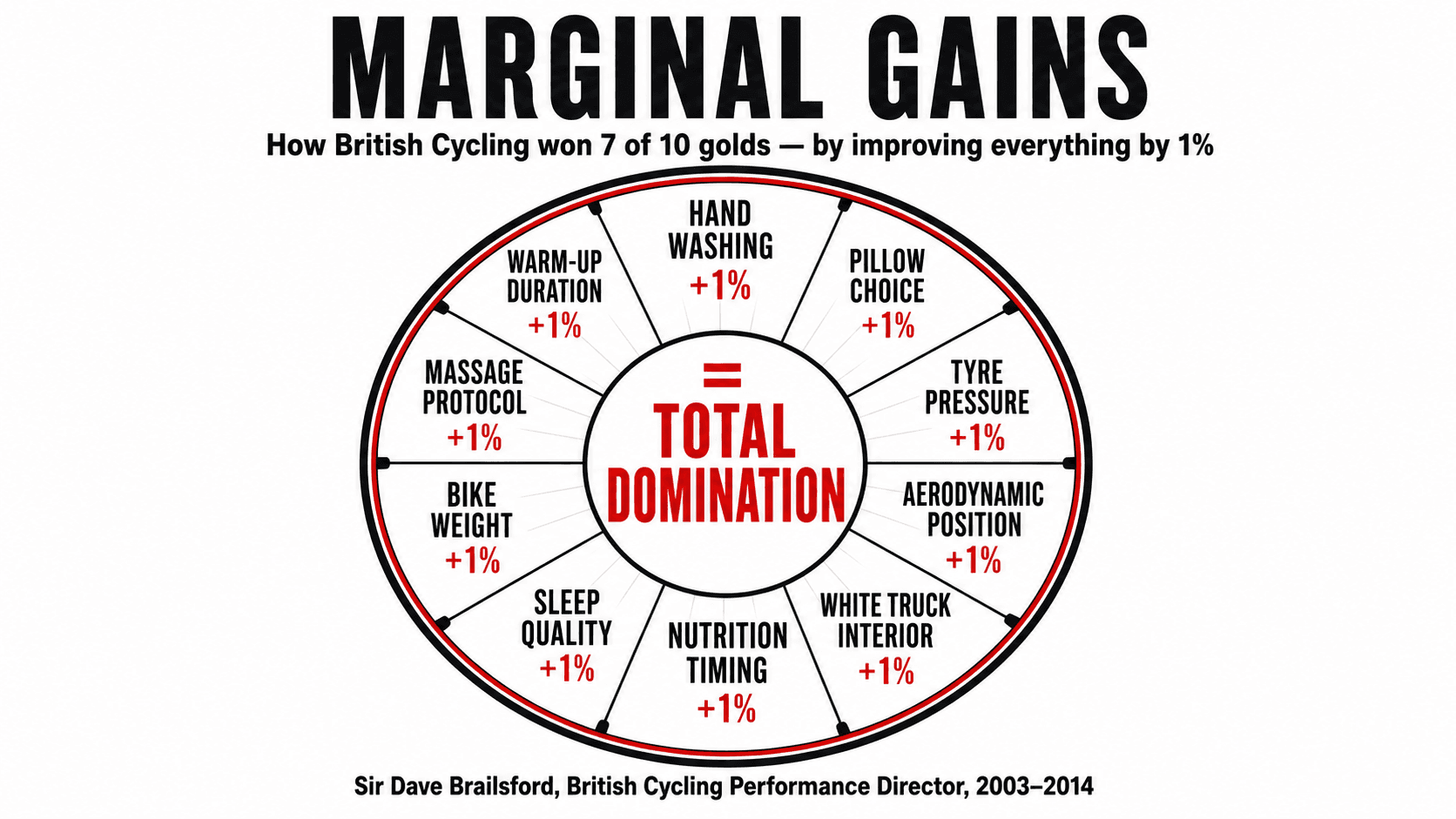
When Dave Brailsford became performance director of British Cycling in 2003, he inherited a programme that had been largely unsuccessful at the highest level for generations. His approach was not to find a revolutionary new training method or recruit radically different athletes. It was to ask a different question: if we broke down everything that goes into cycling performance and improved each element by one percent, what would the cumulative effect be?
The answer, implemented over several years, was a complete domination of the 2008 Beijing Olympics where British cyclists won seven of the ten available gold medals, followed by eight gold medals at the 2012 London Olympics. The gains came not from one big innovation but from hundreds of small ones: optimising hand-washing protocols to reduce illness rates, testing different pillow configurations to improve sleep quality at away competitions, identifying the precise tyre pressure for each track surface, refining the aerodynamic position of each rider by fractions of a degree, painting the inside of the team truck white so dust particles on bicycle components became immediately visible. Individually, each change was trivial. Collectively, they were transformative (1).
“The whole principle came from the idea that if you broke down everything you could think of that goes into riding a bike, and then improved it by one percent, you will get a significant increase when you put them all together.”
— Sir Dave Brailsford
Matthew Syed, in Bounce, describes the same principle from the perspective of elite sport development more broadly: the athletes who reach the highest levels are rarely those with the greatest natural talent. They are those who have accumulated the most deliberate practice across the most variables, over the longest period, with the greatest consistency of application. The marginal gains framework is the systematic version of this: instead of waiting for talent and motivation to determine which variables get refined, it makes the refinement of every variable an explicit, ongoing programme (2).
Key Insight: The marginal gains question is: what are the ten variables that determine my health and fitness results, and which of them could be improved by one percent this week? This is a completely different question from: what dramatic change should I make? One question points to small sustainable refinements across a broad front. The other points to a single big intervention that will solve everything. One compounds. The other disrupts and restarts.
The Mathematics of Marginal Gains: Why Small Consistent Improvements Are Transformational
The reason marginal gains is not simply an interesting story about cycling is that the mathematics behind it are remarkable and apply identically to health and fitness. The numbers make the case better than any motivational argument.
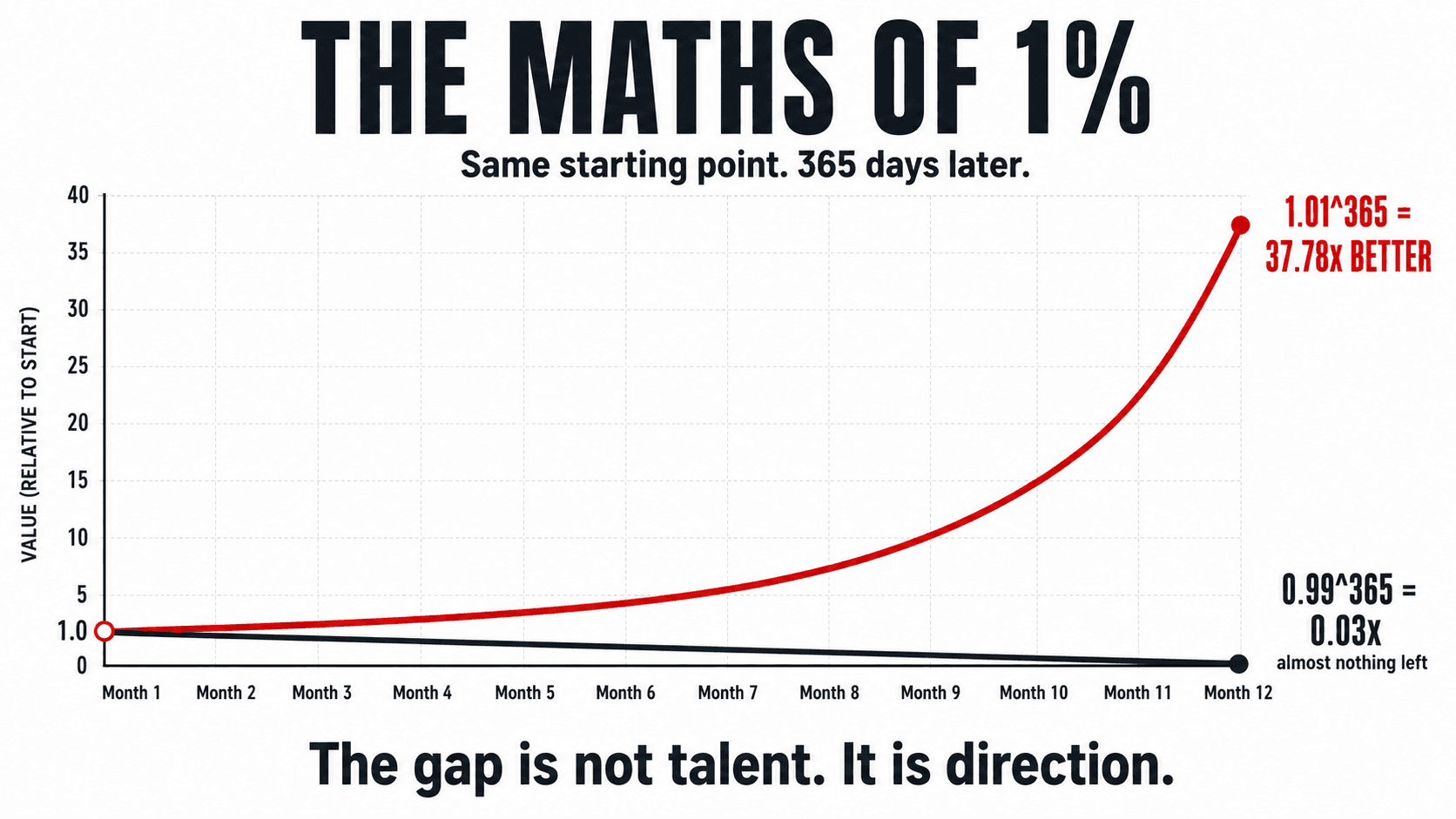
If you improve by one percent every day for a year, you will be 37.78 times better at the end of it than you were at the start. This is not a metaphor. It is basic compound interest applied to performance. 1.01 raised to the power of 365 equals 37.78. Conversely, if you decline by one percent every day for a year, you will be reduced to 0.03 of your starting point. The gap between these two trajectories, starting from an identical position, is almost incomprehensible. And it is generated entirely by the direction and consistency of daily marginal changes (3).
The daily one percent figure is deliberately illustrative rather than literal. In practice, the compound effect in health and fitness operates on a slightly longer timescale: weekly marginal improvements rather than daily ones, with the compounding effect becoming visible over months rather than days. But the principle holds with complete mathematical fidelity. Small consistent improvements in the right direction produce results that dwarf any single dramatic intervention, and small consistent declines in the wrong direction produce deterioration that no single dramatic recovery can fully address.
DIAGRAM: The Compound Marginal Gains Effect — Improvement vs Decline Over Twelve Months
| COMPOUND MARGINAL GAINS | CONSISTENT MARGINAL IMPROVEMENT (1% better, consistently applied) | CONSISTENT MARGINAL DECLINE (1% worse, consistently applied) |
|---|---|---|
| Month 1 | 12% | 12% |
| Month 2 | 18% | 18% |
| Month 3 | 24% | 22% |
| Month 4 | 32% | 26% |
| Month 5 | 42% | 22% |
| Month 6 | 52% | 18% |
| Month 8 | 68% | 14% |
| Month 10 | 82% | 10% |
| Month 12 | 98% | 5% |
Both lines start at exactly the same point. The only difference is the direction of marginal daily and weekly choices. At month three the gap is barely visible. At month twelve it is everything. The transformation that looks sudden from the outside was mathematically inevitable from the inside.
Kobe, Federer, and the Obsessive Daily Refinement of the Greatest
The marginal gains principle did not begin with Dave Brailsford or British Cycling. It is the defining characteristic of every athlete who has sustained elite performance across a career of sufficient length for the compound effect to become visible. The athletes who are remembered as the greatest are almost never the most naturally talented. They are the ones who most consistently applied marginal improvement across the most variables for the longest period of time.
Kobe Bryant's approach to training is one of the most documented examples of marginal gains thinking in professional sport. Bryant was known for arriving at training facilities hours before any other player, not to practice the dramatic moves that defined his public profile, but to refine the small technical elements of his game that most players would not consider worth the time. Post angles, footwork patterns, the precise trajectory of a mid-range jump shot, the timing of a hesitation dribble: Bryant treated every element of his performance as a variable that could be optimised, and he returned to those elements with a consistency and obsessiveness that his contemporaries, including those with comparable natural talent, did not match. The gap in career achievement was not genetic. It was the compound output of marginal refinements made daily across two decades.
Roger Federer's longevity at the highest level of professional tennis demonstrates the same principle from a different angle. Federer maintained peak performance into his mid-thirties in a sport that typically produces its champions in their twenties, not through extraordinary genetics alone, but through the systematic marginal refinement of his physical preparation, recovery protocols, technical game, and psychological approach over a career. His commitment to marginal improvement in areas that his competitors considered secondary, sleep quality, nutrition precision, off-court conditioning, mental preparation for specific opponents, produced a cumulative advantage that extended his competitive window well beyond what talent alone could have achieved.
Key Insight: The question every elite athlete has answered, and that every person pursuing better health needs to answer, is this: what are the small things I consistently do not do well enough, and which of them would compound most meaningfully if I improved them? This is not a question about dramatic change. It is a question about systematic audit and consistent refinement. The dramatic results are the output of that process, not the input.
The Person Who Shows Up Imperfectly Every Day Beats the Person Who Shows Up Perfectly Once a Week
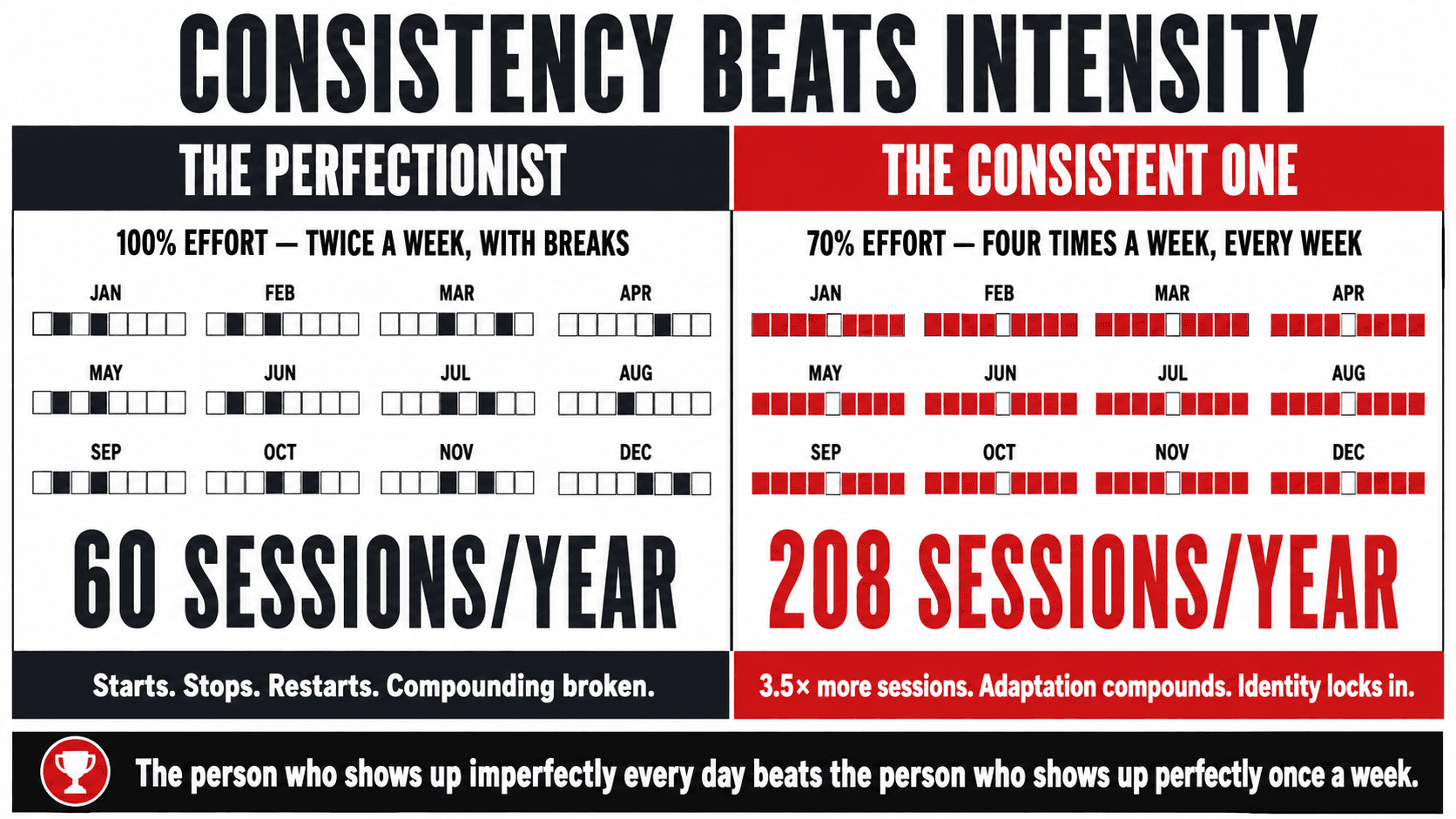
One of the most practical implications of the marginal gains framework is a revaluation of consistency relative to intensity. Most people in health and fitness overvalue intensity and undervalue consistency. They train at maximum effort when motivated, take extended breaks when not, and measure their programme by the quality of their best sessions rather than by the average quality of all of them.
The mathematics of marginal gains tells the opposite story. A person who trains at seventy percent of maximum effort four times per week, every week for a year, accumulates 208 sessions. A person who trains at maximum effort twice a week for six weeks, takes a month off, returns for six weeks, takes another break, and repeats this pattern across a year accumulates perhaps sixty sessions. The first person has trained 3.5 times as often. Their cumulative physical adaptation, the structural changes to muscle, cardiovascular system, and metabolic function, is not 3.5 times greater. It is orders of magnitude greater, because adaptation compounds. Each session builds on the structural improvements of the previous one. Breaks partially dismantle those improvements and restart the compounding cycle from a lower base.
James Clear describes this as the difference between being consistent and being perfect. Perfectionists train perfectly or not at all. The consistent person trains imperfectly, but continuously. A twenty-minute session when there is only twenty minutes available is not a compromise. It is another data point in a compounding series. A walk when there is no time for the gym is not a failure. It is a marginal gain against the alternative of nothing, and it keeps the compounding sequence unbroken (3).
“You don't rise to the level of your goals. You fall to the level of your systems.”
— James Clear, Atomic Habits
Key Insight: The most powerful question in a difficult week is not: how do I do this perfectly this week? It is: what is the minimum I can do this week to keep the sequence unbroken? A ten-minute walk. A single set of press-ups. One protein-led meal. These are not consolation prizes. They are marginal gains that prevent the compounding sequence from resetting and that keep the identity of a person who consistently moves in the right direction intact.
Applying the Marginal Gains Framework to Your Own Health: A Practical Audit
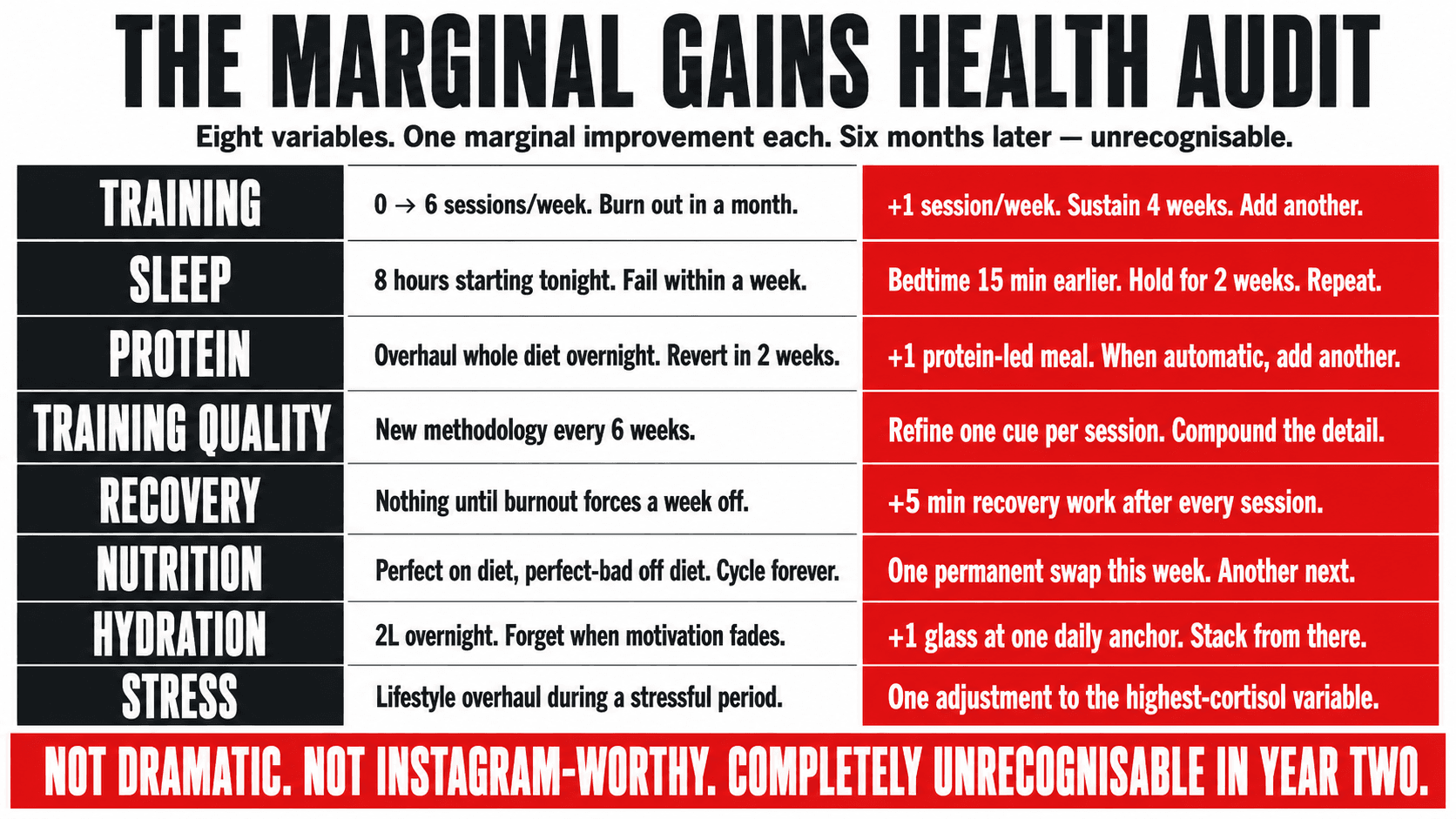
The practical application of marginal gains to health is a systematic audit of every variable that determines your results, followed by the identification of the smallest meaningful improvement in each that you can implement immediately and sustain indefinitely. This is not a dramatic overhaul. It is a calibration.
TABLE: The Marginal Gains Health Audit — Big Bang Thinking vs Marginal Gains Thinking Across Eight Variables
| Variable | Big Bang Thinking (Unstable) | Marginal Gains Thinking (Compounds) |
|---|---|---|
| Training frequency | Go from zero to six sessions per week immediately. Burn out within a month. Return to zero. | Add one session per week to current pattern. When consistent for four weeks, add another. Build to an unbreakable baseline. |
| Sleep | Decide to get eight hours every night starting tonight. Unrealistic schedule means failure within a week. | Move bedtime fifteen minutes earlier this week. Maintain for two weeks. Move it fifteen minutes earlier again. Build to target incrementally. |
| Protein intake | Overhaul entire diet overnight. Too many changes at once. Revert within two weeks. | Add one protein-led meal to your current day. When automatic, add a second. Each addition is a marginal gain that stacks. |
| Training quality | Research and implement an entirely new training methodology every six weeks, always starting from scratch. | Apply one technical cue more consistently per session. Refine one movement pattern per week. Accumulate quality over months. |
| Recovery | Do nothing about recovery until burnout forces a week off, then treat rest as failure. | Add five minutes of deliberate recovery work after each session. Improve one sleep quality marker per week. Recovery is a performance variable. |
| Nutrition quality | Eat perfectly during the diet phase, perfectly badly during the non-diet phase. Cycle indefinitely. | Make one food substitution this week that you will keep permanently. Next week, make another. Marginal permanent improvements over dramatic temporary ones. |
| Hydration | Drink two litres immediately on starting a new health kick. Forget about it when the motivation fades. | Add one glass of water at a consistent daily anchor point. Add a second when the first is automatic. Build a hydration habit through stacking. |
| Stress and cortisol | Attempt a complete lifestyle overhaul during a stressful period. Abandon everything when it becomes unmanageable. | Identify the single highest-cortisol variable this week and make one marginal adjustment to it. Address one thing. Sustain it. Then address the next. |
Eight variables. One marginal improvement each, stacked over six months. Not dramatic. Not Instagram-worthy in week one. Completely unrecognisable in year two.
Why Dramatic Changes Fail and Why This Is Not a Willpower Problem
The failure of dramatic health interventions is not a mystery and it is not a personal failing. It is a structural consequence of attempting to make too many changes simultaneously, at a scale that exceeds the nervous system's capacity for sustainable adaptation.
Every new behaviour competes for cognitive and emotional resources. A person who simultaneously attempts to overhaul their training programme, restructure their diet, fix their sleep schedule, eliminate alcohol, and manage their stress levels is not running one programme. They are running five in parallel, each of which is drawing on the finite pool of willpower, decision-making capacity, and emotional regulation that the prefrontal cortex manages. The research on decision fatigue is unambiguous: the quality of self-regulation decisions degrades across a day as the cognitive resources required for them are depleted. An overhaul that requires perfect decisions across five domains simultaneously is mathematically likely to fail (4).
Marginal gains sidesteps this problem by reducing the cognitive load of any single change to the point where it requires minimal willpower to execute. One small adjustment to one variable at a time is almost frictionless. And because each adjustment is made permanent before the next one is added, the growing stack of improvements becomes the baseline, not the performance. The system becomes progressively more capable with less and less effort required to maintain it.
Kaizen, the Japanese management philosophy of continuous incremental improvement, describes the same dynamic in an organisational context. Toyota's manufacturing dominance was not built on revolutionary product design. It was built on an organisational culture of systematic, permanent, marginal improvement applied continuously across every aspect of the production process. The compound output of thousands of small improvements over decades is what the rest of the world experienced as a transformation. The same principle applies to the production system of your own health.
Key Insight: When you feel the urge to overhaul everything, that impulse is data about your current dissatisfaction, not a prescription for action. The overhaul impulse is the enemy of the marginal gains approach. Instead of acting on it, channel it into a systematic audit: what is the single variable that, if improved by the smallest sustainable amount right now, would produce the greatest compound return? Address that. Leave everything else in place. Repeat weekly.
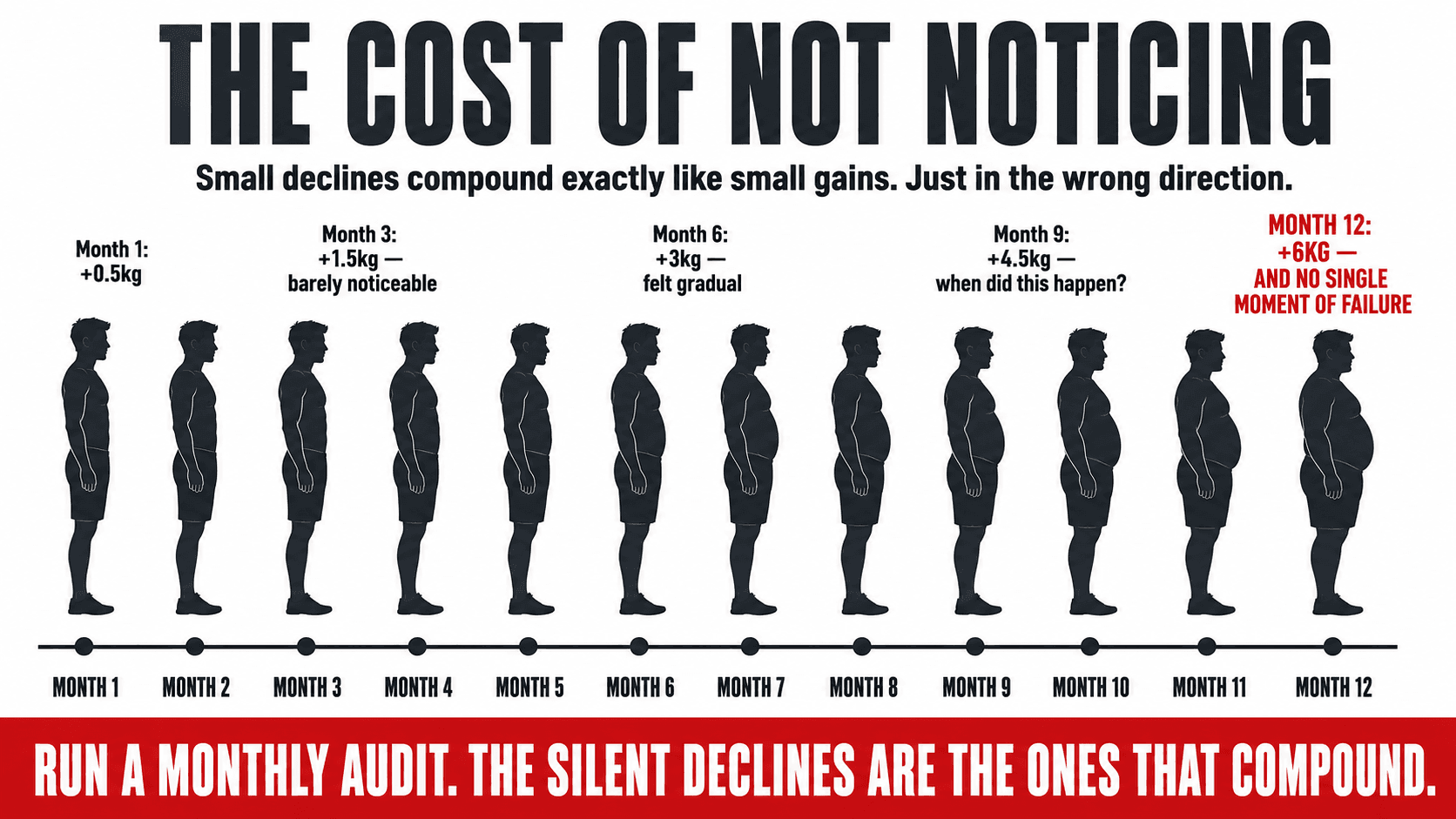
The Cost of Ignoring the Marginals: Why Small Declines Are More Dangerous Than Large Ones
If the upside of marginal gains is compound transformation, the downside of marginal neglect is compound deterioration. This is the aspect of the framework that receives the least attention, possibly because it is the most uncomfortable.
The person who gains body fat at the rate of half a kilogram per month does not notice the change in month one. They do not notice it particularly in month three. By month twelve they have gained six kilograms in a way that felt gradual and almost inevitable, with no single identifiable moment of failure. The deterioration was not dramatic. It was marginal. And it compounded in exactly the same way that improvement does, just in the opposite direction.
This is why the question of direction matters more than the question of magnitude. A modest improvement applied consistently is far more powerful than a dramatic improvement applied intermittently. And a modest decline applied consistently is far more damaging than a dramatic decline that is immediately visible and therefore corrected. The silent marginal declines, the slightly shorter sleep, the slightly lower training frequency, the slightly worse food quality, the slightly higher resting stress level, are the ones that compound into a health position that requires a dramatic intervention to address. By then, the marginal gains approach must first recover lost ground before it can begin building forward.
Key Insight: Run a monthly marginal audit. Once per month, look at the eight variables in the table above and ask honestly: has each one improved, stayed the same, or declined since last month? A single honest monthly review takes ten minutes and prevents the silent compounding of marginal declines before they become dramatic problems. The audit is itself a marginal gain applied to the management of your own health system.
How the Marginal Gains Philosophy Shapes the Programmes I Build
Every programme I build is designed for compound progression rather than dramatic transformation. The first month of any new programme with any new client is never about maximum intensity or dramatic change. It is about establishing a baseline of consistent, high-quality execution across the key variables that will compound over the months and years that follow.
The clients who produce the most dramatic results over twelve months are almost never the ones who trained hardest in the first four weeks. They are the ones who trained consistently across all twelve, with marginal progressive improvements applied week on week across training quality, nutritional precision, sleep, recovery, and stress management. The transformation that their friends notice at a year is the visible output of eleven months of invisible compound improvement.
If you are tired of dramatic interventions that produce short-term results followed by inevitable reversals, the marginal gains framework is the alternative. It is less exciting in month one. It is unrecognisable in year two. I work one-to-one with clients online globally. The programme we build together is built to compound.
Work with Me
Get a personalised coaching plan built around your goals, your schedule, and your life.
Enquire NowReferences
- Syed M. Bounce: The Myth of Talent and the Power of Practice. London: Fourth Estate; 2010.
- Brailsford D. Marginal gains: the story behind Team Sky's success. The Guardian. 2012.
- Clear J. Atomic Habits: An Easy and Proven Way to Build Good Habits and Break Bad Ones. London: Random House Business; 2018.
- Baumeister RF, Tierney J. Willpower: Rediscovering the Greatest Human Strength. New York: Penguin; 2011.
- Imai M. Kaizen: The Key to Japan's Competitive Success. New York: McGraw-Hill; 1986.
- Gladwell M. Outliers: The Story of Success. London: Penguin; 2008.