The Invisible Force That Is Shaping Your Behaviour Right Now
Environment design for health is the most underused lever in personal change, and the most consistently overlooked element in every health programme I have ever seen that fails to sustain results. We live in a culture that frames health behaviour as a product of personal character: the disciplined person makes healthy choices because they are disciplined, and the undisciplined person makes poor ones because they lack the required willpower. This framing is not only unhelpful. It is demonstrably wrong.
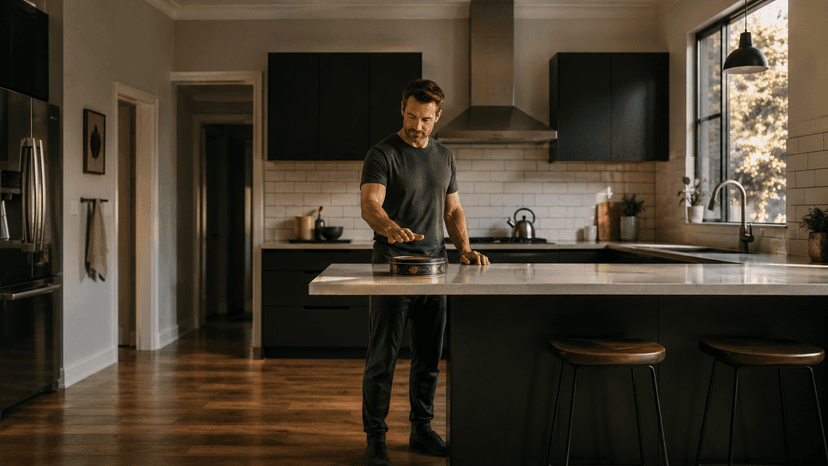
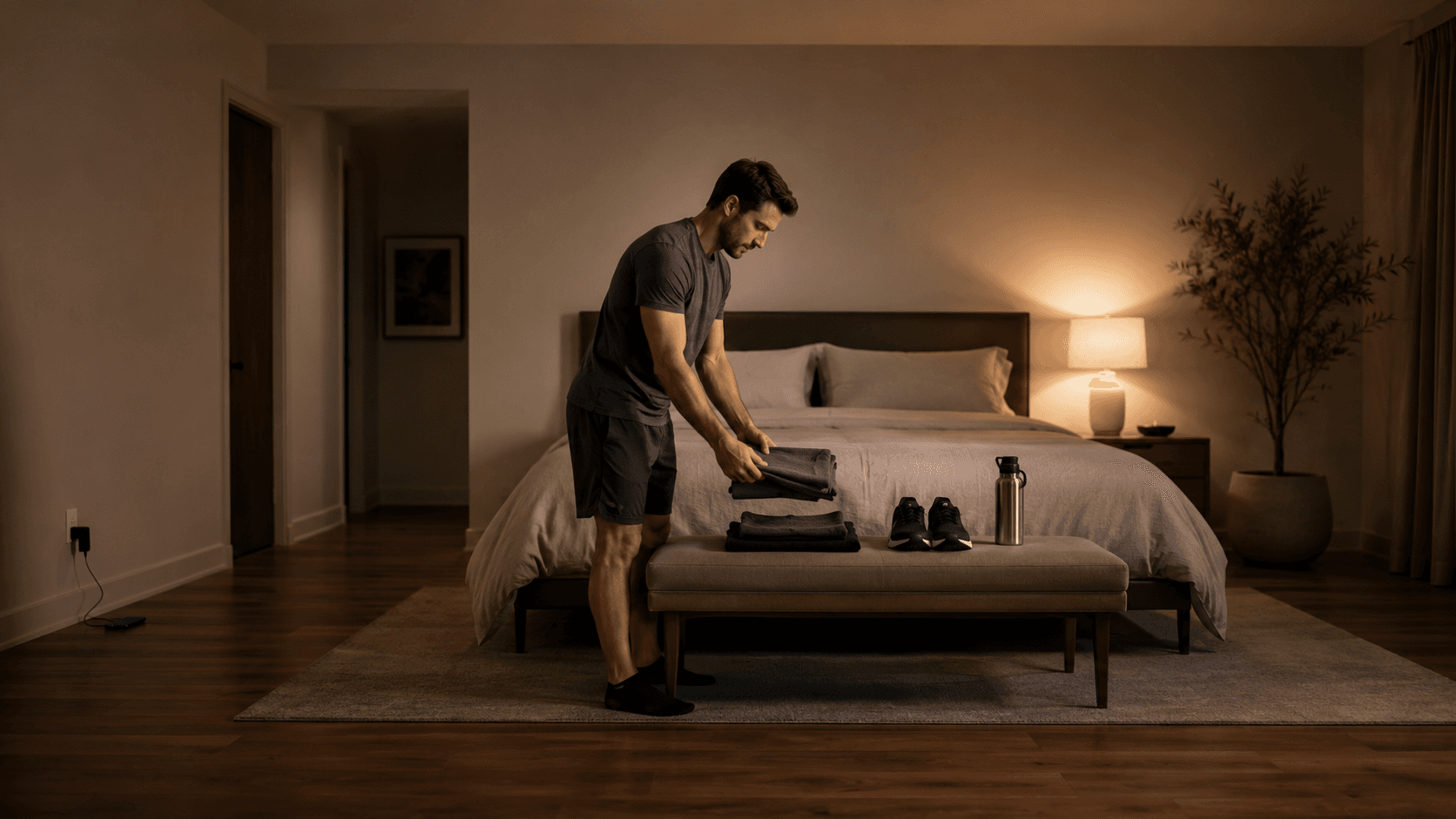
Your environment is making decisions for you right now, in every room of your home and every corner of your workplace. The food that is at eye level in your kitchen. The water bottle that is or is not sitting on your desk. The training kit that is or is not laid out the night before. The phone that is or is not visible from your bed. None of these are neutral arrangements. Every one of them is a cue that your brain processes below the level of conscious decision-making and that shapes your behaviour with a consistency and reliability that no amount of motivation can match.
The person who has redesigned their environment to make healthy choices easy and unhealthy choices inconvenient is not exercising more willpower than the person who has not. They are exercising less. That is the entire point. The goal of environment design is to remove the moment of decision from the healthy choice entirely, so that it happens by default rather than by conscious effort.
Why Willpower Is the Wrong Tool for the Job
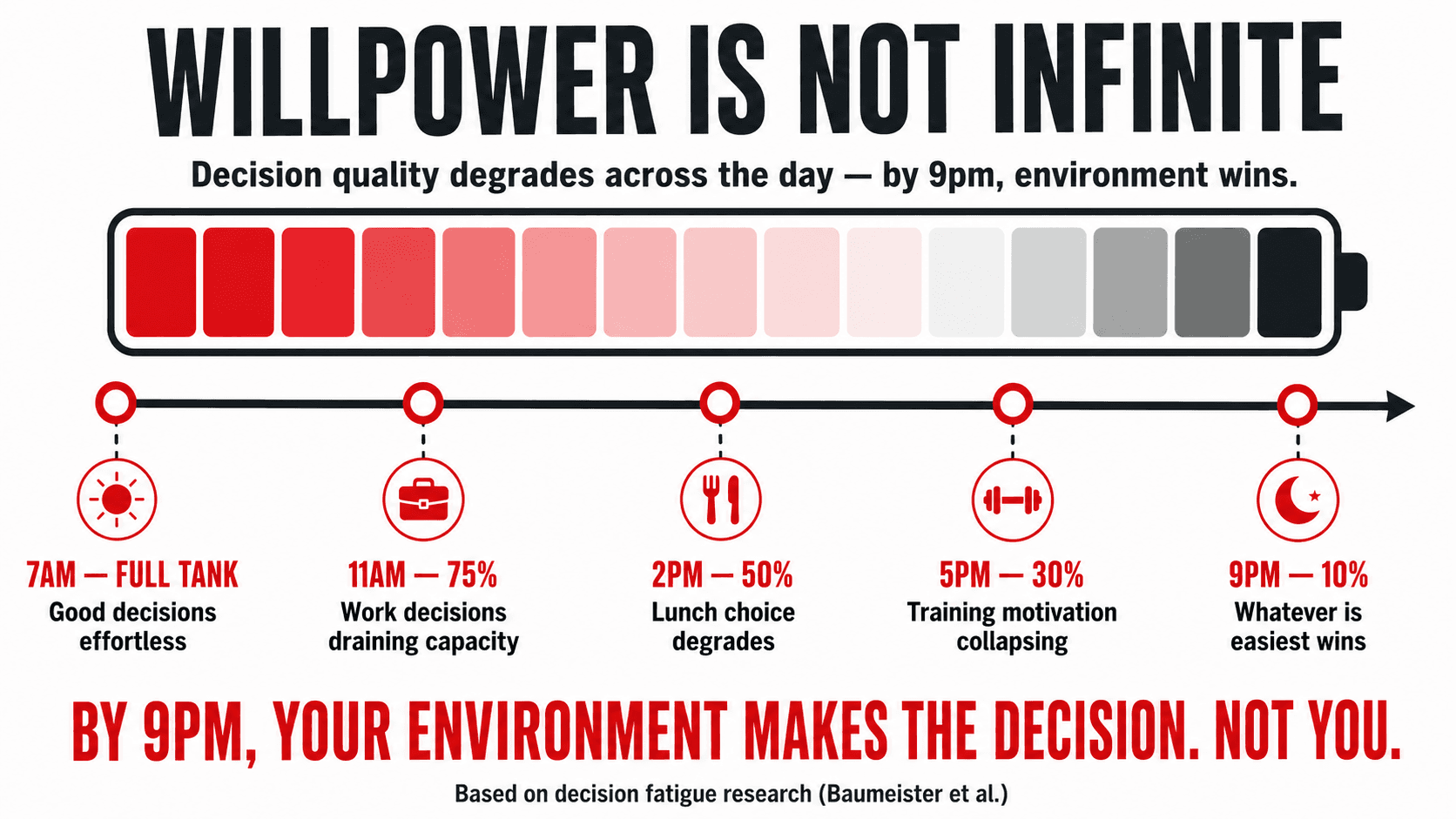
Willpower is a finite, depletable cognitive resource. The research on decision fatigue, pioneered by Roy Baumeister and replicated across dozens of subsequent studies, consistently demonstrates that the quality of self-regulatory decisions degrades across the day as the cognitive resources required for them are used up. A judge who makes complex decisions all morning is measurably less likely to grant parole in the afternoon not because their values have changed, but because their decision-making capacity is depleted. A person who has navigated a full day of work, relationships, and competing demands arrives at the evening with less capacity to resist the cue on the kitchen counter than they had at seven in the morning (1).
BJ Fogg, whose behaviour design research at Stanford produced the Tiny Habits framework, makes the structural argument clearly: if a behaviour requires significant motivation to perform, the system is poorly designed. Well-designed behaviours do not rely on motivation because motivation is unreliable. They rely instead on cues, context, and the path of least resistance, all of which are environmental variables that can be deliberately shaped. Motivation is the fuel of last resort. Environment is the architecture of default (2).
James Clear's concept of friction extends this argument practically. Every behaviour has a friction cost: the number of steps, the amount of physical or cognitive effort, and the time required to initiate it. High-friction healthy behaviours lose to low-friction unhealthy ones not because the unhealthy choice is more wanted, but because it is more immediately available. The gym bag that requires packing loses to the sofa that requires nothing. The healthy meal that requires cooking loses to the takeaway that requires only a phone. Reducing the friction on healthy behaviours and increasing it on unhealthy ones is not about tricking yourself. It is about aligning the architecture of your environment with the direction you actually want to go (3).
“You do not rise to the level of your goals. You fall to the level of your systems.”
— James Clear, Atomic Habits
Key Insight: The single most revealing question you can ask about any healthy behaviour you are struggling to sustain is: how many steps does it currently take to begin? If the answer is more than two, the friction is too high for the behaviour to be reliable under low-motivation conditions. The design task is to reduce that number to one or zero.
The Neuroscience of Environmental Cues: Why Context Controls Behaviour
The brain's habit system, housed primarily in the basal ganglia, operates through a cue-routine-reward loop in which environmental cues trigger automatic behavioural sequences without requiring deliberate conscious decision. This system evolved for efficiency: once a behaviour has been performed reliably in a specific context, the brain automates it, freeing the prefrontal cortex for novel challenges. The consequence is that the environment in which a behaviour was learned becomes a powerful and largely unconscious trigger for that behaviour.
Wendy Wood's research on habit and context demonstrates that approximately 43% of daily behaviours are performed habitually, in the same context, at the same time each day, without conscious deliberation. When context changes, habits are disrupted. When context is deliberately designed, habits are accelerated. People who move house show a spontaneous shift in habits, both healthy and unhealthy, because the environmental cues that triggered their previous automatic behaviours are no longer present. The new environment is a blank slate for habit formation, and those who understand this use it deliberately (4).
This is why environment redesign is often more effective than motivation or commitment for changing health behaviour. Motivation addresses the conscious layer of decision-making. Environment addresses the unconscious layer where the majority of health-relevant decisions actually live. Redesigning the environment does not require the person to want the healthy choice more. It simply places the healthy choice in the position of least resistance, where the brain's automatic systems will select it by default.
Key Insight: The best time to redesign your food environment is immediately after a food shop, before anything has been unpacked and placed. Position fruit and pre-cut vegetables at eye level in the fridge. Place healthy snacks on the counter. Move the biscuits, crisps, and high-calorie convenience foods to the back of the highest cupboard, inside a closed container. This takes eight minutes. It changes your default food environment for the entire week without requiring a single additional decision.
The Friction Dial: Making the Right Choice Easy and the Wrong Choice Inconvenient
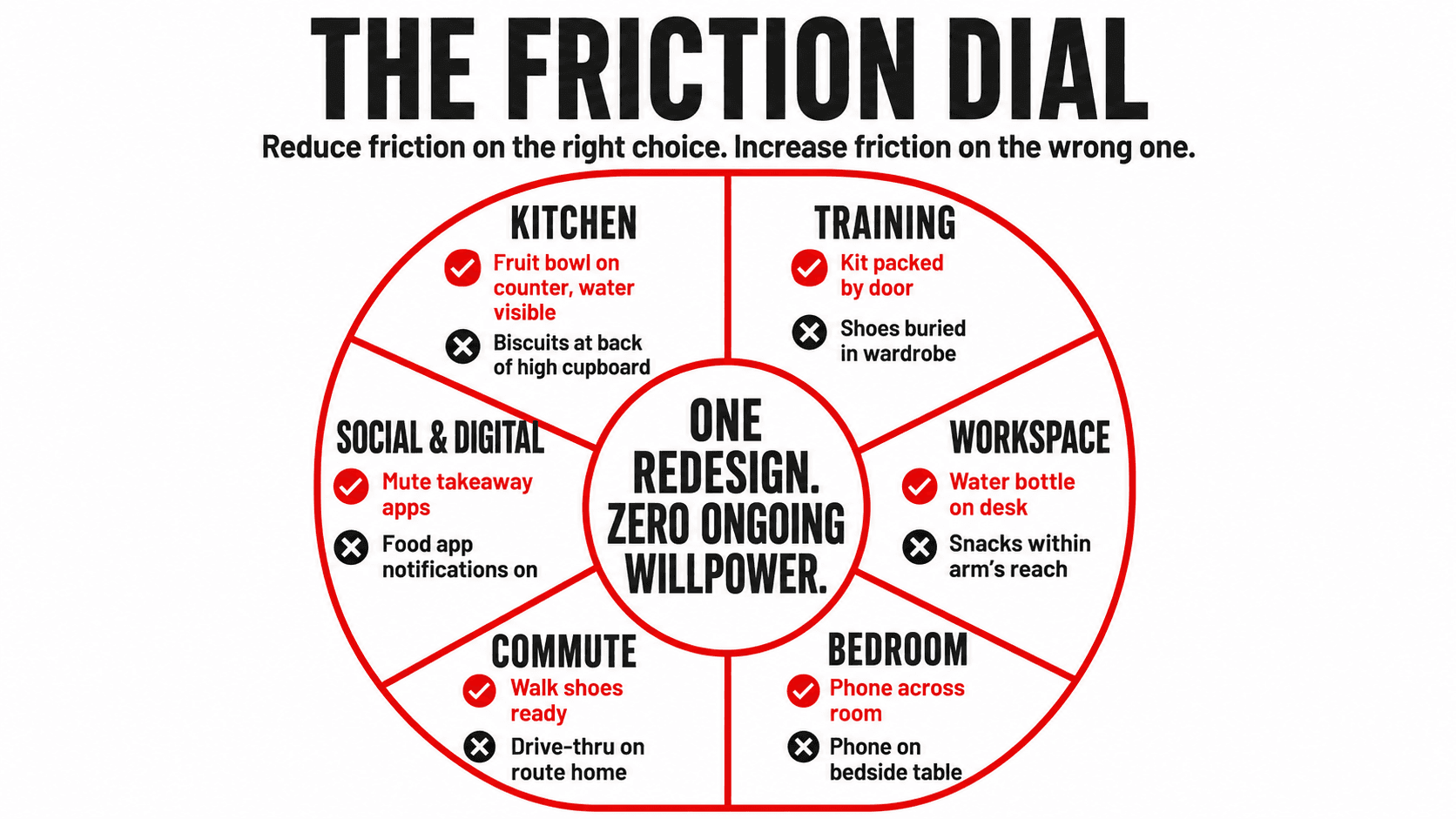
Environment design works in two directions simultaneously. Reduce the friction on healthy behaviours so they require minimum effort to initiate. Increase the friction on unhealthy behaviours so they require conscious effort to access. Both directions are equally important, and together they produce a living and working environment that is quietly coaching you toward better choices every hour of every day.
DIAGRAM: The Friction Dial — Current vs Redesigned Environment Across Six Areas
| Area | LOW FRICTION — Healthy choice made easy | HIGH FRICTION — Unhealthy choice made harder |
|---|---|---|
| Kitchen | Fruit bowl on counter. Water jug on worktop. Protein-rich foods at fridge eye level. Pre-cut veg in clear containers. Healthy snacks in visible bowl. | Sweets, crisps, and biscuits at the back of high cupboards in opaque containers. Takeaway menus removed or deleted. Wine glasses stored high and at back. |
| Training | Gym bag packed the night before and positioned at the front door. Training clothes laid out on the bedroom floor. Gym playlist already queued. Session written in advance. | Television remote in a different room to the sofa during the hour you would otherwise train. Phone charging in a room other than where you sit in the evenings. |
| Desk and workspace | Water bottle visible on desk and refilled at the start of each work block. Healthy snack at desk. Steps target displayed. Movement reminder set. | No food packaging, biscuits, or vending machine products within easy reach. Delivery apps removed from phone home screen. Nearest unhealthy option requires a physical journey. |
| Bedroom | Phone charger outside the bedroom or across the room. Blackout blind in place. Sleep tracking device on charge by the bed. Alarm label reads a motivating identity statement. | Phone not accessible from bed. No television in bedroom. Blue-light emitting devices removed from the hour before sleep. Alcohol not kept in the bedroom. |
| Car and commute | Healthy portable snack in the car. Podcast or audiobook on health and mindset queued. Walking shoes in the boot for opportunistic movement. | Drive-through routes avoided where possible. Petrol station snack habit pre-decided: specific healthy alternative already identified and committed to. |
| Social and digital | Health-supportive accounts prominent in social media feeds. Coaching app on phone home screen. Calendar block for training sessions in advance. | Social media apps moved off home screen or deleted. Notifications for food delivery apps turned off. Evening screen time limiter set. |
None of these changes require willpower to maintain. They require a single session of deliberate redesign. Once the environment is set, it coaches you automatically, every day, without requiring further decisions.
The Research That Changed How Cafeterias, Hospitals, and Offices Feed People
The most compelling evidence for the power of environmental design on health behaviour does not come from the gym or the individual coaching room. It comes from large-scale studies of food environments in institutional settings, where relatively small architectural changes produced dramatic population-level shifts in eating behaviour without any change in education, motivation, or individual instruction.
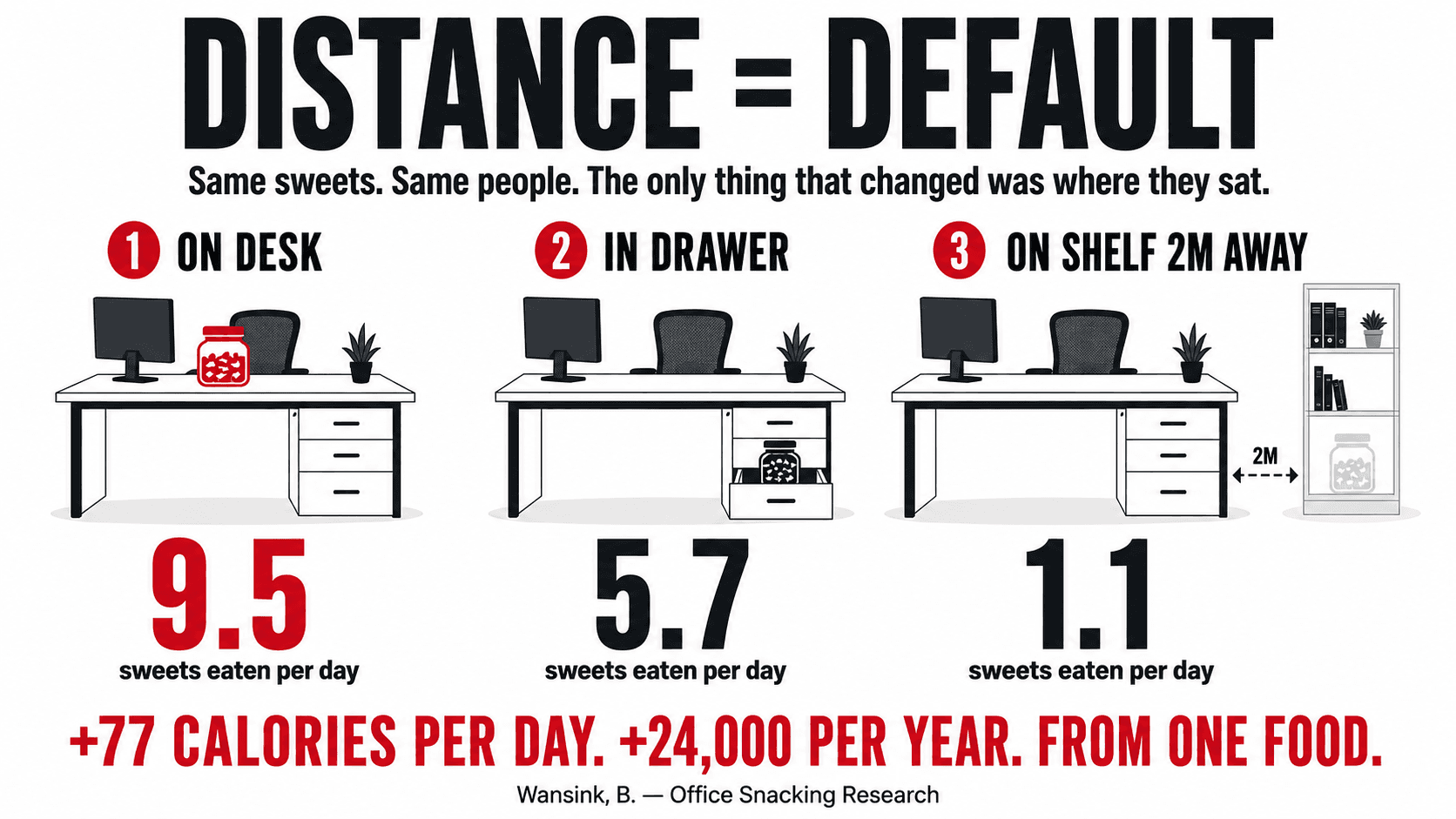
Brian Wansink's food environment research demonstrated repeatedly that people eat more when food is visible, accessible, and convenient, and less when the same food requires additional steps to access. In one series of studies, office workers who had sweets on their desks consumed an average of 9.5 more sweets per day than those whose sweets were placed in a drawer, and 8.4 more than those whose sweets were placed on a shelf two metres away. The food was identical. The people were identical. Only the friction between the person and the food changed. The friction change produced a difference of roughly 77 calories per day from one food source alone, which at six days per week compounds to approximately 24,000 extra calories per year (5).
Hospital cafeteria studies in the United States and United Kingdom have shown that repositioning salad, fruit, and water to the beginning of the food service line and relegating high-calorie items to less prominent positions produces measurable improvements in food selection among the same population, without any educational messaging, pricing changes, or removal of less healthy options. The choice architecture changed. The human behaviour followed. The insight that Richard Thaler and Cass Sunstein formalised as Nudge Theory is simply the environmental design principle applied to institutional scale: people do not make decisions in a vacuum. They make them in an environment, and the environment determines the default (6).
Key Insight: Wansink's research on plate size demonstrates that simply switching to a smaller plate reduces food intake by approximately 22% without any conscious calorie restriction. This is not a diet. It is an environmental adjustment that changes the visual reference point for a normal portion size. A full smaller plate looks like a full meal to the brain even though it contains less food. The psychology of fullness is substantially visual before it is physiological.
The Full Environment Redesign: Before and After Across Every Space That Shapes Your Health
TABLE: Environment Redesign — Before and After Across Home, Work, and Social Spaces
| Location | BEFORE: Default Environment (Works Against You) | AFTER: Redesigned Environment (Works For You) |
|---|---|---|
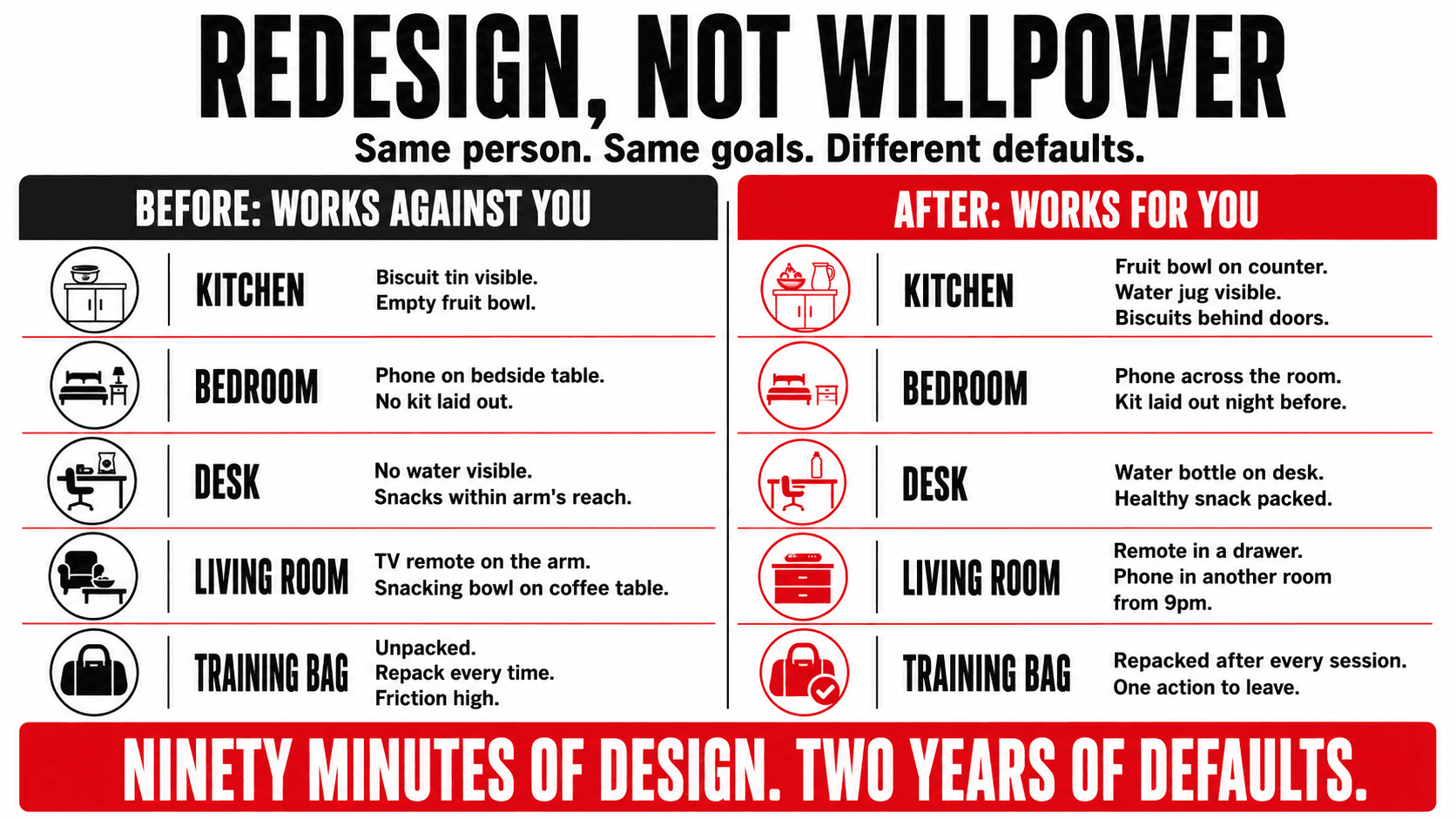
| Kitchen counter | Biscuit tin visible. Bread within easy reach. Empty fruit bowl or none. Kettle next to tea bags and sugar bowl. Cooking oil front and centre. | Fruit bowl stocked and central. Water jug prominent. Protein snacks accessible. Tea bags and biscuits in a closed cupboard. Counter clear of temptation. |
| Fridge | Leftovers and processed items at eye level. Vegetables buried in the bottom drawer. Water at the back. Alcohol at front. | Protein-rich foods and pre-cut vegetables at eye level. Water jug or filtered water visible and front. Fruit prominent. Less optimal items placed low and at back. |
| Bedroom morning | Phone charged on bedside table. No training clothes visible. Alarm set to maximum snooze latitude. No structure to morning. | Phone charged across the room or outside. Training kit laid out on floor the night before. Single alarm. Morning routine written on a notecard placed at eye level. |
| Work desk | No water visible. Communal biscuits or snacks within arm's reach. No movement prompts. No visible health anchors. | Personal water bottle full and on desk. Healthy snack prepared and packed. Movement reminder set. Phone in bag not on desk during focused work. |
| Living room evenings | Television remote immediately accessible. Snacking bowl on coffee table. Phone on sofa arm. No clear wind-down environment. | Television remote in a drawer, requiring a physical action to access. No food in living room during non-meal times. Phone in another room from 9pm. Book or recovery tools in reach instead. |
| Training bag | Unpacked after last session, requiring full repacking each time. Kit in various drawers. Barrier to departure high. | Bag repacked immediately after returning from training. Always ready. Positioned at front door. One action required to leave: pick up the bag. |
| Social media feed | Algorithmically populated with comparison content, processed food advertising, and sedentary entertainment. Default screen first thing in morning. | Curated to include coaching, training, nutrition, and mindset content. Apps that serve health goals on home screen. Delivery and entertainment apps moved to secondary pages or removed. |
This is not a list of restrictions. It is a list of architectural decisions. The redesigned environment does not take away choice. It changes which choice is easiest, and easiest wins in a tired, depleted, or distracted moment more reliably than any motivational commitment ever will.
The People Environment: Your Social Context Is Also an Environmental Variable
Most discussions of environment design focus on the physical environment: the kitchen, the workspace, the bedroom. The social environment is equally powerful and receives far less attention. The people you spend the most time around are not neutral presences. They are environmental cues that shape the norms you operate within, the behaviours you consider standard, and the identity you feel most comfortable expressing.
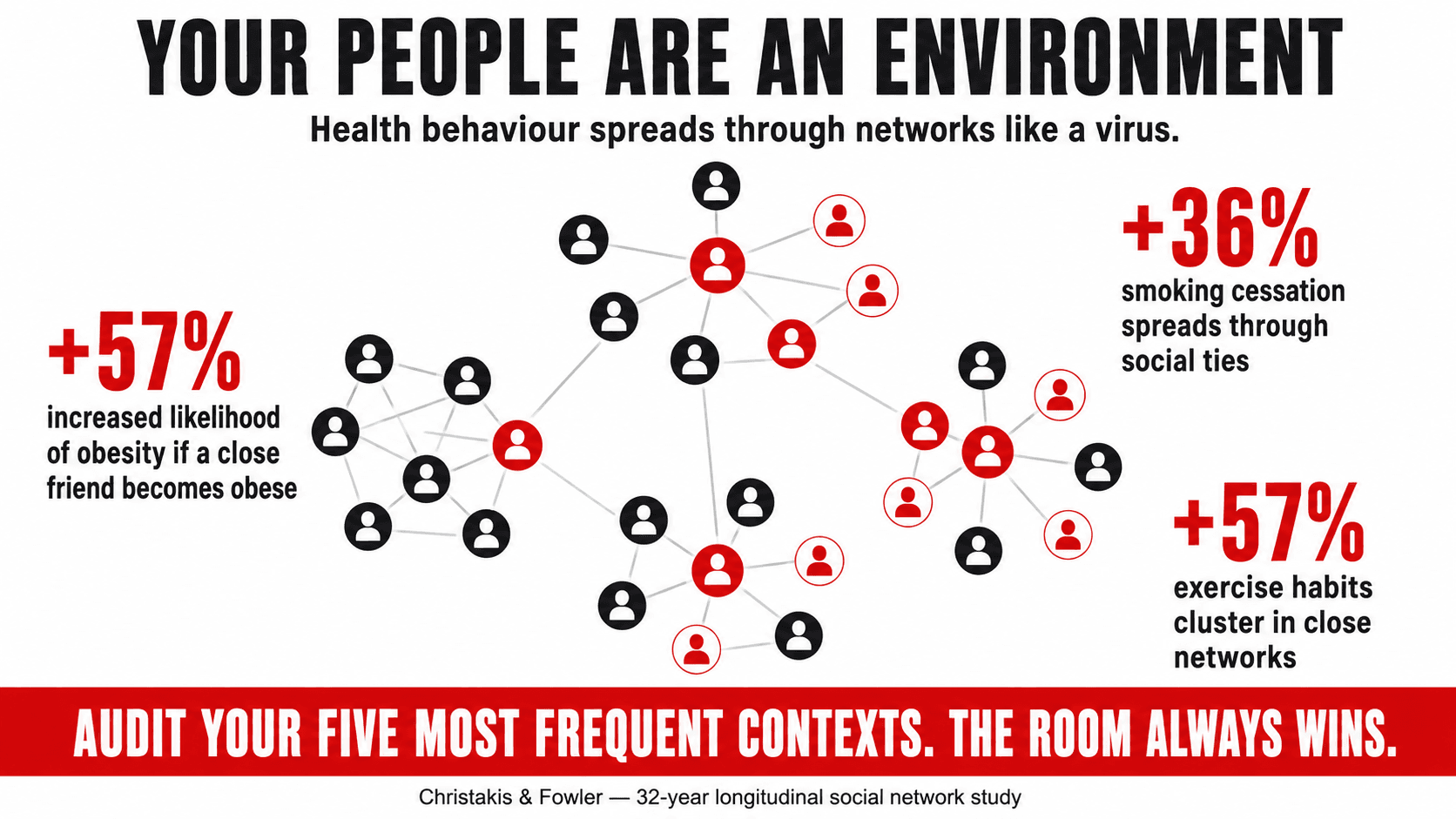
Nicholas Christakis and James Fowler's social contagion research demonstrated through analysis of a thirty-two-year longitudinal dataset that obesity, smoking, and exercise all spread through social networks in ways that look strikingly like infectious disease transmission. A person's likelihood of becoming obese increased by 57% if a close friend became obese. Smoking cessation spread through social networks. Exercise habits clustered among people who spent regular time together. The behaviour of the people around you changes what feels normal, and what feels normal changes what you do without conscious deliberation (7).
This does not mean that you need to change your friends in order to improve your health. It means that your social environment is a variable worth auditing with the same intentionality you would apply to your kitchen. The question is not whether the people around you are good people. It is whether the social context they create makes healthy behaviour easier or harder. And if the answer is harder, the question becomes: what can I do to modify the social environment, without necessarily modifying the people within it?
Practical social environment design looks like: being explicit with close relationships about your health commitments so they do not inadvertently undermine them. Seeking out one social relationship that involves physical activity rather than passive consumption. Being deliberate about which social contexts involve the foods and behaviours that are most difficult to navigate. None of this requires dramatic relationship upheaval. It requires the same friction-reduction logic applied to people rather than objects.
Key Insight: Audit your five most frequent social contexts this week. For each one, ask honestly: does this environment make healthy choices easier or harder? Not whether the people are supportive, but whether the physical setting, the food and drink that is present, the activities involved, and the norms of the group make it more likely or less likely that you will behave consistently with your health goals. The audit itself changes nothing. What you do with the information determines everything.
The Agitate Case: What the Undesigned Environment Is Costing You Daily
The default environment most people inhabit was not designed for their health. It was designed by consumer goods companies, food manufacturers, technology platforms, and property developers whose incentives are not aligned with your long-term wellbeing. The supermarket layout that places confectionery at the checkout. The food delivery apps engineered for immediate gratification. The social media algorithm that promotes the most emotionally engaging content rather than the most health-supportive. The office culture that positions biscuits and cake as the standard of social warmth.
Every one of these default environmental arrangements is generating automatic behaviours in you right now, without your conscious awareness or explicit consent. The person who gains half a kilogram per month, loses sleep to a phone they cannot stop checking, skips training because the bag was never packed, and eats more biscuits than they intended because the tin was visible on the counter is not a person with poor character. They are a person living in an environment that was engineered to produce exactly those outcomes. The solution is not more discipline. It is taking back the architectural authority of your own spaces.
The cost of the undesigned environment accumulates silently and compounds over years. Three hundred extra calories per day from visible snacks. Thirty minutes of lost sleep from the bedside phone. Two missed training sessions per month from the unpacked bag. These are not dramatic failures. They are the predictable output of a system that was never designed to serve the person living in it. Redesigning the environment is not a discipline project. It is a systems project. And systems, once built, run automatically.
Key Insight: Spend ninety minutes this weekend on a single-room environment redesign. Choose the room that most directly affects your health goals, usually the kitchen or the bedroom. Apply the friction principle to every item in it: does this item make the healthy choice easier or harder? Move, store, or remove accordingly. Then live in the redesigned space for two weeks and observe the behavioural changes without changing anything else. The results will make the argument for the approach more convincingly than anything written here.
How Environment Design Is Built Into Every Client Relationship From Day One
The first practical conversation I have with every new client is not about training or nutrition. It is about environment. I ask about the kitchen, the bedroom, the commute, the workplace, and the social context because the programme I build has to be executable in the actual environment the client lives and works in, not in an idealised one.
A nutrition strategy that requires willpower to navigate the home food environment will fail the first time the client is tired, stressed, or distracted, which will be within the first two weeks of any serious life. A training programme that relies on high motivation to overcome high friction will be inconsistently executed and eventually abandoned. The programme that fits into a thoughtfully designed environment requires far less effort to sustain, compounds more reliably, and survives the inevitable disruptions of a real life.
The environment conversation is not a soft coaching add-on. It is a hard prerequisite for sustainable results. If you want to change your health outcomes without relying on a willpower reserve that depletes daily and runs out entirely under pressure, the place to begin is not with a new programme. It is with the spaces where the programme has to survive. I work with clients one-to-one online globally. The environment audit is where that work begins.
Work with Me
Get a personalised coaching plan built around your goals, your schedule, and your life.
Enquire NowReferences
- Baumeister RF, Tierney J. Willpower: Rediscovering the Greatest Human Strength. New York: Penguin; 2011.
- Fogg BJ. Tiny Habits: The Small Changes That Change Everything. London: Virgin Books; 2019.
- Clear J. Atomic Habits: An Easy and Proven Way to Build Good Habits and Break Bad Ones. London: Random House Business; 2018.
- Wood W, Tam L, Witt MG. Changing circumstances, disrupting habits. Journal of Personality and Social Psychology. 2005; 88(6): 918–933.
- Wansink B, Painter JE, Lee YK. The office candy dish: proximity's influence on estimated and actual consumption. International Journal of Obesity. 2006; 30(5): 871–875.
- Thaler RH, Sunstein CR. Nudge: Improving Decisions About Health, Wealth, and Happiness. London: Penguin; 2009.
- Christakis NA, Fowler JH. Connected: The Surprising Power of Our Social Networks and How They Shape Our Lives. London: Little, Brown; 2009.