You Are Not Choosing Most of What You Do
Breaking bad habits and building good ones is the conversation at the centre of almost every health transformation, and yet it remains persistently misunderstood. Most people approach habits as a motivation problem: if I wanted it badly enough, I would do it consistently. When the habit fails, the conclusion is a failure of desire or discipline. This framing is not only inaccurate. It actively prevents the kind of structural thinking that produces lasting behavioural change.
Habits are not choices. They are neurological patterns stored in the basal ganglia, a region of the brain that operates largely below the level of conscious awareness, that are triggered automatically by contextual cues and executed without requiring deliberate decision-making. The reason a habit is difficult to break is not that you lack willpower. It is that the neural pathway underlying it has been reinforced thousands of times and runs automatically before the prefrontal cortex, the seat of conscious decision-making, has had a chance to intervene.
Charles Duhigg, in The Power of Habit, was the first writer to bring the neuroscience of habit formation into mainstream understanding, drawing on Ann Graybiel's research at MIT and decades of neurological study to articulate the cue-routine-reward loop that governs automatic behaviour. The framework he described is not a metaphor or a motivational model. It is a neurological description of how the brain automates behaviour, and understanding it precisely is the prerequisite for changing it deliberately (1).
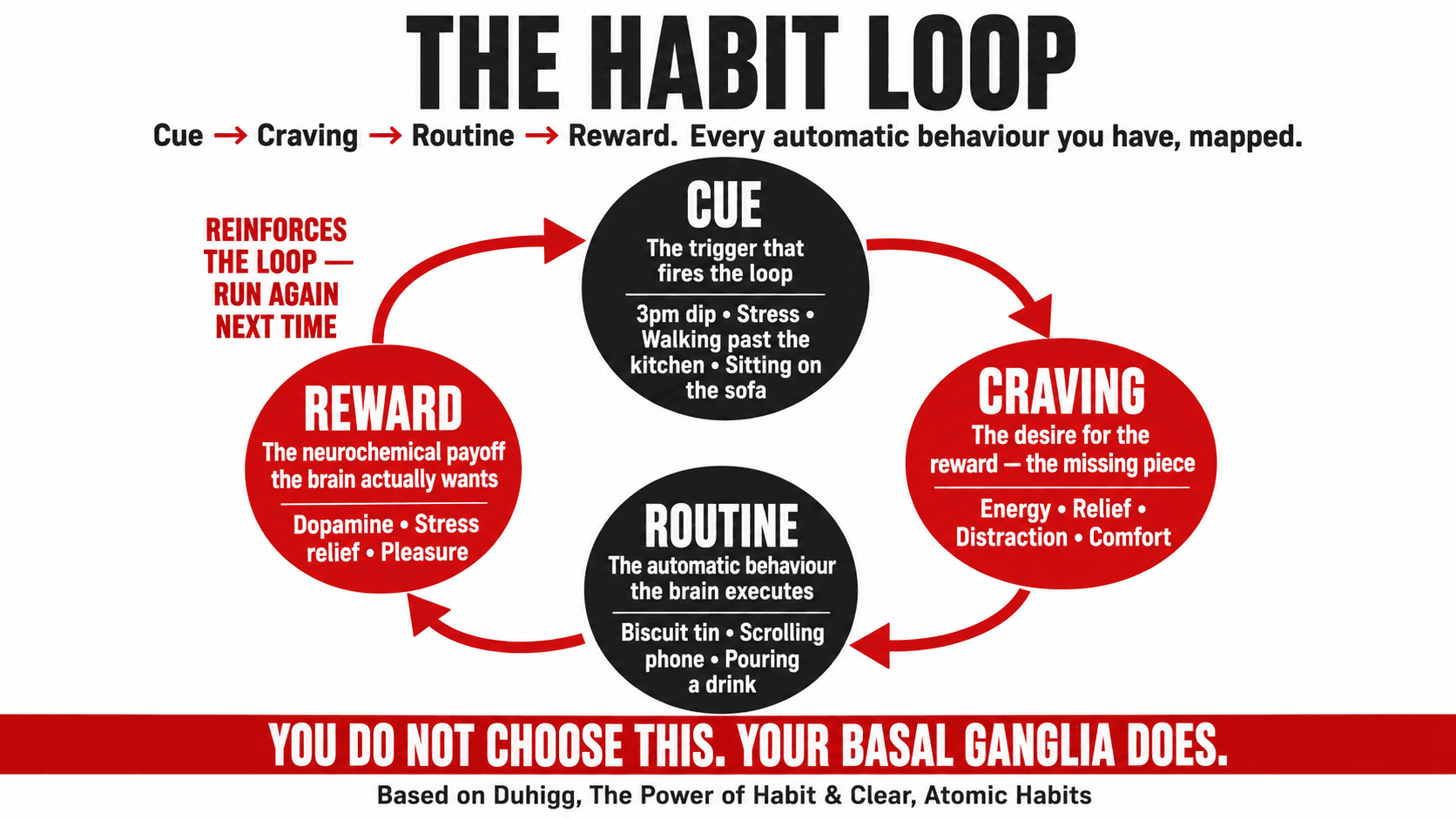
The Cue-Routine-Reward Loop: The Architecture of Every Habit You Have
Ann Graybiel's MIT research on rats navigating a maze produced the foundational insight into how habits form neurologically. As rats learned a maze route repeatedly, their brain activity during the navigation shifted progressively from active problem-solving in the prefrontal cortex to compact, automated execution in the basal ganglia. Once the route was habituated, the brain's activity spiked at two specific moments: at the entry point of the maze, the cue, and at the reward point at the end. Everything in between became neurologically compressed into an automatic routine. The brain had chunked a sequence of decisions into a single automated unit (2).
The same process governs every habit in the human repertoire. The loop has three components. The cue is the trigger that activates the habit: a time of day, a location, an emotional state, the presence of certain people, or the occurrence of a preceding behaviour. The routine is the behaviour itself, which the brain executes automatically in response to the cue. The reward is the payoff that the brain registers at the completion of the routine, the neurochemical signal that marks this loop as worth repeating and strengthens the neural pathway for next time.
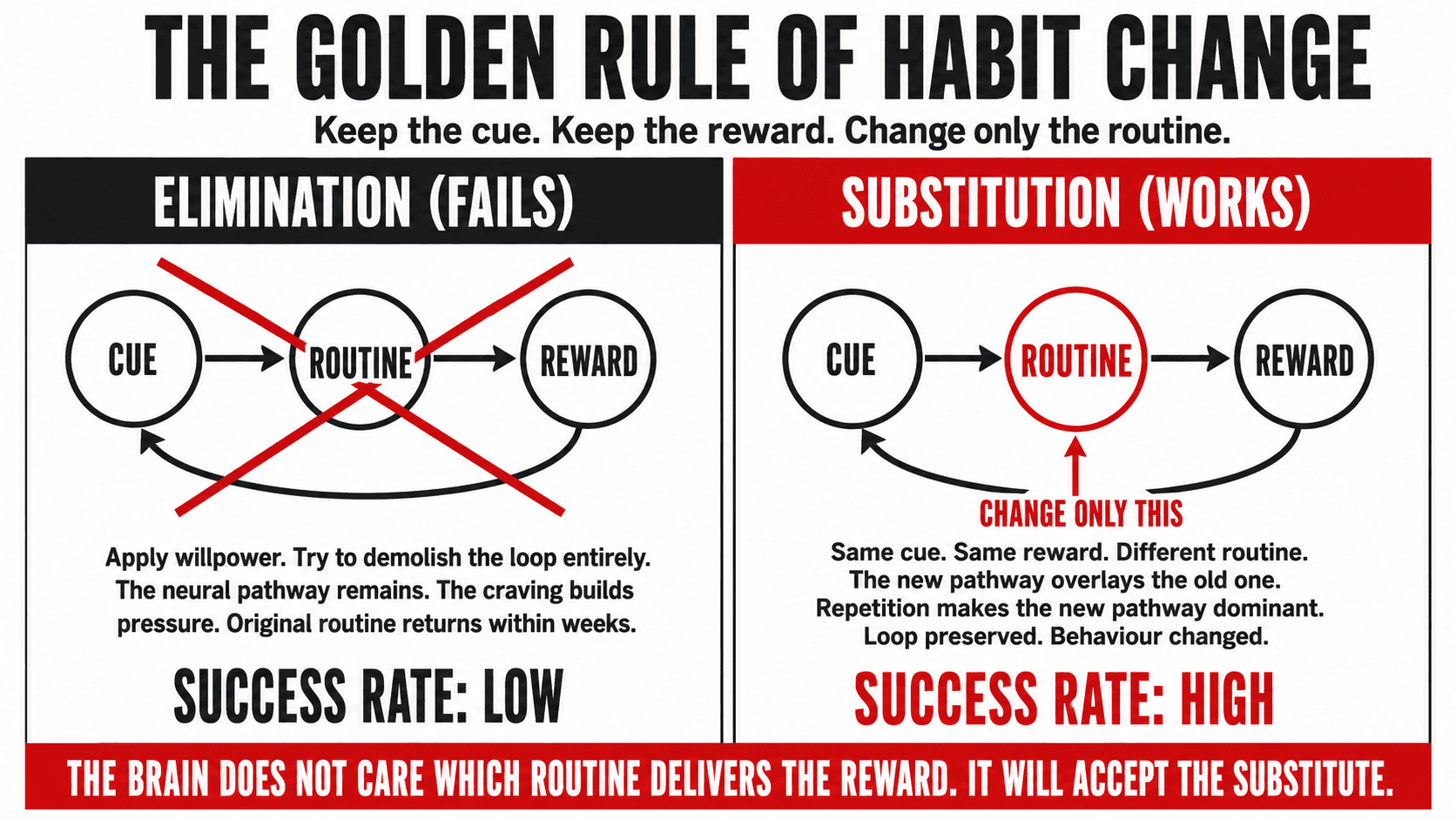
The critical insight that Duhigg brought from this research is one that most habit-change advice entirely misses: habits cannot be eliminated. The neural pathway, once formed, does not disappear. What can be done is to keep the cue and the reward while replacing the routine with one that delivers the same reward through a different behaviour. The loop remains. Only the middle changes. This is why cold-turkey elimination of deeply rooted habits almost always fails, while routine substitution with a structurally equivalent reward almost always succeeds.
“Habits never truly disappear. They are encoded into the structures of our brain, and this is a huge advantage. The problem is that your brain cannot tell the difference between bad and good habits.”
— Charles Duhigg, The Power of Habit
Diagram: The Neurological Habit Loop — How Every Automatic Behaviour Is Structured
THE NEUROLOGICAL HABIT LOOP
CUE
(Trigger)
The environmental or internal trigger that fires the habit automatically — time, place, emotion, person, or preceding action.
Examples: Stress at work. 3pm dip. Walking past the kitchen. Finishing a task. Feeling bored. Sitting on the sofa.
ROUTINE
(Behaviour)
The automatic behaviour the brain executes in response to the cue. Fast, effortless, and unconscious once the loop is established.
Examples: Opening the biscuit tin. Scrolling the phone. Pouring a drink. Skipping the gym. Reaching for coffee number four.
REWARD
(Payoff)
The neurochemical payoff: dopamine, stress relief, social connection, pleasure, or comfort. This is what the brain is actually seeking.
Examples: Momentary stress relief. Distraction. Sensation of relaxation. Avoiding discomfort. Temporary pleasure.
THE CRAVING: The Missing Piece Between Cue and Routine
James Clear's refinement of Duhigg's loop adds a fourth element: the craving. The cue does not trigger the routine directly. It triggers a craving for the reward, and the craving drives the routine. This is why the same cue in a different emotional state does not always produce the same behaviour — the craving is the variable. To change a habit, you must understand not just the cue and the reward, but the craving that connects them. What does the reward feel like? What need does it meet? The new routine must meet the same need.
The habit cannot be broken by willpower alone because willpower operates in the prefrontal cortex and the habit loop runs in the basal ganglia. You are trying to use conscious effort to override a system that was specifically designed to operate without it. The solution is to work with the architecture, not against it.
Why Elimination Fails and Substitution Succeeds
The most common approach to breaking an unwanted habit is elimination: decide to stop doing it, apply willpower, white-knuckle through the cravings, and hope the urge eventually disappears. This approach fails at a high rate because it misunderstands the neurology. The neural pathway underlying the habit does not dissolve when the behaviour stops. It remains encoded, waiting for the cue. The craving it produces does not dissipate. It either finds a different outlet or builds pressure until the original routine is reinstated.
The substitution approach works because it operates within the existing loop structure rather than trying to demolish it. Keep the cue. Keep the reward. Change only the routine to one that delivers the same reward through a different behaviour. The neural pathway of the new routine is laid on top of the old one, and with consistent repetition, the new pathway becomes the stronger of the two. The old pathway never disappears entirely, which is why former smokers can crave a cigarette years after quitting when the original cue is encountered. But the new pathway becomes the dominant response to the cue, and dominance is all that is required for practical behavioural change.
Duhigg's golden rule of habit change states this simply: use the same cue, deliver the same reward, change the routine. The application of this rule requires first identifying the cue and the reward that underlie the habit accurately, which is less straightforward than it sounds. People frequently misidentify the reward their habit is delivering, which leads them to design substitutes that feel plausible but do not meet the same underlying need. A person who eats biscuits when stressed may believe the reward is the taste. The actual reward may be a two-minute break from pressure, social connection with colleagues, or the tactile sensation of doing something with their hands. A substitute that delivers the same taste but not the break from pressure will not satisfy the craving (1).
Key Insight: To identify the actual reward your unwanted habit is delivering, run a fifteen-minute experiment. The next time you feel the urge to perform an unwanted habit, pause. Ask: what am I actually looking for right now? Stress relief? Distraction? Pleasure? Social connection? Energy? Write the answer down. Do this across five or six occasions. A pattern will emerge. The pattern tells you what reward your substitute routine must deliver in order to work.
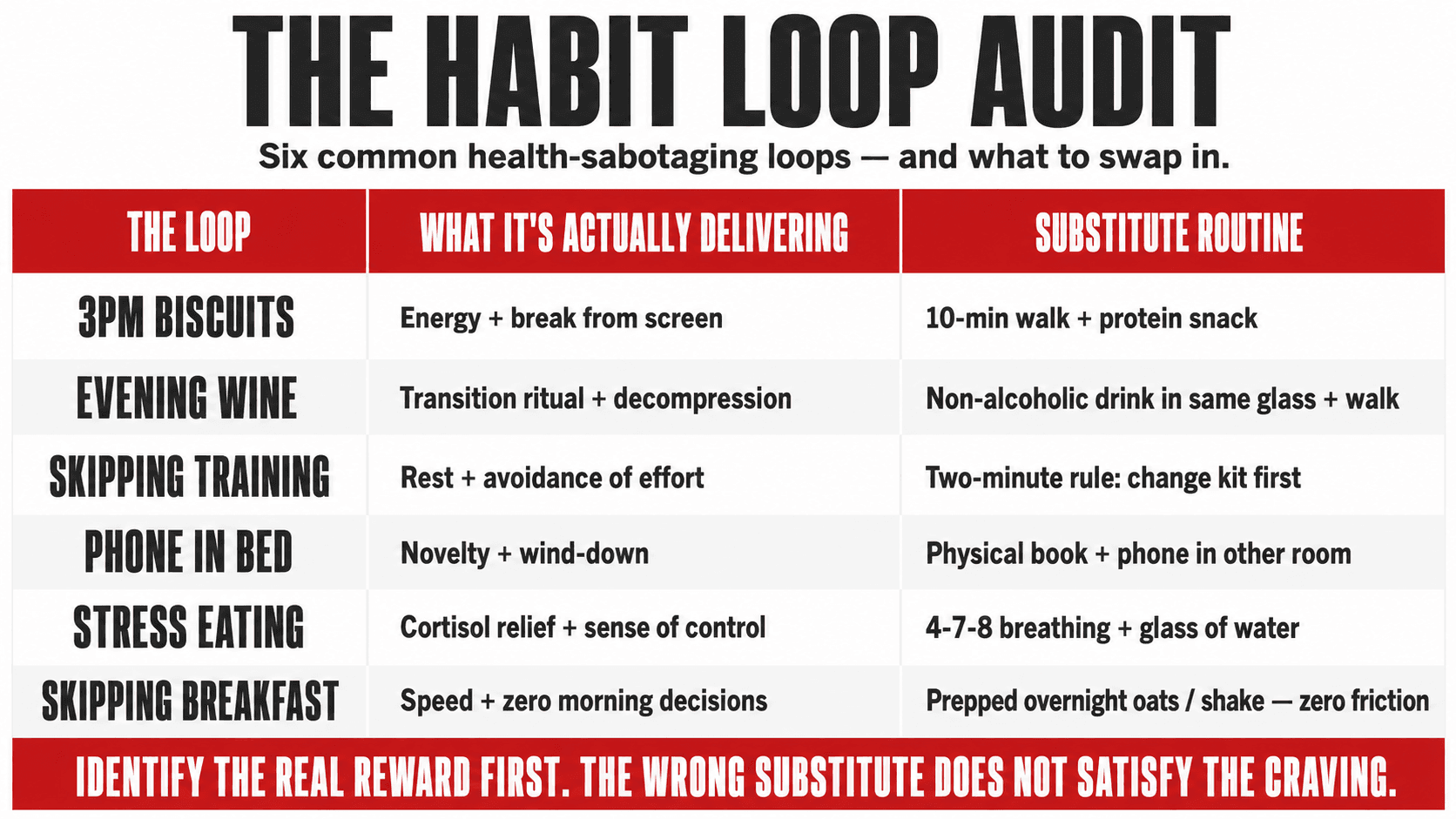
Auditing Your Current Habit Loops: The Five-Column Diagnostic
Before any habit can be changed, it must be understood. The five-column habit audit is a practical tool for mapping the cue, routine, reward, underlying need, and most effective intervention for any habit loop you want to modify. Apply it to your own most persistent unwanted health habits.
| Habit | Cue (Trigger) | Routine (Behaviour) | Reward (Payoff) | Underlying Need | Substitution Intervention |
|---|---|---|---|---|---|
| Afternoon biscuit / snack raid | 3pm energy dip. Desk fatigue. Screen boredom. Triggers predictably after lunch. | Walking to kitchen or canteen and eating high-sugar, high-fat convenience food. | Brief energy lift. Change of scene. Hands doing something. Momentary relief from screen. | Energy restoration and a genuine break from focus. | Pack a high-protein snack. Build a deliberate 10-minute away-from-screen break as the routine. The snack content changes but the break structure is preserved. |
| Evening alcohol | Finishing work. Changing out of work clothes. Settling on sofa. Mental switch from work to rest. | Pouring a glass of wine or opening a beer as the psychological signal of the day ending. | Decompression. Reward for the day. Transition ritual. Relaxation signal. | A clear psychological boundary between work and rest. A decompression ritual. | Replace the routine, not the structure. Non-alcoholic ritual drink served in the same glass. A walk. A specific music playlist. A shower. The transition ritual is the real reward. |
| Skipping training when tired | Fatigue after work. Sofa becomes visible. Work clothes still on. Gym kit not visible. | Sitting down instead of changing for the gym. Session abandoned before it began. | Immediate relief from physical effort. Rest. Avoidance of discomfort. | Rest and recovery, which is legitimate. But often the fatigue is mental, not physical. | Two-minute rule: change into training kit before any decision is made. If still genuinely too tired after changing, rest is legitimate. The kit-change removes the early exit option. |
| Late-night phone scrolling | Getting into bed. Room darkens. Body horizontal. The phone is within reach. | Opening social media or video content and scrolling until significantly past intended sleep time. | Stimulation. Novelty. Mild dopamine from new content. Avoidance of silence and stillness. | Winding down. Transitioning from the demands of the day to rest. Novelty seeking. | Phone charged outside bedroom or across the room. Physical book on bedside table as substitute novelty source. Specific sleep-prep routine as the cue-response instead. |
| Stress eating | Deadline pressure. Difficult conversation. Unexpected bad news. Anxiety spike. | Eating, often rapidly, often processed and high-calorie foods not related to hunger. | Temporary cortisol relief. Oral stimulation. Sensation of control over one small thing. | Stress regulation. A sense of agency and control during a moment of pressure. | Identify three non-food stress regulation tools that take under five minutes: diaphragmatic breathing, a five-minute walk, cold water on the face. Keep them as accessible as the food. |
| Skipping breakfast | Morning time pressure. Alarm snoozed too late. Leaving the house without eating. | Leaving without any food. Arriving at work in a caffeine-only state until mid-morning hunger becomes acute. | Time saved. Easier morning. Short-term convenience. | Speed and ease in the morning. Reducing the number of decisions required before leaving. | Prepare the night before. A protein shake, overnight oats, or portable food requires zero morning decision. Zero friction. The ease of skipping is matched by the ease of the prepared option. |
In every case, the substitution preserves the cue and the reward while changing the routine. This is the structural key. The brain does not care which routine delivers the reward. It will accept the substitute if the reward is genuinely equivalent.
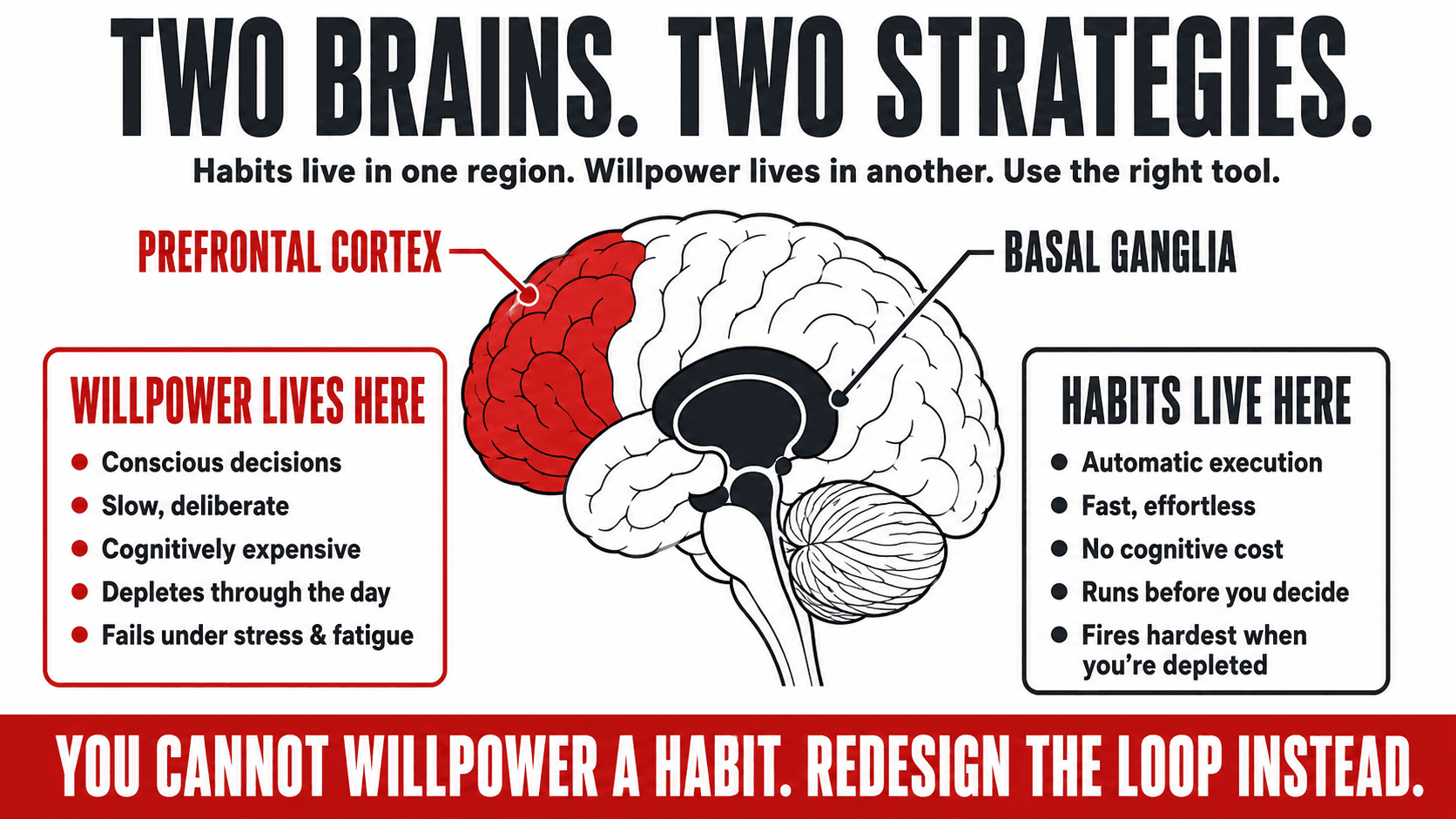
The Basal Ganglia and the Prefrontal Cortex: Why You Are Fighting the Wrong Battle
Understanding which part of the brain governs habits is not academic. It has direct practical implications for the strategy you use to change them. The basal ganglia, a cluster of nuclei deep within the brain that evolved before the prefrontal cortex, stores habituated behaviour as compressed neural routines. It operates quickly, automatically, and without requiring conscious input. It is the brain's efficiency system: once a behaviour is established, the basal ganglia runs it at a fraction of the cognitive cost of conscious decision-making (2).
The prefrontal cortex, by contrast, is the seat of deliberate decision-making, goal-directed behaviour, and self-regulation. It is also slower, more cognitively expensive, and highly sensitive to depletion through fatigue, stress, and decision load. When you use willpower to override a habit, you are using the prefrontal cortex to inhibit basal ganglia execution. This works when the prefrontal cortex is well-rested, unstressed, and operating at full capacity. It works poorly or not at all when it is tired, depleted, or overwhelmed, which is precisely the state in which most habit failures occur.
The practical implication is that willpower is not a strategy for habit change. It is a stopgap that will fail under the exact conditions when the habit cues are strongest. The actual strategy is to redesign the loop so that the basal ganglia, running on automatic, executes the new routine instead of the old one. When the new routine is sufficiently reinforced, the habit change requires no willpower to maintain because it is no longer a decision.
Building New Habit Loops: The Three Conditions for Reliable Habit Formation
Building a new healthy habit is not simply a matter of deciding to do it and repeating it until it sticks. The neuroscience of habit formation identifies three conditions that, when present, accelerate the process and, when absent, produce inconsistent results regardless of motivation level.
The first condition is a specific, consistent cue. New habits form most rapidly when they are attached to a cue that fires reliably at a consistent time and in a consistent context. Habits that are triggered by vague intentions, such as exercising when I have time or eating healthily when I remember, do not form reliably because the cue is inconsistent. The cue must be specific: after I pour my morning coffee, I will take my supplements. When I sit down at my desk, I will fill my water bottle. The moment I arrive home, I will change into training kit before I do anything else. Specificity of the cue is the single most important factor in the early stages of habit formation (3).
The second condition is an immediately accessible reward. The brain reinforces behaviours whose rewards are experienced immediately and weakens behaviours whose rewards are delayed. This is the fundamental problem with most health habits: the reward, better health, lower body fat, improved energy, arrives weeks or months after the behaviour. The immediate experience of a training session is often discomfort. The immediate experience of declining a biscuit is deprivation. To accelerate habit formation, the new routine needs an immediate reward layered on top of its delayed one. This can be as simple as a specific piece of music listened to only during training, a genuine moment of self-acknowledgment after a healthy meal, or a progress log that makes the accumulation of small wins visible.
The third condition is repetition in a consistent context. Habits form through the repetition of a behaviour in a sufficiently consistent context that the neural pathway becomes associated with the contextual cues and fires automatically when they are present. Research on habit formation timescales by Phillippa Lally at University College London found that the average time for a behaviour to reach automaticity was 66 days, with a range from 18 to 254 days depending on the complexity of the behaviour and the consistency of its repetition. The 21-day habit formation myth is precisely that: a myth that sets people up for failure when the habit has not automated by week three (4).
| Old Routine | Reward Being Sought | New Routine (Same Reward) | Difficulty |
|---|---|---|---|
| Biscuits at 3pm | Energy lift, break from screen, brief pleasure | 10-minute walk outdoors with a piece of fruit. Delivers the energy and the break with a nutritional upgrade. | Low |
| Glass of wine to decompress | Transition ritual, decompression, reward for effort | Non-alcoholic botanical drink served identically. Specific playlist. A walk around the block as the boundary ritual. | Medium |
| Stress eating | Cortisol relief, sense of control, oral stimulation | 4-7-8 breathing for two minutes, then a glass of water. Addresses the cortisol directly rather than masking it. | Medium |
| Bedtime phone scrolling | Wind-down, novelty, transition to rest | Physical book of genuine interest. Delivers novelty and mental engagement without blue light suppressing melatonin. | Low |
| Skipping training when tired | Rest, relief from effort, avoidance of discomfort | Change into kit. Walk to gym. Commit only to 10 minutes. The completion rate once changed is above 80% in research. | Medium |
| Sugary coffee drinks | Energy, warmth, pleasure, familiar ritual | Black coffee or americano with a square of dark chocolate alongside. Preserves the ritual and the sensory experience. | Low |
| Takeaway when too tired to cook | Ease, speed, no decisions required, comfort | Pre-prepped batch meal from the freezer. Requires zero decisions. Same ease. Planned when energy was higher. | Low |
Difficulty ratings assume the new routine has been set up in advance with reduced friction. A new routine that requires effort to access at the moment of the cue will fail. Prepare the substitute before the cue arrives, not during it.
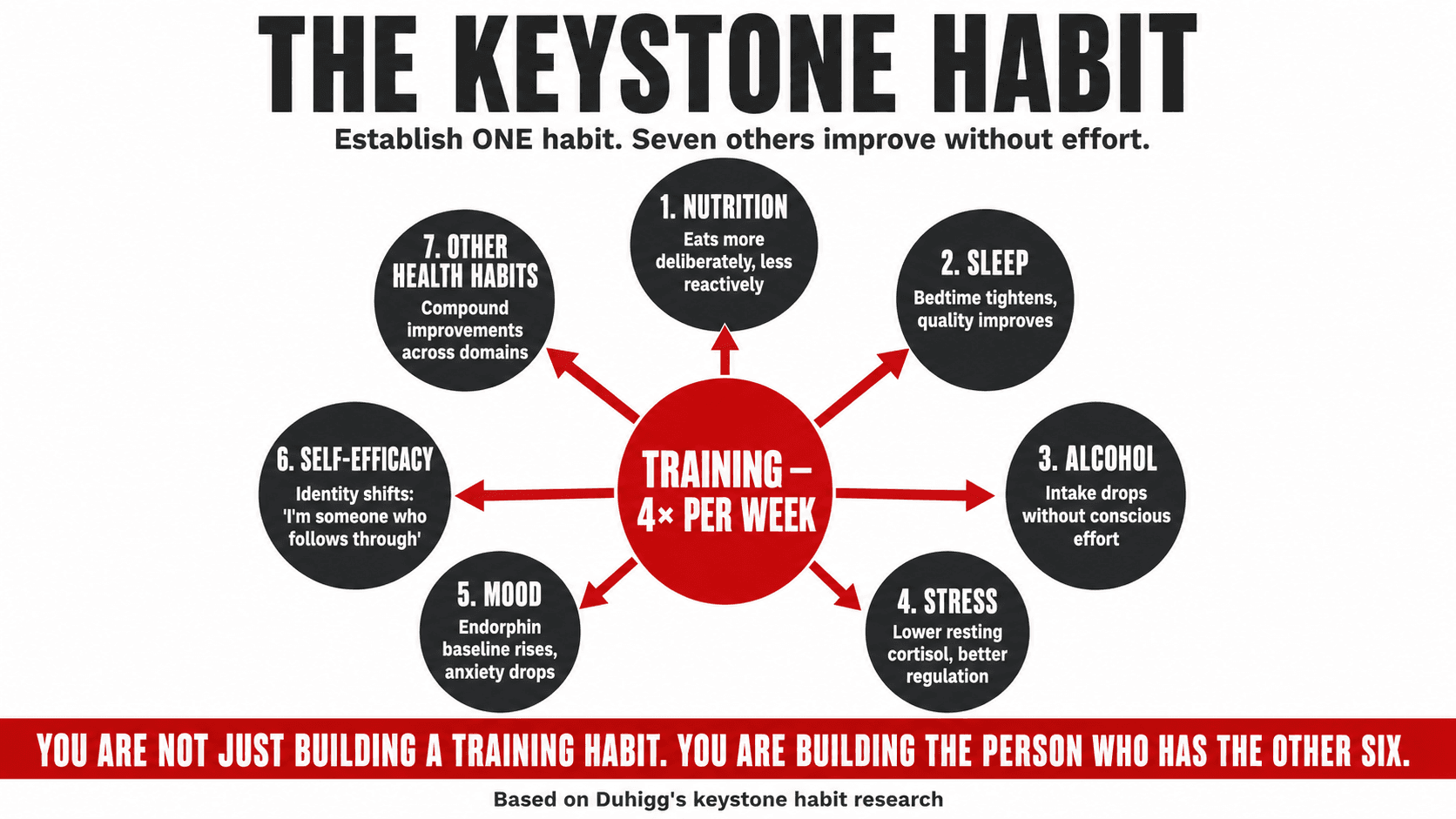
The Keystone Habit: The One Habit That Changes Everything Else
Not all habits carry equal weight. Duhigg identified a category of behaviour he called keystone habits: habits that, when established, trigger a cascade of related behavioural changes without deliberate effort. Exercise is the most reliably documented keystone habit in health research. Study after study shows that people who establish a regular exercise habit spontaneously improve other health behaviours: they eat better, sleep more consistently, drink less alcohol, manage stress more effectively, and report higher self-efficacy across domains not directly related to the exercise itself. The mechanism is partly neurochemical, partly identity-based, and partly the product of schedule restructuring that exercise imposes on the day (1).
Regular training is the keystone habit I prioritise above all others with new clients, not simply because of its direct physical benefits, which are extensive, but because of the cascading behavioural improvements it tends to produce in every other health domain. A person who trains consistently four times per week is a qualitatively different person, in terms of their relationship with their health, from one who trains sporadically. The training habit changes the identity, the identity changes the decisions, and the decisions compound across every other area.
Key Insight: If you could establish only one new health habit this month, make it a training habit with a specific cue, a specific time, and a specific minimum viable session that is so achievable it is almost impossible to skip. Start with three sessions per week of thirty minutes each. Attach each session to a consistent cue: the same time of day, the same trigger, the same initial action. Build the loop with absolute consistency before increasing the intensity. You are not optimising the session. You are building the pathway.
How Habit Loop Work Shapes Every Programme I Build
The habit audit is a standard part of my process with every client, because the physical programme I design has to navigate the existing habit landscape of that person's life, not an idealised version of it. A nutrition strategy that does not account for the 3pm biscuit loop, the Friday evening alcohol ritual, or the stress-eating pattern will fail the moment those cues fire, which is guaranteed within the first two weeks of any serious programme.
Understanding the cue, the actual reward, and the underlying need allows me to design substitutes that satisfy the neurological requirement while serving the health goal. This is not compromise. It is precision. The person who has replaced their stress-eating loop with a two-minute breathing protocol and a handful of protein-rich food has not given something up. They have kept the stress relief and changed only the delivery mechanism. That change compounds invisibly for months before it becomes visible in body composition, in energy, and in the relationship with food.
The clients who sustain change over years are not the ones with the most willpower. They are the ones whose habit loops have been rebuilt so that the healthy behaviour is what happens automatically, and the unhealthy one requires effort. I work with clients one-to-one online globally. The habit audit is where that conversation begins.
Work with Me
Get a personalised coaching plan built around your goals, your schedule, and your life.
Enquire NowReferences
- Duhigg C. The Power of Habit: Why We Do What We Do and How to Change. London: Random House; 2012.
- Graybiel AM. Habits, rituals, and the evaluative brain. Annual Review of Neuroscience. 2008; 31: 359–387.
- Gollwitzer PM. Implementation intentions: strong effects of simple plans. American Psychologist. 1999; 54(7): 493–503.
- Lally P, van Jaarsveld CHM, Potts HWW, Wardle J. How are habits formed: modelling habit formation in the real world. European Journal of Social Psychology. 2010; 40(6): 998–1009.
- Clear J. Atomic Habits: An Easy and Proven Way to Build Good Habits and Break Bad Ones. London: Random House Business; 2018.
- Wood W, Neal DT. A new look at habits and the habit-goal interface. Psychological Review. 2007; 114(4): 843–863.