
The Barrier That Willpower Cannot Break
Limiting beliefs about health are the most clinically significant and most consistently underaddressed variable in any body transformation. I say this across every demographic, every starting point, and every combination of health challenge. The person who knows exactly what to eat, trains with a good programme, has access to quality guidance, and still cannot sustain progress beyond a certain point is almost always hitting a belief ceiling. Not a caloric one. Not a hormonal one. A cognitive one.
A limiting belief is not a conscious opinion that can be argued away with better information. It is a deeply encoded assumption about reality that the brain treats as fact, filters experience through, and uses to determine which possibilities are available to you and which are not. The person who believes, at an identity level, that they are someone who struggles with their weight will unconsciously interpret every setback as confirmation of that belief, discount every success as temporary, and eventually produce the behaviour that the belief predicts. The belief is not describing their situation. It is creating it.
Robert Dilts, whose Neurological Levels model provides the most practically useful framework for understanding how beliefs operate within the architecture of behaviour change, articulates the critical insight directly: change at the level of environment and behaviour is temporary unless it is supported by change at the level of belief and identity. You can redesign someone's food environment, build them an excellent training programme, and provide them with evidence-based nutritional guidance. If the belief underneath remains unchanged, the programme will be sabotaged from within (1).
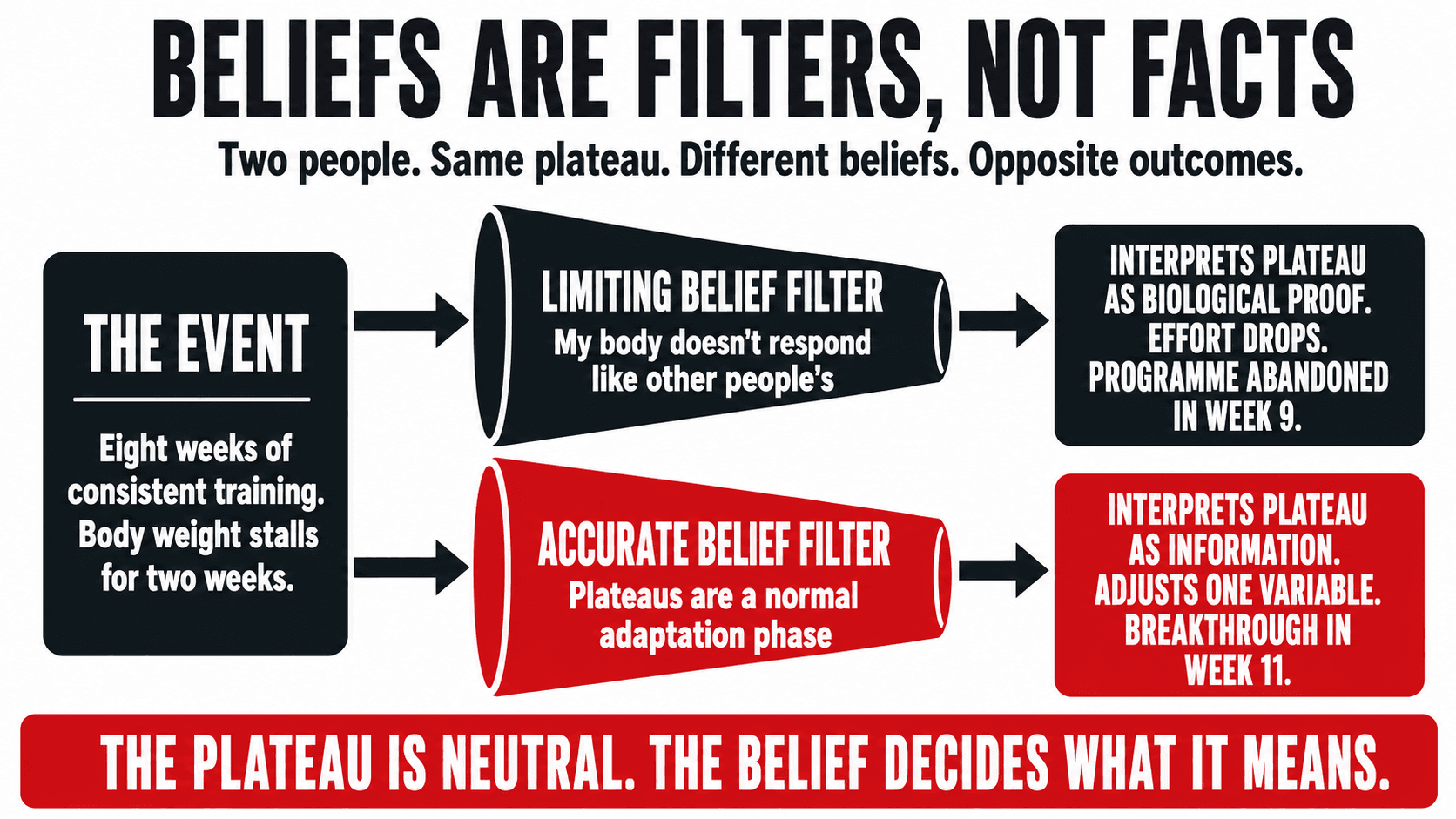
What a Limiting Belief Actually Is: Not a Feeling, a Filter
Most people, when they think of a limiting belief, think of a conscious negative thought: I do not believe I can do this. The more insidious and more damaging category is the belief that operates below conscious awareness as a filter through which all experience is interpreted. This type of belief does not feel like a belief. It feels like an observation about reality.
The brain is a pattern-recognition and prediction machine. Its primary function is not to perceive reality accurately but to generate predictions about what is likely to happen based on past experience, and then to filter incoming information for evidence that confirms those predictions. This is cognitively efficient and neurologically necessary. It is also the mechanism through which a limiting belief becomes self-perpetuating. The brain with a fixed belief about health will notice every failed diet, every returned kilogram, every genetic relative with a similar body type, and file each of these as confirmatory evidence. It will simultaneously discount or reframe every success as exceptional, lucky, or temporary. The belief maintains itself through selective perception, not through accuracy (2).
The consequence is that two people with identical physical starting points, identical programmes, and identical environmental support can produce dramatically different outcomes not because of the programme but because of what each person's belief system does with the experience of following it. One person, encountering a plateau, interprets it as confirmation that their body does not respond and begins the internal process of abandonment. The other person, encountering the same plateau, interprets it as a normal phase of adaptation requiring a specific technical adjustment. The plateau is identical. The belief produces entirely different behavioural responses to it.
“Beliefs have the power to create and the power to destroy. Human beings have the awesome ability to take any experience of their lives and create a meaning that disempowers them or one that can literally save their lives.”
— Tony Robbins
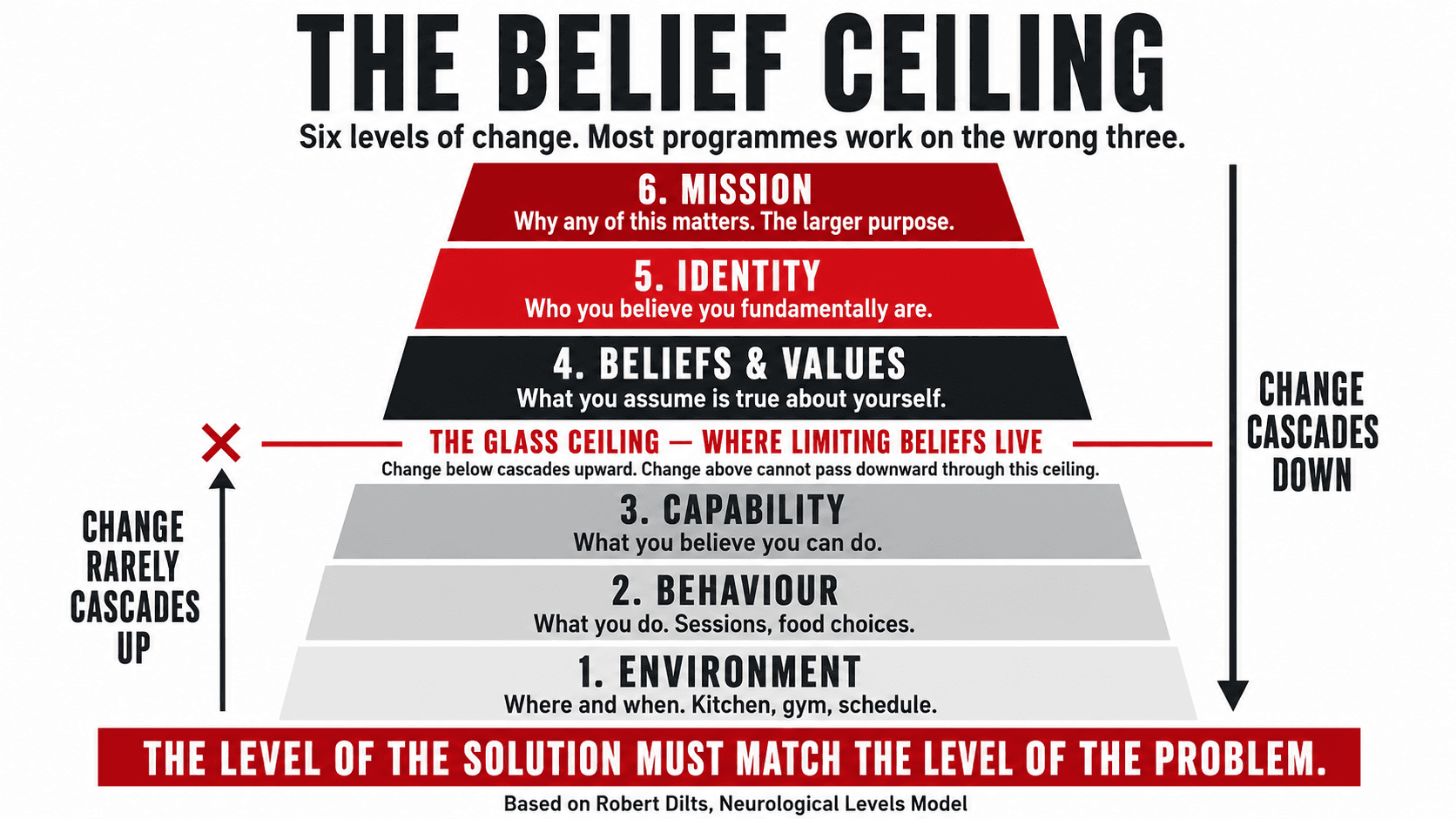
The Belief Ceiling: Where Your Change Attempts Are Stalling and Why
Robert Dilts developed the Neurological Levels model as a framework for understanding why interventions at one level of human experience frequently fail to produce lasting change, and which level an intervention must target to produce genuine and sustainable transformation. The model identifies six levels of experience, each nested within the others, with the deeper levels exerting greater influence over the levels above them. Understanding where your limiting beliefs sit within this structure tells you precisely why your previous change attempts have not held (1).
Diagram: The Belief Ceiling — Six Levels of Change and Where Limiting Beliefs Act as Invisible Barriers
THE NEUROLOGICAL LEVELS — Where Is Your Limiting Belief Living?
MISSION
Purpose. Why any of this matters. The larger reason behind the goal.
I want to be healthy so I can be fully present for my children. So I can perform at the level my ambitions require. So I am not limited by my body.
IDENTITY
Who I believe I am. The self-concept that determines which behaviours feel natural or foreign.
I am someone who takes my health seriously. I am an athletic person. My body responds when I treat it correctly.
THE GLASS CEILING — BELIEFS AND VALUES
This is where limiting beliefs live. They act as an invisible ceiling between the surface levels of behaviour and capability above, and the deep levels of identity and mission below. Change at behaviour level cannot pass upward through an unchanged belief. Change at belief level cascades downward, restructuring capability and behaviour automatically.
CAPABILITY
What I believe I am capable of. The skills and capacities I think are available to me.
I can train consistently. I can cook healthy food. I can manage my weight. My body can change.
BEHAVIOUR
What I actually do. The observable actions that most programmes try to change directly.
Training sessions. Food choices. Sleep routine. Movement patterns. Daily decisions.
ENVIRONMENT
Where and when behaviour happens. The context that cues and supports it.
Kitchen design. Gym membership. Work schedule. Social context. Access to healthy food.
Most health programmes intervene at environment and behaviour level. Most health transformations that last intervene at belief and identity level. The level of the solution must match the level where the problem actually lives.
The practical implication of this model is stark. If your limiting belief sits at the belief or identity level, no amount of nutritional information, programme design, or environmental engineering will produce lasting change. You can know exactly what to eat and still consistently not eat it. You can have a great training programme and still find reasons to skip sessions. You can redesign your kitchen and still undermine the environment you have built. The belief level is operating beneath all of it, filtering every experience and shaping every decision in ways that are invisible until the framework makes them visible.
Key Insight: Ask yourself honestly: in which of the six levels does my core health challenge actually live? If the answer is environment or behaviour, this is a programme design problem with a technical solution. If the answer is capability or belief, the technical solution will not hold without belief work running alongside it. Most people who have tried and failed repeatedly are working on the wrong level.
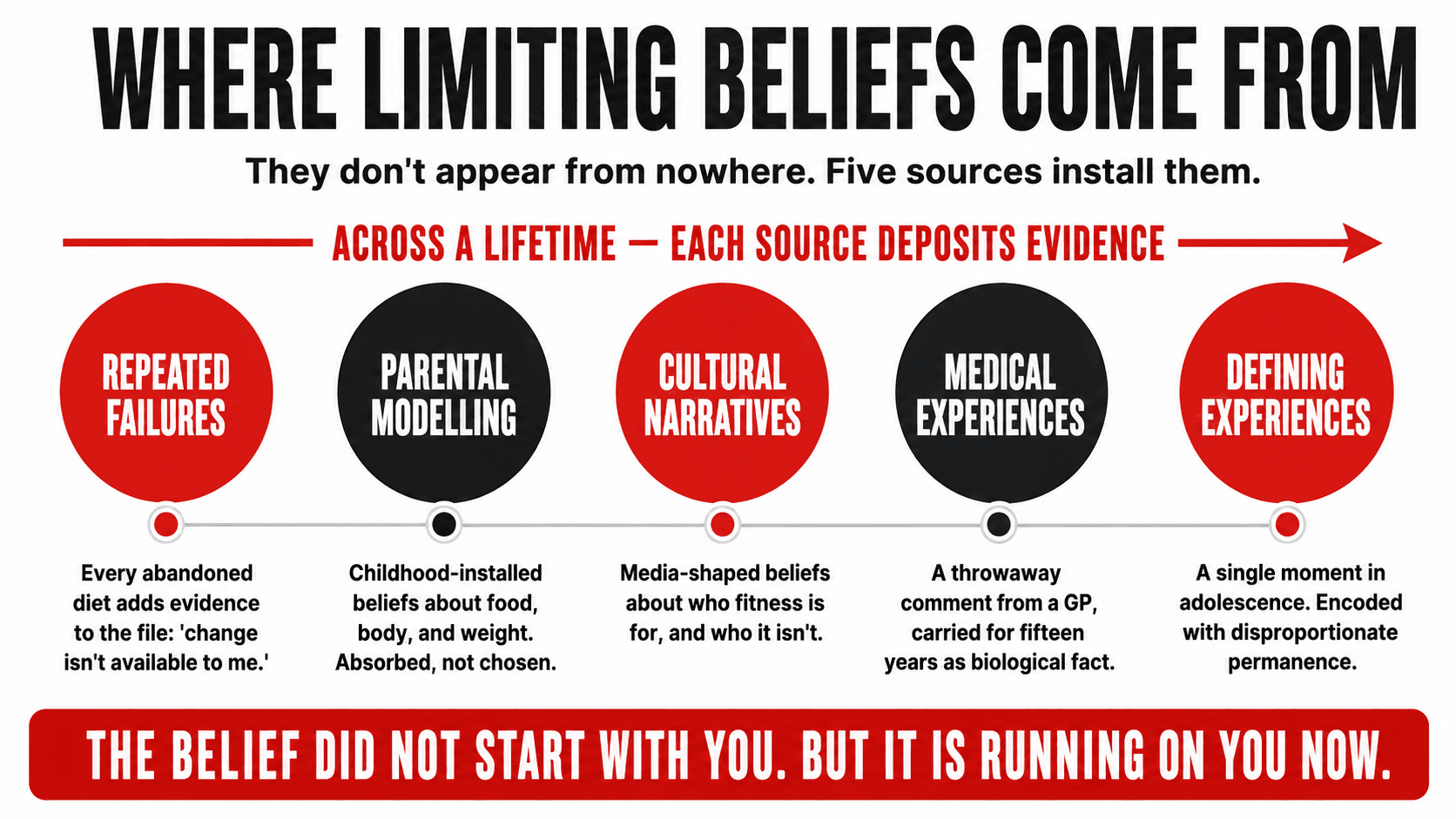
Where Limiting Beliefs About Health Come From: The Five Primary Sources
Limiting beliefs do not appear from nowhere. They are constructed from experience, and understanding their origin is part of the process of dismantling them. In my coaching practice, the limiting beliefs that most consistently cap health results fall into five primary categories of origin.
Repeated unsuccessful attempts are the most common source. Every failed diet, every returned kilogram, every abandoned programme deposits a small piece of evidence into the file the brain maintains on the question of whether lasting change is possible for this person. By the time someone reaches their fifth or sixth serious attempt, the file is thick and the conclusion it supports is powerful: my body does not respond the way other people's do. This is not a rational conclusion based on the evidence. It is a pattern-match between past failures and the prediction of future ones, built by a brain that is doing exactly what it was designed to do.
Parental and familial modelling installs health beliefs before the child has the capacity to evaluate them critically. A parent who consistently described their body negatively, who expressed helplessness about weight management, or who normalised disordered eating passes these beliefs to children not through explicit instruction but through observed behaviour. Research on intergenerational transmission of eating attitudes consistently shows that parental attitudes toward food and body weight are among the strongest predictors of children's own food relationship and body image, effects that persist into adulthood (3).
Cultural and media narratives about what healthy bodies look like, what kinds of people achieve them, and what is required to maintain them shape belief systems at scale. The belief that fitness is for a particular demographic, that certain body types are genetically excluded from lean physiques, or that maintaining health requires a level of sacrifice incompatible with normal life are culturally transmitted beliefs that many people carry as personal observations about their own biology rather than as absorbed social constructions.
Medical experiences that were delivered without adequate explanation or compassion produce lasting limiting beliefs with the authority of professional confirmation behind them. A client told by a GP fifteen years ago that they would always struggle with their weight because of their thyroid, without further investigation or qualification, may carry that belief into every subsequent health attempt as a biological fact that renders effort pointless.
Single defining experiences, particularly those in childhood or adolescence when belief systems are most malleable, can install a limiting belief with a permanence disproportionate to the significance of the event. A critical comment from a teacher, a failed physical fitness test, a moment of humiliation in a sporting context: these can create belief structures that persist for decades, operating below conscious awareness while shaping health behaviour every day.
Key Insight: Write down the three most persistent beliefs you hold about your own body and health. For each one, ask: where did this belief come from? Is it a conclusion I reached from evidence, or is it a story I absorbed from someone or somewhere else? The question is not whether the belief feels true. Most limiting beliefs feel completely true. The question is whether it is genuinely supported by evidence, or whether it has simply been confirmed by the experiences the belief itself has created.
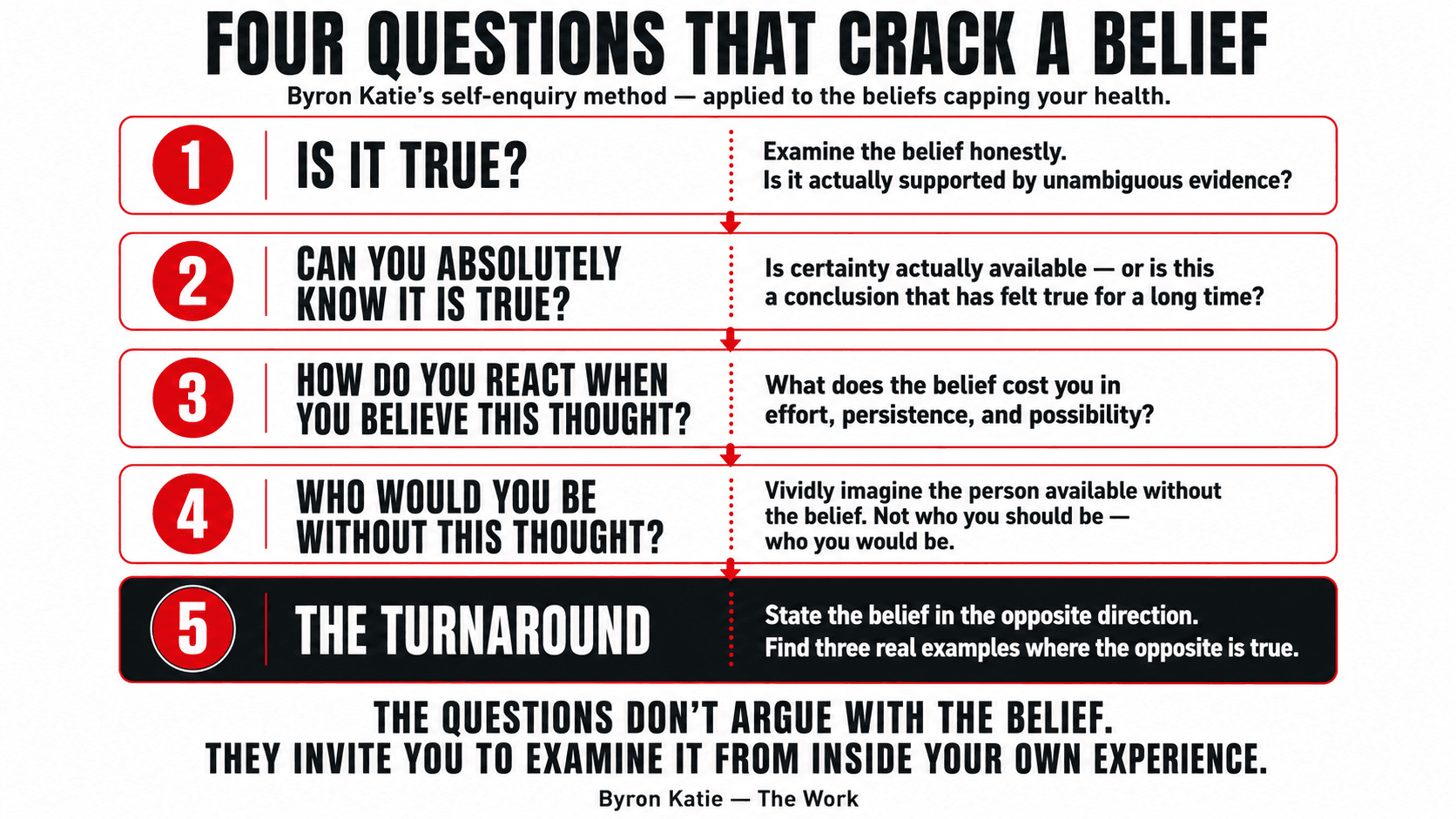
Byron Katie's Four Questions: The Most Effective Tool I Know for Dismantling a Limiting Belief
Byron Katie developed The Work as a method of self-inquiry that uses four questions and a turnaround to systematically examine the validity of a limiting belief and replace it with a more accurate alternative. I do not use The Work because it is fashionable or philosophically appealing. I use it because it is the most practically effective structured method I have encountered for cracking open a limiting belief that feels irrefutably true and making visible its constructed nature. It works on health beliefs specifically because those beliefs tend to be held with particular certainty and defended with particular vigour (4).
| # | The Question | What It Does | Applied to: “My body doesn't respond the way other people's do” |
|---|---|---|---|
| 1 | Is it true? | Invites the first honest examination of whether the belief is actually supported by unambiguous evidence, or whether it has simply felt true for a long time. | Is it absolutely true that your body does not respond? Have there been periods of change? Were there times the approach was genuinely consistent? Or does the belief generalise from selected evidence? |
| 2 | Can you absolutely know it is true? | Deepens the enquiry. Most limiting beliefs, examined carefully, are conclusions rather than facts. This question probes whether certainty is actually available. | Can you absolutely know this is true about your specific biology? Do you have controlled evidence — same programme, full adherence, extended period — that definitively supports it? |
| 3 | How do you react, what happens, when you believe this thought? | Makes the behavioural cost of the belief explicit and visible. The belief is not neutral. It is producing specific consequences that can be named and examined. | When you believe this thought, do you try as hard? Do you give yourself permission to quit earlier? Does the belief change how you interpret a plateau or a setback? What does it cost you? |
| 4 | Who would you be without this thought? | Creates a vivid contrast between the person the belief has been producing and the person available without it. Not who you should be. Who you actually would be. | Without that belief, would you approach the next difficult week differently? Would you stay on a programme through a plateau? Would you interpret a setback as information rather than confirmation? |
| T | THE TURNAROUND | Restate the belief in the opposite direction and find three genuine examples where the opposite is true. | Original: "My body doesn't respond the way other people's do." Turnaround: "My body responds exactly as it should to the inputs I have given it consistently." Find three real examples where this is true. The purpose is not positive thinking. It is reinstating accuracy. |
The four questions do not argue against the belief. They invite the person holding the belief to examine it from inside their own experience. The examination, done honestly, consistently reveals that the certainty with which a limiting belief is held is inversely proportional to how carefully it has been examined.
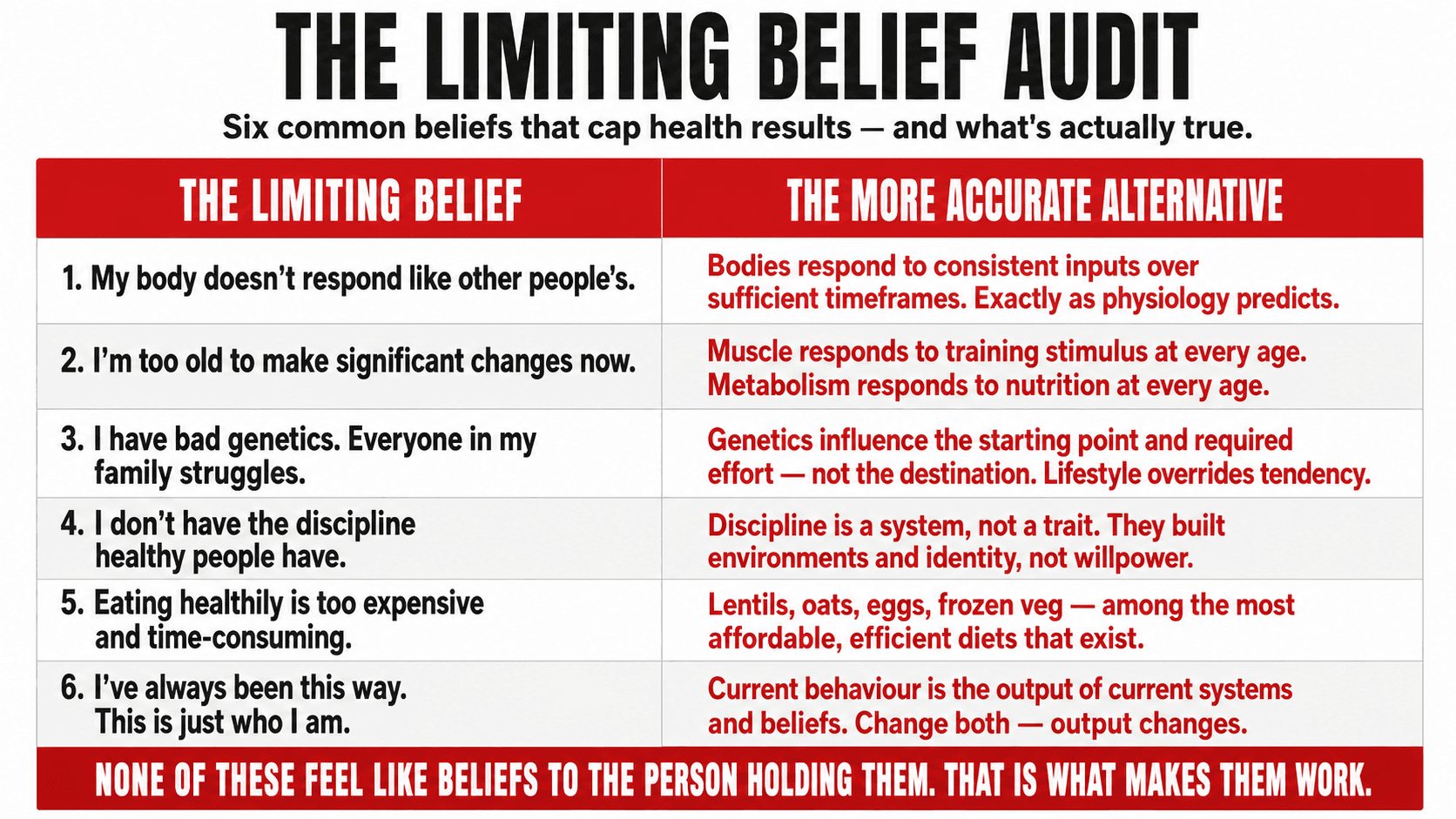
The Limiting Belief Audit: Six of the Most Common Health Beliefs That Cap Results
| The Limiting Belief | Where It Comes From | How It Shapes Behaviour | The Question That Cracks It | The More Accurate Alternative |
|---|---|---|---|---|
| My body just doesn't respond to diet and exercise the way other people's do. | Repeated failed attempts. Comparison to others whose starting point or programme was different. | Reduces effort and adherence. Creates permission to quit before sufficient time has elapsed. Interprets normal plateaus as biological confirmation. | Have you ever applied a single programme with full adherence for a sufficient period under professional guidance? Or is the belief based on inconsistent attempts? | My body responds to consistent, well-designed inputs over a sufficient timeframe, exactly as physiology predicts it should. |
| I'm too old to make significant changes to my body now. | Cultural narratives about ageing. Observing peers who are not in good health. Medical commentary delivered without nuance. | Reduces investment in health before starting. Treats any progress as exceptional rather than expected. Removes the urgency that drives consistent behaviour. | At what specific age did your body lose the capacity to respond to appropriate training stimulus and nutritional change? What is the evidence for that specific threshold? | Muscle responds to training stimulus at every age. Metabolic health improves with consistent nutritional and exercise intervention across the entire adult lifespan. |
| I have bad genetics. Everyone in my family struggles with their weight. | Family patterns observed across generations. Inherited body shape similarities. Potentially poor family-wide lifestyle patterns misread as genetic inevitability. | Creates a biological excuse that short-circuits effort before it begins. Frames healthy behaviour as swimming against a current too strong to overcome. | Are you separating inherited genetic predisposition from inherited lifestyle? Is the family pattern biological or behavioural? Which of those is within your influence? | Genetic predisposition influences the starting point and the required effort level, not the destination. Lifestyle consistently overrides genetic tendency across the research. |
| I don't have the discipline that healthy people have. I'm just not built that way. | Fixed mindset applied to character. Comparison to people whose healthy behaviours appear effortless without seeing the systems behind them. | Treats discipline as an inborn trait rather than a practised skill and designed environment. Frames every failure as character evidence rather than system evidence. | Are the healthy people you are comparing yourself to relying on discipline you lack, or have they built systems and environments that make their behaviour relatively automatic? | Discipline is a product of identity, system design, and habit architecture, not a fixed character trait distributed unequally at birth. |
| Eating healthily is too expensive and too time-consuming to be realistic for my life. | Real financial and time constraints combined with comparison to premium wellness culture that is not representative of practical healthy eating. | Prevents engagement before the practical reality is examined. Uses real constraints as total barriers rather than as variables to be navigated. | Is the belief about healthy eating in general, or about a specific, premium version of it that is not the only available option? What would the minimum viable healthy diet look like for your actual constraints? | Protein-rich plant-based eating — lentils, chickpeas, eggs, oats, frozen vegetables — is among the most affordable and time-efficient dietary patterns available. |
| I've always been this way. This is just who I am. | Long-held patterns treated as permanent character features. Identity-level fixed mindset applied to health behaviour. | Closes off the possibility of change before any attempt is made. Treats current behaviour as biological fact rather than as the output of a learnable and changeable system. | When you say this is just who I am, are you describing a fixed biological reality, or are you describing who you have been, in the environments you have been in, with the beliefs you have held up to now? | Current behaviour is the output of current systems and beliefs, not a permanent character feature. Changing the system and the belief changes the output. |
None of these beliefs feel like beliefs to the person who holds them. They feel like accurate observations about reality. That is the defining characteristic of a well-established limiting belief. The work of dismantling it begins with the willingness to treat it as a hypothesis rather than a fact.
The Neuroscience: Why Beliefs Are Not Fixed and How They Change
The biological basis for belief change is neuroplasticity: the brain's capacity to reorganise its own structure and function in response to new experience and deliberate practice. Beliefs are not stored as immutable facts in a fixed location. They are encoded as neural pathways that are strengthened through repetition and weakened through disuse. A belief held for thirty years has a well-myelinated, highly reinforced neural pathway. Changing it does not require destroying that pathway. It requires building a competing pathway, through the consistent repetition of new thinking and new experience, until the new pathway becomes the dominant response (5).
Albert Bandura's research on self-efficacy demonstrated that the most powerful driver of sustained behaviour change is not motivation, goal-setting, or information. It is the belief that the behaviour is within the person's capability. Self-efficacy, the domain-specific belief in one's own capacity to perform a behaviour and achieve an outcome, is directly predictive of the effort applied, the persistence demonstrated in the face of setbacks, and the ultimate achievement of the goal. Building self-efficacy in health behaviours is therefore not a soft psychological add-on to the physical programme. It is the neurological prerequisite for the physical programme to hold (6).
The practical implication is that every small success with a new health behaviour is doing two things simultaneously. It is producing a physical adaptation, and it is depositing evidence in the emerging neural pathway of the new belief. This is why I design early programme phases to be achievable: not because the standard is low, but because successful repetition of a health behaviour is both a physical and a neurological event. It builds the body and the belief at the same time.
Key Insight: The fastest route to changing a limiting belief is not arguing with it. It is producing contradictory evidence through action. Every week of consistent training is a neuroscience event that weakens the neural pathway of the limiting belief and strengthens the pathway of the new one. The argument against the belief is not made in the mind. It is made in the body, through accumulated evidence that the belief cannot explain.
The Real Cost: What Unexamined Beliefs Take From You Over a Decade
A limiting belief about health is not a minor psychological inconvenience. It is a structural cap on the quality and length of your life, operating invisibly and compounding silently across years and decades. The person who has carried the belief that their body does not respond since their mid-thirties and is now in their mid-forties has spent ten years reinforcing a neural pathway that has shaped every health decision, every abandoned programme, every returned kilogram, and every physical limitation accepted as inevitable.
The decade was not lost to bad character. It was lost to an unexamined belief that felt like an accurate description of reality and was never interrogated with sufficient rigour to reveal its constructed nature. The belief produced the behaviour. The behaviour produced the evidence. The evidence confirmed the belief. The loop ran for ten years before anyone named it.
Examine this honestly: how old is the most powerful limiting belief you hold about your own health? How many of your experiences in the years since it formed have been shaped by it? How much has it cost in terms of physical capacity, energy, confidence, and quality of daily experience? The calculation is uncomfortable. It is also the motivation to do the work.
Key Insight: The belief audit in this article is a starting point, not a complete process. Identifying a limiting belief is the necessary first step. Dismantling it requires the four-question enquiry repeated across multiple sittings, the construction of a more accurate alternative, and the accumulation of contradictory physical evidence through consistent action. If a particular belief has deep roots, working through it with a coach who understands this level of change is not a luxury. It is the most direct route to the results that elude you at the surface level.
Where the Belief Conversation Lives in My Practice
The limiting belief conversation is one I have in some form with almost every client I work with, because it is rarely absent when someone has been trying and failing repeatedly. The physical programme is the easier part of my work. Designing an effective training plan, building a nutritional strategy that fits the life someone actually lives, accounting for their health history, their preferences, and their dietary background — that is technical work I have been doing for fifteen years. I can do it well.
The harder and more consequential work is sitting with someone and making visible the belief that is operating beneath the programme, shaping how they experience every session, every meal, and every setback. The belief that their body is different. That lasting change is not available to them. That they have been this way too long to change now. When that belief is named and examined, something shifts. Not immediately, and not without work. But the shift that happens at the belief level produces changes in behaviour and in body that no technical programme adjustment ever could.
If you are ready to examine the ceiling rather than continue running into it, I work with clients one-to-one online globally. The conversation that changes results does not begin with the programme. It begins with the beliefs the programme has to survive.
Work with Me
Get a personalised coaching plan built around your goals, your schedule, and your life.
Enquire NowReferences
- Dilts R. Changing Belief Systems with NLP. Cupertino: Meta Publications; 1990.
- Beck AT. Cognitive Therapy and the Emotional Disorders. New York: International Universities Press; 1976.
- Rodgers RF, Paxton SJ, Chabrol H. Effects of parental comments on body dissatisfaction and eating disturbance in young adults. Journal of Eating Disorders. 2009; 41(5): 458–471.
- Katie B, Mitchell S. Loving What Is: Four Questions That Can Change Your Life. New York: Harmony Books; 2002.
- Doidge N. The Brain That Changes Itself: Stories of Personal Triumph from the Frontiers of Brain Science. London: Penguin; 2007.
- Bandura A. Self-efficacy: toward a unifying theory of behavioral change. Psychological Review. 1977; 84(2): 191–215.
- Dweck CS. Mindset: The New Psychology of Success. New York: Random House; 2006.