
Most People Set Goals. The Best Athletes Engineer Futures.
Future self projection is the deliberate, structured construction of a vivid, emotionally loaded image of who you will be at a specific point in the future, and the use of that image as the primary navigational anchor for every decision you make in the present. It is not goal-setting. It is not positive thinking. It is not the law of attraction dressed in coaching language. It is a neurologically grounded technique with a substantial body of research behind it, practiced in sophisticated form by the most consistently successful athletes and high performers in the world, and almost entirely absent from the approach of the average person trying to improve their health.
The distinction between setting a goal and projecting a future self is not subtle. A goal is a target: lose fifteen kilograms, run a five-kilometre race, drop a dress size. A future self is a person: who you will be, what you will feel, how you will move, what your energy will be like, how your relationship with your body will have changed, what you will be able to do that you cannot do now. The goal is a destination on a map. The future self is the person who lives there.
Goals run out of motivational fuel. They have a defined end point, and when that point is reached — or when the gap to it feels too large — the driver disappears. A future self that is constructed with sufficient specificity and emotional vividness does not run out of fuel, because it is not a target to be reached. It is an identity to be grown into, and the daily decisions it generates are identity votes rather than performance metrics. The difference in long-term adherence is not marginal. It is the difference between a person who sustains change and a person who cycles through it.
The Neuroscience of Prospective Cognition: Why the Brain Treats a Vivid Future as Present Reality
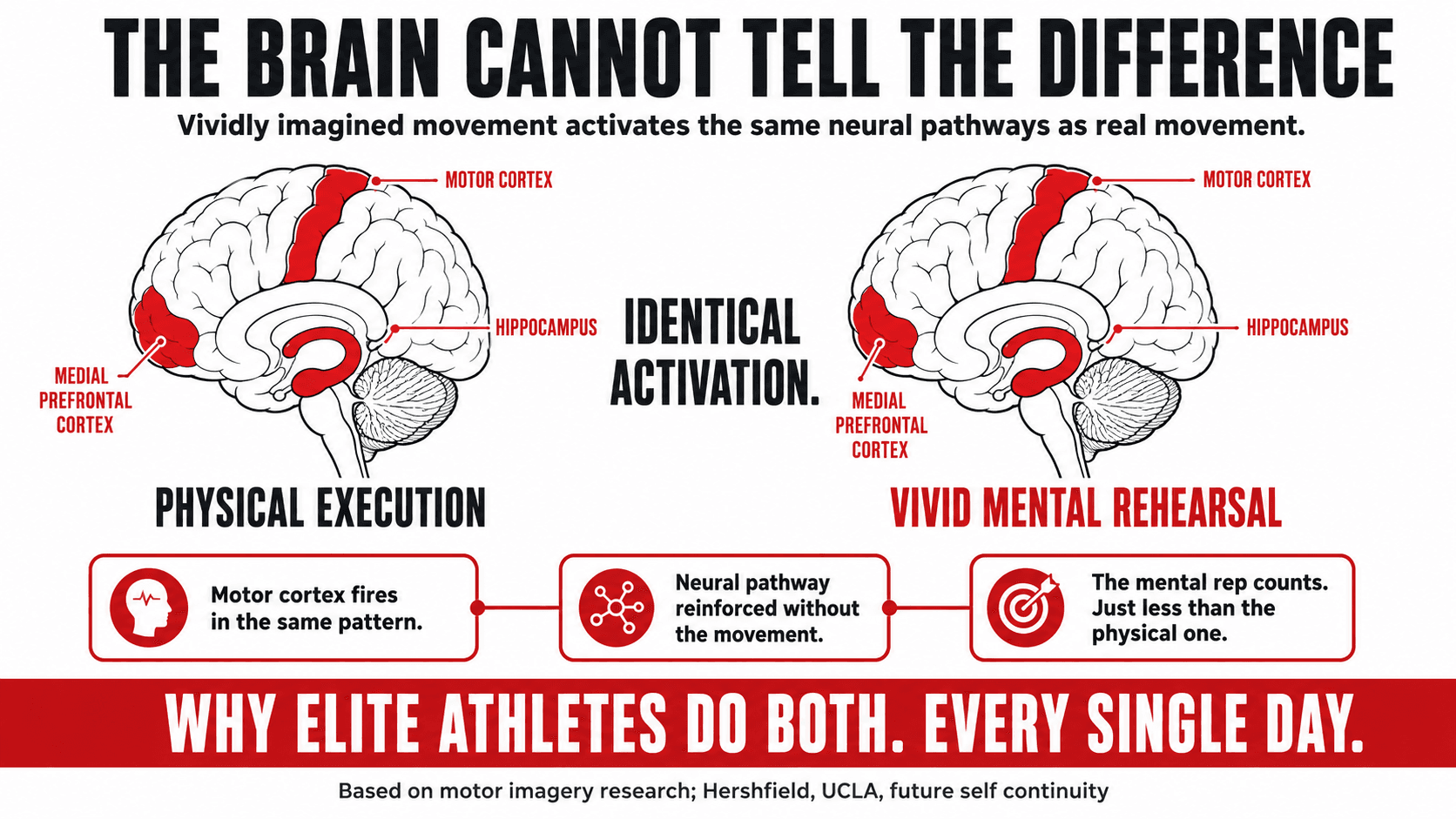
The neuroscience behind future self projection is built on a principle that is both counterintuitive and well-established: the brain does not distinguish reliably between a vividly imagined future experience and a real one when the imagined experience is constructed with sufficient sensory and emotional specificity. The same neural architecture that processes present perception also generates prospective cognition, the mental simulation of future states, and it does so using overlapping brain regions including the medial prefrontal cortex, the hippocampus, and the posterior parietal cortex (1).
Hal Hershfield's research on future self continuity at UCLA produced a finding with direct practical implications: people who feel a strong sense of psychological continuity with their future selves make meaningfully different decisions in the present than people who experience their future selves as strangers. When participants were shown digitally aged photographs of themselves and asked to make financial or health decisions, those who had been exposed to their future self image allocated significantly more resources toward long-term outcomes and made choices more consistent with future wellbeing. The future self, made vivid and personally proximate, changed present behaviour without any change in information, motivation, or programme (2).
Motor imagery research in elite sport provides the most compelling evidence for the neurological reality of vivid mental simulation. Studies using functional MRI have shown that when an athlete mentally rehearses a physical movement with sufficient vividness and precision, the motor cortex activates in patterns closely mirroring those produced by actual physical execution of the movement. The neural pathway is being reinforced without the movement taking place. Repeated mental rehearsal accelerates skill acquisition, improves competitive execution, and reduces performance anxiety because the brain has, in a neurologically meaningful sense, already done the thing it is being asked to do (3).
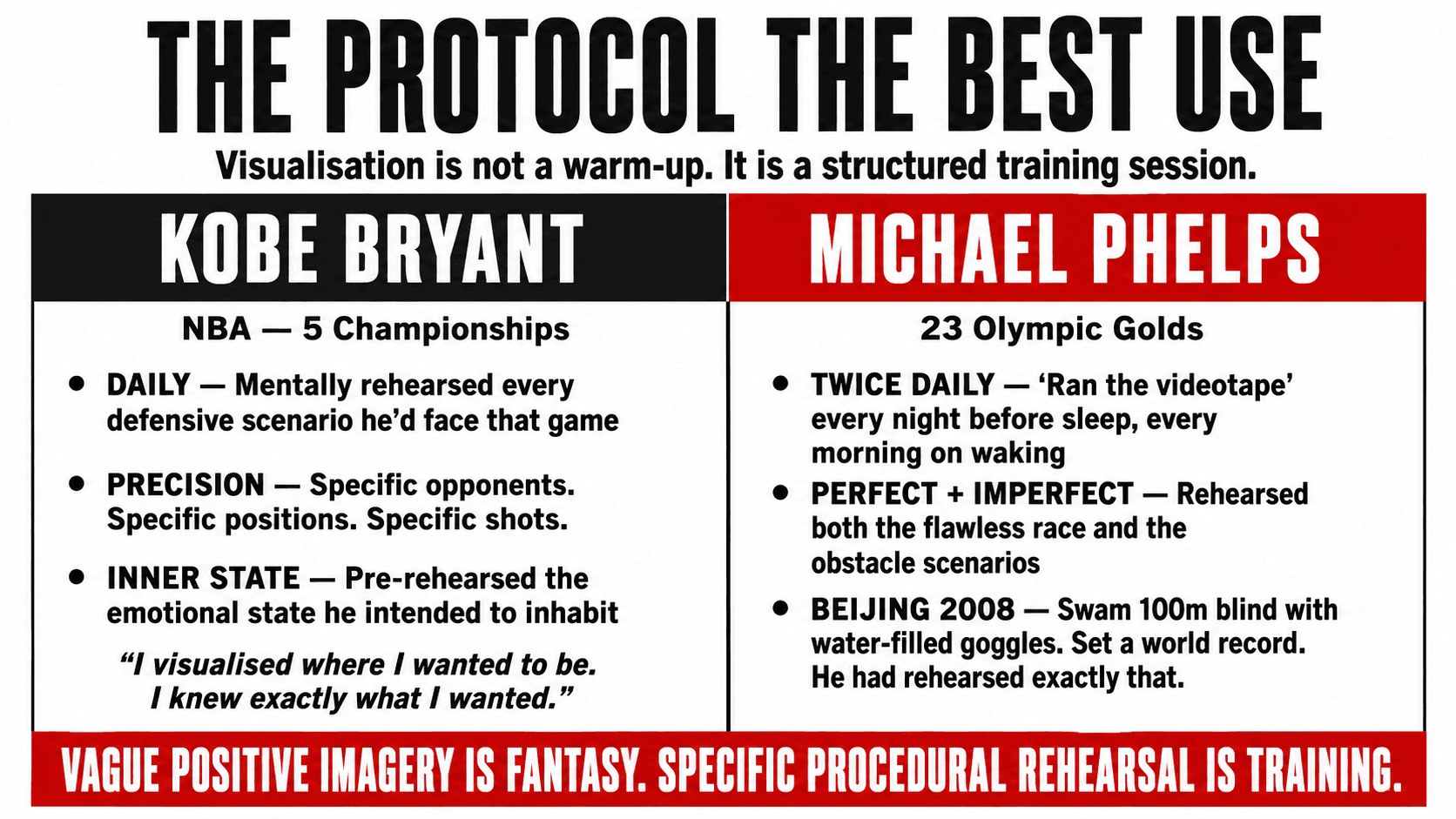
“I visualised where I wanted to be, what kind of player I wanted to become. I knew exactly what I wanted, and I worked every single day to get there.”
— Kobe Bryant
Kobe Bryant and Michael Phelps: How Elite Athletes Use Future Self Projection in Practice
Kobe Bryant's approach to visualisation was not a warm-up exercise or a motivational ritual. It was a structured daily practice in which Bryant mentally rehearsed, with extreme precision, specific situations he would encounter in that day's game or training session. He visualised defensive scenarios he would face from specific opponents, his own movement patterns in response to them, the precise mechanics of specific shots from specific positions, and the emotional state he intended to inhabit during competition. The mental rehearsal was the training session before the training session, and Bryant treated its quality with the same seriousness he applied to physical preparation.
Bob Bowman, Michael Phelps's long-time coach, designed a visualisation protocol that Phelps practiced from early adolescence throughout his career. Bowman instructed Phelps to run what he called the videotape every night before sleep and every morning on waking: a complete, precise mental rehearsal of the perfect race, from the moment of stepping onto the block through every stroke, every turn, every breath, to the finish. The rehearsal was run in two directions — the perfect race and the imperfect race with unexpected obstacles, including a goggle failure mid-race. When Phelps's goggles filled with water at the 2008 Beijing Olympics, he swam the last one hundred metres of his race blind and set a world record. He had rehearsed exactly that scenario (4).
What both examples demonstrate is that elite-level future projection is not vague positive imagery of success. It is specific, procedural, emotionally inhabited mental rehearsal of precisely defined future states, practiced with the same consistency and rigour as physical training. The quality of the mental image determines the quality of the neural reinforcement. A vague future self produces a vague navigational pull. A specific, emotionally vivid future self produces a precise and powerful one.
Key Insight: The difference between a future self that changes your behaviour and one that does not is almost entirely a question of specificity and emotional vividness. A future self described as feeling fitter and more confident is too vague to generate meaningful navigational pull. A future self that you can see clearly, whose daily energy you can feel, whose physical capability you can inhabit in imagination, and whose relationship with their body you can experience emotionally is neurologically real enough to function as a genuine present-tense driver of decisions.
The Future Self Timeline: From Who You Are Now to Who You Are Becoming
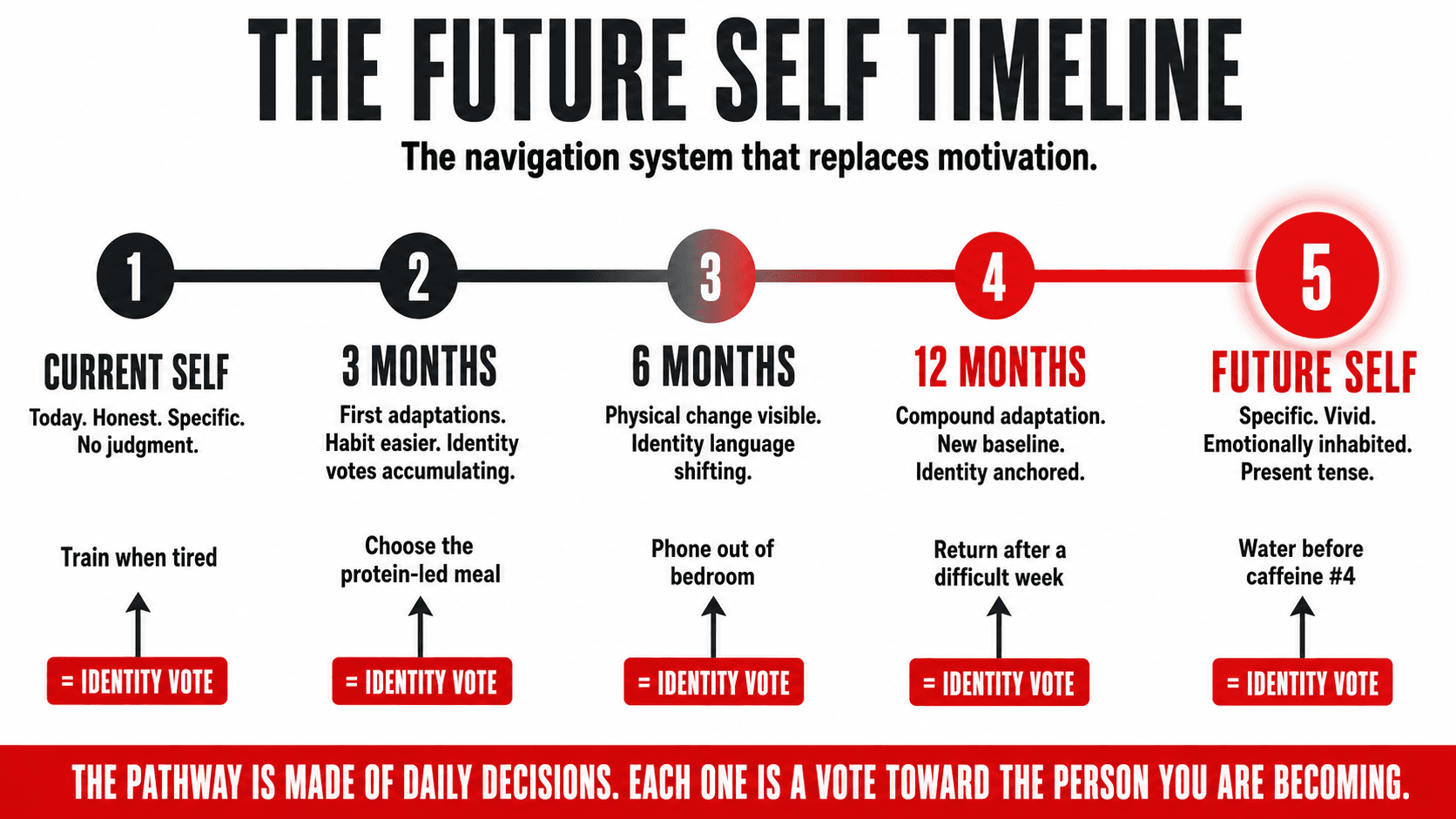
The future self projection exercise works through a structured timeline that makes the journey from present to future self concrete, specific, and neurologically accessible. It is not a visualisation of the destination alone. It is a complete construction of the pathway, the identity votes that compose it, and the daily decisions that constitute those votes.
Diagram: The Future Self Timeline — A Complete Projection from Present Self to Future Self
THE FUTURE SELF TIMELINE — The Navigation System That Replaces Motivation
CURRENT SELF
Today. Honest. Specific. No judgment about where you are starting.
3 MONTHS
First visible adaptations. Energy shifting. The habit becoming easier. First identity votes accumulating.
6 MONTHS
Physical change visible. Habit architecture established. Identity language beginning to shift. Behaviour becoming automatic.
12 MONTHS
Compound physical adaptation. New baseline. Identity anchored. Others notice. Self-concept fundamentally shifted.
FUTURE SELF
Specific. Vivid. Emotionally inhabited. The person navigating toward. Described in present tense.
THE PATHWAY IS MADE OF DAILY DECISIONS — Each decision is an identity vote toward or away from the future self
Daily Decision
Train when tired instead of skipping
Identity Vote
I am someone who shows up regardless of how I feel
Future Self Frame
The future self does not negotiate with tiredness. They train because it is who they are, not because they feel like it today.
Daily Decision
Choose the protein-led meal over the convenient one
Identity Vote
I am someone who fuels their body with intention
Future Self Frame
The future self does not experience this as a sacrifice. They experience it as an expression of who they are and what they are building.
Daily Decision
Go to bed when the phone is still interesting
Identity Vote
I am someone who prioritises recovery as a performance variable
Future Self Frame
The future self understands that sleep is not a passive default. It is the most important training session of the day.
Daily Decision
Return to the programme after a difficult week without drama
Identity Vote
I am someone whose consistency is not conditional on perfect circumstances
Future Self Frame
The future self does not attach self-worth to a week's performance. They return because quitting is inconsistent with who they are.
Daily Decision
Drink water before reaching for caffeine number four
Identity Vote
I am someone who manages my physiology intelligently
Future Self Frame
The future self reads the signal correctly. Not laziness. Not caffeine deficiency. Dehydration. Addressed simply.
The Specificity Problem: Why Most Future Self Projections Fail to Generate Navigational Pull
Gabriele Oettingen's research on positive fantasy and goal achievement identified a finding that initially seems paradoxical: people who spend the most time visualising positive future outcomes in a vague and pleasurable way are actually less likely to achieve them than people who do not visualise at all. The mechanism is what Oettingen calls positive fantasising: the pleasant imagery of a desired future produces a neurological response that mimics the reward of achieving that future, thereby reducing the motivational drive to actually pursue it. The brain experiences a version of the destination without the journey (5).
The effective alternative, which Oettingen calls WOOP (Wish, Outcome, Obstacle, Plan), combines a specific positive future with a clear-eyed acknowledgment of the obstacles that stand between present and future and a concrete if-then plan for navigating them. The effectiveness of WOOP over vague positive visualisation has been demonstrated across multiple domains including health behaviour, academic performance, and interpersonal relationships. The obstacle-awareness component is the critical addition: it prevents the pleasant imagery from substituting for the work while still harnessing the motivational power of the vivid future image (5).
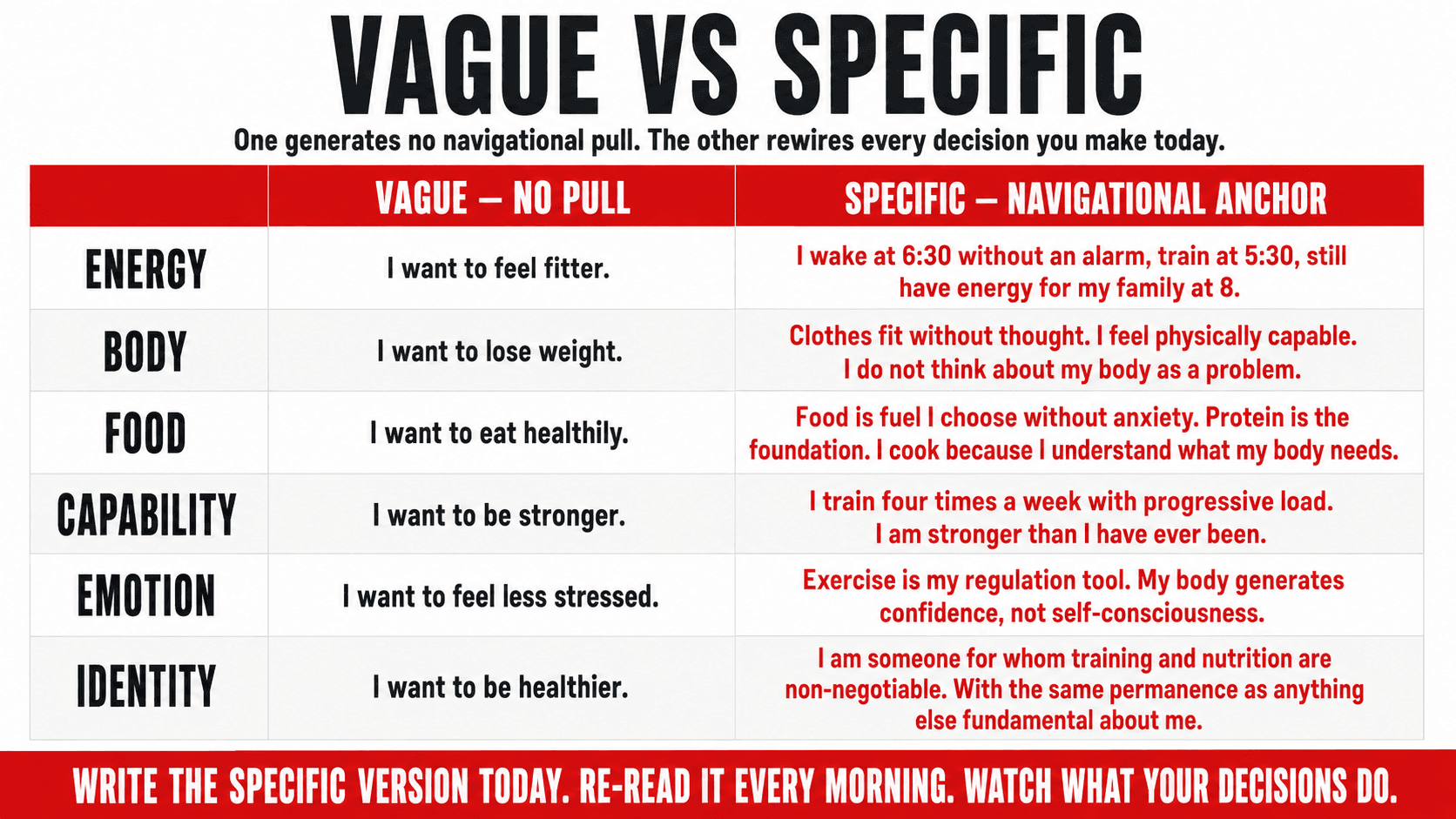
| Domain | VAGUE (No navigational pull) | SPECIFIC (Genuine navigational anchor) |
|---|---|---|
| Physical energy | I want to feel fitter and have more energy. | I wake at 6:30am without an alarm feeling genuinely rested. I move through the day without the 3pm crash I currently experience. I train at 5:30pm and still have energy for my family afterward. I am not tired by 8pm. |
| Body composition | I want to lose weight and feel better about how I look. | I am at a weight that makes movement easy and comfortable. My clothes fit well without deliberate attention to it. I feel physically capable rather than physically limited. I do not think about my body as a problem. |
| Relationship with food | I want to eat healthily and stop craving junk food. | Food is fuel I choose with intelligence and without anxiety. I enjoy meals. I do not restrict or binge. I cook regularly because I understand what my body needs. Protein is the foundation of how I eat, not an afterthought. |
| Physical capability | I want to be stronger and fitter. | I train four times per week with progressive load. I can carry my own bodyweight through functional movements. I am stronger than I have ever been. My cardiovascular fitness means physical challenges that used to exhaust me now feel manageable. |
| Emotional state | I want to feel more confident and less stressed. | I manage pressure without it accumulating into chronic stress. Exercise is my primary regulation tool and it works. My relationship with my body generates confidence rather than self-consciousness. I am not anxious about my health. |
| Identity | I want to be a healthier person. | I am someone who takes their health seriously as a non-negotiable. Training and nutrition are not things I do when motivated. They are part of who I am, with the same permanence as any other fundamental aspect of my identity. |
The specific version is written in present tense because the future self is not a fantasy being wished for. It is a person being inhabited in imagination, with enough sensory and emotional detail to generate real navigational pull toward it.
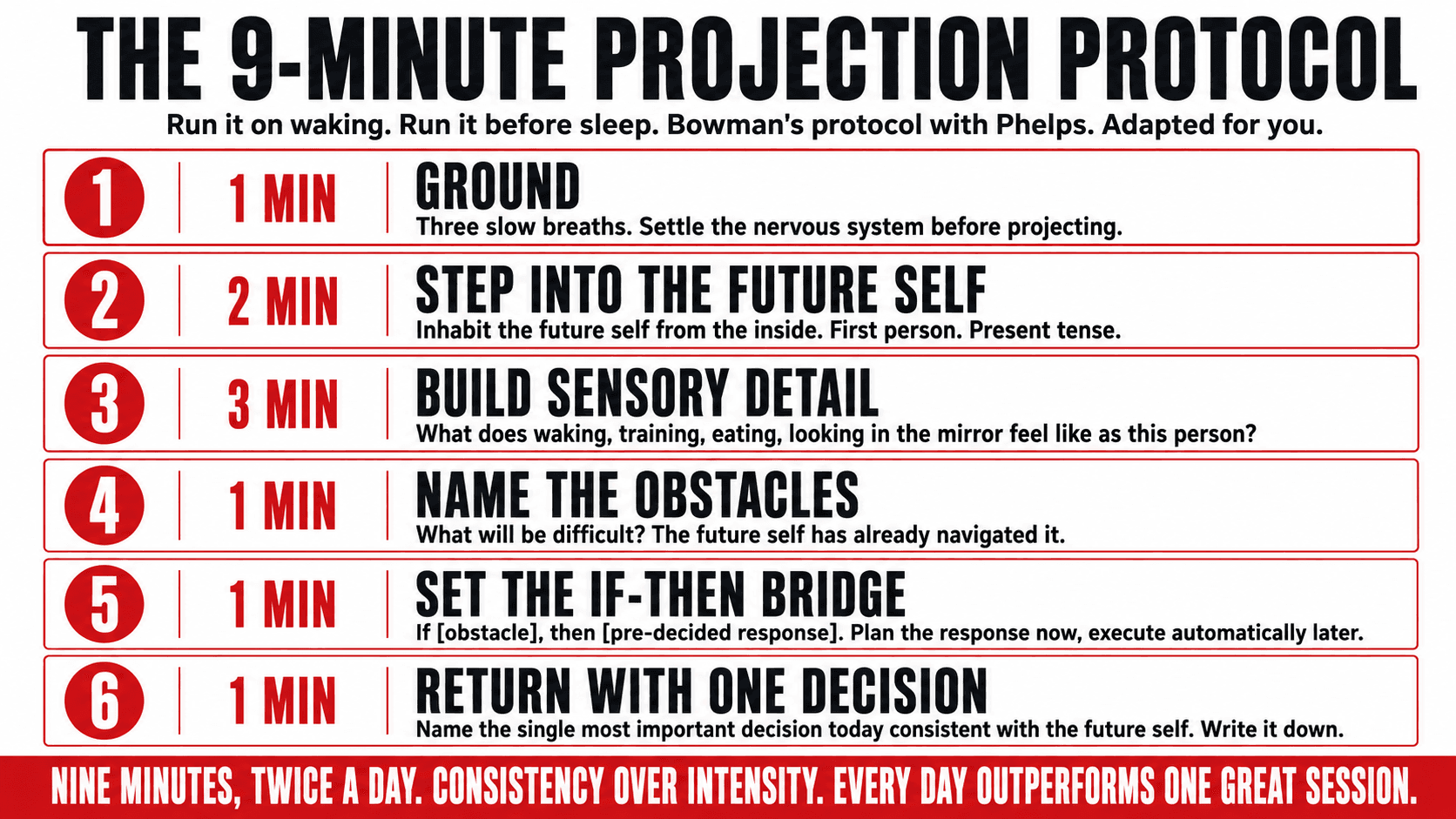
The Practical Visualisation Protocol: How to Build and Use a Future Self Projection Daily
The visualisation protocol I share here draws from Bob Bowman's work with Michael Phelps, Gabriele Oettingen's WOOP research, and the broader evidence base on mental rehearsal in elite sport. It is not complicated. It is specific. And like every habit discussed in this series, its effectiveness is proportional to the consistency with which it is practiced rather than to the intensity of any single session.
| Phase | Duration | The Practice | Neurological Purpose |
|---|---|---|---|
| 1. Ground | 1 min | Sit or lie quietly. Three slow breaths. Eyes closed. Allow the body to settle and the mental noise to reduce before beginning. This is not optional. The quality of the projection depends on the quality of the attentional state entering it. | Activates parasympathetic nervous system. Reduces cortisol. Creates the conditions for deliberate prospective cognition rather than anxious future-worrying. |
| 2. Step into the future self | 2 min | Move mentally to a point in the future that feels specific and real: six months, twelve months, or two years from now. You are not watching yourself from the outside. You are inhabiting the future self from the inside. First person. Present tense. What do you notice first about being this person? | Activates the same neural regions as first-person present experience. The medial prefrontal cortex generates the simulation using memory and imagination simultaneously. |
| 3. Build the sensory detail | 3 min | Inhabit the future self across multiple sensory dimensions. What does waking in this body feel like? What is different about your energy at midday? What does training feel like now that it is simply what you do? What do you feel when you look in the mirror? Build the image layer by layer until it has genuine sensory weight. | Sensory specificity increases neural activation. The more modalities engaged — kinaesthetic, visual, emotional — the stronger the neural reinforcement of the target identity. |
| 4. Name the obstacles | 1 min | Bring to mind the two or three most likely obstacles that stand between present self and future self. Not to catastrophise — to prepare. What will be difficult? What will tempt abandonment? The future self has already navigated these. What did they do? | Oettingen's research confirms this step transforms pleasant imagery into implementation-ready motivation. Obstacle awareness prevents the visualisation from becoming a substitute for the work. |
| 5. Set the if-then bridge | 1 min | For each obstacle identified, formulate a specific if-then response: if I feel too tired to train on Thursday, then I will change into kit and commit only to ten minutes. If the social occasion makes the healthy choice difficult, then I will eat the protein component first and make one deliberate choice from the menu. | Implementation intentions formed in advance produce significantly higher rates of behaviour execution than general motivation alone. The prefrontal cortex plans now so the basal ganglia can execute automatically later. |
| 6. Return with one decision | 1 min | Return to the present. Ask: what is the single most important decision I will make today that is consistent with the future self I just inhabited? Name it specifically. Write it down. That decision is the identity vote for today. | Grounds the visualisation in immediate action. The future self projection generates motivational fuel. The daily decision converts it into the daily habit vote that builds the pathway. |
Total time: 9 minutes. Practice on waking and before sleep. The two-session daily repetition matches Bowman's Phelps protocol and the evidence base on mental rehearsal frequency. Consistency over intensity. Nine minutes every day outperforms forty-five minutes once a week.
The Cost of the Absent Future Self: Why Vague Goals Run Out of Fuel
The most common pattern I see in people who have cycled through health programmes without sustaining change is not a failure of programme quality or nutritional knowledge. It is the absence of a compelling future self. They have goals, often very specific ones with numbers and timelines attached. But they do not have a future person they are navigating toward. When the goal is reached, or when the gap to it seems too large, the driver disappears. There is nothing on the other side of the number that is pulling them through the difficult weeks.
Hershfield's research makes the mechanism visible. When we experience our future selves as strangers, we treat our present decisions toward them with the same indifference we would apply to decisions about a stranger's welfare. We sacrifice the future self's health for the present self's convenience without registering that we are making a meaningful trade-off. When the future self is vivid, specific, and emotionally proximate, it becomes impossible to betray them with the same ease. The present self begins to feel the future self's investment as something worth protecting (2).
I have watched clients who had failed repeatedly at the same goals sustain significant health transformations after a single focused session in which we constructed the future self in sufficient detail for it to become neurologically real. Not the goal. The person. The energy of that person. The way that person moves through a day. The relationship that person has with their body. The future self projection was not the only element of the work. But it was the element that made everything else cohere into a direction rather than a list of tasks.
Key Insight: Write your future self description today. Not a goal list. A person description, written in present tense, twelve months from now. Cover physical energy, body composition, relationship with food, physical capability, emotional relationship with your health, and identity. Make it specific enough that you could recognise yourself in it if you encountered this person. Then re-read it every morning for a week. Notice what changes in the decisions you make.
How Future Self Work Runs Through Every Programme I Build
The future self conversation is one of the first structured exercises I do with a new client, and it informs the design of everything that follows. The training programme I build is not designed in isolation from the future self. It is designed to produce the physical adaptations that make the future self real. The nutritional strategy is not a generic prescription. It is a protocol designed to fuel the specific person the client is becoming.
When a client is in a difficult week and motivation is low, the conversation is not about the programme. It is about the future self. What would that person do this week? The answer is almost never to abandon the programme. It is to modify one variable, maintain the non-negotiables, and return to full execution when the difficult week has passed. The future self provides a stable reference point that outlasts any single bad week, any plateau, any disruption to the external motivation that drove the initial commitment.
If you are ready to build something more durable than a goal, I work with clients one-to-one online globally. The future self conversation is where that work begins. Not because it is philosophically appealing, but because the evidence is clear on what separates the people who transform from the people who cycle: the people who transform know exactly where they are going, and they know it in a way that is specific enough to navigate by.
Work with Me
Get a personalised coaching plan built around your goals, your schedule, and your life.
Enquire NowReferences
- Schacter DL, Addis DR, Buckner RL. Remembering the past to imagine the future: the prospective brain. Nature Reviews Neuroscience. 2007; 8(9): 657–661.
- Hershfield HE, Goldstein DG, Sharpe WF, et al. Increasing saving behavior through age-progressed renderings of the future self. Journal of Marketing Research. 2011; 48(SPL): S23–S37.
- Guillot A, Collet C. Construction of the motor imagery integrative model in sport: a review and theoretical investigation of motor imagery use. International Review of Sport and Exercise Psychology. 2008; 1(1): 31–44.
- Bowman B, Randall M. No Limits: The Will to Succeed. London: Simon and Schuster; 2008.
- Oettingen G. Rethinking Positive Thinking: Inside the New Science of Motivation. New York: Current; 2014.
- Gollwitzer PM, Sheeran P. Implementation intentions and goal achievement: a meta-analysis of effects and processes. Advances in Experimental Social Psychology. 2006; 38: 69–119.
- Clear J. Atomic Habits: An Easy and Proven Way to Build Good Habits and Break Bad Ones. London: Random House Business; 2018.