
The Story You Have Been Told About Talent Is Wrong
Grit and perseverance in health are the qualities that separate the people who transform from the people who cycle. Not talent. Not genetics. Not the right programme appearing at the right moment. Not a burst of motivation so powerful it overcomes every obstacle. The people who produce the most significant and lasting changes to their health and physical capability are, with very few exceptions, not the most naturally gifted or the most intensely motivated. They are the ones who stayed. Who showed up on the unremarkable days. Who did not mistake a plateau for a ceiling or a difficult week for evidence that the effort was pointless.
I have watched talented people with excellent physical potential produce mediocre long-term results because they trained with intensity only when motivated and abandoned programmes at the first sign of difficulty. I have watched people who arrived with significant disadvantages in starting point, in time availability, in metabolic profile, and in fitness history produce transformations that were, by any measure, remarkable, because they applied consistent effort across a sufficient period with a willingness to stay in the process without demanding the results on their own timeline.
Angela Duckworth spent years studying what predicts success in challenging endeavours and arrived at a conclusion that the talent-centric culture of sport, business, and health refuses to fully accept: across virtually every domain studied, the single strongest predictor of exceptional achievement is not intelligence, talent, or aptitude. It is grit: the combination of passion for a long-term goal and the perseverance to pursue it consistently over time, through setbacks, plateaus, and the inevitable periods when the effort-to-result ratio feels deeply unfair (1).
What Duckworth Actually Found: The Research Behind Grit
Duckworth's research began with a simple observation: the most successful cadets at West Point Military Academy, the most effective teachers in challenging schools, the highest-achieving salespeople, and the finalists in the National Spelling Bee were not the most talented in their respective domains. They were the ones who persisted. She developed the Grit Scale, a validated psychometric instrument measuring passion and perseverance for long-term goals, and found that Grit Scale scores predicted outcomes more reliably than IQ, talent assessments, or standardised test scores across multiple high-challenge settings (1).
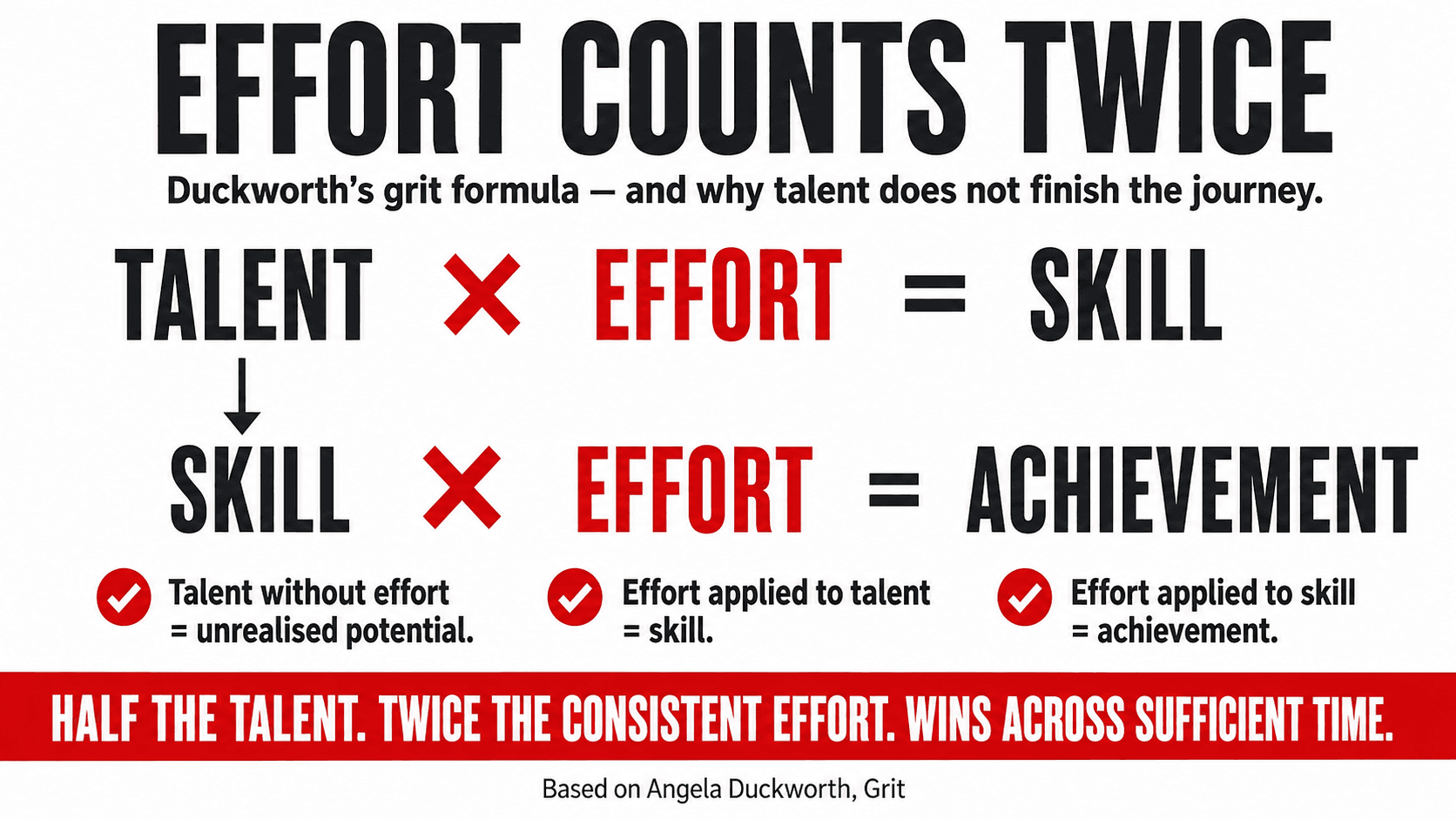
The formula Duckworth proposed is deceptively simple: Achievement equals talent multiplied by effort. Then achievement equals skill multiplied by effort again. In this formulation, effort counts twice. Talent without effort produces unrealised potential. Effort applied to talent produces skill. Effort applied to skill produces achievement. The person with half the natural talent of their competitor but twice the consistent effort will, across sufficient time, produce greater achievement. This is not an inspirational metaphor. It is a mathematical description of how capability compounds over time under consistent application (1).
“Enthusiasm is common. Endurance is rare.”
— Angela Duckworth, Grit
Matthew Syed's Bounce arrives at the same conclusion from a different investigative route. Syed, a former world-class table tennis player, examined the biographical histories of elite performers across multiple disciplines and found that exceptional performance was almost universally preceded by an exceptional volume of practice in a specific environment, often in early life, that was available to the performer through circumstance rather than through superior talent. The suburb of Reading in which Syed grew up happened to produce a disproportionate share of elite English table tennis players not because of genetic clustering but because of proximity to a specific coach with a specific facility available at a specific time. The talent was practice in disguise (2).
Anders Ericsson's research on deliberate practice, which Malcolm Gladwell popularised as the ten-thousand-hour rule in Outliers, provides the mechanistic explanation for why extended sustained practice produces such dramatic capability improvements. Ericsson's original finding, which Gladwell's simplified version partially obscures, is more nuanced and more practically useful: it is not simply the hours of practice that produce expertise. It is the quality and structure of those hours. Deliberate practice, practice that operates at the outer edge of current capability with focused attention and immediate feedback, produces skill acquisition at a rate that unstructured repetition alone cannot match (3).
Key Insight: Duckworth's grit formula applied to health: the person who trains with moderate intensity four times per week, every week, for two years, will produce more significant physical adaptation than the person who trains at maximum intensity for three weeks, takes a month off, repeats. Effort counts twice in the formula. But the effort that counts is sustained effort over time, not peak effort in a single session.
The Talent vs Grit Trajectory: What the Long Game Actually Looks Like Across Ten Years
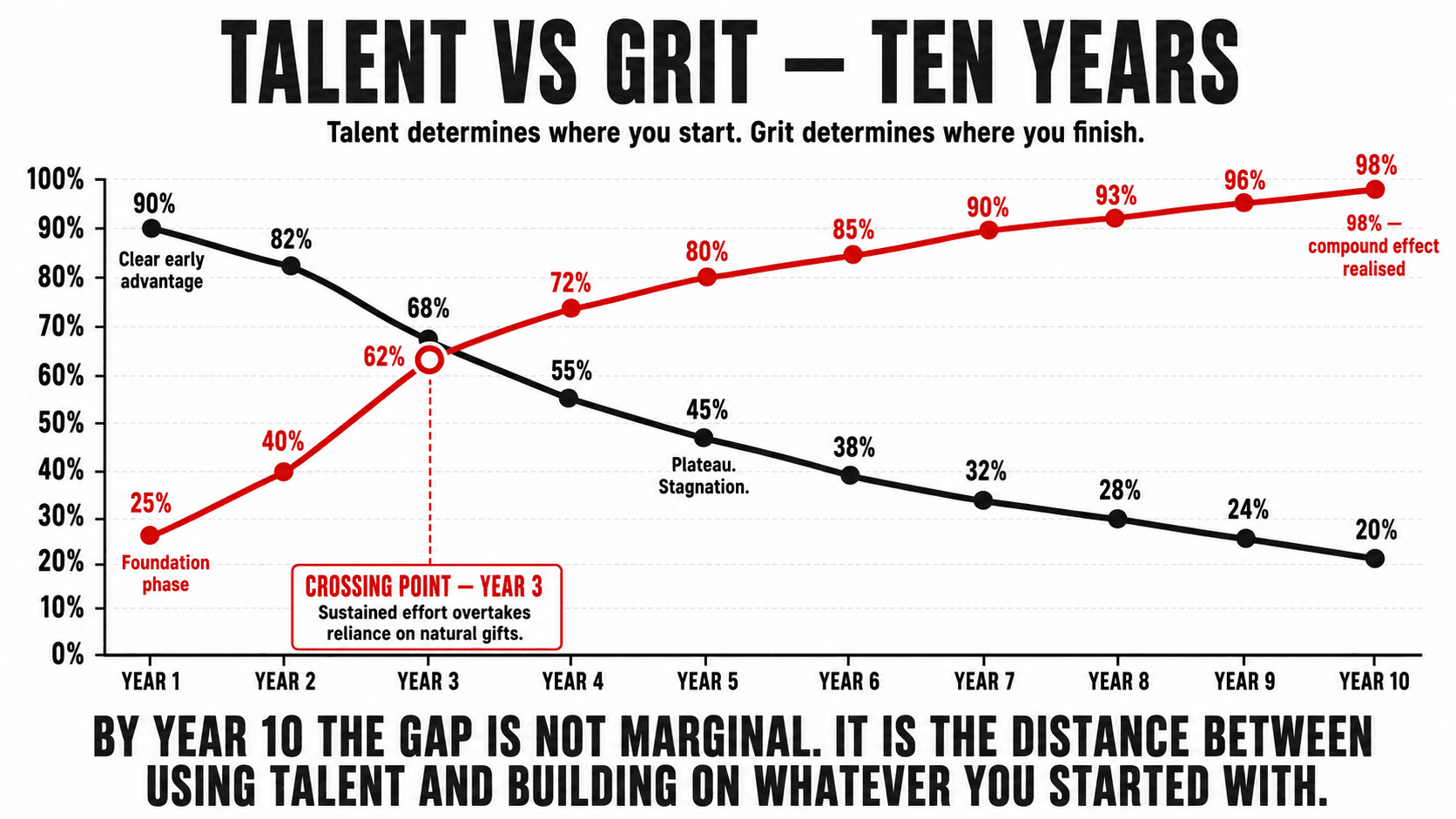
The most important thing to understand about the relationship between talent and grit across time is what the graph of each looks like at different points in the journey. At year one, talent looks like a significant advantage. The naturally gifted person adapts faster, achieves better early results, and requires less effort to produce visible change. The less gifted but more persistent person is still in the foundation-building phase, accumulating consistency without yet seeing the compound return.
By year three, the trajectories have approached each other. The talented person who relies on talent rather than systematic effort has plateaued at a level that their natural gifts could carry them to without demanding more. The persistent person has continued compounding. By year five, the lines have crossed. By year ten, the distance between them is not marginal. It is the distance between someone who used their talent and someone who built on whatever they started with for a decade.
Diagram: Talent vs Grit — Two Trajectories Across Ten Years of Health and Fitness Commitment
TALENT vs GRIT — Two Trajectories Across Ten Years — Same Starting Year, Different Approaches
| Year | HIGH NATURAL TALENT — Relies on gifts, inconsistent effort | AVERAGE STARTING TALENT — Consistent deliberate effort, grit-driven | Commentary |
|---|---|---|---|
| Yr 1 | 90% | 25% | Talent has clear early advantage. Grit is building foundation. |
| Yr 2 | 82% | 40% | Talent plateau begins. Grit approaching steadily. |
| Yr 3 | 68% | 62% | CROSSING POINT — Sustained effort overtakes reliance on natural gifts. |
| Yr 4 | 55% | 72% | Grit pulls ahead. Talent gap becomes visible. |
| Yr 5 | 45% | 80% | Compound effect of consistent practice accelerates. Talent stagnates. |
| Yr 7 | 32% | 90% | Gap is now significant. Different results from same starting period. |
| Yr 10 | 20% | 98% | Decade of deliberate consistent effort. The long game decided here. |
Talent determines where you start. Grit determines where you finish. These two facts are not equally important over a ten-year health journey. The second one dominates the first by a margin that is not even close.
Why Most People Quit Precisely When They Are Closest to Breakthrough
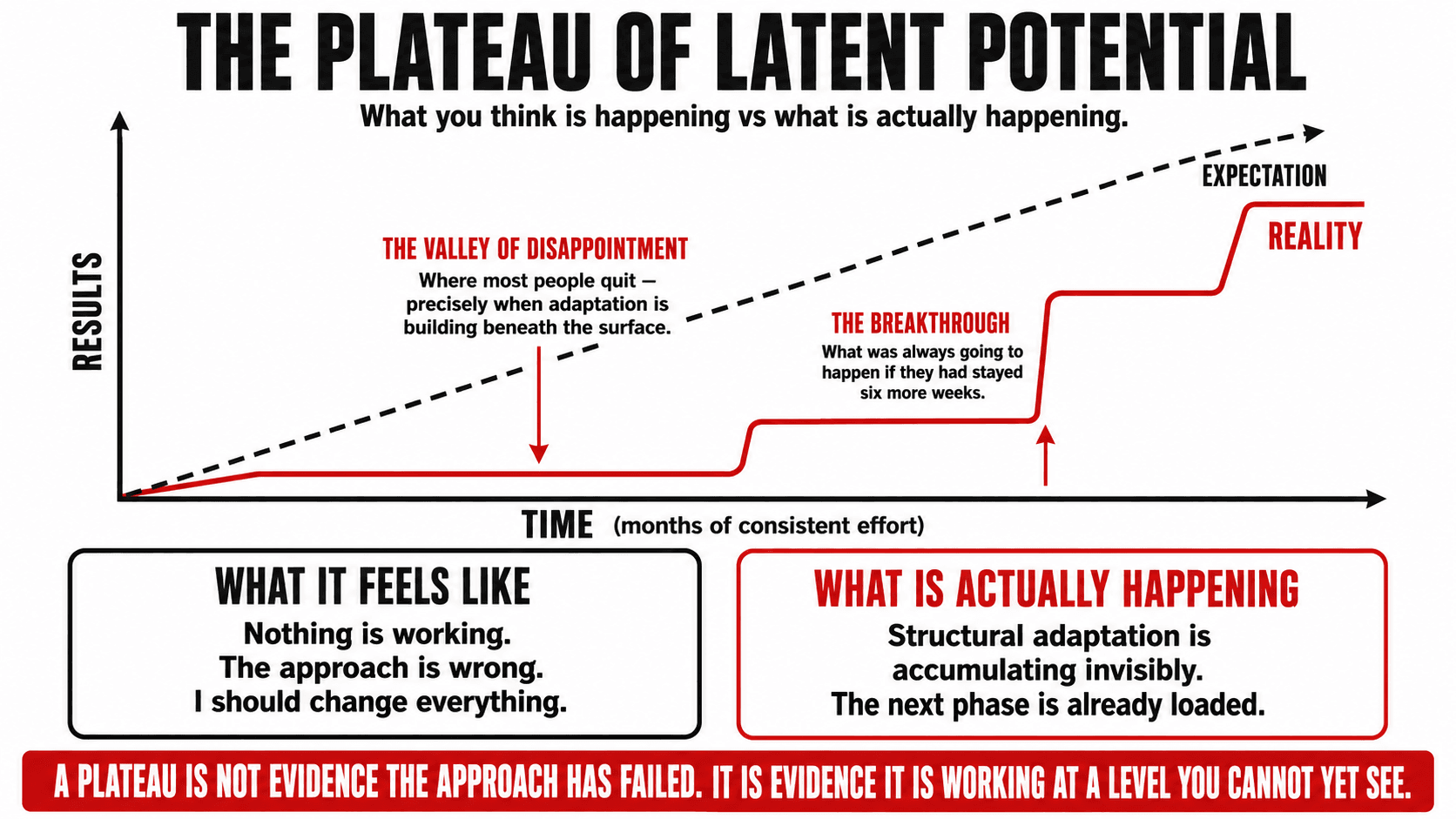
The plateau of latent potential is the name James Clear gives to the phenomenon that Duckworth's grit research makes visible from a different angle: the period in any skill acquisition or physical adaptation process during which effort is accumulating invisibly beneath the surface, results are not yet visible, and the temptation to conclude that the effort is not working is at its highest. This is the most dangerous period in any health transformation, and it is also, by a cruel irony of adaptation physiology, the period that immediately precedes the most significant visible results (4).
Physical adaptation does not occur linearly. Muscle does not grow at a steady, visible rate across every week of training. Cardiovascular capacity does not improve in uniform increments that are perceivable from session to session. Body composition does not shift by a measurable amount every seven days. Adaptation occurs in waves, with long periods of consolidation during which the body is making structural changes that are real but not visible on the scale or in the mirror. The person who stops training during a consolidation period does not simply pause their progress. They dismantle the structural foundation that was about to produce the next visible breakthrough.
Syed describes the same dynamic in talent development: the most critical period in the development of any high performer is the extended stretch in which they are working hard, applying deliberate practice, and not yet producing results that would indicate to an outside observer that exceptional performance is being built. This is when the people who rely on external validation quit and the people with grit stay. What they are staying for is not the motivation to keep going. They are staying because quitting is inconsistent with who they are (2).
“The separation of talent and skill is one of the greatest misunderstood concepts for people who are trying to excel. Talent you have naturally. Skill is only developed by hours and hours and hours of beating on your craft.”
— Will Smith
Key Insight: If you are currently in a plateau, the single most useful piece of information I can give you is this: a plateau is not evidence that the approach has stopped working. It is evidence that the approach is working at a level that has not yet manifested in the metrics you are measuring. Change one variable, log it, and stay for another six weeks before drawing any conclusions. The six weeks after the plateau decision are almost always the most productive of the entire programme.
Deliberate Practice vs Naive Practice: Why Repetition Alone Is Not Enough
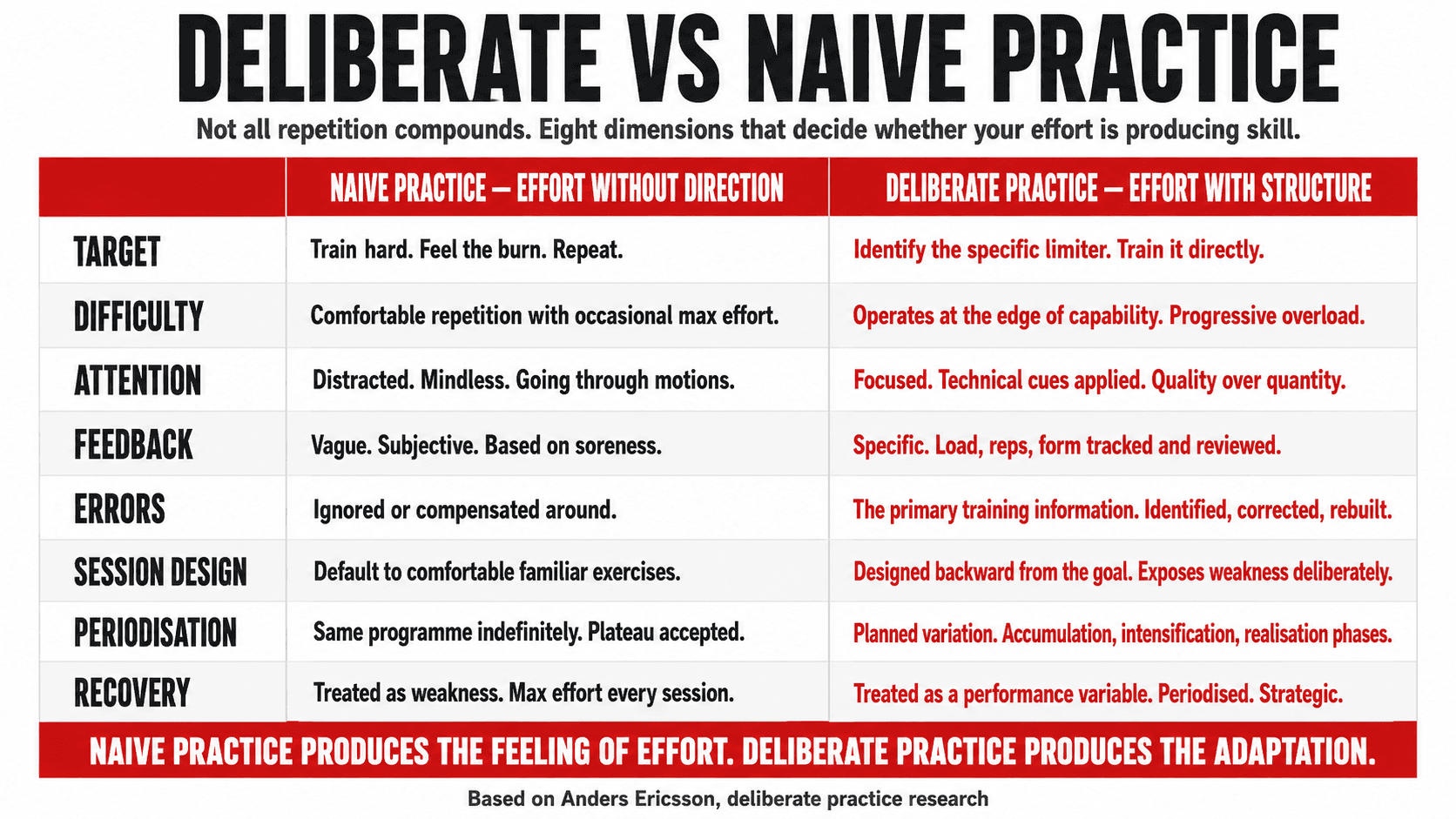
Ericsson's research on deliberate practice is the most important refinement of the simple repetition argument. Not all practice is equal. The violinists at the Berlin Academy of Music that Ericsson studied were not separated in their level of achievement by hours of practice alone. They were separated by the quality and structure of those hours. The elite performers practiced in a specific way: at the outer edge of their current capability, with focused attention on the specific elements most requiring improvement, with immediate feedback on performance, and with deliberate correction of errors. The average performers practiced in a way that felt productive but kept them largely within the zone of comfortable competence (3).
The distinction between deliberate and naive practice is critical for health and fitness because the fitness industry has a significant incentive to make exercise feel difficult without necessarily making it productive. A session that produces maximal discomfort without progressive overload on the specific physical qualities being developed is naive practice. It feels like hard work and produces the hormonal signature of exertion. But it does not produce the specific adaptations that compound into meaningful capability over time.
| Principle | NAIVE PRACTICE (Effort without direction) | DELIBERATE PRACTICE (Effort with structure) |
|---|---|---|
| Target | Train hard. Feel the burn. Sweat a lot. Finish exhausted. Repeat same session. | Identify the specific physical quality most limiting current performance. Design sessions to target it precisely. |
| Difficulty level | Oscillate between comfortable repetition and occasional maximum effort with no systematic progression. | Operate consistently at the edge of current capability. Progressive overload applied systematically. Neither too easy nor too hard. |
| Attention quality | Mindless repetition. Distracted by phone, music, conversation. Going through the motions. | Full focused attention on the specific element being trained. Technical cues applied consciously. Quality over quantity. |
| Feedback | Vague. Based on subjective feeling of effort or soreness. No objective measurement of performance. | Specific. Load, reps, pace, and form tracked and reviewed. Weak points identified and addressed session to session. |
| Error response | Ignore errors or compensate through poor mechanics. Move the body around the weakness rather than through it. | Errors are the primary training information. Identify the specific technical failure, reduce load, correct the pattern, rebuild. |
| Session design | Default to comfortable familiar exercises. Avoid the movements that expose weakness or require technical learning. | Sessions designed backward from the goal: what does the target capability require, and which exercises most specifically develop it? |
| Periodisation | Same programme indefinitely. No planned variation in intensity, volume, or focus. Plateau accepted as ceiling. | Planned variation in training stimulus across phases. Accumulation, intensification, and realisation phases structured deliberately. |
| Recovery | Treated as weakness or laziness. Maximum effort every session regardless of fatigue state. Overreaching without supercompensation. | Treated as a performance variable. Recovery quality determines the quality of adaptation. Periodised rest is part of the training plan. |
Naive practice produces the feeling of effort. Deliberate practice produces the adaptations that compound into capability. The difference between them, applied consistently over two years, is the difference between a person who feels like they train hard and a person whose body shows what two years of intelligent consistent work actually produces.
The Passion Component: Why Grit Without Direction Burns Out
Duckworth's grit construct is not simply perseverance applied blindly in any direction. It is the combination of passion and perseverance, and the passion component is where many people pursuing health goals create a structural problem. Passion in Duckworth's framework is not the Hollywood version: not a burning obsession with six-pack aesthetics or a competitive fixation on performance metrics. It is a stable, enduring interest in the domain, a genuine curiosity about what the body can do and who you can become within it. Without that genuine interest, the perseverance cannot be sustained because the internal fuel runs out before the timeline requires.
The health goals most likely to produce long-term grit are not the ones rooted in appearance-based fear or social comparison. They are the ones connected to something the person genuinely values: the energy to be fully present with their family, the physical capability to pursue activities they love, the metabolic health to reduce disease risk meaningfully, the strength to perform their work at the highest level. Goals rooted in genuine values have a renewable fuel source. Goals rooted in appearance anxiety have a finite one that runs out the moment the anxiety is temporarily resolved or the comparison target becomes unreachable.
Key Insight: Ask yourself honestly: why do you actually want to be healthier and fitter? Not the socially acceptable answer. The true one. The answer that still feels real at 6am on a cold Wednesday when no one is watching and nothing is convenient. That answer is the direction your grit needs to be pointed. If the answer is not compelling in that context, the goal needs reexamining before the programme does.
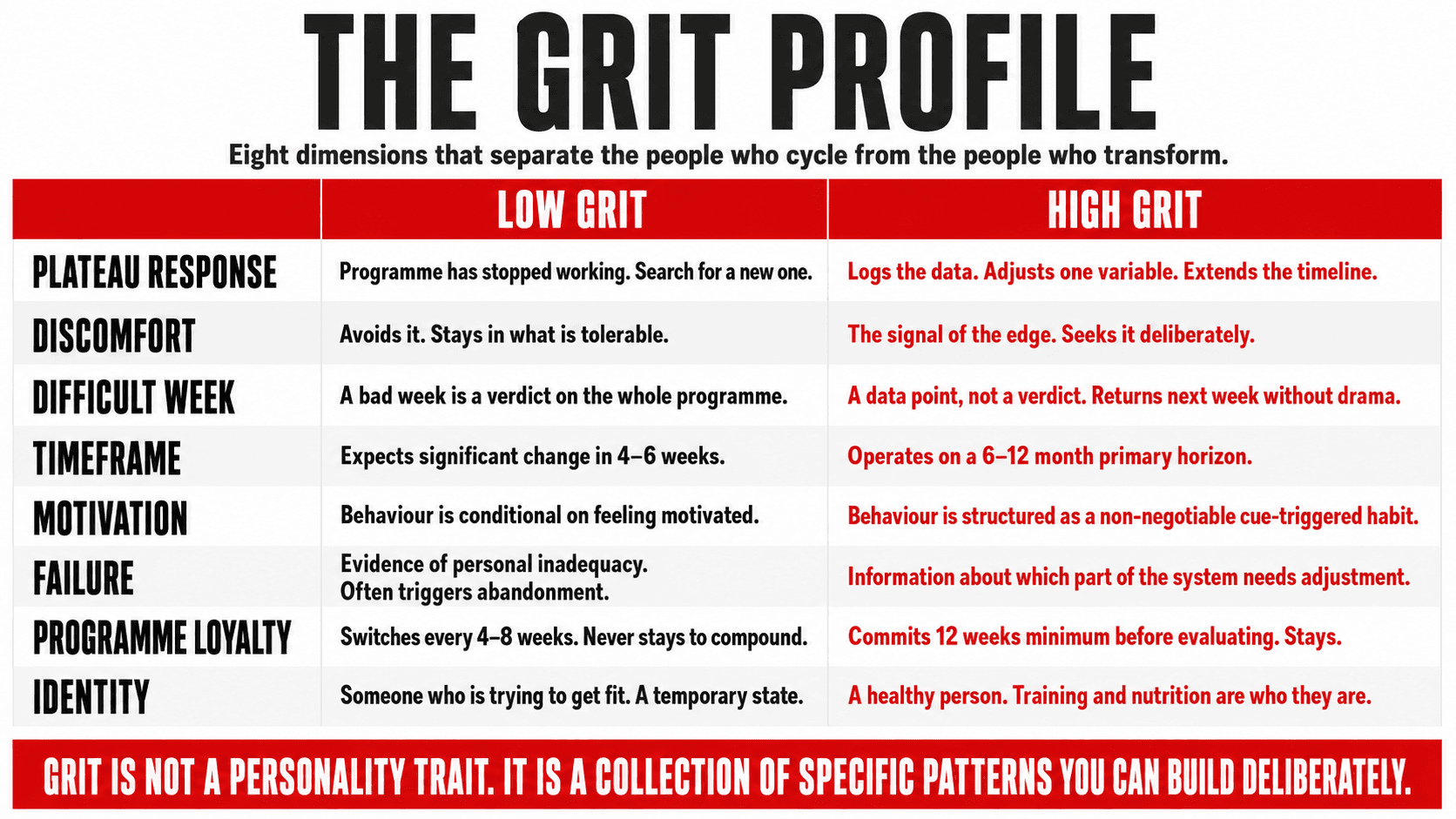
Low Grit vs High Grit in Health: What Each Profile Actually Looks Like
| Dimension | LOW GRIT PROFILE | HIGH GRIT PROFILE |
|---|---|---|
| Response to a plateau | Interprets absence of visible progress as evidence that the programme has stopped working or was wrong for them. Begins searching for a different approach. | Understands plateaus as a structural feature of adaptation. Logs the data, adjusts one variable, extends the timeline, and continues. |
| Relationship with discomfort | Avoids training modalities, food approaches, or lifestyle changes that feel uncomfortable. Defaults to what is known and tolerable. | Understands that productive discomfort is the signal that the edge of current capability is being approached. Seeks the edge deliberately. |
| Response to a difficult week | A bad week produces a narrative about inability to sustain the programme. Often leads to complete abandonment and a reset period. | A bad week is a data point, not a verdict. The minimum viable version of the programme is maintained. Full execution resumes the following week without drama. |
| Goal timeframe | Expects significant visible change within four to six weeks. If it has not arrived, the approach is judged to have failed. | Operates on a six to twelve-month primary horizon for significant body composition change. Measures weekly process metrics rather than weekly outcome metrics. |
| Motivation dependency | Training and nutritional adherence are conditional on feeling motivated. When motivation is absent, behaviour stops. | Training and nutrition are structured as non-negotiable habits triggered by specific cues. Motivation is welcomed but not relied upon. |
| Relationship with failure | A single failure — a missed session, a bad week of eating — is experienced as evidence of personal inadequacy and often triggers abandonment. | Failure is treated as information about which part of the system needs adjustment. Self-compassion applied to the failure, rigour applied to the fix. |
| Programme loyalty | Switches programme every four to eight weeks when early results plateau or a new approach is promoted. Never stays long enough to compound. | Commits to a programme for a minimum of twelve weeks before evaluating whether the approach requires adjustment. Distinguishes programme failure from adherence failure. |
| Long-term identity | Identifies as someone who is trying to get fit or is on a diet — temporary states requiring external maintenance. | Identifies as a healthy person whose training and nutrition are simply part of who they are, not performances that require motivation. |
Grit is not a fixed personality trait. It is a collection of specific cognitive and behavioural patterns that can be developed deliberately. The profiles above describe two different relationships with the process of building health, not two different types of person.
What the Short Game Has Cost You and What the Long Game Requires
Consider the cumulative cost of the short-game approach to health. Every programme started and abandoned. Every set of results that almost arrived before the approach was changed. Every plateau misread as a ceiling. Every return to a starting point that was worse than the last one because the repeated cycle of effort and abandonment has installed a narrative of inability that makes the next attempt harder before it begins.
I am not making a moral argument about persistence. I am making a practical one. The physiology of long-term body composition change, of cardiovascular adaptation, of metabolic improvement, of meaningful strength gain, requires a timeline measured in months and years, not weeks. The person who understands this and designs their approach accordingly does not need more discipline than the person who does not. They need less. Because they are not fighting the timeline. They are working within it.
Duckworth's most practically relevant finding for health is not about talent at all. It is about the relationship between passion and perseverance across time. The people who produce the most significant health transformations are not the ones who tried hardest in the early weeks. They are the ones who were still applying consistent, structured effort in month ten, month fourteen, month twenty. That person is not rare. They simply made a decision about the timeline they were operating on and stopped revising it when it became inconvenient.
Key Insight: Commit to a specific programme for twelve weeks without evaluating whether it is working based on weekly results. At week twelve, conduct a genuine review using objective measures: body composition if relevant, performance data, blood markers if applicable, energy and sleep quality. Make one adjustment based on the data. Extend for another twelve weeks. Repeat. This is the long game. It is not dramatic. It is, however, the only game that produces results that last.
What I Look For and What I Build For
After fifteen years of coaching, the clients who produce the most significant results are not uniformly the most talented, the most motivated at the start, or the most genetically advantaged. They are the ones who decide, early in the process, that they are in for long enough to see the compound effect of deliberate consistent effort. That decision changes how they respond to a plateau, how they interpret a difficult week, and what they do when motivation is absent.
The programme I build is designed for the long game from day one. The early phase is achievable by design, because building the habit of showing up is more important in weeks one through six than maximising the training stimulus. The middle phase introduces progressive challenge as the habit is established. The long phase, from month four onward, is where the compound effect begins to produce results that were not visible in the early weeks but that were accumulating throughout them.
If you are tired of short cycles that produce temporary results, the answer is not a better programme. The answer is a longer decision. I work one-to-one with clients online globally. The work we do together is built for the timeline that actually produces lasting change.
Work with Me
Get a personalised coaching plan built around your goals, your schedule, and your life.
Enquire NowReferences
- Duckworth AL. Grit: The Power of Passion and Perseverance. New York: Scribner; 2016.
- Syed M. Bounce: The Myth of Talent and the Power of Practice. London: Fourth Estate; 2010.
- Ericsson KA, Krampe RT, Tesch-Romer C. The role of deliberate practice in the acquisition of expert performance. Psychological Review. 1993; 100(3): 363-406.
- Clear J. Atomic Habits: An Easy and Proven Way to Build Good Habits and Break Bad Ones. London: Random House Business; 2018.
- Gladwell M. Outliers: The Story of Success. London: Penguin; 2008.
- Duckworth AL, Peterson C, Matthews MD, Kelly DR. Grit: perseverance and passion for long-term goals. Journal of Personality and Social Psychology. 2007; 92(6): 1087-1101.
- Baumeister RF, Vohs KD. Handbook of Self-Regulation: Research, Theory, and Applications. New York: Guilford Press; 2004.