
The Most Expensive Mistake in Health Change: Solving the Wrong Level
The Neurological Levels framework for high performance is the single most practically useful diagnostic tool I have encountered, because it answers the question that most health programmes never ask: at which level does this person's actual problem live? The health and fitness industry is almost entirely focused on the two shallowest levels of human experience, environment and behaviour, and almost entirely silent about the three deeper levels, capability, beliefs, and identity, where the problems that produce chronic health failure most commonly reside.
The consequence is a massive and consistent mismatch between the level at which help is offered and the level at which help is actually needed. The person who cannot sustain a healthy eating pattern despite knowing exactly what to eat is not experiencing an information or behaviour problem. They are experiencing a capability, belief, or identity problem. The person who joins a gym and stops attending within six weeks, despite wanting the result and understanding the requirement, is not experiencing an environment or schedule problem. They are experiencing a beliefs or identity problem dressed in the clothing of a scheduling problem.
Robert Dilts developed the Neurological Levels model within the framework of Neuro-Linguistic Programming as a way of understanding why interventions at one level of human experience so often fail to produce lasting change, and precisely which level an effective intervention must target. The model is not a motivational framework. It is a diagnostic architecture. And applied to health and fitness, it explains more persistent failures more accurately than any nutritional or training theory I am aware of.(1)
The Six Levels: What Each One Covers and Why the Order Matters
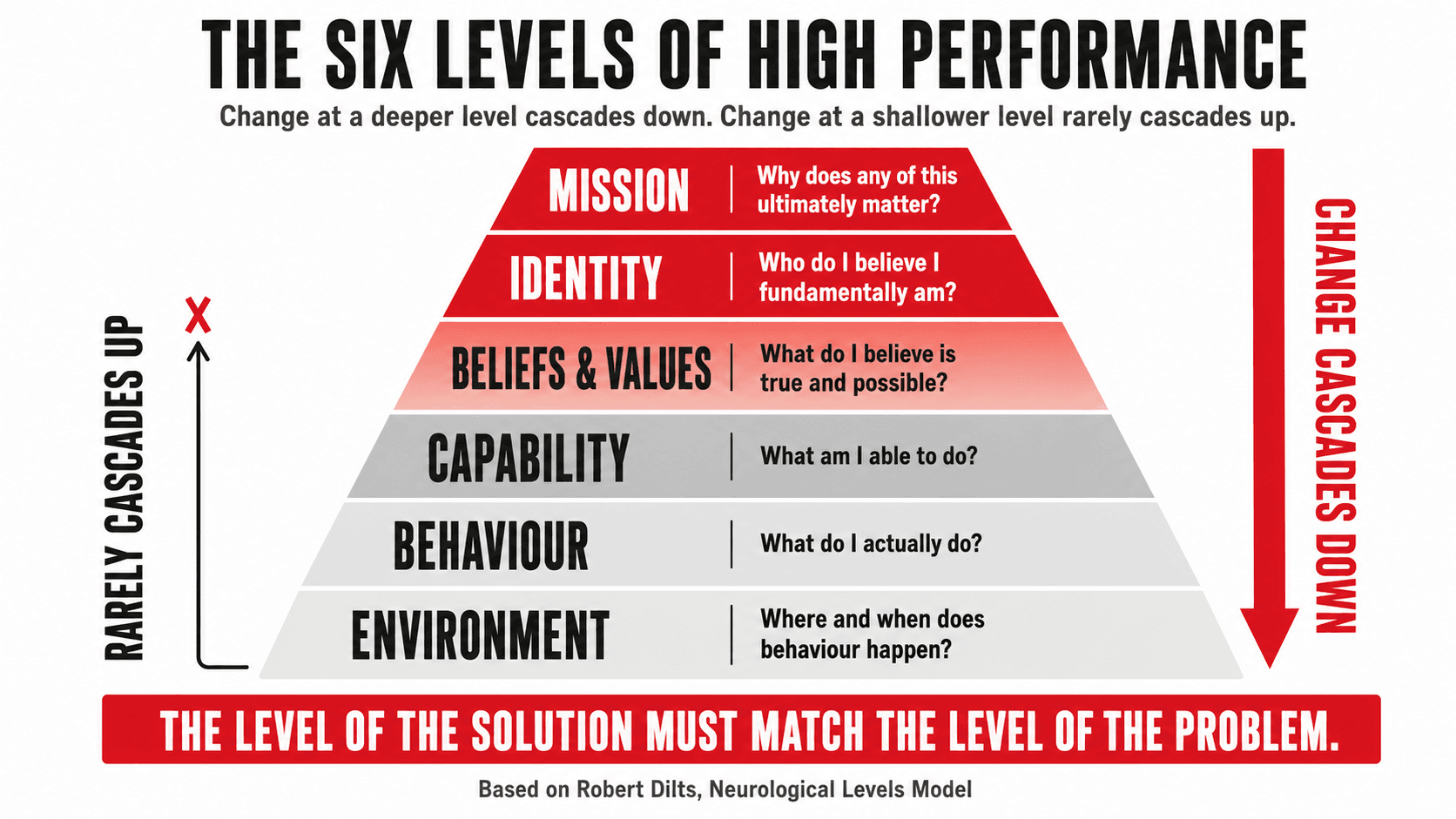
The model identifies six levels of human experience, arranged in a hierarchy from the shallowest and most immediately accessible at the bottom to the deepest and most powerfully influential at the top. The critical principle governing the hierarchy is this: change at a deeper level cascades downward, automatically restructuring the levels below it. Change at a shallower level almost never cascades upward without additional support, because the deeper levels exert a gravitational pull that returns surface behaviour to the pattern that the underlying level supports.
The six levels from shallowest to deepest are: Environment, Behaviour, Capability, Beliefs and Values, Identity, and Mission. Each one answers a specific question, operates through a specific mechanism, and requires a specific type of intervention to change. The diagnostic task is to identify which level is where the person's actual constraint lives, because that is the level at which the intervention must be targeted.
Diagram
The Neurological Levels Pyramid — Six Levels of High Performance Applied to Health
| Level | What It Covers and the Question It Answers | Leverage and Cascade |
|---|---|---|
| Level 6 MISSION | Why does any of this ultimately matter? What is the larger purpose that makes health non-negotiable rather than optional? Being fully present for my family. Performing at the level my work requires. Not being limited by my body at 60. Living the life I want to live for as long as possible. | The deepest level. Change here makes health behaviour feel like an expression of purpose rather than a performance of discipline. Mission-level clarity makes identity stable. |
| Level 5 IDENTITY | Who do I believe I fundamentally am? Does being healthy feel like who I am, or like something I am trying to do? I am a healthy person. I am someone who takes their body seriously. Training is part of who I am, not something I do when motivated. | Change at identity level cascades down through beliefs, capability, and behaviour automatically. Identity is the architect of all behaviour below it. |
| Level 4 BELIEFS | What do I believe is true and possible? What do I believe about my body's capacity to change, my ability to sustain healthy behaviour, and whether lasting transformation is available to me? My body responds to consistent training. I am capable of maintaining healthy eating. | Beliefs act as the invisible ceiling between surface capability and deep identity. Change at belief level unlocks capability that was already available but felt inaccessible. |
| Level 3 CAPABILITY | What am I able to do? What skills do I have? Do I have the practical skills, knowledge, and systems required to execute the programme consistently? Understanding how to train effectively. Knowing how to prepare nutritious food efficiently. | Change at capability level improves execution quality but does not address belief or identity constraints. Capability problems are solvable with education and skill building. |
| Level 2 BEHAVIOUR | What do I actually do? What are my observable actions around training, nutrition, sleep, and health management? Training sessions attended. Meals prepared. Sleep schedule maintained. Alcohol managed. Steps taken. Supplements used consistently. | Where most health programmes intervene. Behaviour change is achievable in the short term without deeper change but cannot be sustained against contrary beliefs and identity. |
| Level 1 ENVIRONMENT | Where and when does my behaviour happen? Does my physical and social context support or undermine the healthy behaviours I am trying to sustain? Kitchen food environment. Gym access. Work schedule. Social influences. Home layout. | The shallowest level. Environment changes are fast and impactful but are the first to break down when deeper level constraints reassert themselves. |
| The leverage principle: change at a deeper level cascades downward automatically. Change at a shallower level almost never cascades upward without additional work. The level of the solution must match the level where the problem actually lives. | ||
The pyramid is read from bottom to top in terms of increasing depth and influence, but from top to bottom in terms of cascade. The person who changes their mission or identity does not then need to separately rebuild their beliefs, capability, and behaviour. The deeper change restructures everything above it in the direction of the new level. This is why identity-based change is so structurally different from behaviour-based change: it operates at level 5 rather than level 2, and its effects cascade downward through four levels of structure that behaviour-level change cannot reach.
Key Insight: When you have tried and failed at a health goal repeatedly, the question is not: what is wrong with my programme? It is: at which level does my actual problem live? If the answer is level 1 or 2, a good programme and environment redesign will solve it. If the answer is level 3, 4, or 5, changing the programme without addressing the deeper level will produce the same pattern of initial success and eventual reversion that you have already experienced. The diagnostic is the starting point.
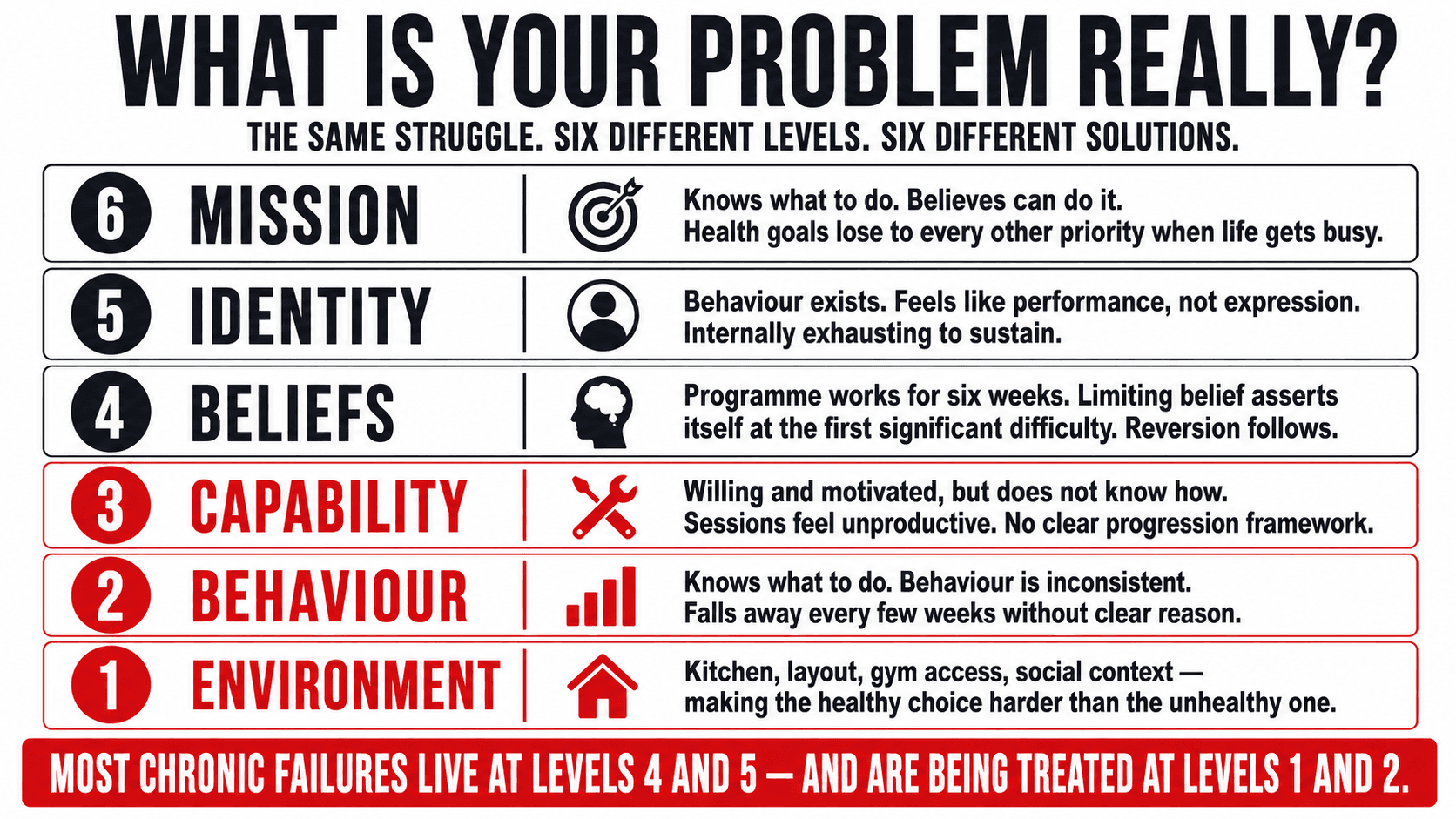
What Problems Look Like at Each Level: The Diagnostic in Detail
Level 1: Environment problems are the most straightforward to identify and address. The person whose kitchen is stocked with foods that undermine their goals, whose gym is inconveniently located, whose workplace does not accommodate any form of movement, or whose social environment involves habitual excessive eating and drinking has an environment problem that a relatively simple redesign can address. The characteristic marker of a genuine environment-level problem is that when the environment changes, the behaviour changes with it and holds without significant internal resistance. If this does not happen, the problem is deeper.
Level 2: Behaviour problems present as a gap between knowing and doing. The person has good information about what to eat and how to train. Their environment is reasonably supportive. But specific behaviours are inconsistent or missing: they do not meal prep, they skip sessions irregularly, they drink more than intended on social occasions. Behaviour-level problems respond to habit design, accountability structures, and scheduling. When addressed at this level, change holds as long as the habit architecture and accountability remain in place. If it collapses without them, something deeper is at work.
Level 3: Capability problems present as willingness without skill. The person genuinely wants to change, has a supportive belief system, and would sustain the behaviour if they knew how to execute it correctly. They do not know how to train effectively. They have never learned to cook in a way that is nutritionally useful. They do not understand how to manage their energy across the day or how to navigate social eating without abandoning their nutritional goals entirely. Capability problems respond directly to skill-building: proper coaching, nutritional education, cooking instruction, and the development of specific practical competencies.
Level 4: Belief problems are the most common level at which chronic health failure actually lives, and the most consistently underaddressed. The person has the capability, the environment, and often the behaviour established in early weeks, but the belief system is working against the programme from the inside. The belief that their body does not respond. The belief that lasting change is not available to them. The belief that they are fundamentally different from people who maintain good health. These beliefs do not announce themselves. They present as persistent pattern disruption that no programme adjustment can resolve, because the problem is not in the programme. It is in the filter through which every experience of the programme is interpreted.
Level 5: Identity problems present as a sustained sense that healthy behaviour is a performance rather than an expression of who the person is. The person trains, but does not feel like an athletic person. They eat well for extended periods, but do not feel like someone whose relationship with food is fundamentally healthy. The behaviour is occurring but it requires continuous, exhausting effort because it is not congruent with the identity underneath it. Identity-level problems require identity-level work: the systematic construction of a new self-concept through accumulated behavioural evidence, reframed language, and the deliberate development of new identity-consistent narratives.
Level 6: Mission problems present as sustained low engagement with health goals despite the absence of any specific belief or identity obstacle. The person can articulate what they want and can execute the programme when externally structured, but cannot generate internal drive sufficient to maintain it independently. The missing element is not belief or identity but purpose: a compelling answer to the question of why this matters that is personally resonant and emotionally motivating. Without mission-level clarity, health goals compete with every other priority on equal terms and consistently lose to the more immediate.
The Same Problem at Different Levels: Why the Intervention Must Match the Diagnosis
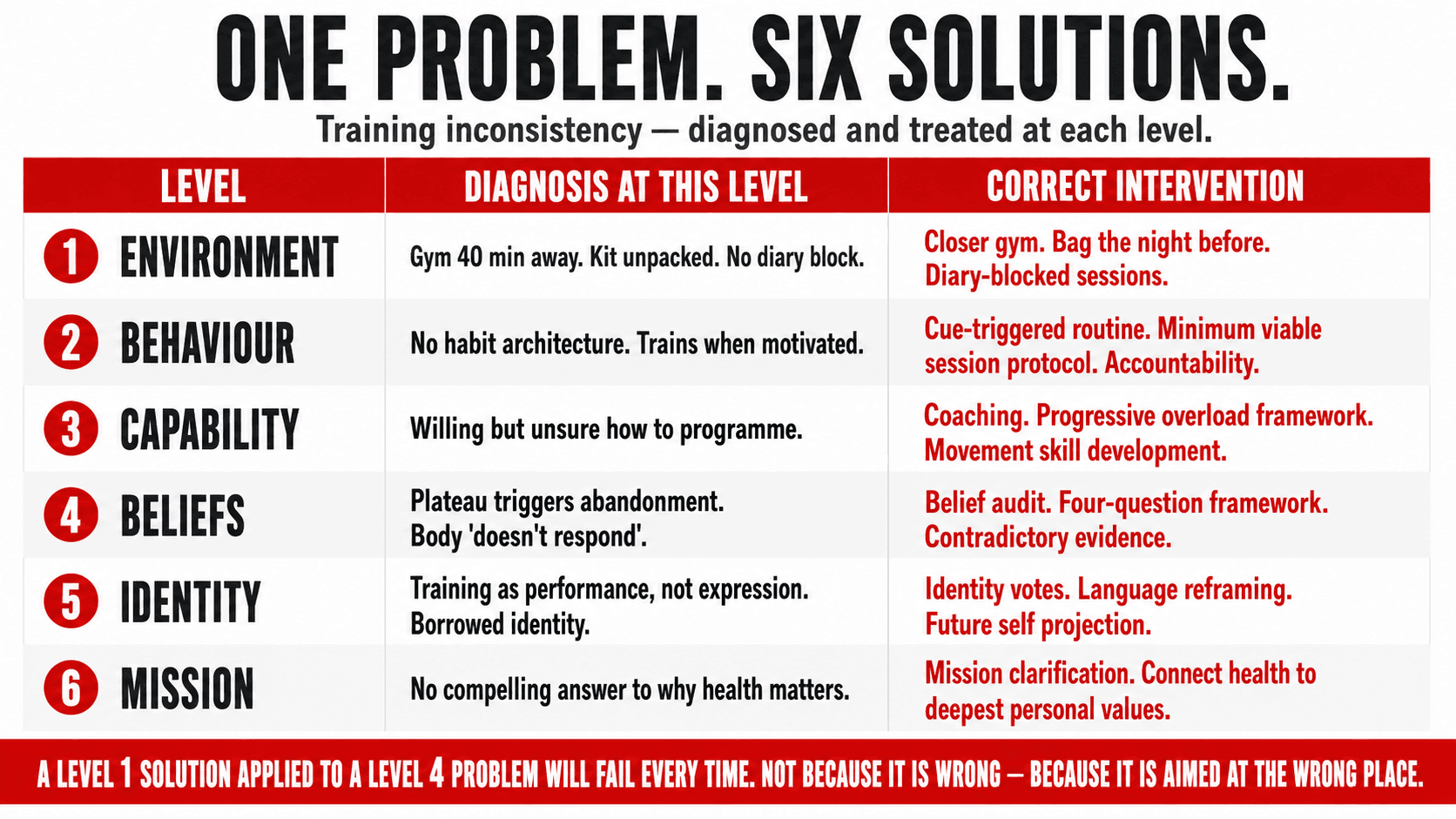
The most practical demonstration of the levels model is to take a single presenting problem and show what it looks like when it is located at each different level, and what the correct intervention is at each level. The presenting problem here is persistent inconsistency with training: the person repeatedly starts and stops a training habit.
Table
Persistent Training Inconsistency — The Same Problem Diagnosed at Each Level
| Level | Diagnosis at This Level | Intervention Required | Expected Outcome if Correct Level |
|---|---|---|---|
| ENVIRONMENT Level 1 | Gym is 40 minutes away. Training kit is unpacked. No specific training time blocked in diary. | Join a closer gym. Pack bag the night before. Block three training sessions per week in the diary as non-negotiable appointments. | Consistency improves immediately and holds. The environmental friction was the primary constraint. Remove it and behaviour changes reliably. |
| BEHAVIOUR Level 2 | Adequate environment but no habit architecture. Training happens when motivated, not as a structured trigger-based routine. | Attach training sessions to specific consistent cues. Implement a minimum viable session protocol for low-motivation days. Build accountability. | Consistency improves and holds while the habit architecture is maintained. Reverts if accountability is removed, suggesting a deeper level may also be involved. |
| CAPABILITY Level 3 | Willing and wants to train but does not know how to programme effectively. Sessions feel unproductive. No sense of direction or progress framework. | Proper coaching and programme design. Progressive overload framework. Movement skill development. The person needs to know what they are doing and why. | Consistency improves once competence grows. The person who felt productive in training is motivated by the training itself. Capability creates its own motivation. |
| BELIEFS Level 4 | Training occurs but is sabotaged at the first significant difficulty. Plateau triggers abandonment. Belief that their body does not respond overrides all external structure. | Belief audit using the four-question framework. Identification and dismantling of the specific limiting belief. Accumulation of contradictory evidence through programme design. | Sustained with appropriate belief work. The programme alone will not hold. The belief work running alongside it is what allows the programme to compound. |
| IDENTITY Level 5 | Training as performance, not expression. Feels like a healthy person's behaviour being borrowed rather than owned. Internally exhausting to maintain. | Identity shift work. Language reframing. Systematic accumulation of identity votes. Future self projection. The training habit must become congruent with self-concept. | Once identity shifts, training becomes intrinsically motivated. The question is not whether to train. It is simply what the training looks like today. |
| MISSION Level 6 | No compelling answer to why health matters beyond appearance or short-term comfort. Health goals compete with every other priority and consistently lose. | Mission clarification. Connect health behaviour to deeply held personal values and long-term purpose. Make health the infrastructure for everything else that matters. | When health is the infrastructure for the person's deepest values, it stops competing with other priorities. It becomes the foundation everything else stands on. |
| The same presenting problem has six different correct interventions depending on which level it actually lives at. Applying a Level 1 solution to a Level 4 problem will fail every time, not because the solution is wrong, but because it is targeted at the wrong level. | |||
The Self-Diagnostic: How to Identify Which Level Your Problem Lives At
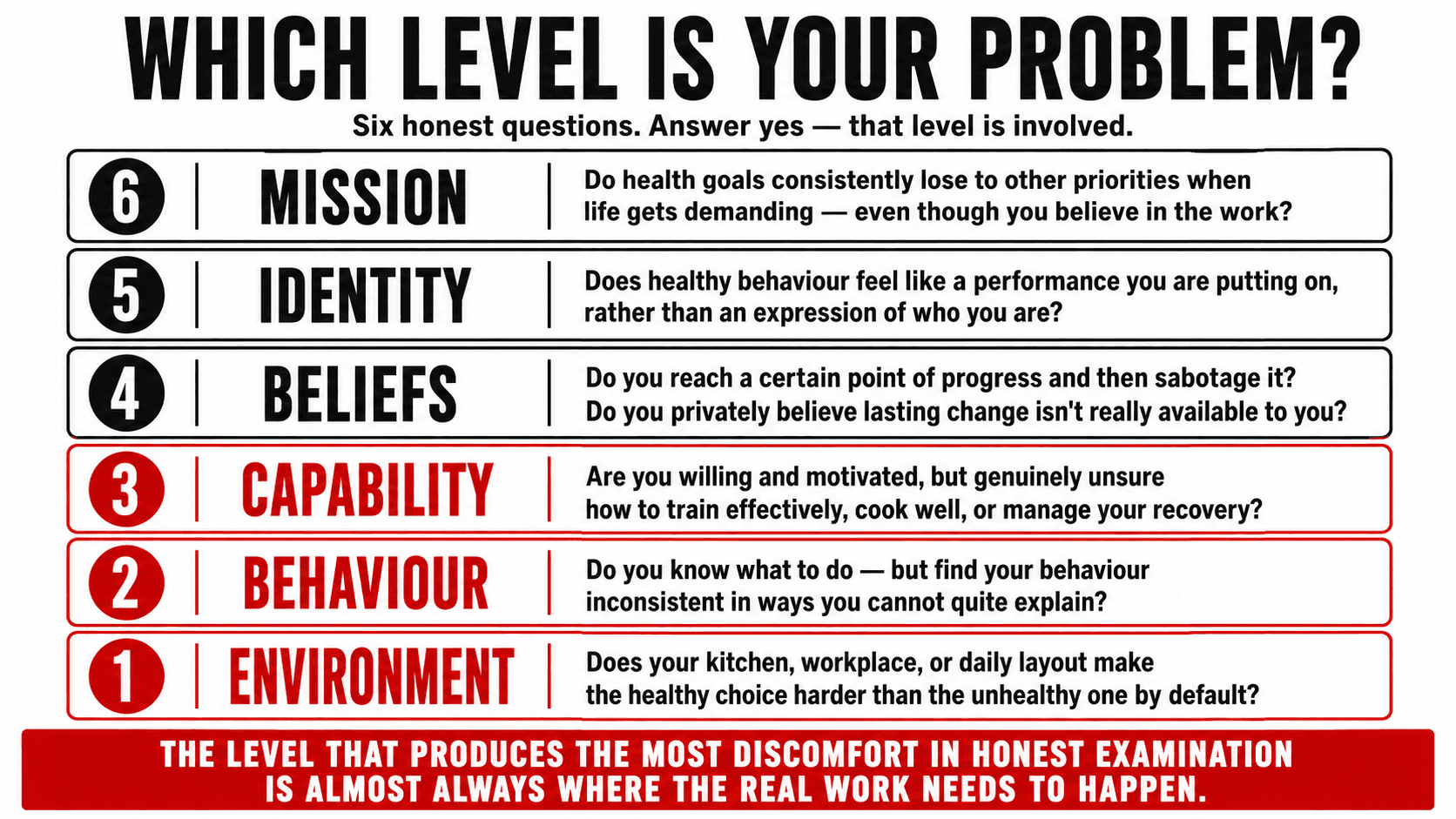
The most direct way to use the Neurological Levels model practically is to run a structured self-diagnostic: a series of questions, one for each level, that reveal where the actual constraint lives by identifying which level produces the most significant recognition and resistance in honest examination.
Table
The Level Diagnostic — Questions to Identify Where Your Health Problem Actually Lives
| Level | The Diagnostic Question | If the Answer Is Yes, This Level Is Involved |
|---|---|---|
| ENVIRONMENT Level 1 | Does your physical environment — kitchen, home layout, workplace, commute — make the healthy choice harder than the unhealthy one by default? | Your environment is working against you. This is the easiest level to address and should be redesigned regardless of what other levels are also involved. |
| BEHAVIOUR Level 2 | Do you know what to do and have a supportive enough environment, but find your behaviour inconsistent? Do you do well for a few weeks and then fall away without a clear reason? | Your habit architecture may be insufficient. The behaviour is not yet automatic. Habit design, scheduling, and accountability structures are the appropriate intervention. |
| CAPABILITY Level 3 | Are you willing and motivated but genuinely unsure of how to train effectively, cook nutritiously, or manage your energy and recovery? Does the practical execution feel technically unclear? | You have a capability gap. Professional guidance, coaching, and practical skill development are what is needed. This is not a motivation problem — it is a skill and knowledge problem. |
| BELIEFS Level 4 | Do you find yourself repeatedly reaching a certain point of progress and then sabotaging it? Do you hold a persistent conviction that your body is different, that lasting change is not really available to you? | A limiting belief is acting as a ceiling. The programme will not hold without belief work. The four-question diagnostic from Article 5 is the starting point for this level. |
| IDENTITY Level 5 | Does healthy behaviour feel like a performance you are putting on rather than an expression of who you are? Does it require sustained conscious effort that never seems to become more natural over time? | You are working against your own identity. The behaviour exists but lacks the structural support of a congruent self-concept. Identity work must run alongside the programme. |
| MISSION Level 6 | Do you know what to do, believe you can do it, and have a supportive identity around health, but find that health goals consistently lose to other priorities when life gets demanding? | You need mission-level clarity. Connect your health behaviour to a purpose large enough and personally resonant enough to make it genuinely non-negotiable rather than aspirational. |
| Most people who have struggled chronically with health have a problem at levels 4 and 5 that is being addressed at levels 1 and 2. The self-diagnostic does not require a coach to administer. It requires honesty. | ||
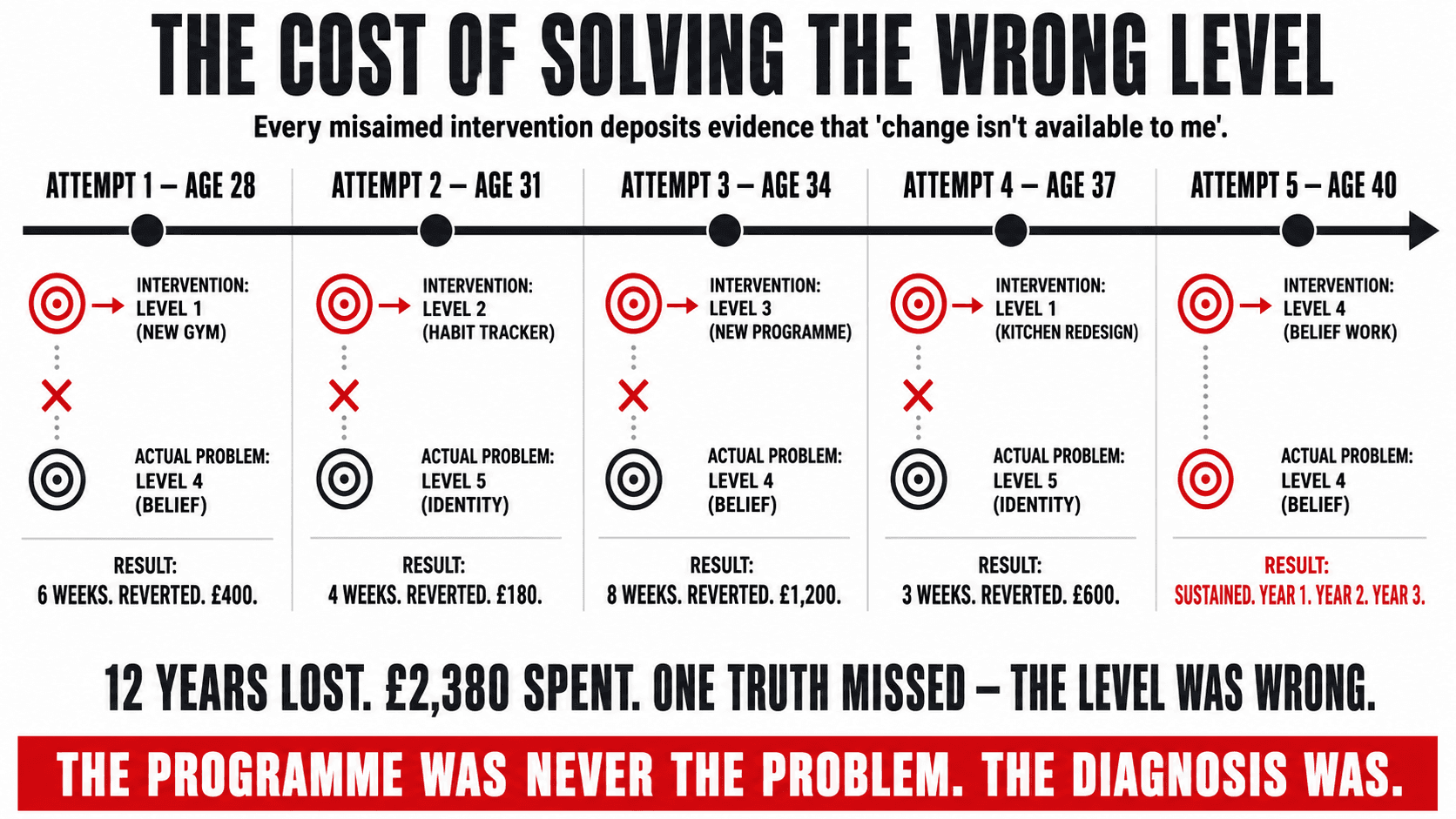
The Agitate Case: The Cost of Repeatedly Solving the Wrong Level
The financial and emotional cost of repeatedly applying the wrong level of intervention is substantial and, for most people, cumulative across years. Every new programme purchased to solve a behaviour problem that is actually a belief problem. Every gym membership that goes unused not because the person lacks access but because attendance requires them to perform against an identity that does not include being an athletic person. Every nutritional intervention that holds for six weeks before the limiting belief reasserts itself and the old pattern returns.
The pattern is not a failure of programmes or of the people who try them. It is a failure of diagnostic precision. The programme was correct for the level it targeted. The level it targeted was wrong for the actual problem. This mismatch is responsible for more wasted money, more eroded confidence, and more entrenched limiting beliefs than any other single factor in health behaviour change. Every failed programme deposits a small amount of additional evidence in the file the brain maintains on the question of whether lasting change is available, making the next correctly-levelled intervention harder to believe in before it has had a chance to work.
The Neurological Levels diagnostic does not make health change easy. Nothing makes it easy. What it makes it is precise. It points the effort in the right direction. And effort pointed in the right direction, applied consistently over a sufficient period, at the level where the actual problem lives, produces results that no amount of the wrong intervention ever could.
Key Insight: Run the self-diagnostic table honestly this week. Answer each question not based on what feels comfortable but based on what the evidence of your behaviour history actually suggests. The level that produces the most discomfort in honest examination is almost always the level where the real work needs to happen. Discomfort in the diagnostic is diagnostic data, not a reason to stop the examination.
How the Levels Diagnostic Shapes Every Programme I Build
The Neurological Levels diagnostic is the framework I use before I design any programme for any client, because the programme I build must be targeted at the level where the actual constraint lives. A technically excellent training and nutritional programme delivered to a person whose problem lives at the belief or identity level will produce the same pattern of short-term success and medium-term reversion that they have experienced repeatedly before.
When a new client comes to me having failed repeatedly despite good programmes and genuine effort, the conversation I have is not about their previous programme. It is about the level. Where does the pattern break down? At what point does a successful period give way to disruption? What happens internally when the disruption begins — is it a belief asserting itself, an identity misalignment, a mission that has run out of fuel? The answers to these questions tell me more about what the programme needs to contain than any fitness assessment.
The programme I build then targets the correct level directly. For some clients that means primarily technical work at levels 1 to 3: environment redesign, habit architecture, and skill development. For others it means running belief and identity work alongside the physical programme, because the physical programme alone cannot hold against the level 4 or 5 constraint beneath it. The physical results in the second case are not produced despite the psychological work. They are produced by it. I work one-to-one with clients online globally. The diagnostic conversation is where the work begins.
Work with Me
Get a personalised coaching plan built around your goals, your schedule, and your life.
Enquire NowReferences
- Dilts R. Changing Belief Systems with NLP. Cupertino: Meta Publications; 1990.
- Dilts R, Hallbom T, Smith S. Beliefs: Pathways to Health and Well-Being. Portland: Metamorphous Press; 1990.
- Bandura A. Self-efficacy: The Exercise of Control. New York: Freeman; 1997.
- Dweck CS. Mindset: The New Psychology of Success. New York: Random House; 2006.
- Clear J. Atomic Habits: An Easy and Proven Way to Build Good Habits and Break Bad Ones. London: Random House Business; 2018.
- Prochaska JO, DiClemente CC. Stages and processes of self-change of smoking: toward an integrative model of change. Journal of Consulting and Clinical Psychology. 1983; 51(3): 390-395.
- Sinek S. Start With Why: How Great Leaders Inspire Everyone to Take Action. London: Penguin; 2011.