
The Motivation Trap: Why Waiting to Feel Like It Guarantees Failure
Habit stacking for health is one of the most practically powerful techniques available for building sustainable healthy behaviour, and one of the most consistently underused. The reason most people do not use it is that it requires a different relationship with the concept of motivation than the one the health and fitness industry has spent decades promoting. Motivation is not the driver of sustainable health behaviour. Structure is. And habit stacking is the most efficient and neurologically sound method of building the kind of structure that does not depend on motivation to function.
The problem with motivation-dependent health behaviour is not the motivation itself. Motivation is a useful accelerant. The problem is relying on it as the primary driver. Motivation is an emotional state, and emotional states are transient by definition. They respond to sleep quality, stress levels, social feedback, the weather, the time of day, and dozens of other variables that have nothing to do with the health goal. A health routine that requires a particular emotional state to activate will fail every time that emotional state is absent, which in a busy, demanding, and imperfect life is routinely.
BJ Fogg, whose Tiny Habits programme has produced measurable behaviour change at scale across a research base spanning thousands of participants, makes the argument structurally: the system design that relies on motivation is a poorly designed system. A well-designed system makes the healthy behaviour the path of least resistance, attaches it to a trigger that fires regardless of motivation level, and makes the initial action so small that the threshold for execution is essentially zero. Habit stacking is the practical architecture of that principle.(1)
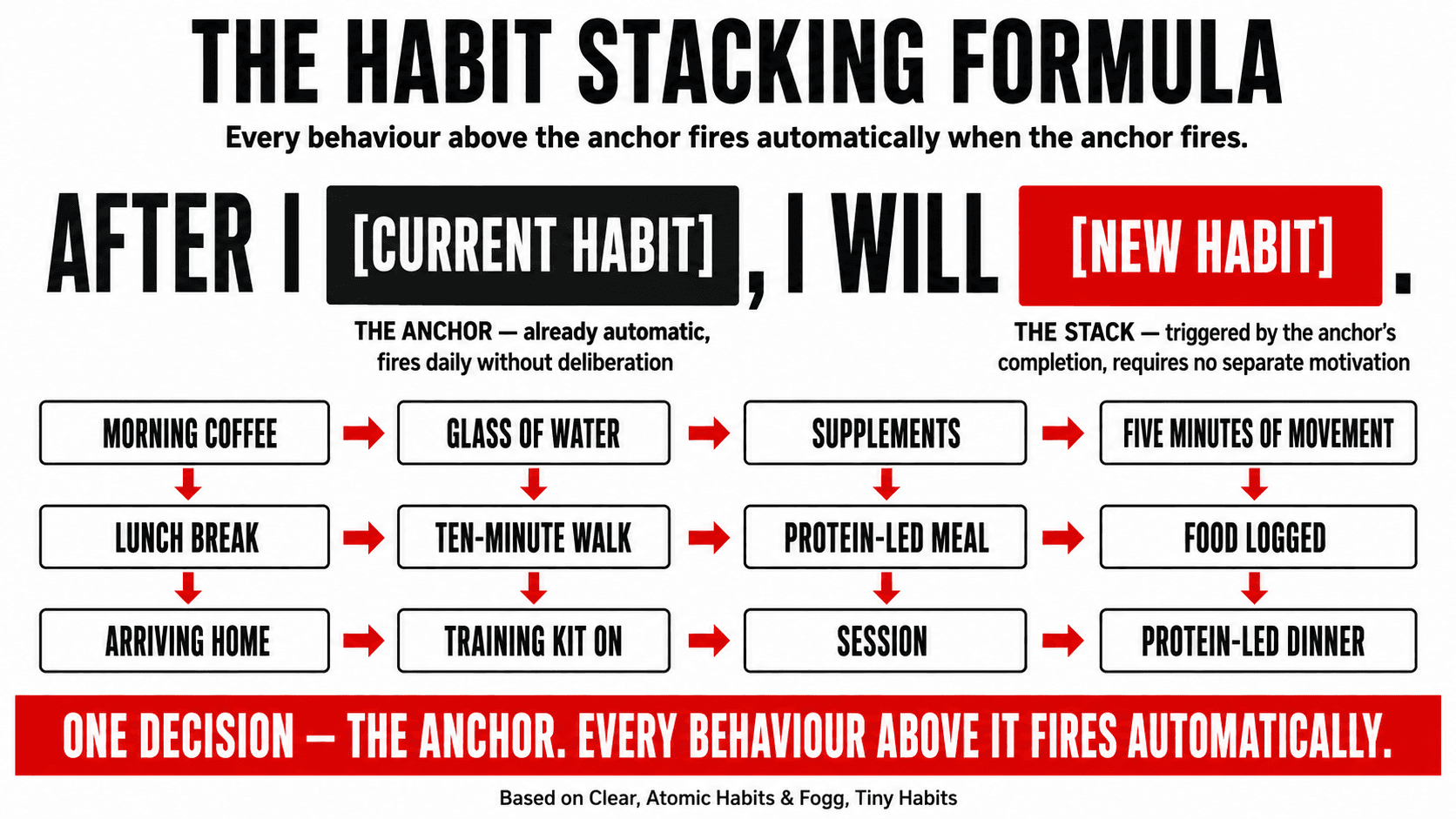
James Clear's formulation of habit stacking formalises the technique as a specific implementation intention: After I do CURRENT HABIT, I will do NEW HABIT. The existing habit is the anchor, the reliable daily trigger to which the new behaviour is attached. The formula converts the existing habit from a standalone routine into the cue for the new one, building a chain of behaviours that fires automatically once the anchor habit is executed. The chain requires no willpower at any point beyond the first action, because each subsequent behaviour is triggered by the completion of the one before it.(2)
“No behaviour happens in isolation. Every action is a prompt for the next.”
— BJ Fogg, Tiny Habits
Why Anchor Habits Work: The Neuroscience of Sequential Behaviour
The neurological basis for habit stacking lies in the brain's sequential processing of well-established behavioural routines. When a behaviour has been executed reliably in a specific sequence with another behaviour, the neural pathway underlying the first behaviour becomes associated with the initiation of the second. The completion of the first habit effectively pre-activates the neural circuitry of the second, reducing the activation energy required to begin it. This is not a metaphor. It is the mechanism through which morning routines, professional rituals, and any well-established daily sequence become neurologically efficient.(3)
The anchor habit is the linchpin of the system because it converts the problem of habit initiation into a problem of habit continuation. Initiating a new behaviour from a cold start requires a deliberate decision, which requires prefrontal cortex engagement and draws on the finite pool of cognitive resources available at that moment. Initiating a new behaviour as the next step in a sequence already in motion requires almost no additional cognitive load, because the sequence itself is already running in the automatic systems of the basal ganglia.
The most reliable anchor habits share three characteristics. They occur at a consistent time each day, they are already highly automated (requiring no conscious decision to initiate), and they are associated with a context that naturally bridges to the new behaviour being stacked onto them. Morning coffee is a powerful anchor because it meets all three criteria: it happens at a consistent time, it is deeply habituated, and the context of the morning provides a natural staging environment for a sequence of health-supportive behaviours that can be built incrementally on top of it.
Key Insight: The formula for every habit stack is: After I [CURRENT RELIABLE HABIT], I will [NEW BEHAVIOUR]. The anchor must be something you do reliably every single day without deliberation. It must already be automatic. If you are choosing an anchor habit that itself requires motivation to perform, you have not identified an anchor. You have identified another aspiration. Coffee, brushing teeth, sitting at your desk, arriving home, getting into bed — these are anchors. Going to the gym is not an anchor. It is the thing you are trying to build.
Three Complete Daily Stacks: Morning, Midday, and Evening Health Routines Built Without Willpower
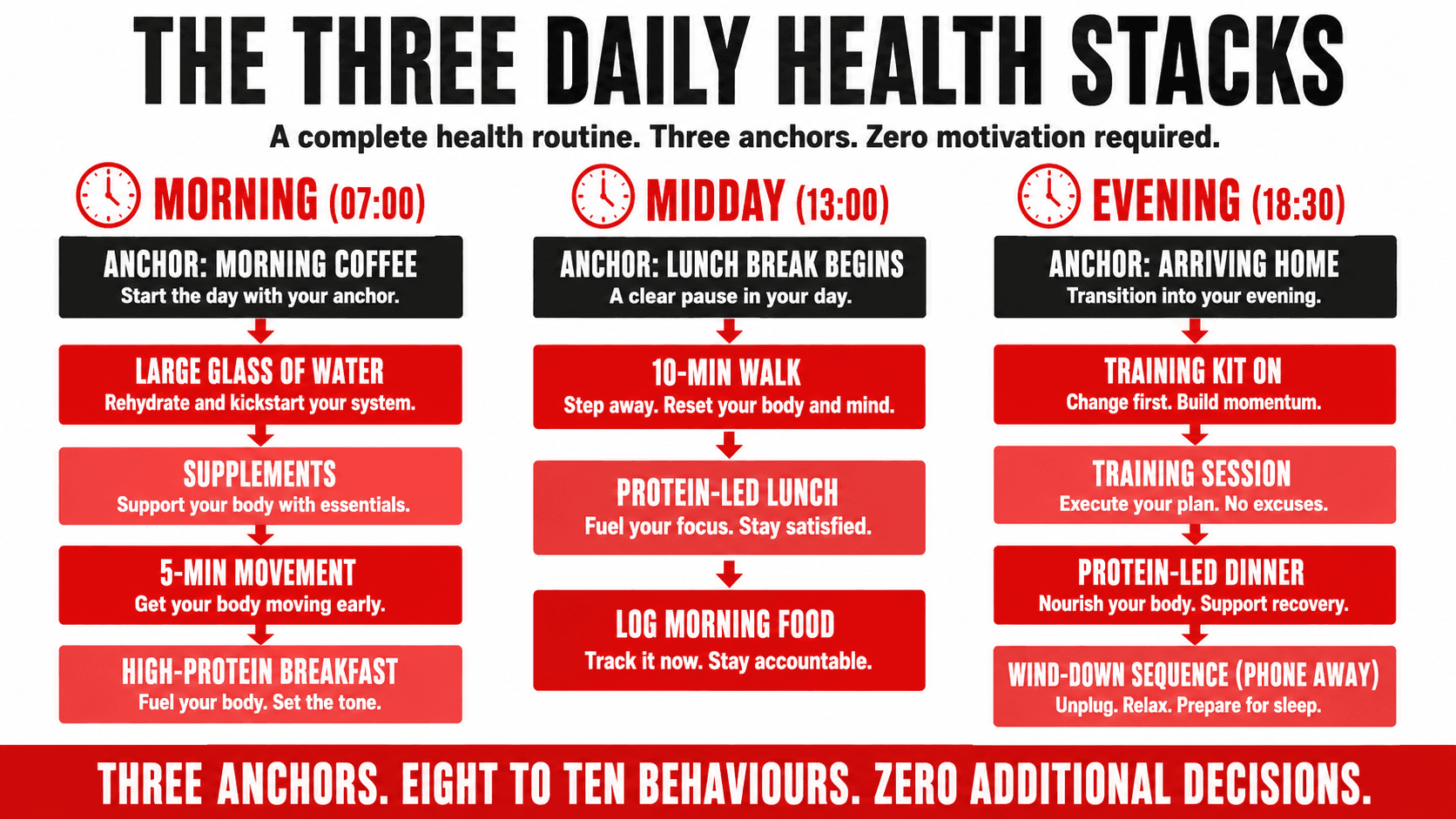
The three stacks below are practical templates, not prescriptions. They are built on the principle that each behaviour is triggered by the completion of the one before it, and that the anchor habit at the base of each stack is something already happening reliably in the person's day. The behaviours stacked above the anchor require no additional decision once the anchor fires.
Diagram
The Three Daily Health Stacks — Anchor-Based Routines for Morning, Midday, and Evening
Morning Stack
Midday Stack
Evening Stack
Anchor
Morning coffee / alarm
The first act of the day. Already automatic. The entire morning stack fires from here.
Anchor
Lunch break begins
A reliable daily transition point. Used as the trigger for a midday health sequence.
Anchor
Arriving home / changing clothes
The physical transition from work mode triggers the evening health sequence.
↓ Hydration
One large glass of water before coffee. Already positioned next to the kettle. Zero extra decision required.
↓ 10-min walk
Leave desk immediately. Walk before eating. Returns blood glucose, breaks sitting, clears head.
↓ Training kit on
Before anything else at home. Kit on within 5 minutes of arriving. Signals the training window.
↓ Supplements
Taken with water. Both items now co-located. Zero extra decision required.
↓ Protein-led lunch
Meal prepared or pre-ordered. Not decided at the point of hunger. Protein first, carbs around it.
↓ Training session
Minimum 30 minutes. Pre-written. No decisions required in the session itself.
↓ 5-min movement
Stretching, press-ups, or a brief walk before showering. Body activated before the day begins.
↓ Log morning food
Takes 90 seconds. Done while eating. Keeps nutritional awareness live without obsession.
↓ Protein-led dinner
Pre-planned or batch-cooked. Not decided post-training when decision fatigue is highest.
↓ High-protein breakfast
Prepared the night before or assembled in under 3 minutes. Greek yoghurt, eggs, protein shake, overnight oats.
Stack complete.
↓ Wind-down sequence
Phone away. Dim lights. Specific reading or stretching. Same 20-minute sequence every evening. Sleep signal to the brain.
Each stack requires one decision: the anchor. Every behaviour above it fires automatically as part of the sequence. Three anchors across the day produce a complete health routine that operates largely without willpower.
The Tiny Habit Principle: Why the First Action Must Cost Almost Nothing
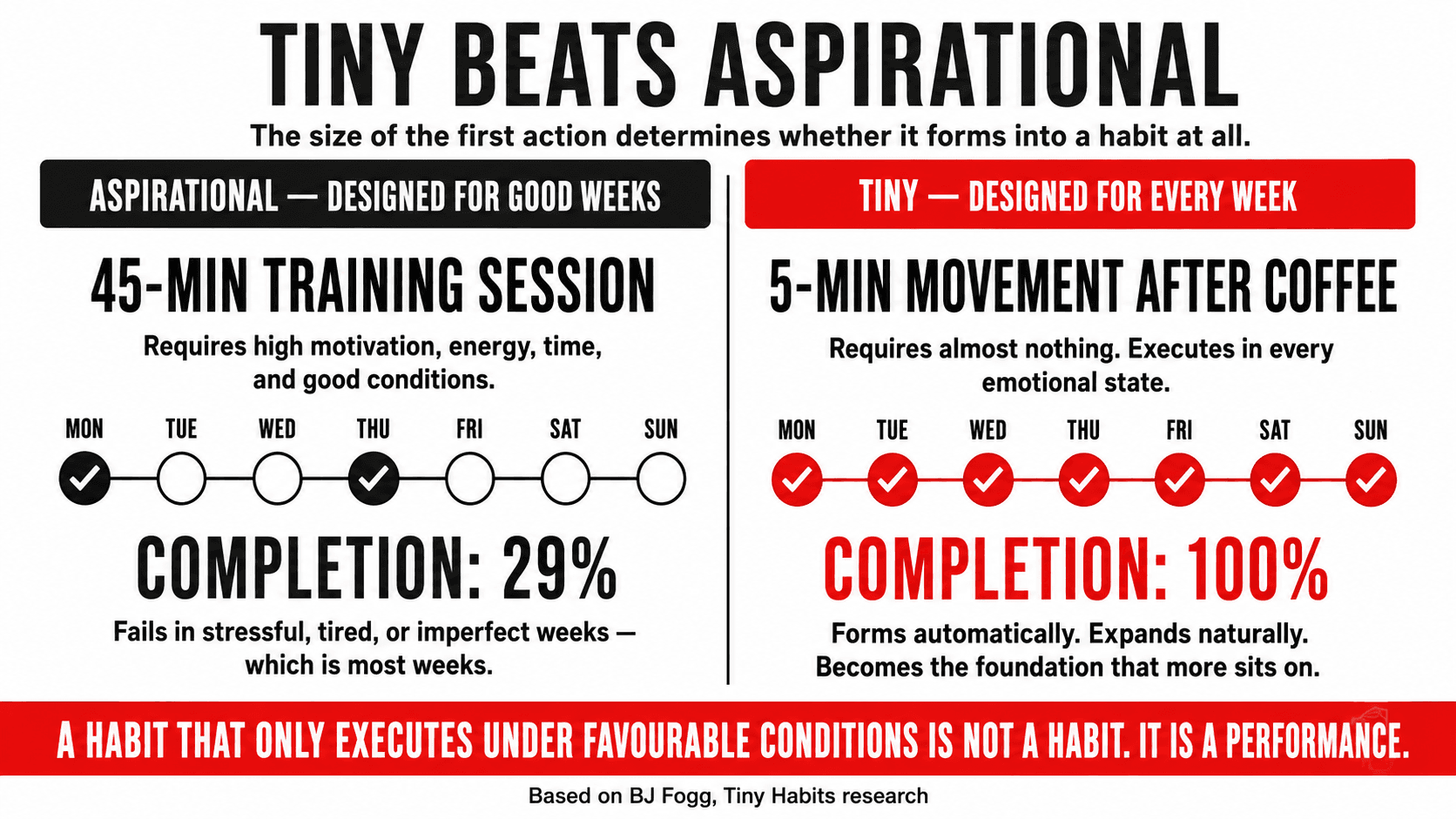
BJ Fogg's most important practical contribution to habit formation is the insight that the size of the initial behaviour determines its formation rate. Tiny behaviours, those requiring thirty seconds or less to complete, form into reliable habits faster than large ones, not because they produce more motivation (they produce less), but because they meet a lower threshold of activation energy in every emotional state. The tiny habit can be executed when motivated, when tired, when stressed, and when deeply unmotivated. The large habit cannot. And a habit that can only be executed under favourable conditions is not yet a habit. It is a performance.(1)
The application of the tiny habit principle to the habit stack changes the design of every new behaviour in the chain. When adding a new health behaviour to an existing anchor, the first version of that behaviour should be designed to be almost insultingly small: one press-up, not twenty. One glass of water, not two litres. A five-minute walk, not a thirty-minute training session. The point is not to produce meaningful physical change from the tiny behaviour itself. The point is to get the sequence running reliably, to build the neural pathway of the habit, and to let the natural expansion of a well-established habit grow the behaviour to a meaningful size over the following weeks.
Fogg's research demonstrates that tiny habits, once reliably established, naturally grow in duration and intensity without deliberate effort in the majority of cases, because the identity shift that accompanies consistent execution of even a small behaviour produces intrinsic motivation to do more. The person who reliably does two minutes of movement every morning after coffee is building a different relationship with morning movement than the person who plans a forty-five-minute session and executes it three times a week. The first person is building the identity of someone who moves every morning. The second is building the identity of someone who sometimes manages to train.(1)
Key Insight: When adding a new behaviour to your stack, ask: what is the smallest version of this behaviour that would count as doing it? That is your starting point, not your aspiration. One minute of breathing practice after brushing teeth counts. It is not inspiring. But it fires the anchor connection reliably and begins the neural pathway that will support a longer practice as the habit matures. Aspiration-sized initial habits fail at a high rate. Tiny initial habits succeed and grow.
Building Your Own Stack: The Anchor Habit Audit
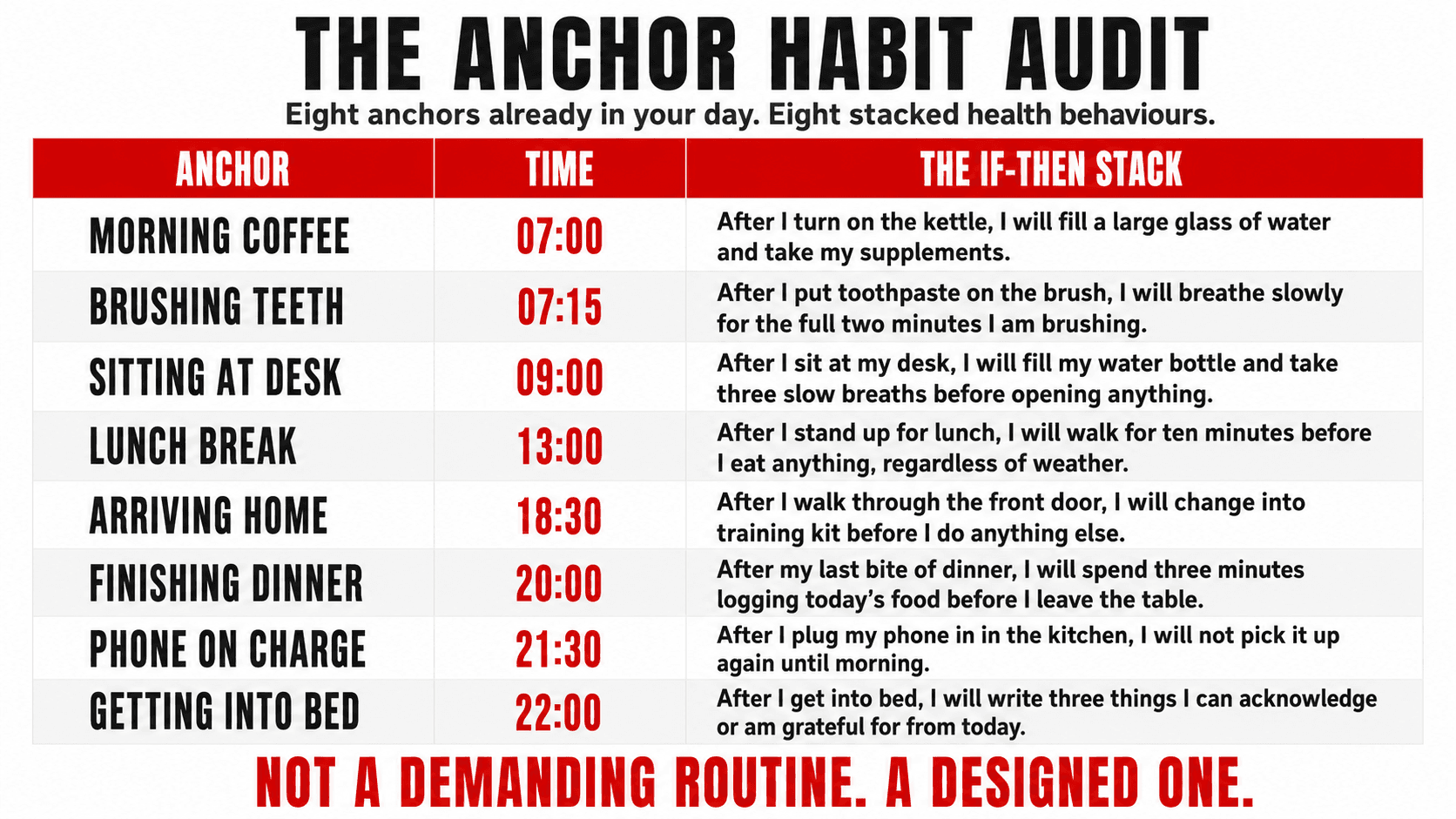
The most common mistake when attempting to implement habit stacking is choosing the wrong anchor. The anchor must be a behaviour that already occurs every day, at a roughly consistent time, without deliberation or decision. It is not a behaviour you plan to do every day. It is a behaviour you already do every day, whether or not you feel like it, without exception.
Table
The Anchor Habit Audit — Identifying Your Most Reliable Daily Triggers and the Stacks They Can Carry
| Existing Reliable Habit | Time | Reliability | New Habit to Stack | The If-Then Formula |
|---|---|---|---|---|
| Morning coffee or tea | 07:00 | 10/10 | Large glass of water + supplements. Takes 90 seconds. Both items co-located with kettle. | After I turn on the kettle, I will fill a large glass of water and take my supplements before anything else. |
| Brushing teeth (morning) | 07:15 | 10/10 | Two minutes of diaphragmatic breathing or body scan. Initiated mid-brush. No additional time cost. | After I put toothpaste on my brush, I will breathe slowly and deliberately for the full two minutes I am brushing. |
| Sitting at work desk | 09:00 | 9/10 | Fill water bottle and place on desk before opening any application. Three slow breaths to anchor focus. | After I sit at my desk, I will fill my water bottle, place it where I can see it, and take three slow breaths before opening my computer. |
| Lunch break starts | 13:00 | 8/10 | Ten-minute walk before eating. Lowers postprandial glucose, breaks sitting, resets focus for afternoon. | After I stand up for my lunch break, I will walk for ten minutes before eating anything, regardless of weather. |
| Arriving home | 18:30 | 9/10 | Training kit on within five minutes. Not a decision. Not conditional. Kit on, then proceed. | After I walk through the front door, I will change into training kit before I do anything else, including checking my phone. |
| Finishing dinner | 20:00 | 9/10 | Log the day's food while still at the table. Takes three minutes. Awareness without obsession. | After I finish my last bite of dinner, I will spend three minutes logging today's food before leaving the table. |
| Phone charger plugged in | 21:30 | 10/10 | Phone stays on charge in the kitchen. Physical book on bedside table. The charger action ends the screen day. | After I plug my phone in to charge in the kitchen, I will not pick it up again until morning. Book and glass of water go to the bedroom instead. |
| Getting into bed | 22:00 | 10/10 | Three things written in gratitude or progress journal. Two minutes maximum. Closes the day with a constructive frame. | After I get into bed and before I open any book, I will write three things from today that I can acknowledge or am grateful for. |
| Eight anchor habits. Eight stacked health behaviours. None requiring a motivational state to execute. Each one triggered by something already happening reliably every day. This is not a demanding health routine. It is a designed one. | ||||
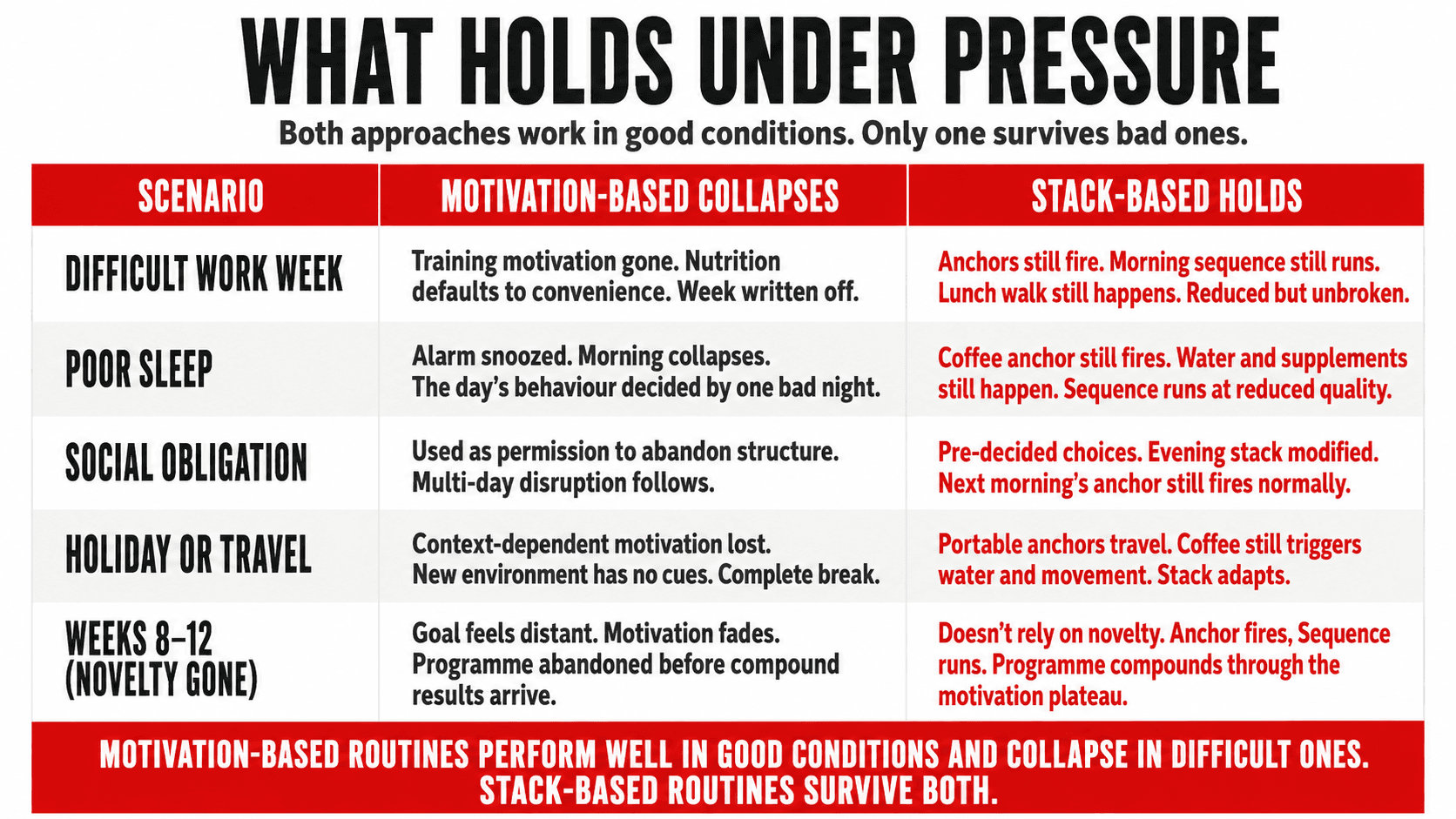
Motivation-Based vs Stack-Based Health Routines: What Each Looks Like Under Pressure
The critical difference between a motivation-based health routine and a stack-based one only becomes visible when the conditions that motivation requires are absent. In a good week, when energy is high, life is organised, and the goal feels proximate and motivating, both approaches produce similar behaviour. The difference emerges in the difficult weeks, which in any honest assessment of a full year represent a substantial proportion of the total.
Table
Motivation-Based vs Stack-Based — What Each Approach Produces in Five Real-Life Scenarios
| Life Scenario | Motivation-Based Approach | Habit Stack-Based Approach |
|---|---|---|
| Difficult week at work: late nights, high pressure, low energy | Training motivation disappears. Nutrition defaults to convenience. Evening routine collapses. Sequence of poor choices begins. Week written off. | Anchor habits still fire. Morning water and supplements still happen. Walk at lunch still happens. Kit-on-arrival still triggers a shortened session. Nutrition choices are pre-decided. The difficult week produces a reduced but unbroken sequence. |
| Poor night's sleep: tired, irritable, no enthusiasm | Alarm is snoozed. Morning routine collapses. Training skipped. Poor nutritional choices made from fatigue. The day's health behaviour determined by one night's sleep. | The anchor of morning coffee still fires. Water is still consumed. Supplements still taken. The morning sequence runs at reduced quality but it runs. One poor night does not break the chain. |
| Social obligations: dinner out, drinks, late return | The social occasion is used as permission to abandon the week's health structure. Pattern disruption becomes multi-day. Recovery to normal behaviour takes several days. | Pre-decided choices for the social occasion. Evening stack is modified but the morning stack the following day fires normally. One disrupted evening does not disrupt the next morning. |
| Holiday or travel: unfamiliar environment, disrupted schedule | The usual motivation is context-dependent. New environment has no associated health cues. The holiday produces a complete break from health behaviour. | Portable anchor habits travel with the person. Morning coffee still triggers water and movement. Evening wind-down sequence still runs. The stack adapts to the new environment rather than dissolving in it. |
| Long-term motivation fade: weeks 8 to 12 of a programme | The novelty has gone. Early results have stabilised. The goal feels distant. Motivation fades and behaviour fades with it. Programme abandoned just before compound results would have arrived. | The habit chain does not rely on novelty or motivation. The anchor fires, the sequence runs, the session happens. The programme compounds through the motivation plateau because the structure does not require motivation to function. |
| Motivation-based routines perform well in good conditions and collapse in difficult ones. Stack-based routines perform at reduced capacity in difficult conditions and recover automatically when conditions improve. Across a full year, the difference in total healthy behaviour is not marginal. | ||
The Implementation Intention: The Psychological Engine Behind the Stack
Peter Gollwitzer's research on implementation intentions provides the psychological mechanism that explains why the if-then formula of habit stacking is so consistently more effective than vague intention. An implementation intention is a specific plan in the form of: if situation X occurs, then I will perform behaviour Y. Across multiple meta-analyses covering thousands of participants and dozens of health-related behaviours, implementation intentions have been shown to approximately double the rate of goal-directed behaviour execution compared to simple goal intention alone. The specificity of the when and where removes the decision from the moment of execution.(4)
The reason implementation intentions work so reliably is that they offload the decision from the cognitively depleted present-moment self to the well-resourced planning self. The person who decides at 9pm on a Sunday that they will walk for ten minutes immediately after finishing lunch on Monday does not need to make that decision at 1pm on Monday when their cognitive resources are half-depleted and the sofa is in reach. The decision was already made. The if-then bridge converts it into an automatic response to a situation rather than a deliberate act of will.
Applied to habit stacking, the implementation intention is formulated at the design stage, not at the execution stage. Every behaviour in the stack has its formula written explicitly: after this, I will do that. The formula is rehearsed mentally until the sequence has been anticipated in enough detail that the brain begins to process the anchor as an automatic trigger for the first stacked behaviour. This is not complicated. It requires one planning session, a piece of paper, and the willingness to treat the design of the routine with the same seriousness as the content of it.
Key Insight: Write your three stacks this week. Use the if-then formula for every behaviour in each stack. Post the stacks somewhere visible: on the kitchen cupboard, in your phone notes, at your desk. Read through each stack mentally before you go to sleep tonight. When the anchor fires tomorrow, the sequence will feel fractionally more automatic than it would have without the mental rehearsal. Repeat for a week. By week three, the anchor will begin to feel incomplete without the first stacked behaviour following it. That feeling is the neural pathway forming.
Building the Stack Incrementally: Why Adding Too Much Too Soon Breaks the System
The most common error in implementing habit stacking is attempting to build the full stack immediately. The person designs an aspirationally complete morning routine of seven behaviours, attempts to execute the entire sequence on day one, finds it cognitively demanding and time-consuming, and abandons the approach within a week on the grounds that they do not have time for it. They did not fail the habit stack. They implemented it incorrectly.
The correct implementation is sequential and patient. Begin with one anchor and one new behaviour. Run that pairing for two weeks with absolute consistency, prioritising reliability of execution over quality of execution. When the first stacked behaviour feels automatic, when it would feel strange not to do it, add the second behaviour to the chain. Two weeks later, add the third. The process of building a complete stack of five or six behaviours takes two to three months at this pace. The resulting stack is neurologically robust. The stack built in a single optimistic planning session is brittle.
Lally's research on habit formation timescales is directly relevant here: the average time for a behaviour to reach automaticity in the group studied was 66 days, with simpler behaviours reaching automaticity faster than complex ones. Adding a new behaviour to an existing stack before the previous one has reached automaticity creates a cognitively demanding sequence that has not yet automated, and therefore still draws on the finite willpower reserve. Patience at the design stage is a form of structural intelligence.(5)
Key Insight: Identify your single most important health behaviour — the one that, if executed every day without exception, would have the greatest compound impact on your results. Find its anchor. Write the if-then formula. Run that single pairing for three weeks before adding anything else. One reliable stacked behaviour beats seven inconsistent aspirations every time the evidence is examined honestly.
How Stack Design Is Built Into Every Programme From the First Conversation
When I work with a new client, the habit stack conversation happens in the first two sessions, because it determines whether the programme I design is executable in the actual life that person is living. The perfect training programme is worthless if it requires conditions that the client's life does not reliably provide. The habit stack is the architecture that makes the programme executable regardless of conditions.
I ask about the anchors first: what happens every day without fail? What are the two or three most reliable behavioural sequences in your existing daily life? From those anchors, I design the stacked behaviours that will carry the health programme. The nutrition strategy gets attached to food preparation anchors. The training habit gets attached to arrival-home or morning-alarm anchors. The sleep routine gets attached to phone-charger and bedtime anchors. The supplement protocol gets attached to morning coffee.
The stack makes the programme weather-resistant. A difficult week produces a reduced but unbroken sequence. A holiday produces a portable version. A motivationally flat month produces the same behaviour that a motivated month does, because the anchor fires and the sequence runs regardless of the internal state that precedes it. That is the difference between a programme built on motivation and a programme built on structure. I work one-to-one with clients online globally. The stack design is where the structure begins.
Work with Me
Get a personalised coaching plan built around your goals, your schedule, and your life.
Enquire NowReferences
- Fogg BJ. Tiny Habits: The Small Changes That Change Everything. London: Virgin Books; 2019.
- Clear J. Atomic Habits: An Easy and Proven Way to Build Good Habits and Break Bad Ones. London: Random House Business; 2018.
- Graybiel AM. Habits, rituals, and the evaluative brain. Annual Review of Neuroscience. 2008; 31: 359-387.
- Gollwitzer PM, Sheeran P. Implementation intentions and goal achievement: a meta-analysis of effects and processes. Advances in Experimental Social Psychology. 2006; 38: 69-119.
- Lally P, van Jaarsveld CHM, Potts HWW, Wardle J. How are habits formed: modelling habit formation in the real world. European Journal of Social Psychology. 2010; 40(6): 998-1009.
- Wood W, Neal DT. A new look at habits and the habit-goal interface. Psychological Review. 2007; 114(4): 843-863.
- Duhigg C. The Power of Habit: Why We Do What We Do and How to Change. London: Random House; 2012.