
The Goal-Setting Problem Nobody in the Fitness Industry Talks About
Effective goal setting for health is one of the most discussed and least understood subjects in personal development and fitness. Everyone sets goals. New Year generates them by the millions. App-based fitness programmes prompt users to set them on day one. Coaches ask for them in first consultations. And yet the research on goal achievement rates is sobering: a consistently cited figure from Dominican University of California suggests that fewer than one in three people achieve the goals they set, with the failure rate for vague, unstructured goals significantly higher.(1)
The reason is not that people lack commitment when they set their goals. In the moment of goal-setting, the commitment is real. The reason is structural. The goals themselves are built incorrectly. They are set at the wrong level of the goal hierarchy, framed in terms that produce the wrong psychological relationship with the pursuit of them, disconnected from any underlying purpose that would sustain them through the inevitable difficult periods, and measured in ways that generate discouragement rather than momentum.
Tony Robbins has argued for decades that the quality of your life is determined by the quality of the questions you ask yourself. Goal setting, understood properly, is the structured practice of asking the right questions in the right order. Most people asking those questions start in the middle of the hierarchy, miss the layers below and above it entirely, and wonder why the answer they arrive at does not sustain them through the difficulty that is the inevitable companion to any goal worth having.(2)
The Three Types of Goal: Why Setting Only Outcome Goals Is a Structural Error
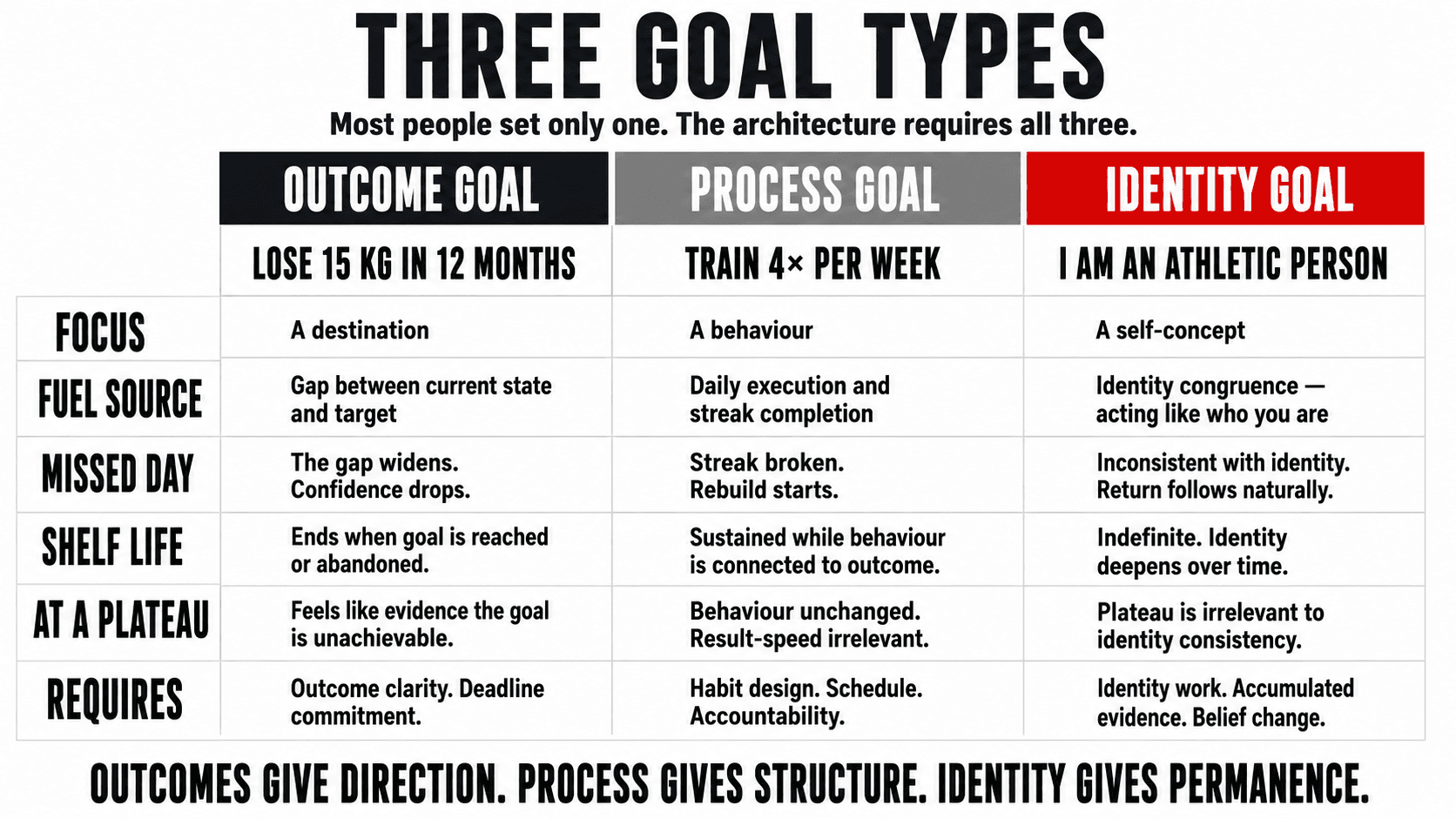
Before addressing the architecture of effective goal setting, the foundational distinction must be made between the three types of goal that any health-related objective can be structured as. These are outcome goals, process goals, and identity goals. Most people setting health goals set exclusively outcome goals. This is the first and most consequential structural error in the process.
Outcome goals are destination-focused: lose fifteen kilograms, run a sub-twenty-five-minute 5k, reach a specific body fat percentage. They are specific and measurable, which makes them feel well-constructed. Their weakness is motivational: the entire reward structure of an outcome goal is deferred to the moment of achievement. Every day before that moment is a day of unrewarded effort measured against the gap between where you are and where you want to be. When progress slows or stalls, the gap measurement generates discouragement. When the goal is achieved, the motivational structure collapses because the driver has been removed.
Process goals are behaviour-focused: train four times per week, eat a protein-led breakfast every day, sleep seven hours minimum. They are within complete daily control, which makes them motivationally superior to outcome goals in the medium term. Their weakness is meaning: without an outcome goal above them and an identity goal beneath them, process goals can feel like a performance of discipline without a compelling reason for the discipline. They answer the question of what to do without fully answering the question of why it matters.
Identity goals are self-concept-focused: I am someone who takes their health seriously. I am an athletic person. My body is a priority, not an afterthought. They have been covered in depth in earlier articles in this series, but their role in goal architecture deserves specific attention here. An identity goal does not have an achievement date or a measurable metric. It has a quality of commitment and a consistency of behaviour. When the identity goal is properly established, it functions as the deepest motivational layer of the goal system, generating adherence not from external reward or disciplinary effort but from the internal coherence of behaving consistently with who you are.
Table
Three Goal Types — Outcome, Process, and Identity Compared Across Six Dimensions
| Dimension | Outcome Goal | Process Goal | Identity Goal |
|---|---|---|---|
| Focus | A destination: the result to be achieved. | A behaviour: the action to be performed. | A self-concept: the person to become. |
| Daily motivation source | Gap between current state and target. Shrinks as goal approaches, disappears when reached. | Daily execution and streak maintenance. Immediate reward from process completion. | Identity congruence. Every consistent action feels like an expression of who you are. |
| Response to missed days | Missed days widen the gap and reduce confidence. Each missed day feels like failure. | Streak broken requires rebuilding. But process goals are retried without identity judgment. | A missed day is inconsistent with identity. The identity drives return. No narrative of failure, just course correction. |
| Shelf life | Ends when the goal is reached or abandoned. Motivational structure collapses at achievement. | Sustained as long as behaviour remains connected to valued outcomes. | Indefinite. The identity does not expire. It deepens over time. |
| Relationship with plateaus | Plateau feels like evidence that the goal is unachievable. High dropout rate during plateaus. | Plateau does not affect process goal. The behaviour is the same regardless of result speed. | Plateau is irrelevant to identity consistency. The person who exercises trains whether or not they are losing weight. |
| What it requires | Outcome clarity and deadline commitment. | Habit design, scheduling, and accountability architecture. | Identity work, accumulated evidence, and belief-level change. |
| Effective goal architecture uses all three types simultaneously, with each layer informing and supporting the ones above and below it. Outcome goals give direction. Process goals give structure. Identity goals give permanence. | |||
The Goal Architecture Pyramid: Five Levels From Daily Action to Life Purpose
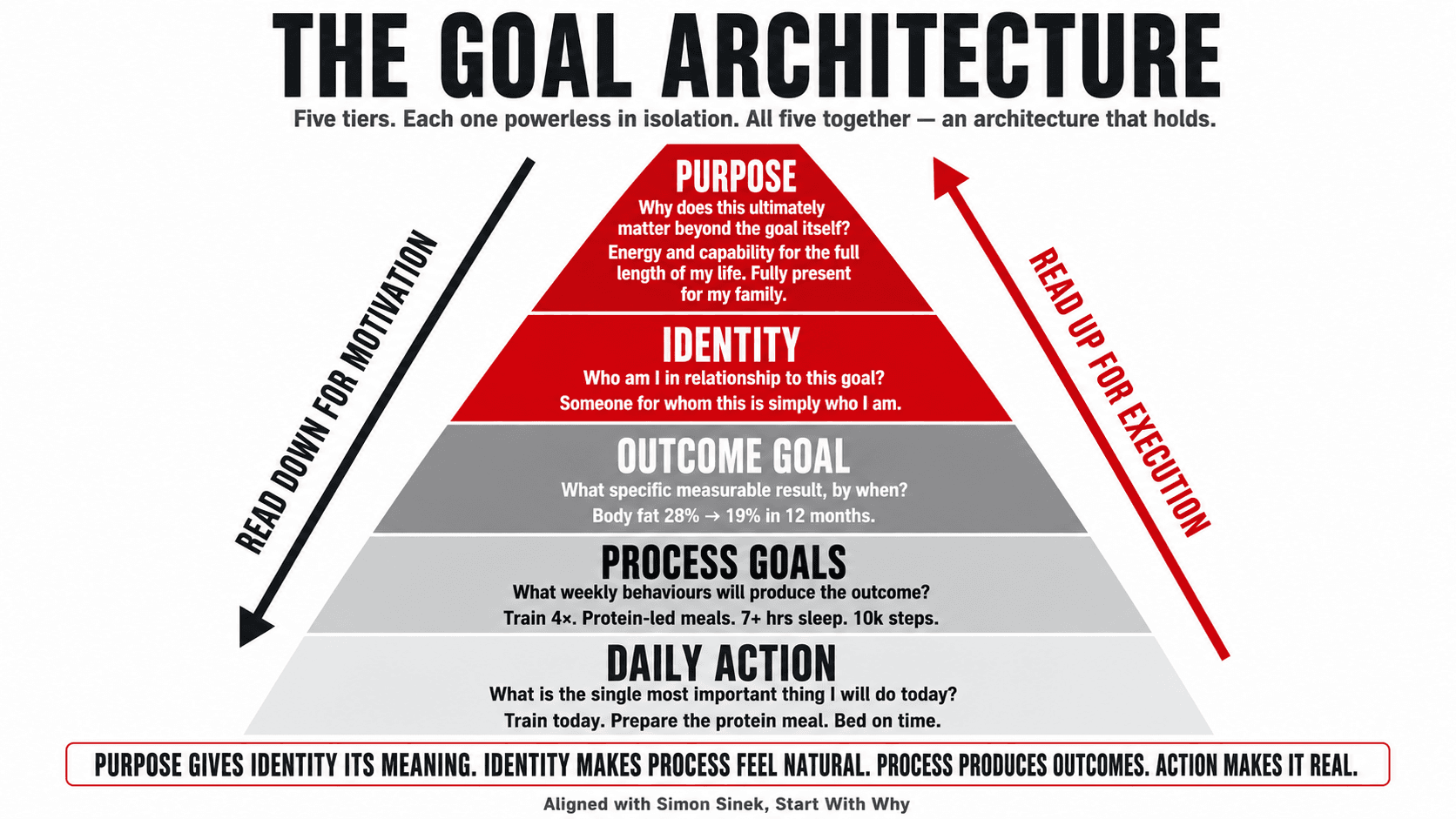
The most effective goal structures are not single goals with SMART criteria attached. They are layered architectures in which a daily action sits within a process goal, which serves an outcome goal, which expresses an identity, which is grounded in a purpose larger than the goal itself. Each layer derives its motivational force from the layer below it. Each layer is meaningless in isolation and powerful in context.
Diagram
The Goal Architecture Pyramid — From Daily Action to Life Purpose
| Tier | The Question and the Health Example | The Motivational Power |
|---|---|---|
| Tier 5 PURPOSE | Why does this ultimately matter beyond the goal itself? I want to be energetic, strong, and physically capable for the full length of my life. I want to be fully present for my children and for the work I care about. My health is not vanity. It is the infrastructure for everything that matters. | The renewable fuel source. When the outcome goal is distant or the process goal is difficult, purpose answers the question of why the effort is worth it. Purpose outlasts motivation, plateaus, and setbacks. |
| Tier 4 IDENTITY | Who am I in relationship to this goal? I am someone who takes their health seriously as a non-negotiable. I am a person who trains consistently and eats with intelligence. This is not something I am doing. It is part of who I am. | Identity makes goal-consistent behaviour the path of least psychological resistance. When the behaviour is an expression of identity, its absence produces discomfort. Its presence produces coherence. |
| Tier 3 OUTCOME GOAL | What specific, measurable result am I committed to and by when? I will reduce my body fat by ten percent over twelve months. I will complete my first half-marathon by October. I will normalise my blood pressure without medication within eighteen months. | Outcome goals provide direction and a measurable horizon. They answer the question of where. They must be connected to purpose and identity below them to sustain through the journey. |
| Tier 2 PROCESS GOALS | What are the weekly behaviours that will produce the outcome? Train four times per week. Eat a protein-led meal at every sitting. Sleep a minimum of seven hours. Walk ten thousand steps daily. Manage alcohol to one or two occasions per week. | Process goals are the daily and weekly controllables. They convert the outcome goal into executable present-tense actions. They provide the immediate reward of execution regardless of outcome speed. |
| Tier 1 DAILY ACTION | What is the single most important thing I will do today? Train today. Prepare the protein-led meal. Go to bed on time. Take the supplements. Fill the water bottle. Choose the walk over the taxi. One vote for the identity. One brick in the wall. | The daily action is where the architecture becomes reality. Every day, one decision that is consistent with the identity and that moves toward the outcome. This is the practice. Everything else is the structure. |
| Read the pyramid from bottom to top for execution: daily action builds process habits, process habits produce outcomes, outcomes express identity, identity is sustained by purpose. Read it from top to bottom for motivation: purpose gives identity its meaning, identity makes process goals feel natural, process goals produce outcomes, outcomes are achieved through daily action. | ||
Simon Sinek's Golden Circle framework arrives at the same structural principle from a leadership and organisational context: the most inspiring and sustainable behaviour begins with Why, moves to How, and ends with What. The Why is the purpose tier of the goal architecture. The How is the identity and process tiers. The What is the outcome tier. Most people start with What, skip Why entirely, and wonder why the What fails to sustain them through the difficulty that the journey to it reliably contains.(3)
“People don't buy what you do; they buy why you do it. And what you do simply proves what you believe.”
— Simon Sinek, Start With Why
Key Insight: The test of a well-constructed goal architecture is what happens in week ten, when the novelty has gone, the initial results have plateaued, and the motivation of the early commitment has faded to its natural resting level. If the only thing sustaining the behaviour in week ten is the outcome goal, there is a structural problem. If the behaviour in week ten is sustained by process habit, identity coherence, and purpose, the architecture is sound.
The Goal Quality Audit: Eight Dimensions That Separate Goals That Hold From Ones That Collapse
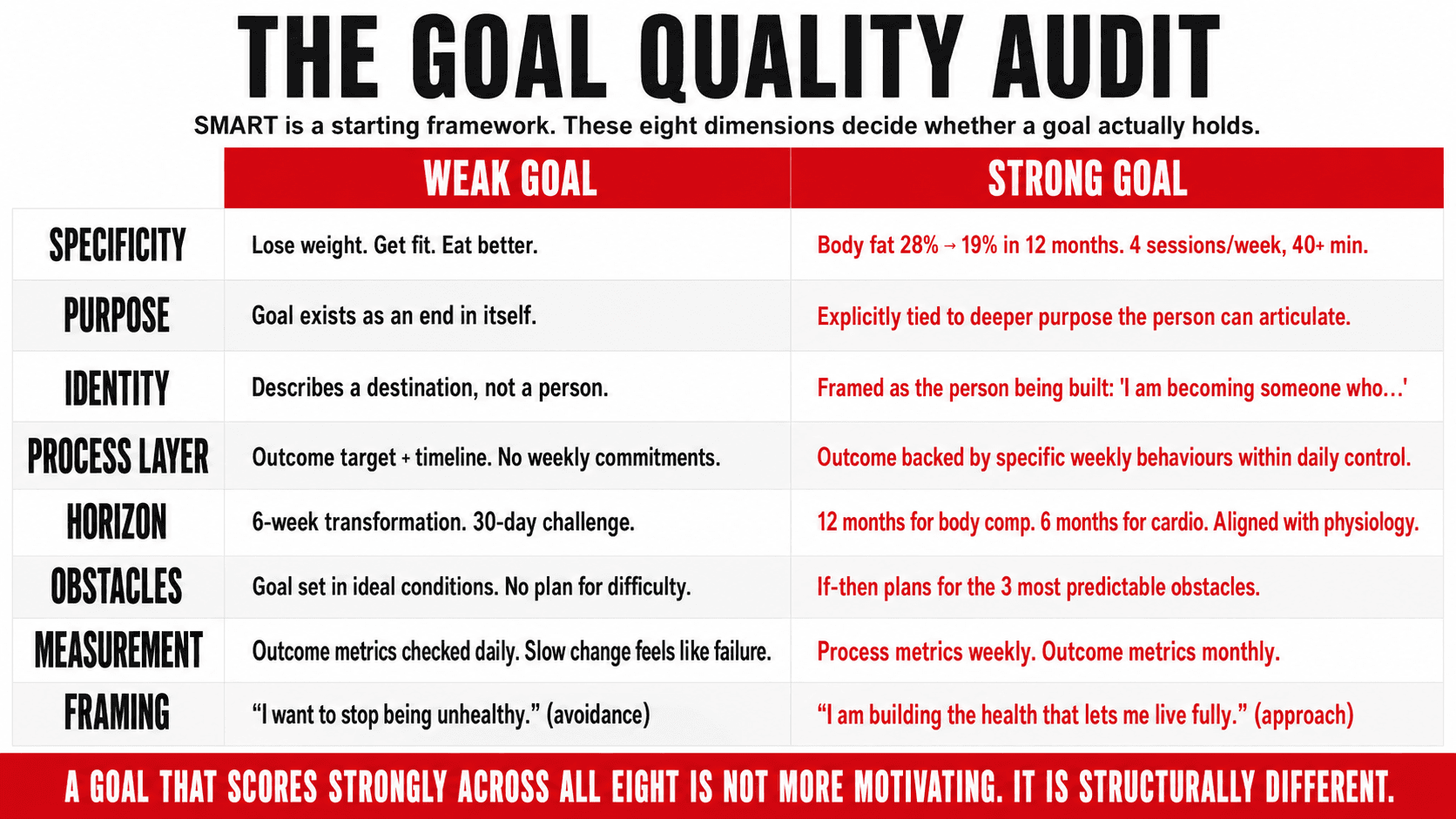
The SMART criteria — Specific, Measurable, Achievable, Relevant, Time-bound — are a useful starting framework but an insufficient one. They address the form of a goal without addressing the motivational architecture beneath it. A goal can be SMART and still lack the purposeful grounding and identity connection that determine whether it sustains across twelve months of variable conditions. The eight-dimension quality audit below examines what SMART criteria miss.
Table
Goal Quality Audit — Eight Dimensions That Separate Goals That Last From Goals That Collapse
| Criterion | Weak Goal Construction | Strong Goal Construction |
|---|---|---|
| Specificity | Lose weight. Get fit. Eat better. Be healthier. Vague enough that the brain cannot form a clear navigational image. | Reduce body fat from 28% to 19% within twelve months. Complete four training sessions per week of at least forty minutes. Specific enough to direct daily decisions. |
| Purpose connection | The goal exists as an end in itself with no articulated connection to anything the person values more deeply than the goal. | The goal is explicitly connected to a deeper purpose that the person can articulate: I want to be strong and energetic to be fully present for my family and to sustain the work I care about. |
| Identity alignment | The goal describes something the person wants to do or have. It describes a destination, not a person. | The goal is framed in terms of the person they are becoming: I am building the identity of someone for whom this level of health is simply who I am. |
| Process layer | The goal has an outcome target and a timeline but no specific weekly or daily behavioural commitments that will produce the outcome. | The outcome goal is backed by specific weekly process commitments that are within complete daily control regardless of outcome speed. |
| Horizon realism | Timeline set to produce motivation rather than physiological reality. Six-week transformations. Thirty-day challenges. Timelines that invite the wrong psychology. | Timeline set to physiological and behavioural reality: twelve months for significant body composition change, six months for meaningful cardiovascular improvement. |
| Obstacle anticipation | Goal set in the context of ideal conditions. No acknowledgment of the obstacles, difficult periods, and disruptions that are guaranteed to occur. | Goal setting includes specific if-then plans for the three most predictable obstacles: the difficult week, the motivational plateau, the social disruption. |
| Measurement approach | Measured exclusively by outcome metrics that change slowly and provide frequent discouragement when checked too often. | Measured primarily by process metrics (sessions attended, days of nutritional adherence) with outcome metrics checked monthly rather than daily. |
| Language and framing | Avoidance-framed: I want to stop being so unhealthy. I want to lose this weight. The goal is oriented away from something undesirable. | Approach-framed: I am building the health and physical capability that allows me to live fully. The goal is oriented toward something genuinely desired. |
| A goal that scores strongly across all eight dimensions is not simply more motivating than one that does not. It is structurally different. It is an architecture rather than a target. It has layers that support each other and a foundation that sustains the entire structure through the conditions that targets cannot survive. | ||
The Approach vs Avoidance Distinction: Why Fear-Based Goals Run Out of Fuel
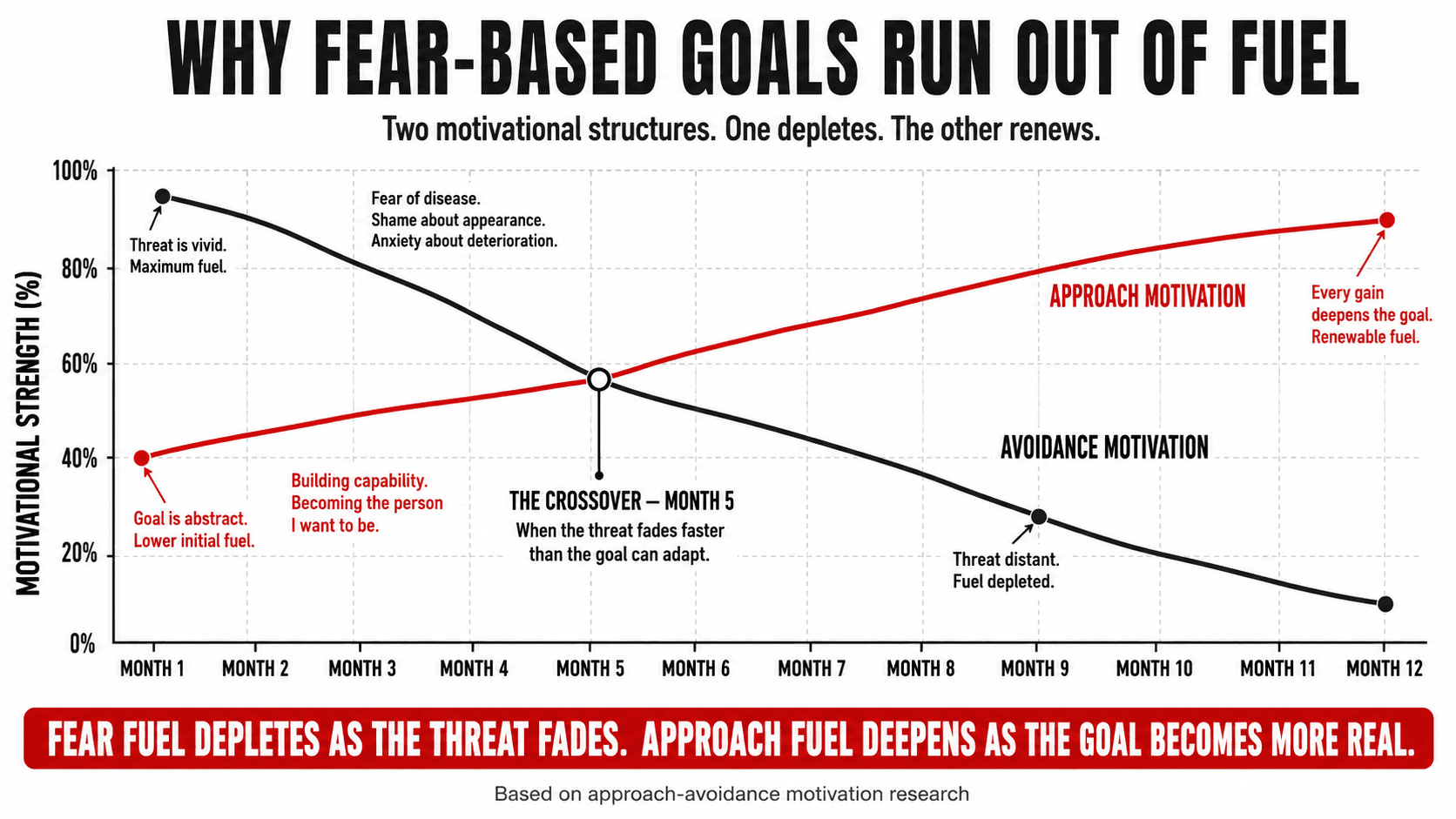
One of the most well-replicated findings in motivation research is the asymmetry between approach motivation and avoidance motivation. Approach motivation, the drive toward a desired positive state, is sustained more reliably over long periods than avoidance motivation, the drive away from an undesired negative state. This is not simply a preference finding. It has a neurological basis: approach motivation is mediated by the brain's reward circuitry and maintains a relatively stable activation across time, while avoidance motivation is mediated by threat-detection systems that habituate as the perceived threat becomes more familiar or more distant.(4)
The practical consequence for health goal setting is direct. A goal framed around fear of disease, shame about current appearance, or anxiety about physical deterioration is an avoidance goal. It generates strong initial motivation because the perceived threat is vivid and proximate. As the programme continues and the threat becomes less vivid, either because health improves and the fear is temporarily relieved, or because the programme is demanding and the threat feels distant, the motivational fuel depletes. The person who started training out of fear of a health scare finds themselves at week twelve with a body that feels meaningfully better but a motivational structure that was designed for acute threat rather than long-term development.
The approach-framed version of the same goal is structurally superior because it points toward an ever-expanding possibility rather than away from a receding threat. The goal of building physical capability, energy, and health that allows the fullest possible engagement with the life I want to live does not diminish as the programme produces results. It deepens. Every positive adaptation is evidence of the goal becoming more real, not evidence that the threat has been sufficiently avoided.
Key Insight: Examine the honest motivational structure of your current health goals. Are they primarily approach-framed or avoidance-framed? If the dominant driver is fear, shame, or the memory of a health scare, the goal architecture will sustain you through the first weeks and become unreliable after the acute emotional fuel has burned. The reframe is not about positivity. It is about pointing the same commitment in a direction that provides renewable fuel rather than a depleting one.
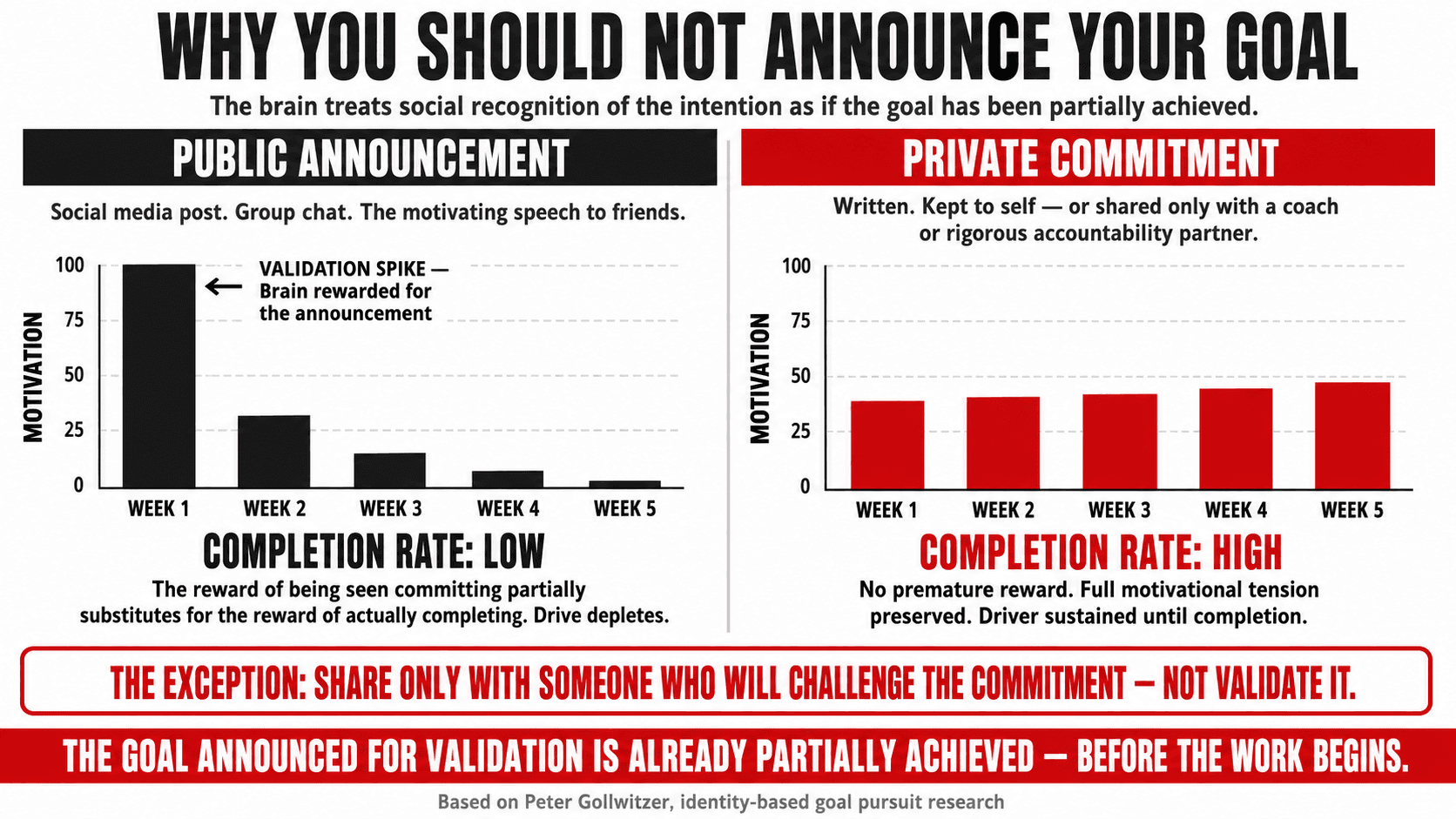
The Premature Reward Effect: Why Telling Everyone Your Goal Reduces Your Chances of Achieving It
Peter Gollwitzer's research on identity-based goal pursuit produced a finding that is counterintuitive but extraordinarily consistent in replication: people who announce ambitious goals to others and receive social recognition for having set the goal are significantly less likely to achieve it than those who keep the goal private. The mechanism is what Gollwitzer termed the premature reward effect: the social acknowledgment of the stated intention produces a neurological reward that is similar in quality to the reward of actual achievement. The brain, having received a version of the reward for the announced intention, reduces the drive to earn it through the less immediately gratifying work of sustained effort.(5)
This is the argument for keeping your health goals private, which runs entirely against the social media culture of publicly announced New Year commitments, before photographs, and progress accountability posts. Those practices feel psychologically supportive because they feel like commitment devices. In Gollwitzer's research, they function as substitutes for the achievement rather than accelerants toward it. The social validation of the announced goal provides a shortcut to the feeling of success that the actual goal was supposed to produce.
The exception identified in Gollwitzer's research is the goal shared with someone who will respond to the announcement with challenge rather than validation: someone who asks what are you going to do tomorrow rather than that is amazing, you will definitely achieve it. The challenging response does not provide a premature reward. It increases the motivational demand of the stated commitment and extends rather than substitutes for the actual work required.(5)
“Setting goals is the first step in turning the invisible into the visible.”
— Tony Robbins
Key Insight: Keep your significant health goals private, or share them only with people whose response you know will be rigorous rather than supportive. A coach, a close relationship with high standards, or an accountability partner whose respect you have to earn through follow-through rather than through the announcement itself. The goal shared for validation is already partially achieved before the work begins, and the partial achievement reduces the drive to complete it.
Writing the Goal Architecture: A Practical Template
The goal architecture is most powerful when it is written explicitly, in full, on a single page. The process of writing forces the clarity that mental goal-setting allows you to avoid. Vague purpose statements, unconvincing identity claims, and aspirationally unrealistic outcome goals are all immediately visible on paper in a way they are not in thought. The writing is the diagnostic as much as it is the plan.
The template has five sections, corresponding to the five tiers of the pyramid. Purpose first: write two to three sentences that articulate the genuine, personally resonant reason this health goal matters. Not the socially acceptable version. The true one. Then identity: one sentence, present tense, describing the person you are in the process of becoming. Then outcome: one specific, measurable, time-bound result. Then process: three to five weekly behavioural commitments that are within complete daily control. Finally, the daily action: the single most important thing you will do today.
Read the completed architecture from bottom to top before you go to sleep and after you wake up for seven days. The seven-day repetition is not motivational ritual. It is the deliberate construction of neural associations between the purpose and identity layers and the daily behaviour, so that the daily behaviour begins to feel like an expression of the person you are rather than an aspiration you are pursuing. That shift, from aspiring to expressing, is the shift that changes everything.
Key Insight: Spend thirty minutes this week writing your full goal architecture. Use the five-tier structure. When you write the purpose section, stop when you find yourself writing something that feels genuinely true rather than something that sounds impressive. The purpose that makes you quietly emotional is almost always more motivationally powerful than the one that sounds like a coaching platitude. Start there. Build the architecture on top of it.
How Goal Architecture Is Built Into Every Client Programme
The goal architecture conversation is the second conversation I have with every new client. The first is about the environment. The second is about the goal structure, because a programme without a well-constructed goal architecture is a programme without the motivational infrastructure to survive the difficult periods that are guaranteed to arrive.
I am not looking for SMART goals in that conversation. I am looking for purpose. I am listening for the moment when the client's language changes quality: from describing what they want to achieving to describing what they want to become and why it matters at the level that is genuinely true for them. That moment tells me what the goal architecture must be built on. Everything else — the training design, the nutritional strategy, the habit architecture — is built on top of it.
If your previous goals have run out of fuel before the results arrived, the problem is almost certainly structural rather than motivational. The goal was not poorly chosen. It was poorly built. I work one-to-one with clients online globally. The architecture conversation is where the programme begins.
Work with Me
Get a personalised coaching plan built around your goals, your schedule, and your life.
Enquire NowReferences
- Matthews G. Goal Research Summary. Dominican University of California. 2015.
- Robbins T. Awaken the Giant Within: How to Take Immediate Control of Your Mental, Emotional, Physical and Financial Life. New York: Simon and Schuster; 1991.
- Sinek S. Start With Why: How Great Leaders Inspire Everyone to Take Action. London: Penguin; 2011.
- Elliot AJ. Approach and avoidance motivation and achievement goals. Educational Psychologist. 1999; 34(3): 169-189.
- Gollwitzer PM, Sheeran P, Michalski V, Seifert AE. When intentions go public: does social reality widen the intention-behavior gap? Psychological Science. 2009; 20(5): 612-618.
- Locke EA, Latham GP. Building a practically useful theory of goal setting and task motivation: a 35-year odyssey. American Psychologist. 2002; 57(9): 705-717.
- Clear J. Atomic Habits: An Easy and Proven Way to Build Good Habits and Break Bad Ones. London: Random House Business; 2018.