
If you have ever searched for a six week fat loss plan online, you will know that the internet is saturated with generic templates, cookie cutter programmes, and transformation challenges that promise dramatic results with minimal thought. Most of them are built around the same formula: slash your calories as low as possible, do as much cardio as you can tolerate, and hope for the best. Some of them work in the short term. Almost none of them work long term. And the reason is that a six week fat loss phase is not about suffering through six weeks of restriction. It is about structuring those six weeks intelligently so that you lose the maximum amount of fat while preserving your muscle, your metabolic health, your energy, and your sanity.
The problem with most fat loss programmes is that they treat all six weeks the same. Same calories, same training, same approach from day one to day forty-two. But your body does not respond the same way in week six as it does in week one. Metabolic adaptation begins within the first week of calorie restriction and becomes progressively more pronounced over time (1). Your resting metabolic rate declines, your non-exercise activity drops, your hunger hormones shift, and your training performance deteriorates. A programme that does not account for these changes is a programme that will stall, and often it will stall right when motivation is at its lowest.
I have refined a six week fat loss structure that I use with every client I work with, adapting the specifics to their individual circumstances but keeping the framework consistent. This is the exact process behind results like 24 kilograms lost by a client managing type 1 diabetes, 33 kilograms lost by a vegetarian client, and clients going from XXL to Medium in nine months. Every one of those transformations started with structured, intelligently programmed fat loss phases. Here is exactly how I build one.
Before the Six Weeks Begin: The Non-Negotiable Prerequisites
I never start a client on a fat loss phase until three things are in place. First, I need an accurate picture of their current maintenance calories. This means at least seven to fourteen days of food tracking at their normal intake, combined with daily weigh-ins, to establish a baseline. If someone comes to me already eating very low calories, I will spend time building their intake back up to a genuine maintenance level before starting the deficit. You cannot create a sustainable deficit from a starting point that is already too low (2).
Second, I need their training foundation established. A client who has never resistance trained needs an introductory phase to learn movement patterns, build work capacity, and develop the consistency habit before I overlay a calorie deficit on top. Dieting without a resistance training stimulus is a recipe for muscle loss and metabolic suppression (3).
Third, I need their lifestyle stressors assessed. If a client is sleeping four hours a night, going through a divorce, and working 80 hour weeks, adding aggressive calorie restriction on top of that is irresponsible. Cortisol is already elevated, recovery is already compromised, and adherence will be near impossible. Sometimes the best fat loss intervention is to fix the sleep and the stress first.
Never start a fat loss phase from a place of chaos. Get your baseline calories, your training, and your sleep in order first. Skipping this step is the single most common reason fat loss phases fail before they even begin.
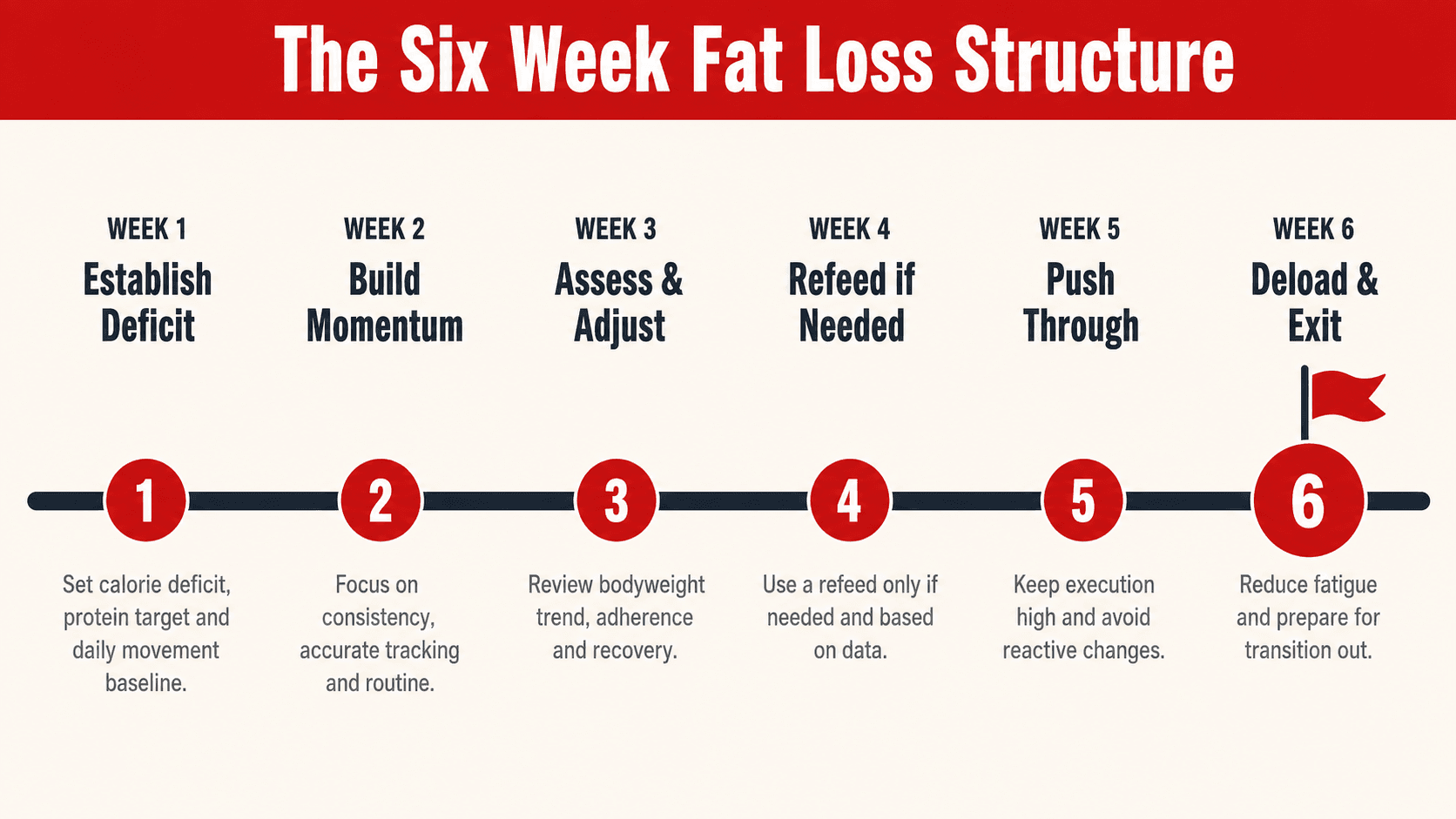
The Six Week Fat Loss Phase: Week by Week Overview
This table provides a bird's-eye view of how I structure each week of a six week fat loss phase. The specifics change for every client, but the progression and the principles remain consistent.
| Week | Nutrition Focus | Training Focus | NEAT Target | Key Monitoring |
|---|---|---|---|---|
| 1 | Establish deficit: 400 to 500 kcal below maintenance. Set protein at 1.8 to 2.2g/kg. Track all food. | Introduce or maintain resistance training 3 to 4 sessions. Establish baseline loads. | 8,000 to 10,000 steps | Daily weigh-ins. Baseline waist measurement. Baseline photos. |
| 2 | Same deficit. Refine food choices for satiety and adherence. Address any tracking gaps. | Progressive overload: aim to add reps or small load increases to all compound lifts. | 8,000 to 10,000 steps | Weekly average weight. Check step count vs target. |
| 3 | Assess adherence. If progress is on track, maintain calories. If stalled, audit food tracking. | Maintain progressive overload. Increase training volume slightly if recovery allows. | 8,000 to 10,000 steps | Fortnightly waist measurement. Compare weekly weight averages. |
| 4 | Consider a 1 to 2 day refeed if energy or training performance is declining. Otherwise maintain deficit. | Maintain training intensity. Deload is NOT needed at week 4 for most clients. | 8,000 to 10,000 steps | Weekly average weight. Training performance log. Energy and mood check-in. |
| 5 | If fat loss has slowed, increase NEAT by 1,000 to 2,000 steps before reducing food further. | Push for personal bests on key lifts. This is the peak training week. | 10,000 to 12,000 steps | Weekly average weight. Waist measurement. Compare to week 1 photos. |
| 6 | Maintain or slightly reduce deficit if needed. Begin planning the transition to maintenance. | Slight deload: reduce volume by 30 to 40% while maintaining intensity. | 8,000 to 10,000 steps | Final weigh-in. Final waist measurement. Final photos. Plan maintenance phase. |
Weeks 1 and 2: Establishing the Deficit and Building Momentum
The first two weeks are about precision and establishing the systems that will carry the client through the entire phase. I set the calorie deficit at 400 to 500 calories below their established maintenance level. This is moderate enough to avoid aggressive metabolic adaptation while being meaningful enough to produce visible results within the first two weeks (4). For most of my clients, this translates to a rate of fat loss of approximately 0.5 to 1 percent of bodyweight per week, which is the range supported by research for maximising fat loss while preserving lean mass.
Protein is set at 1.8 to 2.2 grams per kilogram of bodyweight. This is the most critical macronutrient during a fat loss phase. A meta-analysis of 49 studies involving 1,863 participants found that protein supplementation beyond approximately 1.6 grams per kilogram per day produced no further gains in fat-free mass during resistance training (5). However, during a calorie deficit, the demands on protein increase because the body is more likely to break down muscle tissue for energy. I err toward the higher end of the range, 2.0 to 2.2 grams per kilogram, for clients who are leaner or training with high volumes.

For omnivore clients, this protein comes from chicken, turkey, fish, eggs, lean beef, Greek yoghurt, and whey protein. For vegetarian clients, the same targets are achieved through eggs, Greek yoghurt, cottage cheese, tofu, tempeh, seitan, and supplemental whey or casein. For vegan clients, I build protein around tofu, tempeh, seitan, edamame, lentils, chickpeas, soy protein isolate, pea protein, and strategic combinations of legumes and grains. The target is the same regardless of dietary preference. The execution changes, the principle does not.
Carbohydrates and fats fill the remaining calories after protein is set. I do not prescribe a specific ratio because it depends on the individual's preference, training demands, and metabolic health. A client with type 2 diabetes or PCOS may benefit from moderately lower carbohydrates and higher fats, while a client training with high volume and intensity may need more carbohydrates to fuel performance. The only non-negotiable is that fat intake does not drop below approximately 0.7 grams per kilogram of bodyweight to support hormonal health (6).
Weeks 3 and 4: Assessing, Adjusting, and Maintaining Momentum
By week three, I have two full weeks of data. I know how the client's weight is trending, how their waist measurement has changed, how their training is responding, and how their adherence has been. This is the first real decision point in the programme.
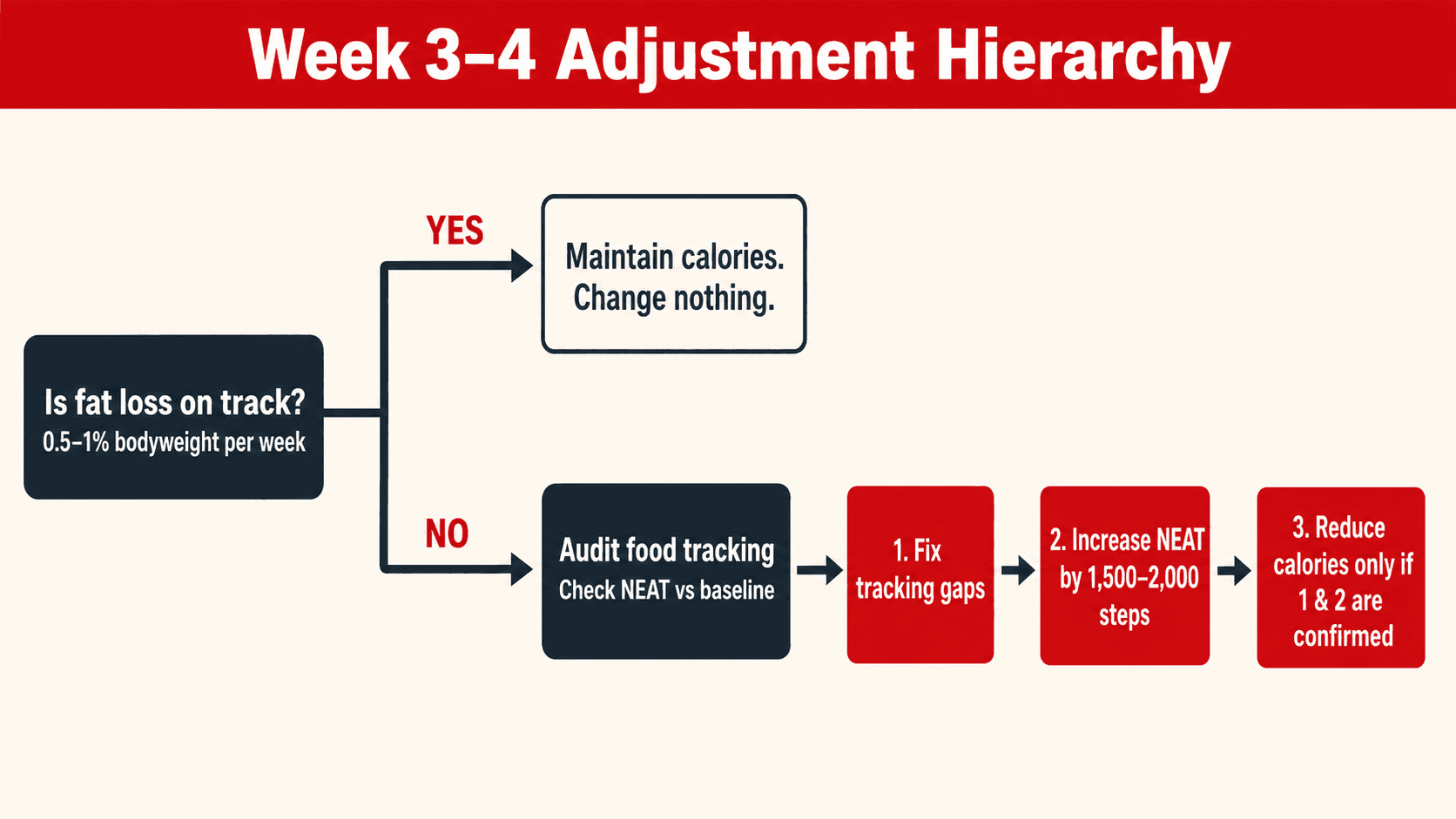
If the client is losing 0.5 to 1 percent of bodyweight per week and their training performance is stable or improving, I change nothing. The biggest mistake I see in fat loss programming is making adjustments too early. Two weeks of data is the minimum required to assess a genuine trend once you account for water fluctuations, glycogen changes, and daily variability. Many coaches and clients panic after five days of a flat scale and immediately slash calories. This is almost always premature.
Do not make nutritional adjustments based on less than two full weeks of consistent data. Short-term scale fluctuations are driven by water, sodium, glycogen, bowel contents, and stress. They tell you nothing meaningful about fat loss. Only trends over two to four week periods reveal genuine progress or genuine stalls.
If progress has genuinely stalled after two to three weeks of confirmed adherence, I follow a specific hierarchy of adjustments. First, I audit the food tracking for hidden calories and portion drift. Second, I check step count against baseline. Third, if both are confirmed accurate, I increase NEAT before reducing food. Adding 1,500 to 2,000 steps per day is almost always my preferred first adjustment because it increases expenditure without increasing hunger, reducing training fuel, or accelerating metabolic adaptation.
Week four is when I assess whether a refeed day is warranted. If the client's training performance has declined noticeably, their energy is consistently low, or their hunger is becoming difficult to manage, I will implement a one to two day refeed at maintenance calories with increased carbohydrates. This is particularly important for leaner clients, female clients approaching the luteal phase of their cycle, and anyone whose mood or sleep has deteriorated since starting the deficit.
The Training Structure: What I Programme and Why
Resistance training during a fat loss phase serves one primary purpose: to provide the stimulus that tells your body to preserve muscle mass. Without that stimulus, your body will preferentially break down muscle tissue alongside fat during a calorie deficit, leaving you lighter but with a worse body composition (3). Here is the training framework I use for most clients during a six week fat loss phase.
| Element | What I Programme | Why It Matters |
|---|---|---|
| Frequency | 3 to 4 resistance sessions per week. Full body or upper/lower split depending on the client. | Hitting each muscle group at least twice per week optimises the muscle preservation signal during a deficit (7). |
| Exercise selection | Compound movements as the foundation: squats, deadlifts, presses, rows, lunges. Isolation work as supplementary. | Compound lifts recruit the most muscle mass, generate the strongest anabolic signal, and burn the most calories per set. |
| Rep ranges | Primarily 6 to 12 reps for compound lifts. 10 to 15 reps for isolation work. Heavy singles and triples are not prioritised. | Moderate rep ranges balance mechanical tension with sufficient volume. Very heavy loads increase injury risk when recovery is compromised by a deficit. |
| Progressive overload | Aim to maintain or increase weight on the bar each week. If load cannot increase, increase reps within the target range. | Progressive overload is the primary driver of muscle retention during a deficit. If you are lifting less each week, you are losing muscle (8). |
| Volume | Start at 10 to 16 hard sets per muscle group per week. Adjust down only if recovery is compromised. | Volume is the secondary driver after intensity. Enough to stimulate, not so much that it exceeds recovery capacity in a deficit. |
| Rest periods | 2 to 3 minutes between compound sets. 60 to 90 seconds between isolation sets. | Adequate rest ensures you can lift with the intensity needed to preserve muscle. Rushing rest periods to burn more calories is counterproductive. |
| Cardio | Minimal structured cardio. NEAT (walking) is the primary tool for additional energy expenditure. | Excessive cardio competes with recovery from resistance training, increases hunger, and accelerates metabolic adaptation. Walking does not (9). |
| Week 6 deload | Reduce training volume by 30 to 40% while maintaining the same intensity (load on the bar). | Allows accumulated fatigue to dissipate before the maintenance phase. Prevents the training staleness that often develops in the final week of a deficit. |
Never reduce the weight on the bar during a fat loss phase unless injury or pain requires it. The single most important training variable during a deficit is intensity, meaning the load you lift relative to your capacity. If you start voluntarily reducing loads because you feel tired or unmotivated, you are removing the stimulus your body needs to retain muscle. Reduce volume before you reduce intensity. Reduce frequency before you reduce volume. The weight on the bar is the last thing to go.
Weeks 5 and 6: Pushing Through and Planning the Exit
Week five is typically the hardest week psychologically. The novelty of the new programme has worn off. Fatigue has accumulated. Hunger is at its peak. Motivation is at its lowest. This is precisely the week where most people either quit or make rash decisions like dramatically cutting calories or adding excessive cardio. I prepare every client for this in advance.
If fat loss has slowed in week five, my first intervention is always to increase NEAT rather than reduce food. Adding 2,000 extra steps per day at this stage costs almost nothing in terms of fatigue or recovery but adds 100 to 200 additional calories of expenditure. I only reduce calories further if NEAT is already maximised and food tracking confirms consistent adherence.
Week six includes a training deload. I reduce volume by 30 to 40 percent while keeping the same loads on the bar. This serves two purposes. It allows accumulated fatigue to clear before the transition to maintenance. And it gives the client a psychological win: they feel stronger, more energetic, and more positive about their results going into the maintenance phase, which dramatically improves adherence to the post-diet plan.
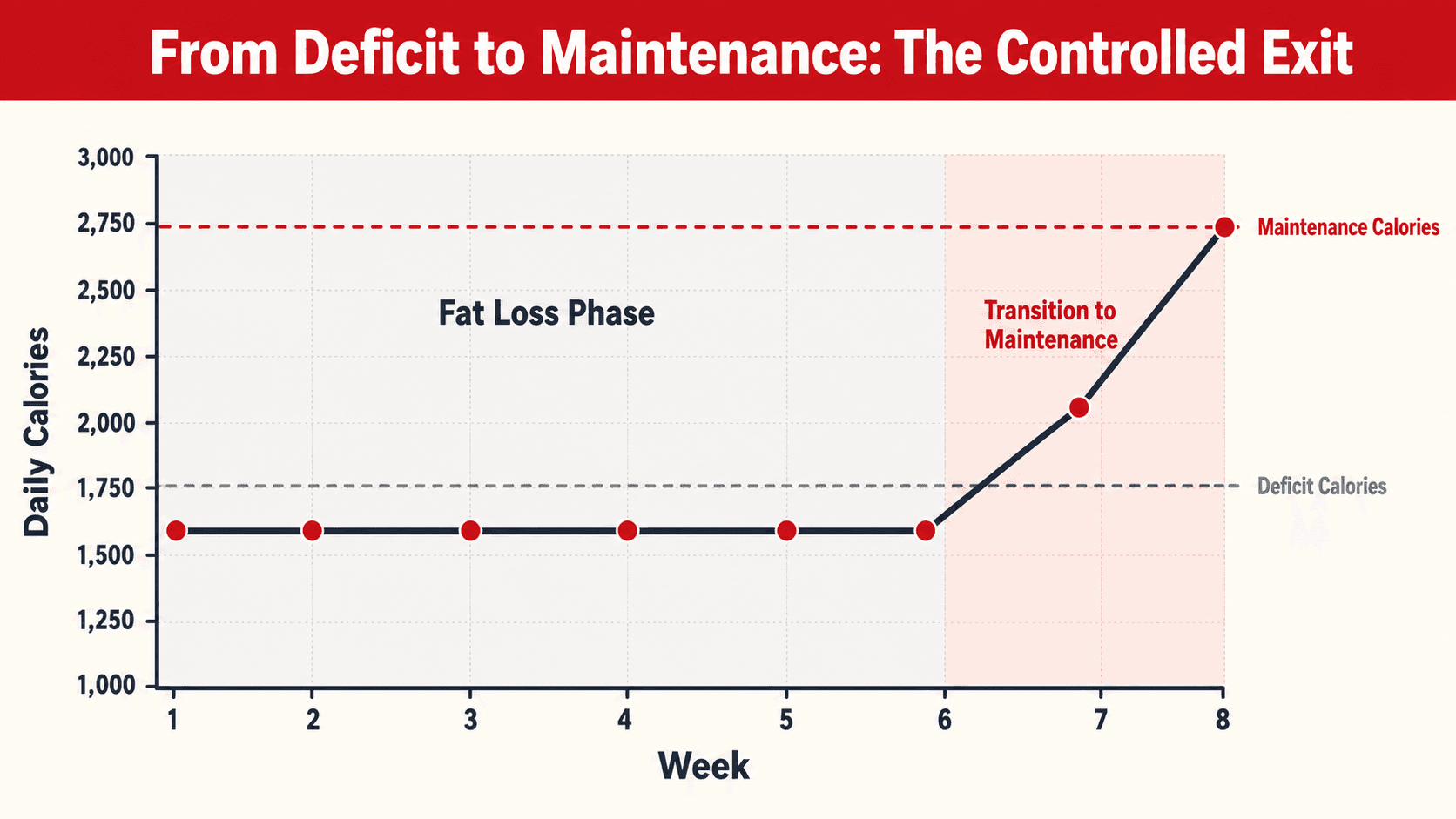
The most important part of week six is planning the exit strategy. A fat loss phase without a structured transition to maintenance is incomplete. I gradually increase calories back to maintenance level over one to two weeks, keeping protein high, keeping training consistent, and monitoring weight to ensure a controlled transition. The goal is to stabilise at the new lower weight without the rebound that occurs when people abruptly return to unrestricted eating.
What Realistic Six Week Results Look Like
One of the most damaging things in the fitness industry is unrealistic expectations set by transformation challenges and social media. Here is what realistic, healthy, sustainable progress actually looks like over a structured six week fat loss phase.
| Metric | Realistic Six Week Range | What This Means in Practice |
|---|---|---|
| Total weight loss | 2 to 5 kg (depending on starting weight and body fat level) | Higher starting weight typically means faster initial loss due to greater energy expenditure |
| Waist circumference reduction | 2 to 6 cm | Often a more reliable indicator of fat loss than scale weight, especially in the first phase |
| Body fat percentage change | 1 to 3 percentage points | Meaningful change that is visible in the mirror and measurable with calipers or scans |
| Strength on key lifts | Maintained or slightly increased | If strength drops significantly, protein is too low, the deficit is too aggressive, or recovery is compromised |
| Visual change | Noticeable in photos, particularly around the midsection, face, and upper arms | Progress photos taken in the same lighting and conditions are one of the best assessment tools |
Top Tips: Getting the Most from Your Six Week Fat Loss Phase
Set your deficit at 400 to 500 calories below maintenance, not 800 or 1,000. A moderate deficit produces nearly the same fat loss as an aggressive one over six weeks but with dramatically less muscle loss, less metabolic adaptation, less hunger, and far better adherence (4). The clients who get the best six-week results are not the ones who eat the least. They are the ones who adhere the most consistently.
Take progress photos in the same lighting and conditions every two weeks. Your eyes adjust to gradual changes and you will not see the difference in the mirror. Side-by-side photos at weeks 0, 2, 4, and 6 reveal changes that are invisible in real time. Front, side, and back. Same time of day. Same location. Same clothing.
Prioritise sleep above everything except nutrition and training. A study published in the Annals of Internal Medicine found that sleep restriction during a calorie deficit reduced the proportion of weight lost as fat by 55 percent and increased the loss of lean mass (10). Five and a half hours of sleep versus eight and a half hours resulted in similar total weight loss but dramatically different body composition outcomes. Sleep is not a luxury during a fat loss phase. It is a performance-enhancing tool.

Track your training performance with the same discipline as your food. Record the weight, sets, and reps for every exercise in every session. If your performance is trending downwards over two consecutive weeks, something needs to change: more food, more sleep, more recovery, or less volume. Declining training performance during a deficit is the earliest warning sign that you are losing muscle.
Plan your meals around your protein target first, then fill in the rest. Protein is the hardest macronutrient to hit consistently, especially for vegetarian and vegan clients. Build every meal around a protein source first, whether that is chicken, fish, eggs, tofu, tempeh, seitan, lentils, Greek yoghurt, or a protein shake, then add your carbohydrates and fats around it.
Do not add a maintenance phase after six weeks as an afterthought. Plan it from the start. Before the fat loss phase even begins, I tell every client exactly what will happen in weeks seven and eight. Calories go up to maintenance. Training continues. Monitoring continues. This is not the end of the process. It is part of the process. The maintenance phase locks in your results and prepares your body for the next phase, whether that is continued fat loss or a shift toward building muscle.
The Bottom Line
A six week fat loss phase is not about starving yourself for forty-two days and hoping for the best. It is a structured, progressive, data-driven process with clear phases, specific targets, built-in adjustments, and a planned exit strategy. The nutrition is precise but sustainable. The training is designed to preserve muscle, not just burn calories. The monitoring is consistent and objective. And the whole thing is designed to produce results that last, not results that evaporate the moment you stop dieting.
If you want a six week fat loss phase built specifically for you, with every calorie, every training session, every adjustment, and every decision handled by an expert coach, get in touch. I work one-to-one with clients online globally. Whether you eat meat, are vegetarian, vegan, or plant-based, whether you are managing diabetes, PCOS, hypertension, or simply want to look and feel your best, I will build the programme that gets you there. No templates. No guesswork. Just structured, evidence-based coaching that delivers.
Work with Me
Get a personalised coaching plan built around your goals, your schedule, and your life.
Enquire NowReferences
- Trexler ET, Smith-Ryan AE, Norton LE. Metabolic adaptation to weight loss: implications for the athlete. Journal of the International Society of Sports Nutrition. 2014; 11(1): 7.
- Dulloo AG, Jacquet J, Montani JP, Schutz Y. How dieting makes the lean fatter: from a perspective of body composition autoregulation through adipostats and proteinstats awaiting discovery. Obesity Reviews. 2012; 13(Suppl 2): 1-21.
- Cava E, Yeat NC, Mittendorfer B. Preserving healthy muscle during weight loss. Advances in Nutrition. 2017; 8(3): 511-519.
- Garthe I, Raastad T, Refsnes PE, Koivisto A, Sundgot-Borgen J. Effect of two different weight-loss rates on body composition and strength and power-related performance in elite athletes. International Journal of Sport Nutrition and Exercise Metabolism. 2011; 21(2): 97-104.
- Morton RW, Murphy KT, McKellar SR, et al. A systematic review, meta-analysis and meta-regression of the effect of protein supplementation on resistance training-induced gains in muscle mass and strength in healthy adults. British Journal of Sports Medicine. 2018; 52(6): 376-384.
- Helms ER, Aragon AA, Fitschen PJ. Evidence-based recommendations for natural bodybuilding contest preparation: nutrition and supplementation. Journal of the International Society of Sports Nutrition. 2014; 11: 20.
- Schoenfeld BJ, Ogborn D, Krieger JW. Effects of resistance training frequency on measures of muscle hypertrophy: a systematic review and meta-analysis. Sports Medicine. 2016; 46(11): 1689-1697.
- Schoenfeld BJ, Grgic J, Ogborn D, Krieger JW. Strength and hypertrophy adaptations between low- vs high-load resistance training: a systematic review and meta-analysis. Journal of Strength and Conditioning Research. 2017; 31(12): 3508-3523.
- Levine JA. Non-exercise activity thermogenesis (NEAT). Best Practice and Research Clinical Endocrinology and Metabolism. 2002; 16(4): 679-702.
- Nedeltcheva AV, Kilkus JM, Imperial J, Schoeller DA, Penev PD. Insufficient sleep undermines dietary efforts to reduce adiposity. Annals of Internal Medicine. 2010; 153(7): 435-441.