You Are Eating Well. But Are You Actually Nourished?
Here is something I see constantly with clients over 40. They eat what they consider to be a healthy diet. They include plenty of vegetables. They avoid junk food most of the time. Some are vegetarian or vegan. Others eat meat and fish regularly. And yet, when I start digging into what they are actually consuming, and more importantly what their blood work reveals, there are nutrient deficiencies hiding beneath the surface that are quietly undermining their health, their energy, their training, and their body composition.
This is not a niche problem. Research published in the European Journal of Clinical Nutrition has shown that nutrient deficiencies in adults over 40 are remarkably common, even in developed countries with abundant food supply(1). The most frequent shortfalls include vitamin D, vitamin B12, magnesium, calcium, iron, omega-3 fatty acids, and zinc. These are not obscure micronutrients. They are fundamental building blocks that your body relies on for everything from bone density and muscle function to immune health, cognitive performance, and hormonal balance.
If you follow a vegetarian or vegan diet, some of these risks are amplified further. A systematic review of 40 studies found that B12 deficiency prevalence among vegetarian and vegan adults ranged from 0 to 86.5 percent, with vegans at the highest risk(2). That is not a scare statistic. It is a well-documented reality that anyone eating a plant-based diet needs to take seriously.
But this article is not just for vegetarians or vegans. Whether you eat meat, fish, dairy, plants, or a mix of everything, the chances are that after 40, you are falling short on at least one critical nutrient. And I want to show you exactly where the gaps are and how to close them.
Why Nutrient Deficiencies Get Worse After 40
Several things happen to your body after 40 that make nutrient deficiencies more likely and more damaging. First, your body becomes less efficient at absorbing certain nutrients. Stomach acid production declines with age, which directly impairs the absorption of vitamin B12, calcium, iron, and magnesium(3). You might be eating the same foods you always have and still be getting less from them.
Second, if you are taking medications, which becomes increasingly common after 40, those medications can deplete key nutrients. A review published in the Journal of Pharmacy Practice identified that commonly prescribed drugs including statins, blood pressure medications, diabetes medications such as metformin, and proton pump inhibitors can deplete vitamin B12, magnesium, CoQ10, and calcium(4). This is something most people never consider and most GPs never mention.
| Reason | Detail |
|---|---|
| 1. Reduced Absorption | Stomach acid declines, impairing uptake of B12, calcium, iron, magnesium |
| 2. Medication Effects | Statins deplete CoQ10. Metformin depletes B12. PPIs impair calcium and magnesium absorption |
| 3. Increased Demand | Ageing muscles, bones, and organs require more of certain nutrients to maintain function |
| 4. Dietary Habits | Appetite changes, smaller portions, and restrictive diets narrow the range of nutrients consumed. Even a ‘healthy’ diet can leave gaps when these four factors compound. |
Third, your requirements actually increase for certain nutrients as you age. Protein needs go up because of anabolic resistance. Calcium and vitamin D requirements increase to protect bone density. Omega-3 demands rise because of increasing systemic inflammation. Your body is not just getting less. It needs more. And that mismatch is where the damage accumulates.
Left unaddressed, these deficiencies do not just make you feel tired. They accelerate muscle loss, weaken bones, impair immune function, slow recovery from training, disrupt sleep, and contribute to the progression of conditions like osteoporosis, cardiovascular disease, and cognitive decline. This is not theoretical. These are measurable, clinical outcomes that I see reflected in the blood work of clients who come to me for help.

The Seven Critical Nutrients and How to Get Enough of Each One
I am going to walk you through the seven nutrients that I see most commonly deficient in clients over 40. For each one, I will explain what it does, why you might be lacking it, and how to fix it through food and, where necessary, supplementation. I will cover options for omnivores, vegetarians, and vegans because the risks and solutions differ depending on your dietary approach.
1. Vitamin D: The Deficiency Almost Everyone Has
Vitamin D is arguably the most widespread deficiency in the UK, and for good reason. Our primary source is sunlight, and in the UK, from October to March, the sun is not strong enough to produce adequate vitamin D through the skin. The National Diet and Nutrition Survey found that approximately one in five adults in the UK has low vitamin D status(5). During winter months, that figure rises considerably.
Vitamin D is essential for calcium absorption, bone health, immune function, and muscle performance. A deficiency has been linked to increased risk of osteoporosis, cardiovascular disease, type 2 diabetes, depression, and impaired muscle recovery(1). If you are training hard and not supplementing vitamin D, particularly in winter, you are almost certainly not recovering as well as you could be.
Vitamin D Food Sources and Supplement Guidance
| Source | Vitamin D Content | Dietary Suitability |
|---|---|---|
| Salmon (100g, cooked) | ~10–20 µg (400–800 IU) | Omnivore / Pescatarian |
| Sardines (100g, canned) | ~4.8 µg (192 IU) | Omnivore / Pescatarian |
| Egg yolks (2 large) | ~2 µg (80 IU) | Vegetarian |
| Fortified plant milk (250ml) | ~1.5–2.5 µg (60–100 IU) | Vegan / Vegetarian |
| Fortified cereals (30g serving) | ~1–2.5 µg (40–100 IU) | Vegan / Vegetarian |
| UV-exposed mushrooms (100g) | ~10–20 µg (400–800 IU) | Vegan |
| Supplement (D3 cholecalciferol) | 1,000–4,000 IU daily | All (vegan D3 from lichen available) |
Top Tip
If you live in the UK, supplement vitamin D3 year round at a minimum of 1,000 IU daily. During winter (October to March), consider increasing to 2,000 to 4,000 IU. Ask your GP for a blood test to check your 25-hydroxyvitamin D level. Aim for 75 to 100 nmol/L for optimal health.
2. Vitamin B12: The Silent Deficiency
Vitamin B12 is essential for red blood cell production, neurological function, and DNA synthesis. A deficiency can cause fatigue, weakness, numbness in the hands and feet, memory problems, and if left long enough, irreversible nerve damage(6). What makes B12 particularly dangerous is that deficiency develops slowly and symptoms are often attributed to ‘just getting older’ rather than a correctable nutritional problem.
B12 is found almost exclusively in animal products, which is why vegetarians and especially vegans are at significantly elevated risk. But here is what many people do not realise: B12 deficiency is also common in omnivores over 50, because absorption declines with age. In the general population, B12 deficiency affects approximately 6 percent of people under 60 and up to 20 percent of those over 60(6). Among vegans, one systematic review and meta-analysis found that mean serum B12 levels were significantly lower than in omnivores, with elevated markers of functional deficiency(7).
Vitamin B12 Deficiency Risk by Dietary Pattern
| Dietary Pattern | Estimated Deficiency Risk | Key Reason | What to Do |
|---|---|---|---|
| Omnivore under 50 | Low (6%) | Adequate intake from meat, fish, eggs, dairy | No supplement needed unless symptomatic |
| Omnivore over 50 | Moderate (up to 20%) | Reduced stomach acid impairs absorption | Consider 250–500 mcg methylcobalamin daily |
| Lacto-ovo vegetarian | Moderate to high (up to 32%) | Limited intake from eggs and dairy; no meat or fish | Supplement 250–500 mcg methylcobalamin daily |
| Vegan | High (up to 86.5%) | No animal-sourced B12; plant foods contain none | Supplement 250–1,000 mcg methylcobalamin daily. Non-negotiable. |
I need to be direct here, particularly if you are vegan. Vitamin B12 supplementation is not optional. It is essential. There is no reliable plant-based food source of B12 unless it has been fortified. Nutritional yeast and fortified plant milks can contribute, but they are rarely sufficient on their own. A daily supplement of at least 250 mcg of methylcobalamin, the active form of B12, is the safest approach(6).
Top Tip
Ask your GP to test your serum B12 level, especially if you are vegetarian, vegan, or over 50. If your level is below 300 pg/mL, supplementation is strongly advisable. Do not wait for symptoms to appear before acting.

3. Magnesium: The Mineral You Need for Everything
Magnesium is involved in over 300 enzymatic processes in the body, including energy production, muscle contraction, nerve function, blood pressure regulation, and protein synthesis(8). Despite this, studies consistently show that a significant proportion of adults in Western countries fail to meet the recommended intake. In the UK and the US, estimates suggest that between 50 and 70 percent of adults consume less magnesium than they need(8).
A magnesium deficit affects sleep quality, increases muscle cramps, raises blood pressure, and impairs insulin sensitivity. For anyone with hypertension or type 2 diabetes, optimising magnesium intake is particularly important. If you are exercising regularly, your needs are even higher because magnesium is lost through sweat.
Top Magnesium Food Sources
| Food Source | Magnesium per Serving | Dietary Suitability |
|---|---|---|
| Pumpkin seeds (30g) | ~150 mg | All diets |
| Dark chocolate (30g, 70%+) | ~65 mg | All diets |
| Almonds (30g) | ~80 mg | All diets |
| Spinach (100g, cooked) | ~87 mg | All diets |
| Black beans (100g, cooked) | ~70 mg | All diets |
| Edamame (100g) | ~64 mg | All diets |
| Avocado (1 medium) | ~58 mg | All diets |
| Tofu, firm (100g) | ~53 mg | Vegan / Vegetarian |
| Brown rice (150g, cooked) | ~43 mg | All diets |
Top Tip
If you struggle to get enough magnesium through food, supplement with 200 to 400 mg of magnesium glycinate or magnesium citrate before bed. These forms are well absorbed and the glycinate form may also support sleep quality.
4. Calcium: Not Just About Dairy
Calcium is critical for maintaining bone mineral density, which becomes increasingly important after 40 when bone turnover accelerates, particularly for women approaching or past menopause. The recommended daily intake for adults over 50 is 1,000 to 1,200 mg(9). Many people assume they are getting enough because they consume some dairy, but portion sizes often fall well short of what is needed.
For vegans, calcium is a genuine concern. A systematic review published in Clinical Nutrition found that calcium intake in the majority of vegans studied was below the recommended 750 mg per day(10). Over time, chronically low calcium intake, combined with inadequate vitamin D, creates the conditions for accelerated bone loss and increased fracture risk.
Calcium Sources: Dairy and Non-Dairy Compared
| Food Source | Calcium per Serving | Dietary Suitability | Notes |
|---|---|---|---|
| Yoghurt, plain (200g) | ~300 mg | Vegetarian | Also provides protein and probiotics |
| Cheddar cheese (30g) | ~220 mg | Vegetarian | Calorie-dense; portion control needed |
| Milk, semi-skimmed (250ml) | ~300 mg | Vegetarian | One of the most efficient sources |
| Fortified soy milk (250ml) | ~300 mg | Vegan | Check the label: must say ‘fortified with calcium’ |
| Fortified oat milk (250ml) | ~240–300 mg | Vegan | Shake well; calcium settles at the bottom |
| Tofu, calcium-set (100g) | ~350 mg | Vegan | Exceptional source; check it is set with calcium sulphate |
| Kale (100g, cooked) | ~150 mg | All diets | High bioavailability compared to spinach |
| Broccoli (100g, cooked) | ~47 mg | All diets | Good bioavailability but lower absolute amount |
| Almonds (30g) | ~75 mg | All diets | Also provides magnesium and healthy fats |
| Fortified orange juice (250ml) | ~300 mg | Vegan | Convenient but watch the sugar content |
There is an important nuance here. Not all plant-based calcium sources are equally well absorbed. Spinach, for example, is often cited as a calcium source, but it contains high levels of oxalates which bind to calcium and severely reduce absorption. Kale, broccoli, and bok choy have much better bioavailability. This is the kind of detail that matters when you are relying on plants for your calcium intake.
Top Tip
If you are vegan or dairy-free, aim for at least two to three servings of calcium-fortified foods per day (fortified plant milk, calcium-set tofu, fortified juice). Always shake fortified milks before pouring, as calcium sinks to the bottom of the carton. Consider a calcium citrate supplement of 500 mg if your dietary intake consistently falls below 800 mg.
5. Iron: Understanding the Two Types
Iron deficiency is the most common nutritional deficiency worldwide, and it does not only affect women of menstruating age(1). After 40, iron status can be affected by reduced absorption due to declining stomach acid, increased use of medications that impair absorption (particularly PPIs and antacids), and in some cases, chronic low-level blood loss from gastrointestinal conditions.
There are two types of dietary iron, and understanding the difference is critical, especially if you follow a plant-based diet. Haem iron, found only in animal products, is highly bioavailable and absorbed at a rate of approximately 15 to 35 percent. Non-haem iron, found in both plant and animal foods, is absorbed at a much lower rate of around 2 to 20 percent(11). This means that vegetarians and vegans need to consume significantly more total iron and use specific strategies to enhance absorption.
| Type | Detail |
|---|---|
| Haem Iron (animal sources only) | Absorption rate: 15–35%. Found in: red meat, poultry, fish, shellfish. Not affected by dietary inhibitors. |
| Non-Haem Iron (plant and animal sources) | Absorption rate: 2–20%. Found in: lentils, beans, tofu, spinach, fortified cereals. Absorption enhanced by: vitamin C, cooking in cast iron. Absorption inhibited by: tea, coffee, calcium, phytates. Vegetarians and vegans can meet iron needs, but they must pair iron-rich foods with vitamin C and avoid tea or coffee with meals. |
Top Tip
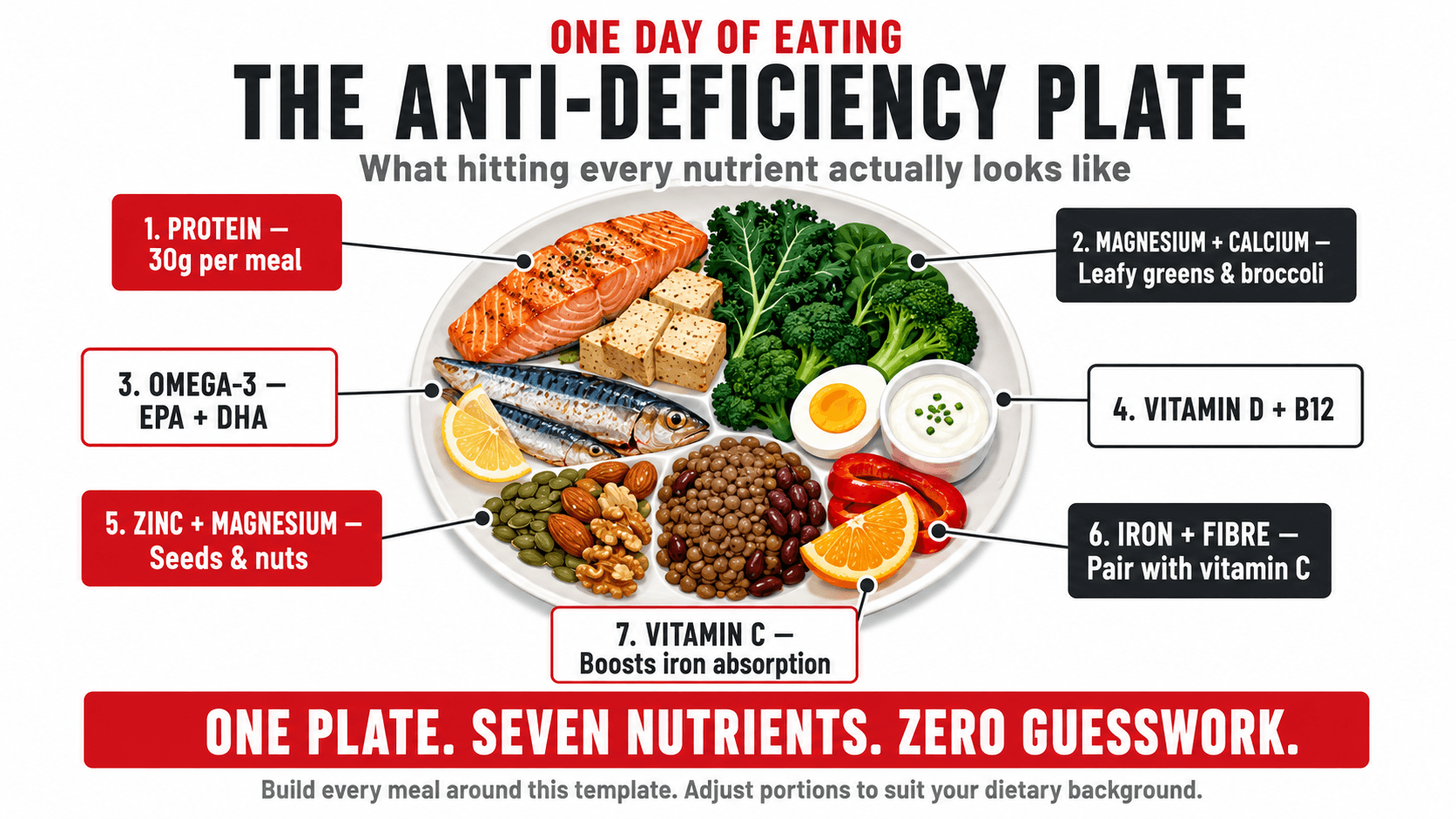
Always pair plant-based iron sources with a vitamin C-rich food to dramatically increase absorption. For example, add lemon juice to lentils, eat red peppers with beans, or have a glass of orange juice with fortified cereal. Avoid drinking tea or coffee within 30 minutes of an iron-rich meal.
6. Omega-3 Fatty Acids: Your Anti-Inflammatory Shield
Omega-3 fatty acids, specifically EPA and DHA, are among the most important nutrients for managing inflammation, supporting cardiovascular health, and maintaining joint function as you age. The typical Western diet is heavily skewed toward omega-6 fatty acids (from vegetable oils, processed foods) and deficient in omega-3s, creating a pro-inflammatory environment in the body(12).
For omnivores and pescatarians, oily fish is the best source of EPA and DHA. Two to three portions of oily fish per week will provide adequate amounts. For vegetarians and vegans, this is one of the most significant nutritional challenges because plant-based omega-3 sources primarily contain ALA (alpha-linolenic acid), which the body converts to EPA and DHA at a very low rate, typically less than 10 percent(13). A systematic review found that EPA and DHA intakes among vegetarians and vegans were significantly lower than in omnivores(14).
Omega-3 Sources by Diet Type
| Source | Omega-3 Content | Type of Omega-3 | Suitability |
|---|---|---|---|
| Salmon (150g) | ~3–4g EPA + DHA | EPA + DHA (direct) | Omnivore / Pescatarian |
| Mackerel (150g) | ~3–4g EPA + DHA | EPA + DHA (direct) | Omnivore / Pescatarian |
| Sardines (100g) | ~1.5–2g EPA + DHA | EPA + DHA (direct) | Omnivore / Pescatarian |
| Fish oil supplement | ~1–2g EPA + DHA per dose | EPA + DHA (direct) | Omnivore / Pescatarian |
| Algae oil supplement | ~250–500mg DHA + EPA per dose | EPA + DHA (direct) | Vegan |
| Flaxseed (2 tbsp, ground) | ~3.5g ALA | ALA (requires conversion) | All diets |
| Chia seeds (2 tbsp) | ~2.5g ALA | ALA (requires conversion) | All diets |
| Walnuts (30g) | ~1.3g ALA | ALA (requires conversion) | All diets |
Top Tip
If you are vegan, an algae-based omega-3 supplement providing at least 250mg of combined EPA and DHA daily is strongly recommended. ALA from flaxseed and chia seeds is beneficial but does not adequately replace preformed EPA and DHA for most people.
7. Zinc: The Overlooked Essential
Zinc is required for immune function, wound healing, protein synthesis, testosterone production, and over 300 enzyme reactions in the body(1). Despite its importance, zinc deficiency is surprisingly common because the body has no dedicated storage system for it. You need a consistent daily supply.
For vegetarians and vegans, zinc is a particular concern because the phytates found in wholegrains, legumes, nuts, and seeds inhibit zinc absorption. The bioavailability of zinc from plant-based diets can be as much as 50 percent lower than from omnivorous diets. For this reason, some experts recommend that vegetarians aim for up to 50 percent more zinc than the standard RDA(14).
Zinc Sources for All Dietary Backgrounds
| Food Source | Zinc per Serving | Dietary Suitability | Absorption Tip |
|---|---|---|---|
| Oysters (6 medium) | ~32 mg | Omnivore | Richest natural source by far |
| Beef (100g) | ~7 mg | Omnivore | Highly bioavailable |
| Chicken thigh (100g) | ~3 mg | Omnivore | Dark meat higher than breast |
| Pumpkin seeds (30g) | ~2.5 mg | All diets | Soak or toast to reduce phytates |
| Chickpeas (100g, cooked) | ~1.5 mg | All diets | Soak before cooking to improve absorption |
| Lentils (100g, cooked) | ~1.3 mg | All diets | Pair with alliums (garlic, onion) for enhanced absorption |
| Cashew nuts (30g) | ~1.6 mg | All diets | Also provides magnesium and iron |
| Tempeh (100g) | ~1.1 mg | Vegan | Fermentation improves mineral bioavailability |
| Fortified cereal (30g) | ~2–4 mg | All diets | Check labels; varies by brand |
Top Tip
Soaking, sprouting, and fermenting grains and legumes reduces phytate content and significantly improves zinc absorption. If you eat a plant-based diet, these preparation methods are not optional extras. They are practical necessities for optimising mineral uptake.
Supplements: A Practical Framework
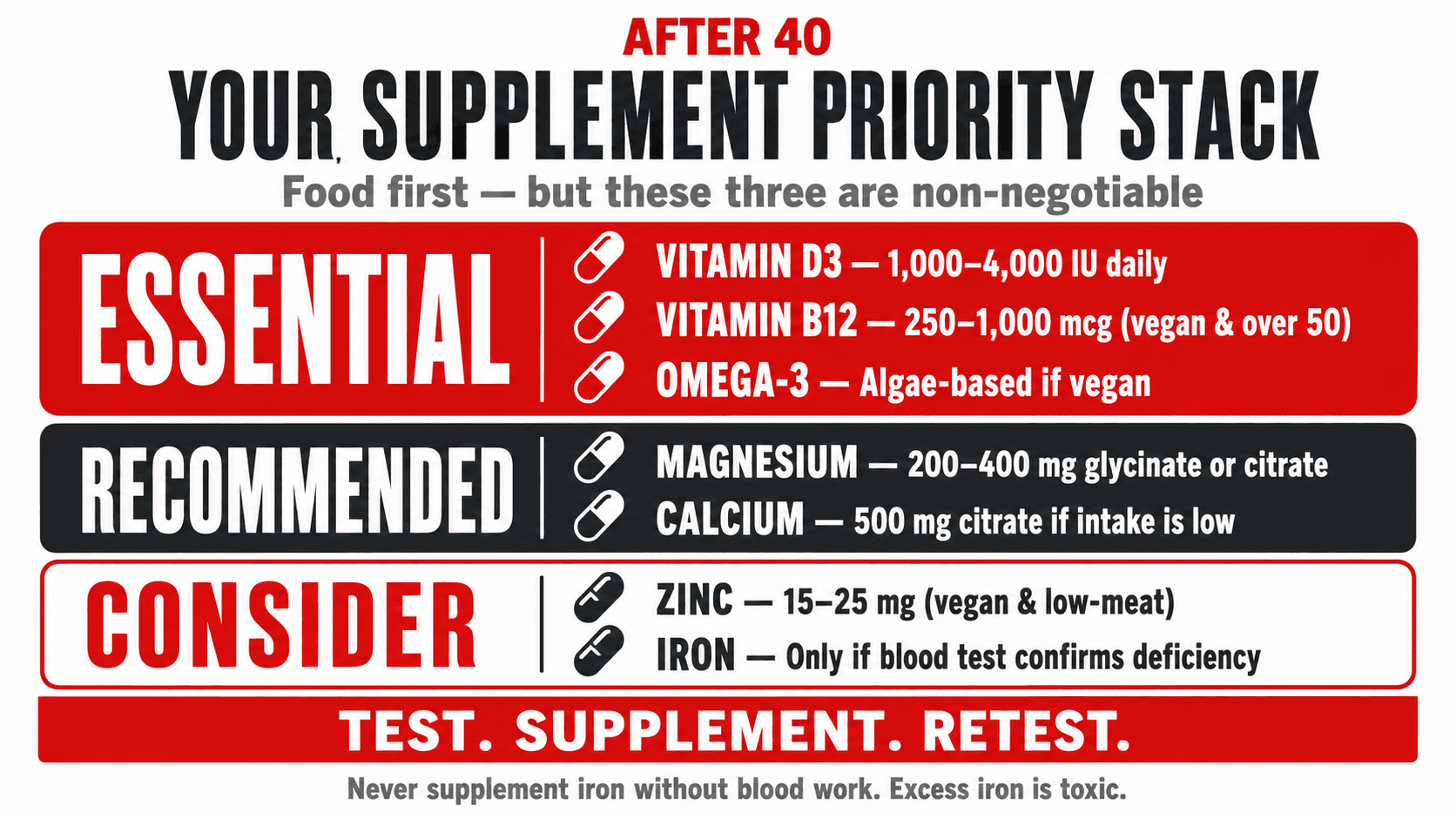
I am not someone who pushes supplements as a first resort. Food should always be the foundation. But there are specific situations where supplementation moves from ‘nice to have’ to ‘essential’, and being over 40 on any diet increases those situations.
Here is a clear, practical framework based on dietary pattern.
Supplement Priority Framework by Dietary Pattern
| Supplement | Omnivore Over 40 | Vegetarian Over 40 | Vegan Over 40 |
|---|---|---|---|
| Vitamin D3 (1,000–4,000 IU) | Recommended | Recommended | Essential (use vegan D3 from lichen) |
| Vitamin B12 (250–1,000 mcg) | Consider if over 50 | Recommended | Essential. Non-negotiable. |
| Omega-3 (EPA + DHA) | Eat oily fish 2–3x/week or supplement | Supplement recommended | Essential (algae-based) |
| Magnesium (200–400 mg) | Recommended if intake is low | Recommended if intake is low | Recommended if intake is low |
| Calcium (500 mg citrate) | Only if dietary intake < 800 mg | Consider if low dairy | Recommended unless diet is calcium-rich |
| Iron | Only if deficient on blood test | Only if deficient on blood test | Only if deficient on blood test |
| Zinc (15–25 mg) | Rarely needed | Consider if intake is low | Recommended |
One important point. Do not self-prescribe iron supplements without blood work. Iron is one of the few nutrients where excess is as dangerous as deficiency. Too much iron causes oxidative damage and can be toxic. Always test first, supplement only if needed, and retest after supplementing(11).
Top Tip
Get a comprehensive blood panel done at least once a year. At minimum, ask your GP to test: full blood count, serum ferritin (iron stores), serum B12, folate, 25-hydroxyvitamin D, HbA1c (blood sugar), and a lipid panel. This gives you a clear picture of where you stand and where to focus your efforts.
A Food First Approach: Your Daily Nutrition Checklist
Rather than obsessing over individual nutrients in isolation, I encourage my clients to focus on building meals around nutrient-dense whole foods. If you are consistently including the right categories of food, most of the gaps close themselves. Here is a practical daily checklist.
| Daily Nutrition Checklist for Over 40s |
|---|
| Protein at every meal (25–40g from meat, fish, eggs, tofu, tempeh, legumes, or protein supplement) |
| At least two servings of calcium-rich foods (dairy, fortified plant milk, calcium-set tofu, kale) |
| A portion of dark leafy greens (spinach, kale, Swiss chard, broccoli) |
| A serving of nuts or seeds (pumpkin seeds, almonds, walnuts, flaxseed) |
| At least one vitamin C-rich food with an iron-rich meal |
| Oily fish twice per week OR an algae-based omega-3 supplement daily |
| Vitamin D3 supplement daily (all diets, all year in the UK) |
| B12 supplement if vegetarian, vegan, or over 50 |
Tick these off daily and you will cover the vast majority of nutritional gaps that undermine health after 40.

How I Can Help You
Nutrition is one of the most powerful tools you have for protecting your health, your energy, and your body composition as you age. But it is also one of the areas where the most confusion and misinformation exist. What I have laid out in this article is based on peer-reviewed evidence and clinical practice across every dietary background.
I am a lifelong vegetarian myself. I understand the specific challenges of meeting nutritional targets without meat or fish because I have navigated them my entire life. I also work with omnivores, pescatarians, and vegans with equal confidence. What matters is not which dietary label you identify with. What matters is whether your diet is actually giving you what your body needs.
If you are over 40 and serious about your health, I offer one-to-one coaching online globally. I will assess your current nutrition, identify the gaps, and build a personalised plan that works for your lifestyle, your goals, and your dietary preferences. No fads. No guesswork. Just evidence and results.
Work with Me
Get a personalised coaching plan built around your goals, your schedule, and your life.
Enquire NowReferences
- Pfeiffer CM, Sternberg MR, Schleicher RL, Haynes BMH, Rybak ME, Pirkle JL. The CDC’s Second National Report on Biochemical Indicators of Diet and Nutrition in the U.S. Population is a valuable tool for researchers and policy makers. Journal of Nutrition. 2013; 143(6): 938S–947S.
- Pawlak R, Parrott SJ, Raj S, Cullum-Dugan D, Lucus D. How prevalent is vitamin B12 deficiency among vegetarians? Nutrition Reviews. 2013; 71(2): 110–117.
- Saltzman JR, Russell RM. The aging gut: Nutritional issues. Gastroenterology Clinics of North America. 1998; 27(2): 309–324.
- Hamid Y, Abdullah N, Jose S, Mohamed SHM. Do medicines commonly used by older adults impact their nutrient status? A systematic review. European Journal of Clinical Pharmacology. 2022; 78(8): 1229–1244.
- Public Health England. National Diet and Nutrition Survey: Rolling Programme Years 9 to 11 (2016/2017 to 2018/2019). PHE Publications. 2020.
- Azzini E, Raguzzini A, Polito A. Vitamin B12 and Plant-Predominant Diets. Nutrients. 2022; 14(10): 1981.
- Sherwood SN, Sherwood CH, Sherwood SN. A systematic review and meta-analysis of functional vitamin B12 status among adult vegans. Journal of Human Nutrition and Dietetics. 2024; 37(6): 1395–1411.
- DiNicolantonio JJ, O’Keefe JH, Wilson W. Subclinical magnesium deficiency: a principal driver of cardiovascular disease and a public health crisis. Open Heart. 2018; 5(1): e000668.
- National Institutes of Health, Office of Dietary Supplements. Calcium Fact Sheet for Health Professionals. NIH. 2024.
- Bakaloudi DR, Halloran A, Rippin HL, Oikonomidou AC, Dardavesis TI, Williams J, et al. Intake and adequacy of the vegan diet. A systematic review of the evidence. Clinical Nutrition. 2021; 40(5): 3503–3521.
- Hurrell R, Egli I. Iron bioavailability and dietary reference values. American Journal of Clinical Nutrition. 2010; 91(5): 1461S–1467S.
- Simopoulos AP. The importance of the ratio of omega-6/omega-3 essential fatty acids. Biomedicine and Pharmacotherapy. 2002; 56(8): 365–379.
- Burdge GC, Calder PC. Conversion of alpha-linolenic acid to longer-chain polyunsaturated fatty acids in human adults. Reproduction Nutrition Development. 2005; 45(5): 581–597.
- Neufingerl N, Eilander A. Nutrient Intake and Status in Adults Consuming Plant-Based Diets Compared to Meat-Eaters: A Systematic Review. Nutrients. 2022; 14(1): 29.
Disclaimer: This article is for educational purposes only and does not constitute medical advice. If you have any existing health conditions or take medications, consult your GP or a registered dietitian before starting any supplementation.