
The Loop Nobody Talks About
The negative thought loop in health behaviour is so common, so predictable in its structure, and so consistent in its consequences that I am surprised how rarely it is named and addressed directly in health and fitness contexts. The conversation about nutrition protocols and training programmes and sleep architecture is important. But the person who misses a training session and spends the next three days in a spiral of self-criticism that ends with them eating the contents of the kitchen and writing off the week is not going to be helped by a better programme. They are going to be helped by understanding what is happening neurologically and how to interrupt it.
The mechanics of the negative thought loop in health behaviour follow a structure so consistent across individuals and programmes that it has become one of the most recognisable patterns I encounter in coaching. It almost always begins with a single deviation from the plan: a missed session, a poor nutritional day, a week of poor sleep that has derailed the consistency of the previous three weeks. The deviation itself is rarely the problem. Training programmes are designed to accommodate imperfection. Nutrition protocols bend without breaking. A single missed session changes almost nothing physiologically.
The problem is the internal response to the deviation. The thought that follows the deviation is almost never accurate, rarely proportionate, and consistently more damaging than the deviation itself. The person who misses one session and tells themselves they have ruined the programme, that they cannot trust themselves, that this is proof of their fundamental lack of discipline, has done far more damage to the programme with those thoughts than with the missed session. And the thoughts, unchallenged, tend to generate consequences that confirm them.
“You can't stop the waves, but you can learn to surf.”
— Jon Kabat-Zinn
The Neuroscience of Why Negative Thought Loops Self-Reinforce
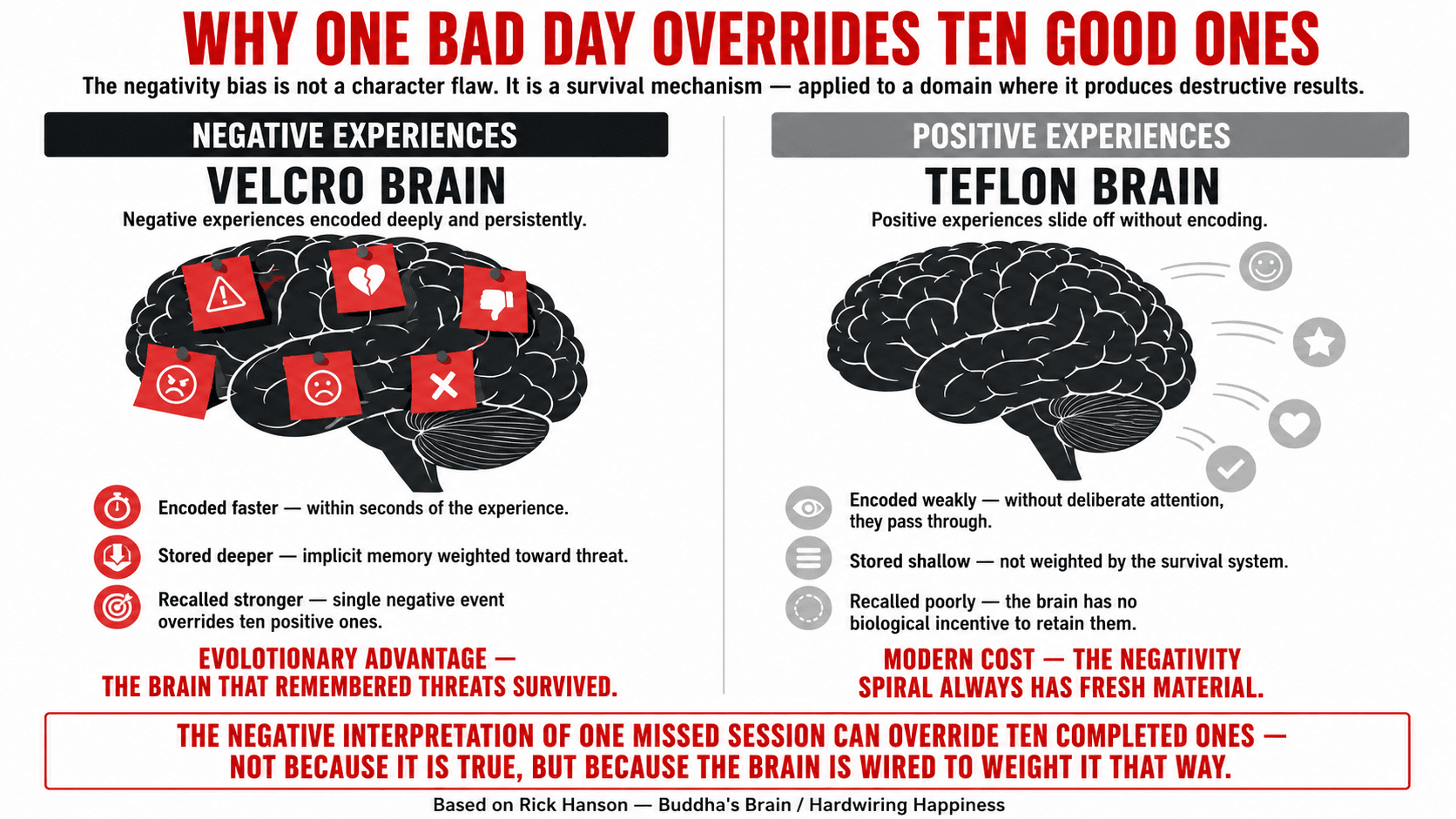
Rick Hanson's research on what he describes as the negativity bias of the human brain provides the neurological foundation for understanding why negative thought loops are so persistent and so difficult to interrupt from the inside. The negativity bias is not a psychological weakness or a character flaw. It is a survival mechanism with deep evolutionary roots: the brain that registered and remembered negative experiences more strongly than positive ones was the brain that survived, because it learned faster from threats than from rewards. The asymmetry that kept our ancestors alive is the same asymmetry that makes the negative interpretation of a missed training session feel more real, more true, and more important than the evidence of the previous ten sessions attended.(1)
At a neurological level, negative thoughts and negative emotional experiences are processed with greater speed, greater depth of encoding, and greater persistence in long-term memory than positive ones. Hanson's description of the brain as having Velcro for negative experiences and Teflon for positive ones is colloquial but neurologically accurate. The implicit memory system that stores emotionally charged experiences is weighted toward the negative because negative experiences had greater survival relevance. The practical consequence is that a single negative thought about health behaviour can override a substantial accumulation of positive experience with a speed and completeness that has no parallel in the opposite direction.
Martin Seligman's research on learned helplessness, developed initially through animal studies and subsequently extended to human populations, identified the mechanism by which repeated exposure to uncontrollable negative outcomes produces a generalised withdrawal of effort across domains that have no direct connection to the original negative experience. The person who has experienced enough health-related failure, who has internalised the narrative that they cannot sustain a programme, who has accumulated enough evidence for the limiting self-belief that they are not someone who succeeds at this, is exhibiting a version of learned helplessness that is not a choice and is not a moral failing. It is a neurologically predictable response to accumulated experience of a particular kind.(2)
Aaron Beck's cognitive model of depression, which became the foundation of cognitive behavioural therapy, identified the cognitive triad that characterises depressive thinking: negative views of the self, negative views of the world, and negative views of the future. In health behaviour contexts, the equivalent pattern is common without meeting any clinical threshold: the person who misses a session forms a negative view of themselves as undisciplined, a negative view of their situation as uniquely difficult, and a negative view of the future as likely to produce more failure. The triad is self-reinforcing because each element provides evidence for the others.(3)
Key Insight: The negative thought loop is not the truth about your programme. It is the predictable neurological response of a brain that is designed to weight negative experiences more heavily than positive ones, applied to a domain where that weighting produces reliably destructive results. Understanding this distinction does not eliminate the loop. But it changes the relationship to it: from identification with it as accurate self-knowledge to recognition of it as a biological process that can be observed, labelled, and interrupted.
The Negativity Spiral and the Positive Loop: The Same Architecture, Opposite Directions
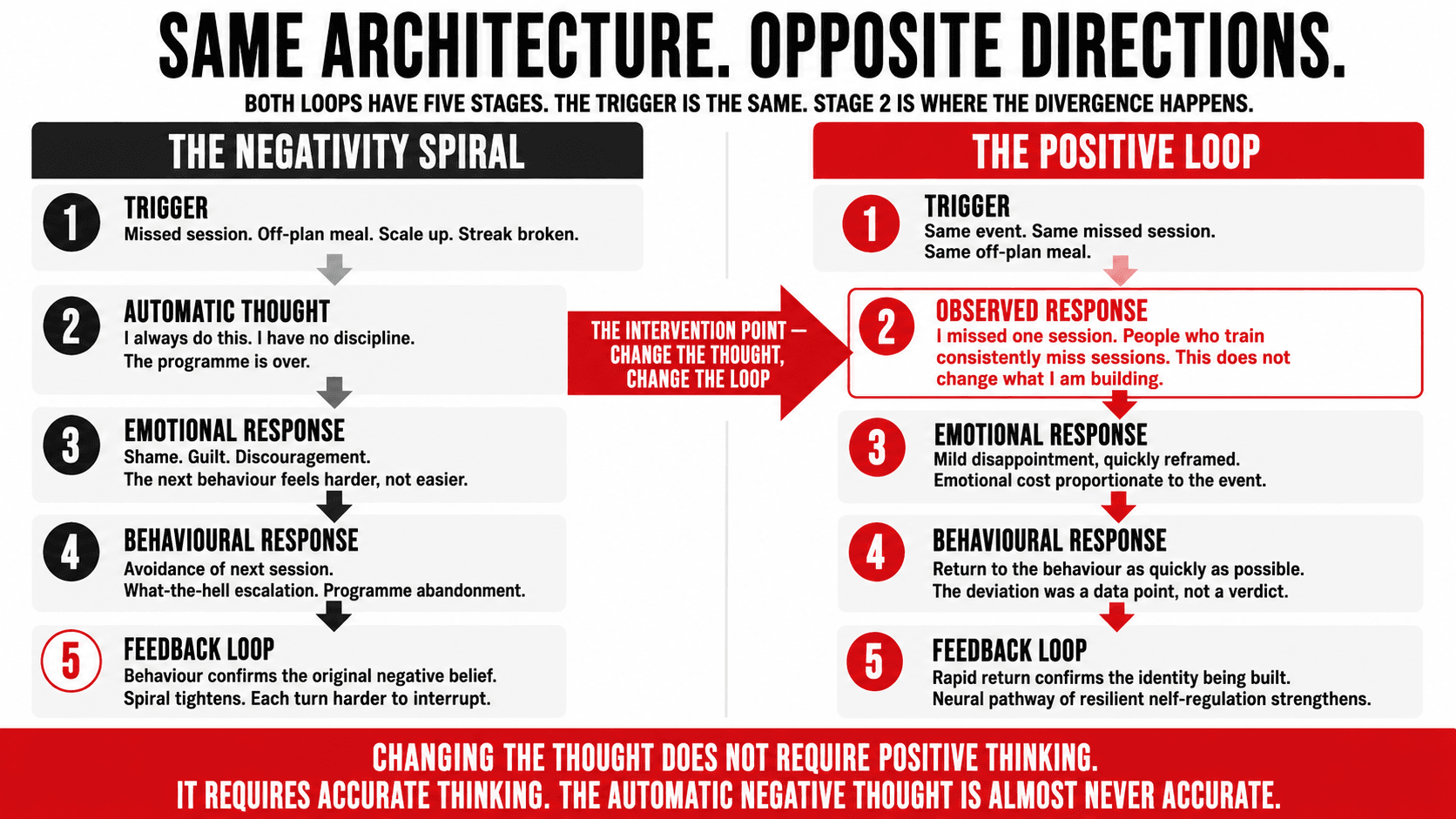
The negativity spiral and the positive reinforcement loop are structurally identical. Both involve a trigger, a thought, an emotional response, a behavioural consequence, and a feedback that reinforces the original tendency. The difference is not the architecture. It is the direction of travel. Understanding both structures side by side makes the mechanism visible, and visible mechanisms can be interrupted.
The Negativity Spiral vs The Positive Reinforcement Loop — Five Stages Compared
The Negativity Spiral
Trigger
Missed a training session. Ate off-plan. Scale weight increased. Broke a streak.
Automatic Thought
I always do this. I have no discipline. I am not the kind of person who can stick to this. I have ruined the programme.
Emotional Consequence
Shame. Guilt. Discouragement. The emotional state makes executing the next healthy behaviour feel harder, not easier.
Behavioural Response
Avoidance of the next session because the shame of failing again feels worse than the shame of stopping. Or the what-the-hell effect: if I have already broken it I might as well.
Feedback Loop
The avoidance and escalation provide new evidence for the original negative belief. The spiral tightens. Each turn makes interruption harder.
The Positive Reinforcement Loop
Trigger
Same event: a missed session, a difficult week, a deviation from the plan.
Observed Response
I missed one session. People who train consistently miss sessions. This does not change what I have built or who I am becoming.
Emotional Consequence
Mild disappointment, quickly reframed. The emotional cost is proportionate to the event rather than amplified by the thought.
Behavioural Response
Return to the behaviour as quickly as possible. The deviation was a data point, not a verdict. The next session confirms the identity.
Feedback Loop
The rapid return provides evidence for the identity being built. The loop strengthens the neural pathway of resilient self-regulation.
The spiral and the loop share the same trigger and the same architecture. The intervention point is Stage 2: the automatic thought. Changing the thought does not require positive thinking. It requires accurate thinking. The negative automatic thought is almost never an accurate description of the situation.
Seligman's Explanatory Style: The Three Dimensions That Determine How Damaging a Negative Thought Is
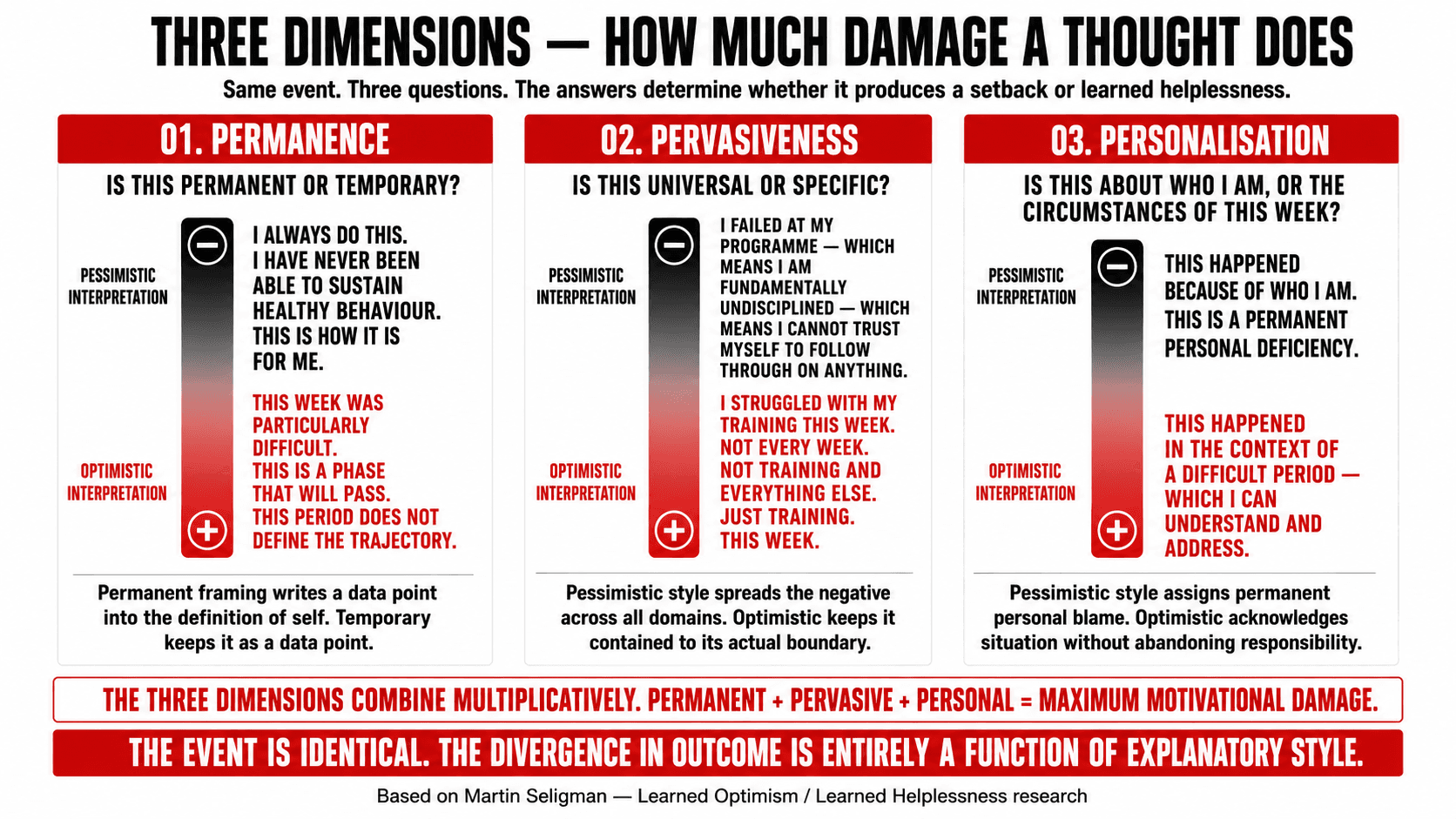
Seligman's research on optimism and learned helplessness identified three dimensions of explanatory style that determine how much damage a negative thought or experience does to a person's subsequent motivation and behaviour. Each dimension is a spectrum, and the position the person habitually occupies on each spectrum determines whether negative experiences produce temporary discouragement or sustained learned helplessness.
The first dimension is permanence. The pessimistic explanatory style treats negative events as permanent: I always do this, I have never been able to sustain healthy behaviour, this is how it is for me. The optimistic explanatory style treats them as temporary: this week was particularly difficult, this is a phase that will pass, this period does not define the trajectory. The permanent framing takes a single data point and writes it into the definition of self. The temporary framing keeps it as a data point.
The second dimension is pervasiveness. The pessimistic style treats negative events as universal, spreading their implications across all domains: I failed at my programme, which means I am fundamentally undisciplined, which means I cannot trust myself to follow through on anything. The optimistic style keeps negative events specific: I struggled with my training this week. Not this week and every other week. Not training and everything else. Just training, this week, given a specific set of circumstances.
The third dimension is personalisation. The pessimistic style attributes negative events to permanent personal deficiency: this happened because of who I am. The optimistic style acknowledges situational factors without abandoning personal responsibility: this happened in the context of a difficult period, which I can understand and address.(2)
These three dimensions combine multiplicatively. The person who responds to a missed training week with permanent, pervasive, and personal explanations has constructed a thought that is maximally damaging to subsequent motivation. The person who responds with temporary, specific, and situationally contextualised explanations has constructed a thought that produces minimum motivational cost from the same event. The event is identical. The divergence in outcome is entirely a function of explanatory style.
Key Insight: The three questions that interrupt the pessimistic explanatory style in real time are: Is this permanent or temporary? Is this universal or specific? Is this about who I am or about the circumstances of this week? Answering these questions honestly at the moment of the negative thought does not require positive spin. It requires accurate description of what has actually happened rather than the catastrophised version the negativity bias generates automatically.
The Pattern Interruption Protocol: Eight Triggers and Their Specific Interventions
Pattern interruption is not the instruction to think positively. It is the specific, practised response to the specific moment when the automatic negative thought arises, designed to produce a more accurate thought and a more functional behavioural response. The protocol works because the negative thought loop requires the second thought to become the spiral. The automatic negative thought at Stage 2 is involuntary and neurologically predictable. The response to it is where the intervention lives.
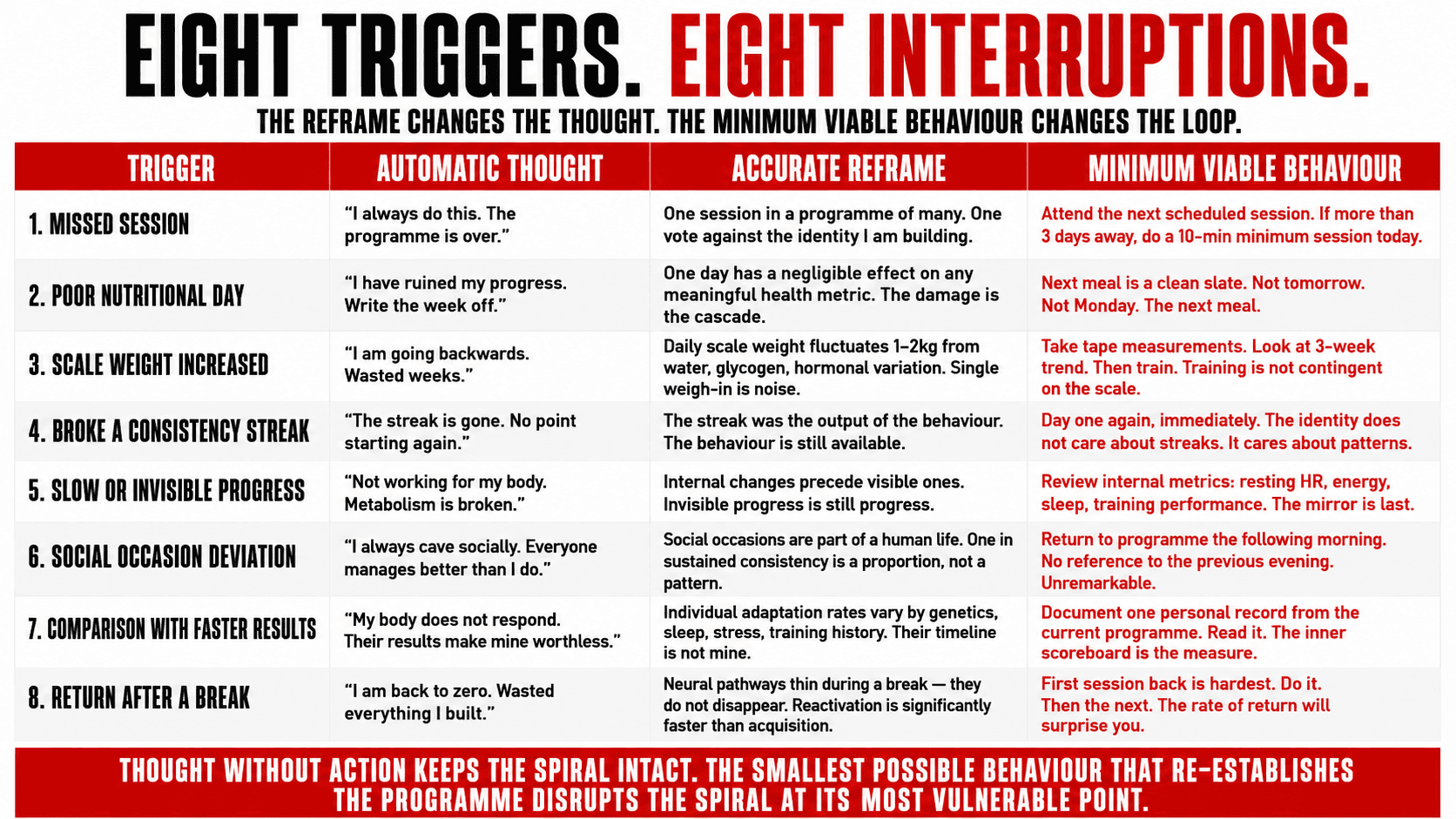
The eight most common triggers for negative thought loops in health programmes are listed below alongside the automatic negative thought they typically generate, the accurate reframe that replaces it, and the minimum viable behaviour that re-establishes the programme without requiring full recovery of motivation.
The Pattern Interruption Protocol — Eight Triggers, Automatic Thoughts, Reframes, and Minimum Viable Behaviours
| Trigger | Automatic Negative Thought (Spiral entry) | Accurate Reframe (Interruption) | Minimum Viable Behaviour (Loop re-establishment) |
|---|---|---|---|
| Missed training session | I always do this. I cannot be trusted to follow through. The programme is over. | I missed one session in a programme of many. One vote against the identity I am building. The programme is exactly where it was yesterday. | Attend the next scheduled session regardless of how it feels to get there. If that session is more than three days away, do a ten-minute minimum session today. The minimum viable behaviour re-establishes the loop. |
| Poor nutritional day | I have ruined my progress. I might as well write the week off. I have no willpower. | One day of poor nutritional choices has a negligible effect on any meaningful health metric. The damage is in the cascade, not the day itself. | The next meal is a completely clean slate. Not tomorrow. Not Monday. The next meal. Make the single next choice well. The programme is not measured in days, it is measured in trends. |
| Scale weight increased | None of this is working. I am going backwards. I have wasted weeks. | Scale weight fluctuates by one to two kilograms daily from water, glycogen, food volume, and hormonal variation. A single weigh-in is noise, not signal. Signal is the average trend across four weeks. | Take body measurements with a tape measure. Look at the trend across the last three weekly weigh-ins rather than the daily figure. Then train. The training is not contingent on the scale. |
| Broke a consistency streak | The streak is gone. There is no point starting again. I always end up here. | The streak was the output of the behaviour. The behaviour is still available. Streaks are motivating tools, not the programme itself. Breaking one does not break the programme. | Day one again, immediately. The identity being built does not care about streaks. It cares about the pattern across the full programme timeline. Return to the behaviour today. |
| Slow or invisible progress | This is not working for my body. I am different. My metabolism is broken. I am wasting my time. | Physiological adaptation precedes visible change. The internal changes, metabolic, hormonal, cardiovascular, occur before and independent of the visible ones. Invisible progress is still progress. | Review the internal metrics: resting heart rate trend, energy levels across the week, sleep quality, performance in training sessions. These change before the mirror does. They are the evidence the spiral wants to ignore. |
| Social occasion deviation | I always cave in social situations. I have no control. Everyone else manages this better than I do. | Social occasions are part of a human life and a healthy programme accommodates them. One social occasion within a programme of sustained consistency is a proportion, not a pattern. | Return to the programme the following morning without any reference to the previous evening. The return is the measure of the programme, not the deviation. Make it immediate and unremarkable. |
| Comparison with faster results | My body does not respond like other people's. I am doing something wrong. Their results make mine look worthless. | Individual adaptation rates vary significantly and are determined by genetics, sleep, stress, training history, and dozens of other variables outside the comparison. Their timeline is not a benchmark for mine. | Document one specific personal record from the current programme: a training performance metric, a body measurement, a health marker. Read it. The inner scoreboard, not the comparison, is the measure. |
| Return after a break | I am back to zero. I have wasted everything I built. Starting again feels pointless. | Neural pathways do not disappear during a break. They thin. Reactivation is significantly faster than original acquisition. Returning is not starting over. It is returning to a weaker version of where I left off, with the architecture intact. | The first session back is always harder than the first session ever was. It is also faster to recover from. Do the session. Then do the next one. The rate of return will surprise you. |
The minimum viable behaviour is the most important column. The reframe changes the thought. The minimum viable behaviour changes the loop. Thought without action keeps the spiral intact. The smallest possible behaviour that re-establishes the programme disrupts the spiral at its most vulnerable point.
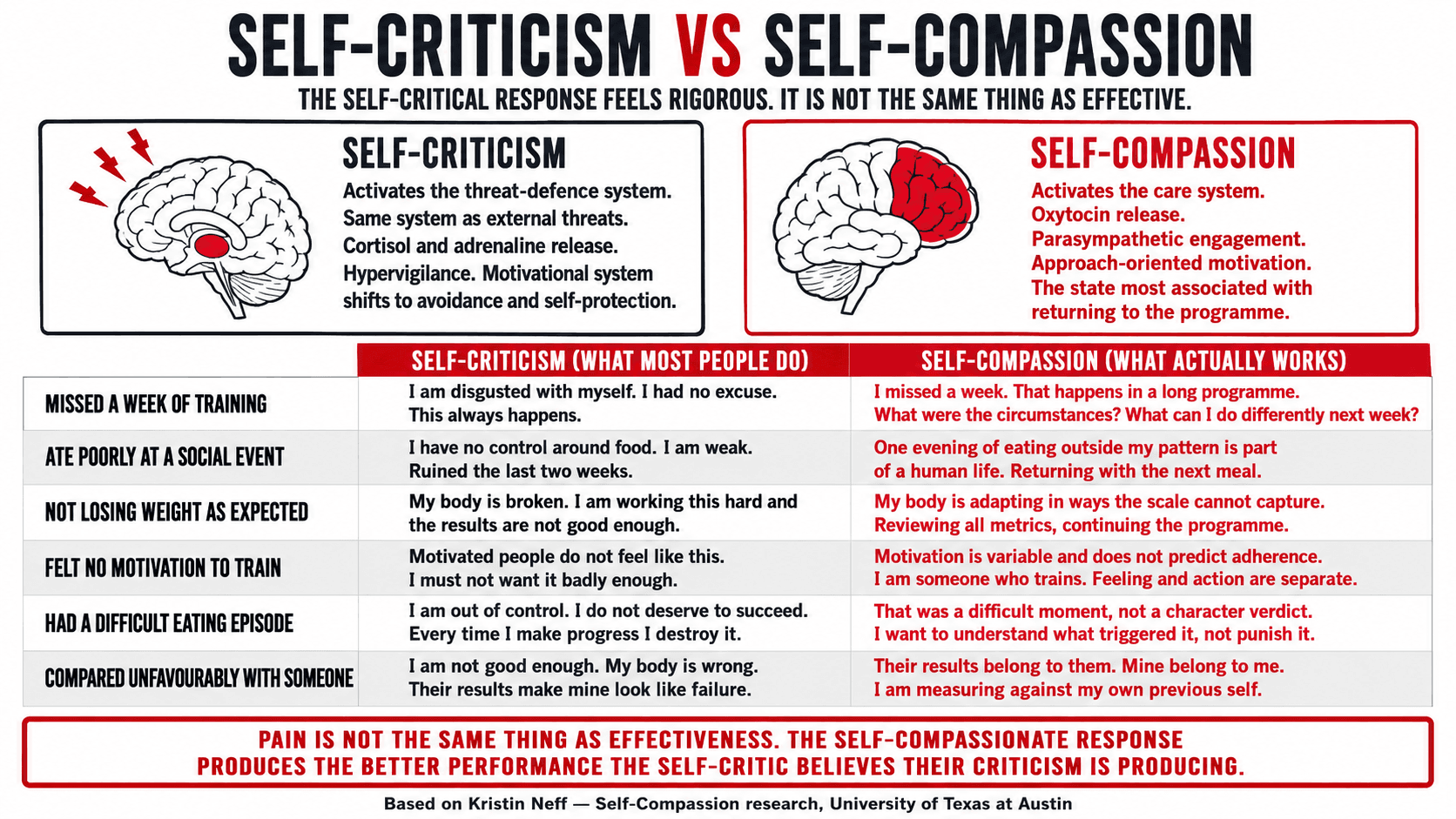
Kristin Neff's Self-Compassion Research: Why Being Kinder to Yourself Produces Better Results
One of the most counterintuitive findings in the psychology of behaviour change is Kristin Neff's research on the relationship between self-compassion and performance. The intuitive assumption in health and fitness culture is that self-criticism is a driver of discipline: the person who is hard on themselves performs better because the cost of falling short is higher. Neff's research consistently produces the opposite finding. Self-compassion, defined as treating oneself with the same kindness and understanding one would offer a close friend who had failed at something important, is associated with greater motivation to improve after failure, higher rates of programme adherence after setbacks, and lower rates of the avoidance behaviours that characterise the negativity spiral.(4)
The mechanism is neurological rather than sentimental. Self-criticism activates the threat-defence system, which is the same system activated by external threats. When the threat system is activated, the body releases cortisol and adrenaline, the brain becomes hypervigilant for evidence of further threat, and the motivational system shifts from approach-oriented behaviour toward avoidance and self-protection. The person who responds to a missed session with harsh self-criticism has activated a neurological system designed for physical survival and directed it inward. The physiological state it produces is not conducive to returning to training. It is conducive to hiding from the perceived threat.
Self-compassion, by contrast, activates the care system, which is associated with the release of oxytocin and the engagement of the parasympathetic nervous system. The physiological state produced by self-compassionate response to failure is the one most associated with the approach-oriented motivation that generates the return to the programme. Neff's finding is not that self-compassion makes failure feel unimportant. It is that self-compassion produces a physiological and motivational state that makes the response to failure more functional and more likely to result in the improved performance that the self-critic believes their criticism is producing but that the research shows it is actually undermining.(4)
Self-Criticism vs Self-Compassion in Health Behaviour — Eight Common Scenarios
| Health Behaviour Event | Self-Criticism Response (What most people do) | Self-Compassion Response (What actually works) |
|---|---|---|
| Missed a week of training | I am disgusted with myself. I had no excuse. This always happens. I should be further along by now. I clearly cannot be trusted with my own health. | I missed a week. That happens in a long programme. What were the circumstances, and what can I do differently next week? Missing a week is a speed bump. Hating myself for it is the part that costs the programme. |
| Ate poorly at a social event | I have no control around food. Everyone else manages this. I am weak. I ruined the progress of the last two weeks with one evening. | One evening of eating outside my normal pattern is a normal part of a human life. It had a negligible effect on my health metrics. I am returning to my programme with the next meal. |
| Not losing weight as fast as expected | My body is broken. I am working this hard and the results are not good enough. I am a failure even at this. | My body is adapting in ways the scale cannot fully capture. I am going to look at all my metrics rather than just one. I am going to continue the programme because I trust the process. |
| Felt no motivation to train | Motivated people do not feel like this. I must not want this badly enough. If I really cared I would not need to be dragged to the gym. | Motivation is variable and does not predict long-term adherence. I went today not because I felt like it but because I am someone who trains. The feeling and the action are separate things. |
| Had a binge-eating episode | I am out of control. I do not deserve to succeed at this. Every time I make progress I destroy it. I am pathetic. | That was a difficult moment, not a character verdict. I want to understand what triggered it rather than punish myself for it. Understanding is the useful response. Punishment is not. |
| Compared unfavourably with someone else's results | I am not good enough. My body is wrong. Their results make mine look like a failure. I should be doing better. | Their results belong to them and their body, their starting point, their circumstances. My results belong to me. I am measuring my progress against my own previous self. That is the only comparison that tells me anything accurate. |
Self-compassion is not letting yourself off the hook. It is the response to failure that is most likely to produce improved performance the next time. The self-critical response feels more rigorous because it is more painful. Pain is not the same thing as effectiveness.
Hanson's Positive Neuroplasticity: Installing the Positive Loop Deliberately
Rick Hanson's work on positive neuroplasticity addresses the asymmetry problem directly: given that the brain encodes negative experiences more strongly than positive ones, what can be done to correct the imbalance? His answer is a practice of deliberate installation: consciously registering positive experiences, including small ones, with sufficient duration and depth of attention that they encode into long-term memory rather than passing through the consciousness without leaving a trace. The brain's Teflon for positive experiences is not fixed. It is a default that can be overridden by deliberate attentional practice.(1)
The application to health behaviour is direct. The person who completes a training session and immediately moves on to the next task without registering the fact of its completion is allowing the experience to pass through without encoding. The same session, paused over for thirty seconds of genuine acknowledgment of what was just accomplished, the effort made, the decision honoured, the vote cast for the identity being built, encodes differently. It does not need to be a dramatic celebration. It needs to be a genuine, sustained moment of registration.
Over weeks and months, the accumulated difference between these two approaches to positive experience is substantial. The person who consistently registers and encodes the positive experiences within their programme builds an internal evidence base for their capability and their consistency that the negativity bias has to work against rather than simply overwhelm. Recording and reviewing the personal record of progress creates an accessible repository of positive evidence that the negativity spiral cannot access if it remains invisible.
Key Insight: After every session this week, take thirty seconds before leaving the training space or putting down the water bottle and consciously register what was just accomplished. Not the performance, not the comparison to the ideal, not whether it was good enough. Simply the fact that it happened. You planned it and you did it. That is worth thirty seconds of deliberate acknowledgment. The accumulation of those moments across months is what builds the internal evidence base that the negativity spiral runs out of material against.
The All-or-Nothing Pattern: Why Perfectionism Feeds the Spiral
The all-or-nothing pattern in health behaviour is the specific cognitive structure that makes a single deviation into a programme failure. It is the belief, often not consciously articulated, that adherence is binary: either the programme is being followed perfectly or it is not being followed at all. Under this structure, any deviation triggers the negative spiral because any deviation represents a movement from the all category to the nothing category. The person who would have continued their programme with ninety percent adherence instead abandons it entirely because ninety percent is experienced as failure rather than as an excellent result.
Beck's cognitive therapy identified dichotomous thinking as one of the primary cognitive distortions that produce and maintain depressive and anxious thinking. In health behaviour contexts, it produces a relationship with the programme that is structurally set up for the negativity spiral: any imperfection triggers the thought that the programme is broken, which triggers the emotional response of discouragement, which triggers the behaviour of abandonment, which confirms the thought.(3)
The corrective is not to lower standards. It is to measure accurately. A programme executed at ninety percent adherence over six months produces results that a programme executed at one hundred percent for three weeks and abandoned cannot approach. The person who maintains a good-enough programme indefinitely outperforms the person who maintains a perfect programme briefly every time. The perfectionism that feels like high standards is, in practice, the mechanism that produces the worst long-term outcomes, because it creates the conditions in which the negativity spiral has maximum destructive power.
Key Insight: This week, set a weekly adherence target as a percentage rather than as a binary. If your training programme has four sessions, ninety percent adherence for the week means four sessions. Seventy-five percent means three. Fifty percent means two. Fifty percent adherence maintained over twelve weeks produces better outcomes than one hundred percent adherence for three weeks followed by abandonment. Measure in proportions. The spiral thrives on all-or-nothing. Proportional measurement starves it.
Building the Loop That Goes the Other Direction
The most important structural change I make in coaching clients who are caught in repeating negativity spirals is not a change to their training programme or their nutritional approach. It is a change to the evidence they are collecting about themselves. The negative thought loop is fuelled by an accumulation of evidence for the negative belief. The positive loop is fuelled by an accumulation of evidence for the alternative. The programme that builds the positive evidence base, systematically and deliberately, starves the spiral of the material it needs to function.
This means keeping a record of completions, not just targets. It means reviewing the record of what has been done rather than what was supposed to be done. It means building the minimum viable behaviour protocol before it is needed, so that the response to the first deviation is already decided and does not need to be constructed in the emotional state that the deviation produces. And it means treating self-compassion not as weakness but as the neurologically intelligent response to failure that the research consistently shows it to be.
The person who can miss a week, return without drama, and continue as if the week was a minor weather event rather than a programme-ending catastrophe is not someone with exceptional discipline. They are someone who has built the positive reinforcement loop deliberately enough that the negativity spiral does not have the structural foothold it needs to gain traction. That is learnable. It is what I work on with clients who have been in the spiral long enough that they have started to mistake it for the truth. I work one-to-one with clients online globally.
Work with Me
Get a personalised coaching plan built around your goals, your schedule, and your life.
Enquire NowReferences
- Hanson R. Hardwiring Happiness: The New Brain Science of Contentment, Calm, and Confidence. New York: Harmony Books; 2013.
- Seligman MEP. Learned Optimism: How to Change Your Mind and Your Life. New York: Knopf; 1991.
- Beck AT, Rush AJ, Shaw BF, Emery G. Cognitive Therapy of Depression. New York: Guilford Press; 1979.
- Neff KD. The role of self-compassion in development: a healthier way to relate to oneself. Human Development. 2009; 52(4): 211–214.
- Neff KD, Hsieh YP, Dejitterat K. Self-compassion, achievement goals, and coping with academic failure. Self and Identity. 2005; 4(3): 263–287.
- Shahar B, Szsepsenwol O, Zilcha-Mano S, et al. A wait-list randomized controlled trial of loving-kindness meditation programme for self-criticism. Clinical Psychology and Psychotherapy. 2015; 22(4): 346–356.
- Baumeister RF, Bratslavsky E, Finkenauer C, Vohs KD. Bad is stronger than good. Review of General Psychology. 2001; 5(4): 323–370.