
The Exit Door You Leave Open Is the One You Will Eventually Use
The commitment problem in health behaviour is almost never a knowledge problem. The people I work with know, with considerable precision, what they need to do. They know the training frequency that produces results. They know the nutritional principles that govern body composition. They know that sleep matters and stress compounds and consistency outperforms intensity every time. The knowledge is not the constraint. The constraint is the structure of the commitment that is meant to produce the behaviour. And in the vast majority of cases, that structure has a fatal design flaw built into it from the beginning: the exit is left open.
I will start on Monday. I will try this for a month and see how it goes. I will give this a proper go this time. These are the phrases of conditional commitment, and they share a structural property that determines their outcome before the first session happens. The door back to the old pattern is not locked. It is not even properly closed. It is open, and the brain, which is an efficiency machine that defaults to the path of least resistance, knows it is open. Every time the new behaviour requires effort, discomfort, or sacrifice, the open door is there. The conditional commitment means the question of whether to continue is always available to be asked. And on enough difficult days, it will be answered with the exit.
Genuine commitment, in the sense that produces the behaviour change that lasts, is not the same thing as strong motivation. Motivation fluctuates. It is highest at the point of decision, when the gap between the current state and the desired state is most vivid, the discomfort of the present most keenly felt, and the possibilities of the future most brightly imagined. It then declines, reliably and predictably, as the initial intensity fades and the reality of the daily work replaces the vision. A commitment structure that depends on sustained motivation is a commitment structure that is designed to fail at exactly the point it is most needed.
“Until one is committed, there is hesitancy, the chance to draw back, always ineffectiveness.”
— W.H. Murray, The Scottish Himalayan Expedition, 1951
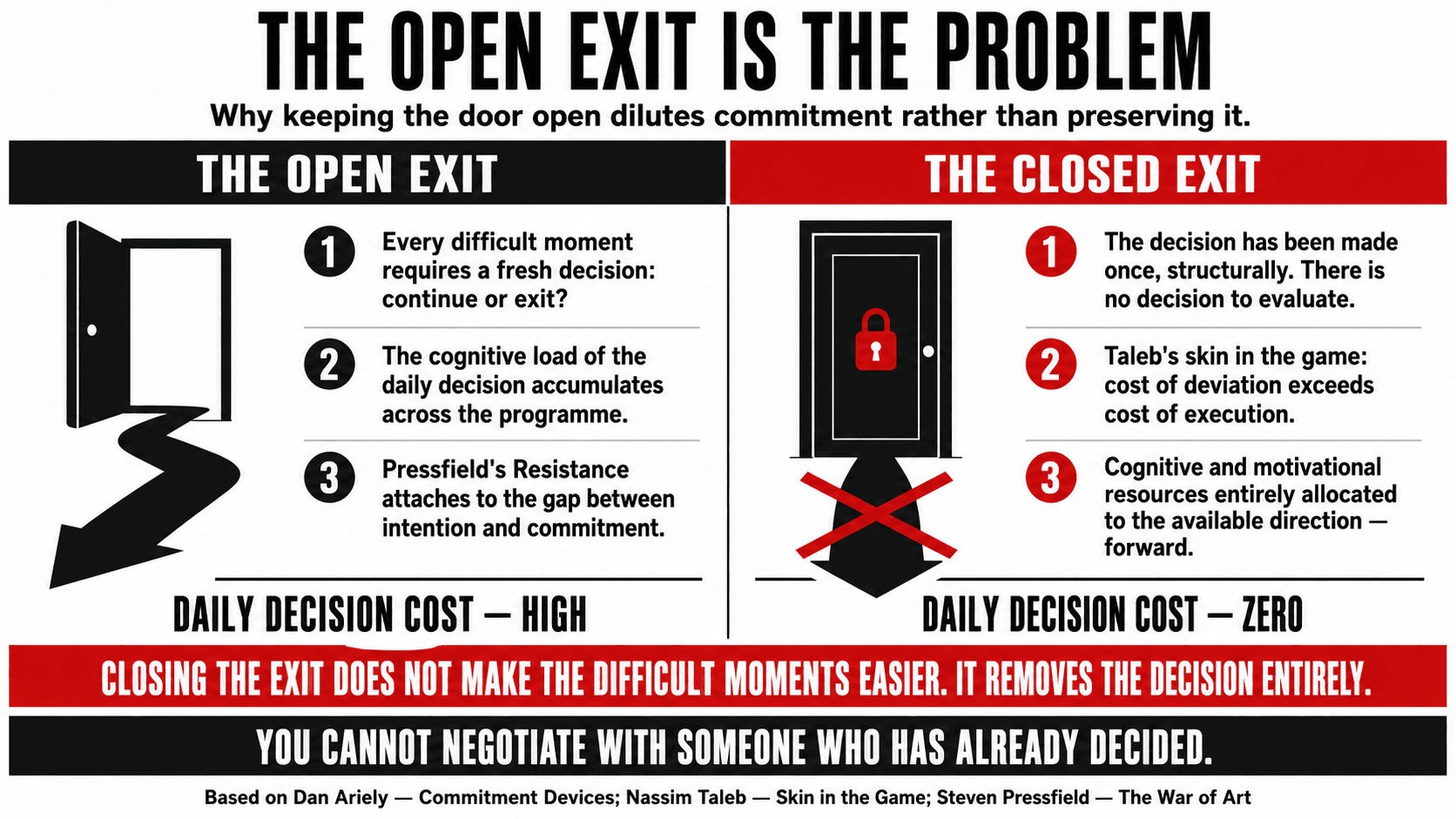
The Psychology of the Open Exit: Why Keeping Options Available Reduces Commitment to Each One
Dan Ariely's research on commitment devices provides the empirical foundation for understanding why the open exit dilutes commitment rather than simply leaving it intact. In a series of studies examining how people perform when given the ability to pre-commit to a course of action versus when they retain the freedom to change their minds, Ariely found that commitment devices, mechanisms that impose costs on deviation from an intended behaviour, consistently improved performance and adherence compared to conditions in which the same intentions were held without structural commitment.(1)
The mechanism is not simply about adding punishment to failure. It is about removing the constant decision cost that the open exit imposes. When the option to abandon a programme remains available, every difficult moment requires a decision: am I continuing or am I using the exit? That decision costs cognitive and emotional resources. Over the course of a long programme, the accumulated cost of making the same decision repeatedly, always in the most difficult moments, always against the temptation of the open door, is enormous. Closing the exit does not make the difficult moments easier. It removes the decision entirely. There is no decision to make because there is no exit to evaluate.
This is the mechanism that Nassim Taleb describes in the concept of skin in the game: commitment backed by real consequences. The person who has genuine skin in the game, who has put something of value at stake that they will lose if they fail to follow through, is not making a decision about whether to continue every time the programme becomes difficult. They have already made the decision. The ongoing behaviour is the expression of a commitment that has been structurally reinforced by consequences they do not want to experience. The cognitive load of the daily decision has been removed by the prior commitment.(2)
Steven Pressfield's framework in The War of Art approaches the same truth from a creative and philosophical direction. Pressfield's description of Resistance, the internal force that opposes any committed creative or productive work, is a precise account of what happens in the space between the open exit and the behaviour it is meant to prevent. Resistance, in Pressfield's framework, does not attack committed behaviour directly. It attacks the indeterminate commitment, the I will try, the I will see, the I am doing this unless it gets too hard. Full commitment, the decision that the work will be done regardless of the mood, the difficulty, or the competing demands, removes the foothold that Resistance requires. You cannot negotiate with someone who has already decided.(3)
Key Insight: The question to ask about any commitment you are currently holding is not: how motivated am I to do this? It is: what happens if I do not? If the honest answer is nothing, the commitment is a preference. Preferences dissolve under pressure. Commitments backed by consequences do not. Not because the consequences are punitive but because they change the decision structure. There is no decision to make when the alternative has a real cost.
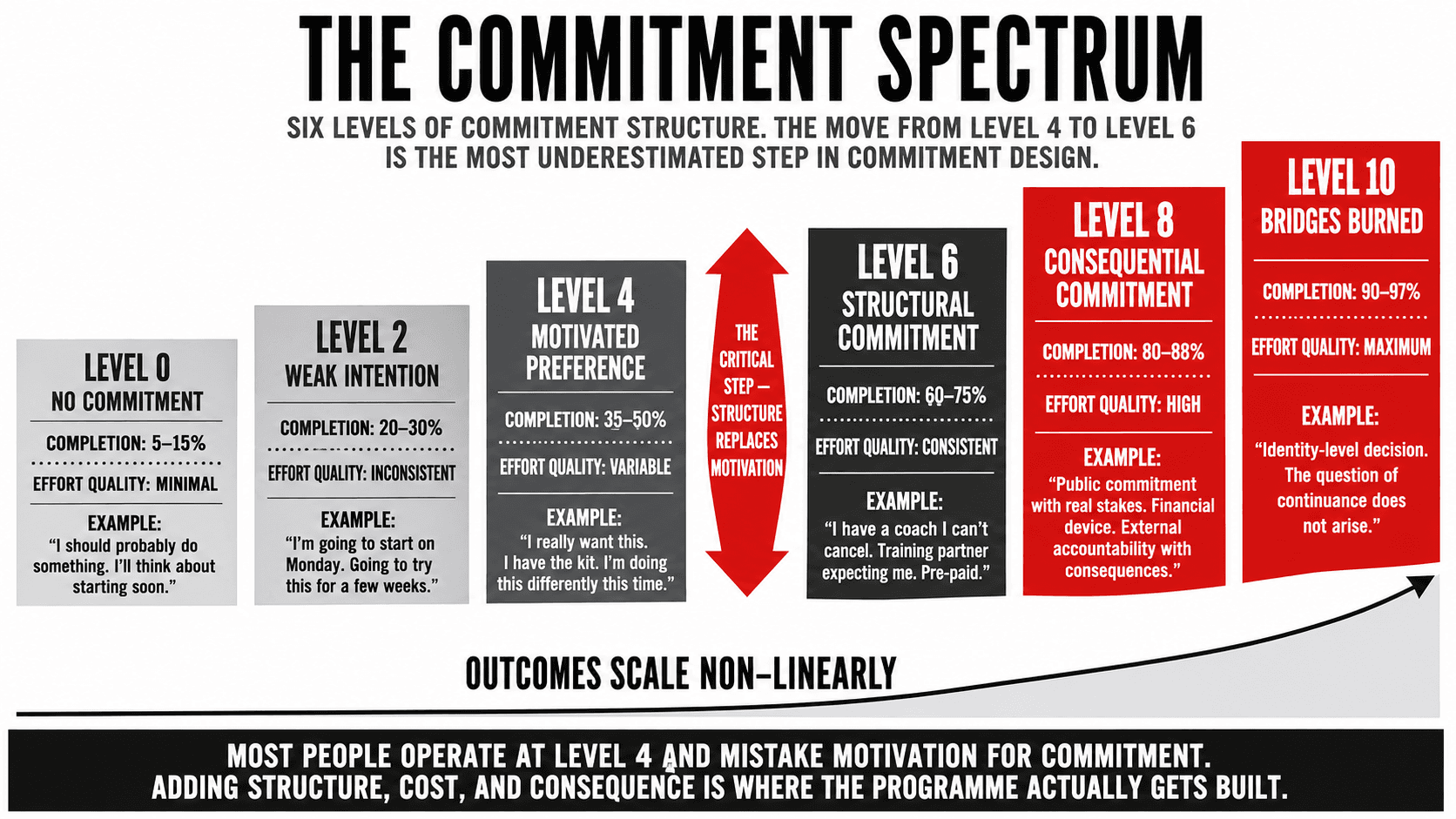
The Commitment Spectrum: From Open Exit to Bridges Burned
The commitment spectrum maps the six meaningful levels of commitment structure from zero, where the behaviour is entirely optional and the exit is wide open, to ten, where the commitment is structurally non-negotiable and the question of continuance does not arise. At each level, the probability of long-term behaviour completion and the quality of the effort applied to each session are mapped. The relationship between commitment level and both outcomes is not linear. It is disproportionate: the move from level four to level seven produces a far larger change in outcomes than the move from level zero to level four.
The Commitment Spectrum — Six Levels of Commitment Structure with Completion Probability and Effort Quality
| Level | Commitment Type | What It Looks Like in Practice | Exit Status | Long-term Completion | Effort Quality |
|---|---|---|---|---|---|
| 0 | No Commitment | I should probably do something about this. I will think about starting soon. It would be nice to get fit. | Wide open | 5–15% | Minimal |
| 2 | Weak Intention | I am going to start on Monday. I am going to try this for a few weeks. I will give this a go and see how it feels. | Fully open | 20–30% | Inconsistent |
| 4 | Motivated Preference | I really want this. I have signed up for the gym. I have bought the kit. I am genuinely going to do this differently this time. | Open under pressure | 35–50% | Variable |
| 6 | Structural Commitment | I have a coach I cannot cancel without cost. I have a training partner expecting me. I have paid in advance. Missing is inconvenient. | Partially closed | 60–75% | Consistent |
| 8 | Consequential Commitment | I have made a public commitment with real social stakes. I have a financial commitment device. I have a deadline with external accountability and genuine consequences for non-completion. | Substantially closed | 80–88% | High |
| 10 | Bridges Burned | The decision has been made at the identity level. The behaviour is non-negotiable. There is no version of this week in which the sessions do not happen. The question of continuance does not arise because the exit has been removed structurally and psychologically. | Closed | 90–97% | Maximum |
The move from level 4 to level 6 is the most commonly underestimated step in commitment design. Most people operate at level 4 and mistake motivation for commitment. Adding structure, cost, and consequence moves the commitment to a level where motivation is no longer the determining variable.
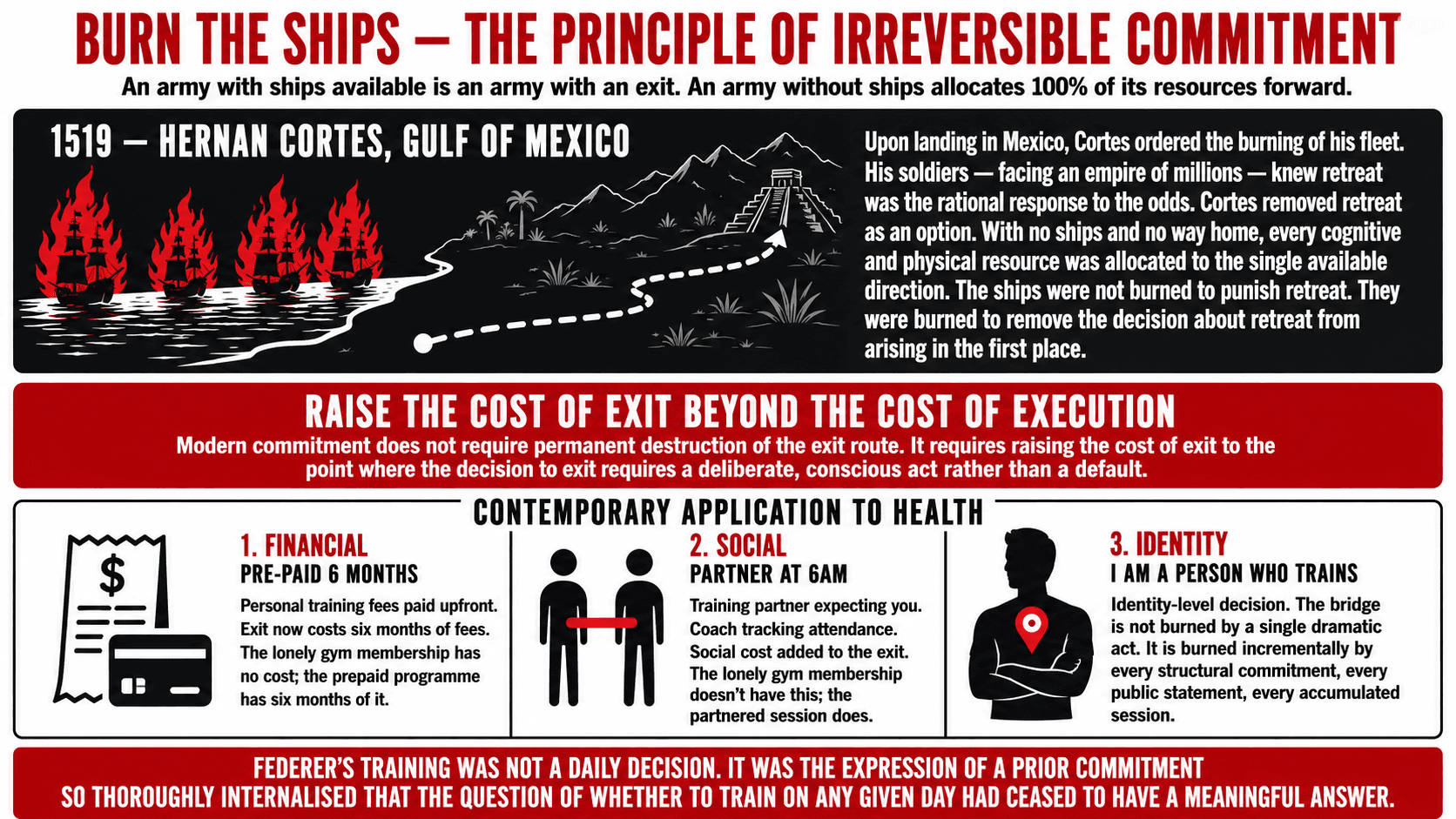
Burning the Ships: The Historical and Contemporary Evidence for Irreversible Commitment
The story of Hernan Cortes ordering his ships burned upon landing in Mexico in 1519 is the most frequently cited historical example of commitment by irreversibility, and while the precise details have been debated by historians, the strategic logic it illustrates is not in question. An army that has ships available to it is an army that has an exit. An army that knows retreat is physically impossible is an army whose cognitive and motivational resources are entirely allocated to the single available direction: forward. The ships were not burned to punish retreat. They were burned to remove the possibility of the decision about retreat arising in the first place.
The contemporary equivalent in health behaviour is not dramatic. It does not require the permanent destruction of the exit route. What it requires is raising the cost of exit to the point where the decision to exit requires a deliberate, conscious act rather than a default. The person who has paid six months of personal training fees upfront has not burned their ships, but they have raised the cost of exit from zero to six months of fees. The person whose training partner is expecting them at six in the morning has not made retreat impossible, but they have added a social cost to the exit that the lonely gym membership does not carry. These are not the same as identity-level commitment, but they are structurally superior to the open door.
Elite athletes and professional performers at the highest levels describe their relationship to training not as a decision they make daily but as a structure they entered at some prior point that now operates independently of motivation. Roger Federer, who by his own account trained with a specificity and volume that most recreational players would consider incomprehensible, described the daily training not as a product of motivation but as the expression of a prior commitment so thoroughly internalised that the question of whether to train on any given day had ceased to have a meaningful answer. The question was not whether but how.
This is the destination the commitment structure is designed to reach: the point at which the behaviour has moved from the category of decisions that require motivation to the category of structures that require only execution. The bridge is not burned by a single dramatic act. It is burned incrementally, by every structural commitment that raises the cost of exit, every public statement that adds social accountability, every identity statement that makes the behaviour an expression of self rather than a performance against resistance, and every accumulated session that builds the neural pathway of the identity that does not consider stopping.
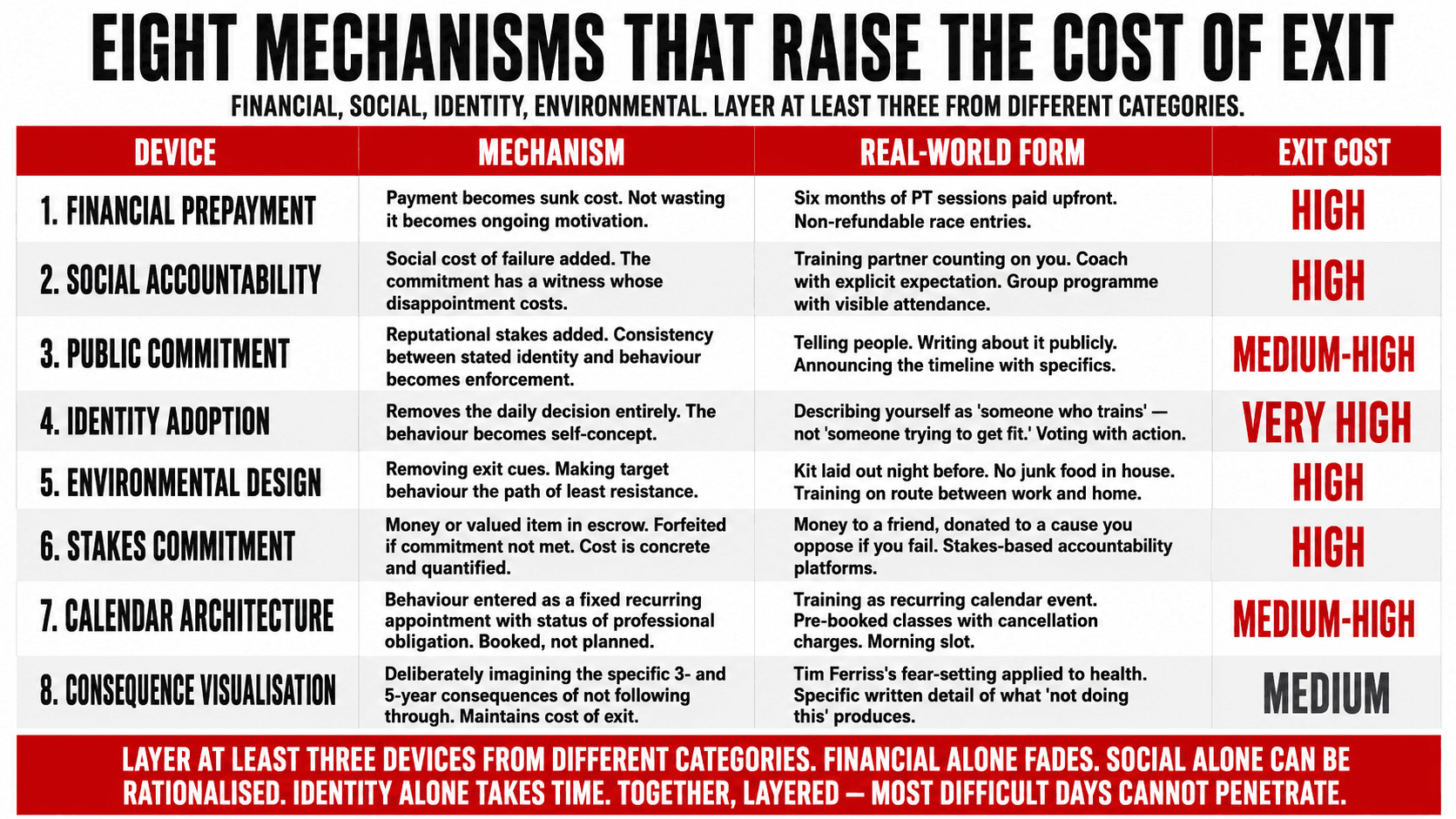
The Commitment Device Library: Eight Mechanisms That Raise the Cost of Exit
A commitment device is any mechanism that raises the cost of not following through on an intended behaviour. The research on commitment devices consistently shows that they outperform intention alone, motivation alone, and willpower alone in producing sustained behaviour change. The eight devices below represent a spectrum from structural to psychological, from financial to social, and from external to internal. The most effective commitment architecture uses more than one, layered together so that the total cost of exit across all devices exceeds the cost of continuing on any particular difficult day.
The Commitment Device Library — Eight Mechanisms with Mechanisms, Real-World Forms, Evidence, and Strength Ratings
| Device | Mechanism | Real-World Form in Health | Research Support | Exit Cost Rating |
|---|---|---|---|---|
| Financial Prepayment | Paying in advance transfers future behaviour into a sunk cost. The cognitive value of not wasting the payment becomes an ongoing motivation to attend. The exit now has a visible financial price. | Paying for six months of personal training sessions upfront. Booking a race or event with a non-refundable entry fee. Paying for a nutrition programme in full rather than monthly. | Ariely et al. found that prepayment of gym memberships significantly increased subsequent attendance compared to pay-as-you-go structures, even controlling for cost per session. | HIGH |
| Social Accountability | The social cost of failing to follow through is added to the exit. The commitment now has a witness, and the social pain of the witness's knowledge of failure becomes part of the cost of exiting. | A training partner who is counting on your presence. A coach whose expectation you would disappoint. A group programme where absences are visible. A challenge shared with colleagues. | Prestwich et al. found that forming implementation intentions with social partners significantly improved health behaviour adherence compared to individual intention-setting alone. | HIGH |
| Public Commitment | Making the intention publicly known adds reputational stakes to the commitment. The social self, which is highly motivated to maintain consistency between stated identity and behaviour, becomes an enforcement mechanism. | Telling people in your life what you are doing. Writing about the commitment publicly. Announcing a goal or programme start with specifics and a timeline. Making the identity statement to people whose respect matters to you. | Gollwitzer's implementation intention research shows that when-then plans stated publicly are significantly more likely to be executed than privately held intentions, even at matched motivation levels. | MEDIUM-HIGH |
| Identity Adoption | Adopting the identity label of the behaviour you are committed to removes the daily decision entirely. A runner runs. The question is not whether to run but when. The identity commitment is the most durable device because it operates at the deepest level of self-concept. | Actively describing yourself as someone who trains, rather than as someone who is trying to get fit. Writing the identity statement and reading it. Using the identity language with others. Voting for the identity with every action. | Clear's identity-based habit framework, drawing on Bandura's self-efficacy research, shows that identity-consistent behaviour is maintained at significantly higher rates than outcome-motivated behaviour across long time horizons. | VERY HIGH |
| Environmental Design | Removing the environmental cues and access points that facilitate the exit behaviour while making the target behaviour require the least possible friction. The commitment device is built into the structure of the environment rather than requiring daily willpower. | Laying out training kit the night before. Having no junk food in the house. Scheduling training sessions as calendar events with the same status as work meetings. Training on the route between work and home so that attending requires less effort than avoiding. | Fogg's behaviour design research demonstrates that reducing the activation energy for target behaviours to near zero is the single most reliable predictor of behaviour automaticity, independent of motivation level. | HIGH |
| Stakes Commitment Device | Placing money, a valued item, or a meaningful stake in escrow with a trusted third party, to be forfeited if the committed behaviour is not completed. The exit now has a concrete, quantified, predetermined cost. | Giving a friend money to donate to a cause you oppose if you do not complete your programme commitment. Using platforms designed for stakes-based accountability. Agreeing with a coach that sessions not attended are paid at double rate. | Ariely and Wertenbroch found that self-imposed deadlines with real financial penalties were significantly more effective at producing task completion than deadlines with no consequences, even in populations who considered themselves self-disciplined. | HIGH |
| Calendar Architecture | The commitment is not held in intention but entered into a calendar system as a fixed, recurring appointment with the same categorical status as a professional obligation. The session is booked, not planned. The difference is structural. | Training sessions entered as recurring calendar events. Pre-booked classes where late cancellation incurs a charge. A fixed morning protocol that occupies the calendar slot that casual decisions would otherwise fill. Training before work, not after, so that the day cannot displace it. | Implementation intention research consistently shows that specifying the exact when and where of intended behaviour, as distinct from simply intending it, more than doubles execution rates across health behaviour domains. | MEDIUM-HIGH |
| Consequence Visualisation | Regularly and deliberately visualising the consequence of not following through, specifically and emotionally rather than abstractly, maintains the psychological cost of the exit at a level that competes with the cost of continuing on difficult days. | Tim Ferriss's fear-setting exercise applied to health: writing in specific detail what the health, energy, and life quality consequences of not following through will look like in three and five years. Reading this on difficult days before making the exit decision. | Oettingen's WOOP research demonstrates that mental contrasting, specifically imagining both the desired positive outcome and the specific obstacles and consequences of not achieving it, significantly outperforms purely positive visualisation in producing goal-directed behaviour. | MEDIUM |
The most durable commitment architectures combine at least three devices from different categories. Financial cost alone fades as the payment becomes history. Social accountability alone can be rationalised away. Identity adoption alone takes time to build. Together, layered, they produce a commitment structure that most difficult days cannot penetrate.
The Commitment Diagnostic: Distinguishing Commitment from Preference
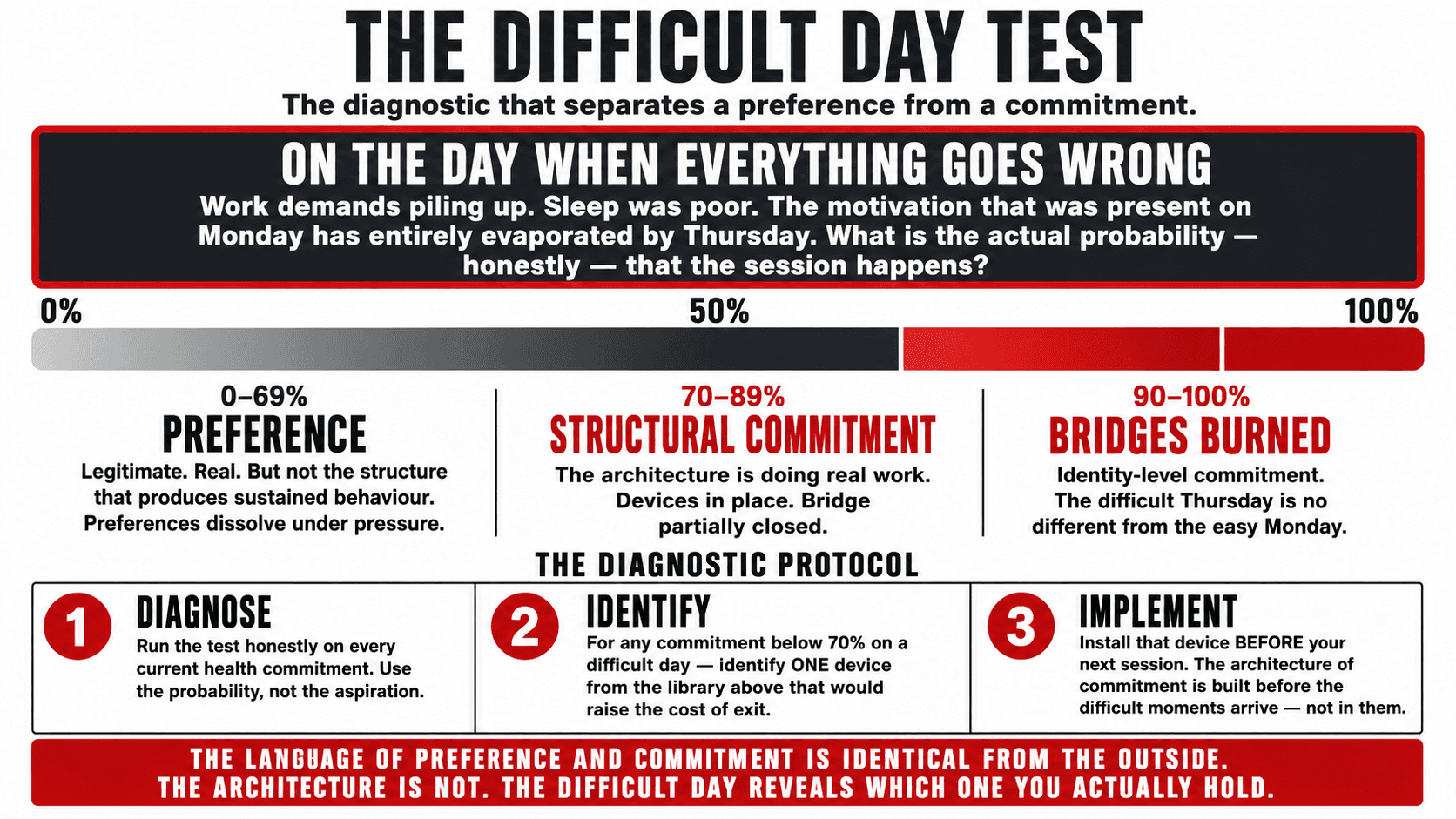
The most useful diagnostic test for the current commitment level of any health behaviour is the difficult day test: on the day when everything goes wrong, when work demands pile on top of each other, when sleep was poor, when the motivation that was present on Monday has entirely evaporated by Thursday, what is the actual probability that the session happens? If the honest answer is less than seventy percent, the commitment is a preference. Preferences are legitimate. Preferences are the starting point. But preferences are not the structure that produces the sustained behaviour that produces the sustained result.
The preference masquerades as commitment because the language of both is identical from the outside. I am committed to my health. I am going to get this done. This is a priority for me. These statements can be true at level four of the spectrum, where the open door means the difficult Thursday will reveal that the priority adjusts in the face of other demands, or they can be true at level eight, where the commitment structure means the difficult Thursday is no different from the easy Monday in terms of whether the session happens. The language is the same. The architecture is not.
Pressfield's description of Resistance captures the specific quality of the gap between preference and commitment with precision that no clinical psychology framework quite matches. Resistance, in his account, is attracted to the gap between intention and commitment like a predator to a wound. The I will try gives Resistance everything it needs. The decision has been made gives it nothing to work with. Closing the door is not about willpower. It is about removing the architectural requirement for willpower on every difficult day by making the decision once, structurally, at a level that holds when motivation does not.(3)
Key Insight: Run the difficult day test on your current health commitments now. Be honest about the probability, not the aspiration. For any commitment where the honest probability is below seventy percent on a difficult day, the commitment needs a structural upgrade. Identify one device from the table above that would raise the cost of exit on your current programme and implement it before your next session. The architecture of commitment is not built in the easy moments. It is built before the difficult ones arrive.
The Destination: From Commitment Device to Identity Expression
The commitment devices in the table above are means, not ends. They are scaffolding that holds the behaviour in place during the period when the identity that will eventually sustain it independently is being built. The financial pre-commitment is necessary at level four or five of the spectrum. It becomes progressively less necessary as the behaviour moves toward identity expression. The person who has trained consistently for three years does not need a financial penalty to attend their sessions. The identity has been built sufficiently that the session is simply what Thursday looks like.
The goal of commitment architecture is to get the behaviour through the period when the identity does not yet exist to sustain it, using structural devices that hold the door closed until the identity closes it permanently. This is the correct sequencing. Most people attempt to build the identity first, through motivation and intention, and install the structural commitment devices only if the identity fails to materialise. The more effective sequence is the reverse: install the structural devices from the beginning, so that the behaviour happens with sufficient consistency for the identity to form, and then observe the point at which the structural devices become progressively less necessary because the identity has taken over the load.
I work with clients who have been in the I will try phase for years, sometimes decades. They are not without commitment. They are without commitment architecture. The transition from I will try to the behaviour is simply what I do is not a motivational event. It is a structural one. It requires raising the cost of exit, layer by layer, until the cost of not continuing exceeds the cost of continuing on every category of difficult day the programme will face. I work one-to-one with clients online globally. The first conversation is about the architecture, not the plan.
Work with Me
Get a personalised coaching plan built around your goals, your schedule, and your life.
Enquire NowReferences
- Ariely D, Wertenbroch K. Procrastination, deadlines, and performance: self-control by precommitment. Psychological Science. 2002; 13(3): 219–224.
- Taleb NN. Skin in the Game: Hidden Asymmetries in Daily Life. New York: Random House; 2018.
- Pressfield S. The War of Art: Break Through the Blocks and Win Your Inner Creative Battles. New York: Black Irish Entertainment; 2002.
- Prestwich A, Conner M, Lawton R, et al. The effects of planning on intentions and behaviour: a systematic review. Personality and Social Psychology Review. 2015; 19(4): 323–347.
- Gollwitzer PM, Sheeran P. Implementation intentions and goal achievement: a meta-analysis of effects and processes. Advances in Experimental Social Psychology. 2006; 38: 69–119.
- Oettingen G, Pak H, Schnetter K. Self-regulation of goal setting: turning free fantasies about the future into binding goals. Journal of Personality and Social Psychology. 2001; 80(5): 736–753.
- Bryan G, Karlan D, Nelson S. Commitment devices. Annual Review of Economics. 2010; 2(1): 671–698.