
The Fuel That Does Not Run Out
Purpose-driven motivation for health is the only form of motivation that does not have a natural expiry. Every other motivational source covered in this series has conditions under which it weakens: novelty fades, early results plateau, social validation becomes unreliable, fear of consequences habituates, outcome goals are achieved or deferred, and the immediate reward of the healthy choice competes daily with the immediate reward of the easier one. Mission does not have these vulnerabilities because it does not depend on any of the conditions that other motivational sources require in order to function.
Viktor Frankl survived three years in four Nazi concentration camps, including Auschwitz. He arrived at the camps as a trained psychiatrist and left as the founder of logotherapy, a psychotherapeutic approach built on the observation he made in the most extreme conditions of human suffering imaginable: the people most likely to survive were not the strongest, the healthiest, or the best resourced. They were the ones with a reason. A purpose that extended beyond the present moment of suffering into a future they were committed to reaching. The meaning they had constructed for their existence gave them access to a source of motivational fuel that was unavailable to those without it, because it did not depend on the conditions of the present moment for its power. (1)
The application of this principle to the comparatively comfortable difficulty of a health programme is not a trivial analogy. It is a direct one. The person in the fourteenth week of a programme, when the early results have plateaued, the novelty has gone, the social encouragement has dried up, and the training requires effort against the competing pull of a tired evening, is in a small and entirely survivable version of the same structural situation that Frankl observed in the camps. They need a reason. Not a goal. Not a target. A reason. Something that makes the healthy behaviour feel like an expression of something important rather than a performance of discipline that currently feels unrewarded.
“He who has a why to live can bear almost any how.”
— Friedrich Nietzsche, cited by Viktor Frankl
The Problem With Goals That Have No Mission Beneath Them
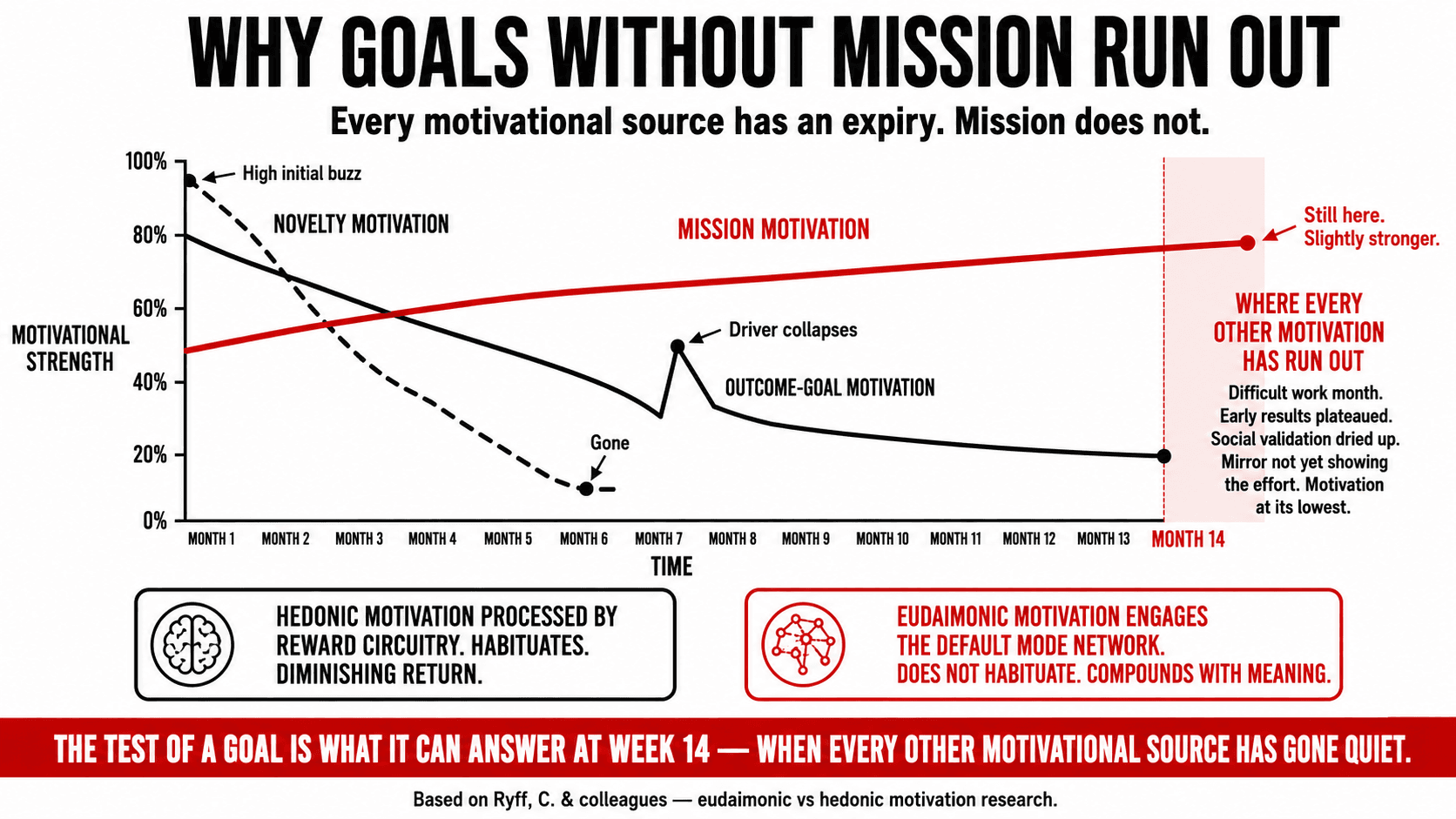
Goals without mission beneath them are destination-only structures. They specify where the person is going without specifying why the journey matters beyond the arrival. This structural weakness is usually invisible in the early months of a programme, because the goal itself provides sufficient forward orientation. The distance to be covered is enough of a direction. But as the programme extends, the goal's motivational power is eroded by time, by the slowness of progress relative to expectation, and by the accumulating difficulty of sustaining effort over months rather than weeks. At some point in every long programme, the question why am I doing this arises. If the only honest answer is to reach the goal, the answer becomes progressively less satisfying the further the goal appears or the closer it gets and the emptier it feels on arrival.
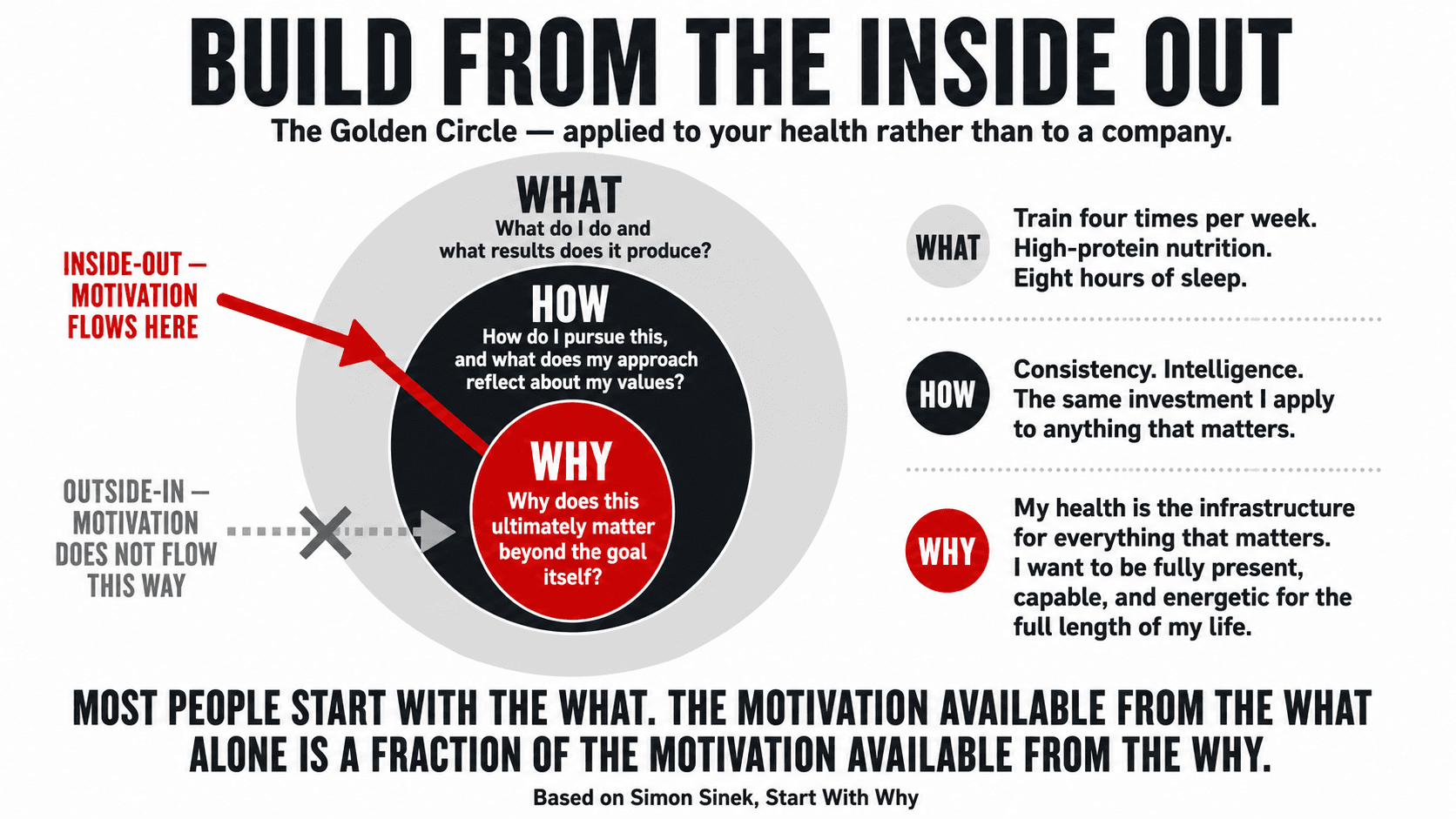
Simon Sinek's Golden Circle framework makes this argument from a leadership and organisational context with a clarity that translates directly to individual health behaviour: the most inspiring and most durable motivation originates in the Why, moves through the How, and produces the What. The Why is the purpose, the cause, the belief that gives the behaviour its meaning beyond the behaviour itself. The How is the approach, the values, the method. The What is the product, the outcome, the visible result. Most people pursuing health goals start with the What, occasionally think about the How, and rarely if ever access the Why at a level of genuine personal truth. The motivation available from the What layer alone is substantially weaker than the motivation available from the Why layer, not because the What is unimportant but because it is downstream of the Why and derives its power from it. (2)
The research on eudaimonic vs hedonic motivation provides the neurological basis for this difference. Hedonic motivation, the pursuit of pleasure and the avoidance of pain, is processed primarily in the brain's reward circuitry and is subject to the habituation and diminishing return effects that any reward-based system eventually produces. Eudaimonic motivation, the pursuit of meaning, purpose, and the realisation of personal values, activates different neural circuits including the default mode network and the areas associated with self-referential processing, and does not habituate in the same way. The person acting from a genuine sense of purpose engages a neurological system that is fundamentally more sustaining than the one engaged by the person acting from the desire for reward or the fear of consequence. (3)
Key Insight: The test of whether a health goal has a genuine mission beneath it is the question it can answer when the going is hardest. At week fourteen, after a difficult work month, with the mirror not yet reflecting what the effort deserves, with motivation at its seasonal low: can the goal answer the question of why this matters enough to stay? If the honest answer is only that you want to look different or weigh less, the architecture is insufficient. If the answer is something about who you are, what you are here to do, what you want to be capable of, and for whom, the architecture will hold through week fourteen and well beyond it.
Sinek's Golden Circle Applied to Health: Building From the Inside Out
The Golden Circle applied to personal health replaces the corporate context of Sinek's original framework with the individual's relationship to their body, their energy, and their physical capability. The three layers function identically: the Why is the mission that gives the behaviour its meaning, the How is the identity and the approach through which the mission is expressed, and the What is the visible behaviour and its outcomes. The motivation flows from the inside out, not from the outside in.
The Golden Circle Applied to Health — Without and With Mission at the Core
| Layer | Without Mission at the Core — Outside-in motivation | With Mission at the Core — Inside-out motivation |
|---|---|---|
| Outermost Layer WHAT — What do I do and what results does it produce? | I train four times per week and follow a nutritional protocol. The results are visible progress. When the progress slows, the motivation for the What weakens because the What is the entire structure. | I train and eat well because it is the expression of who I am and what I am committed to. The What is the visible surface of a structure that goes much deeper. Its execution does not depend on the visibility of results. |
| Middle Layer HOW — How do I pursue this and what does my approach reflect about my values? | I train with progressive overload and follow a high-protein nutritional approach. The How is technical, not meaningful. It describes method without connecting to identity or purpose. | I pursue my health with consistency, intelligence, and the same investment I apply to things that matter. The How reflects a set of values: commitment, self-respect, long-term thinking. These values sustain the How through difficulty. |
| Core Layer WHY — Why does this ultimately matter beyond the goal itself? | ABSENT. There is no Why beneath this structure. The goal is the entire justification for the effort. When the goal is distant, achieved, or feels insufficient, the structure collapses. | I take my health seriously because I want to be fully capable, energetic, and present for the full length of my life. My health is not vanity. It is the infrastructure for everything that matters to me. This Why does not expire. |
The outside-in structure motivates until the results slow, the goal is reached, or the discipline becomes exhausting. The inside-out structure motivates because the core is not a result. It is a commitment to a way of being that does not have an expiry date.
The Five Why Excavation: Finding the Mission Beneath the Goal
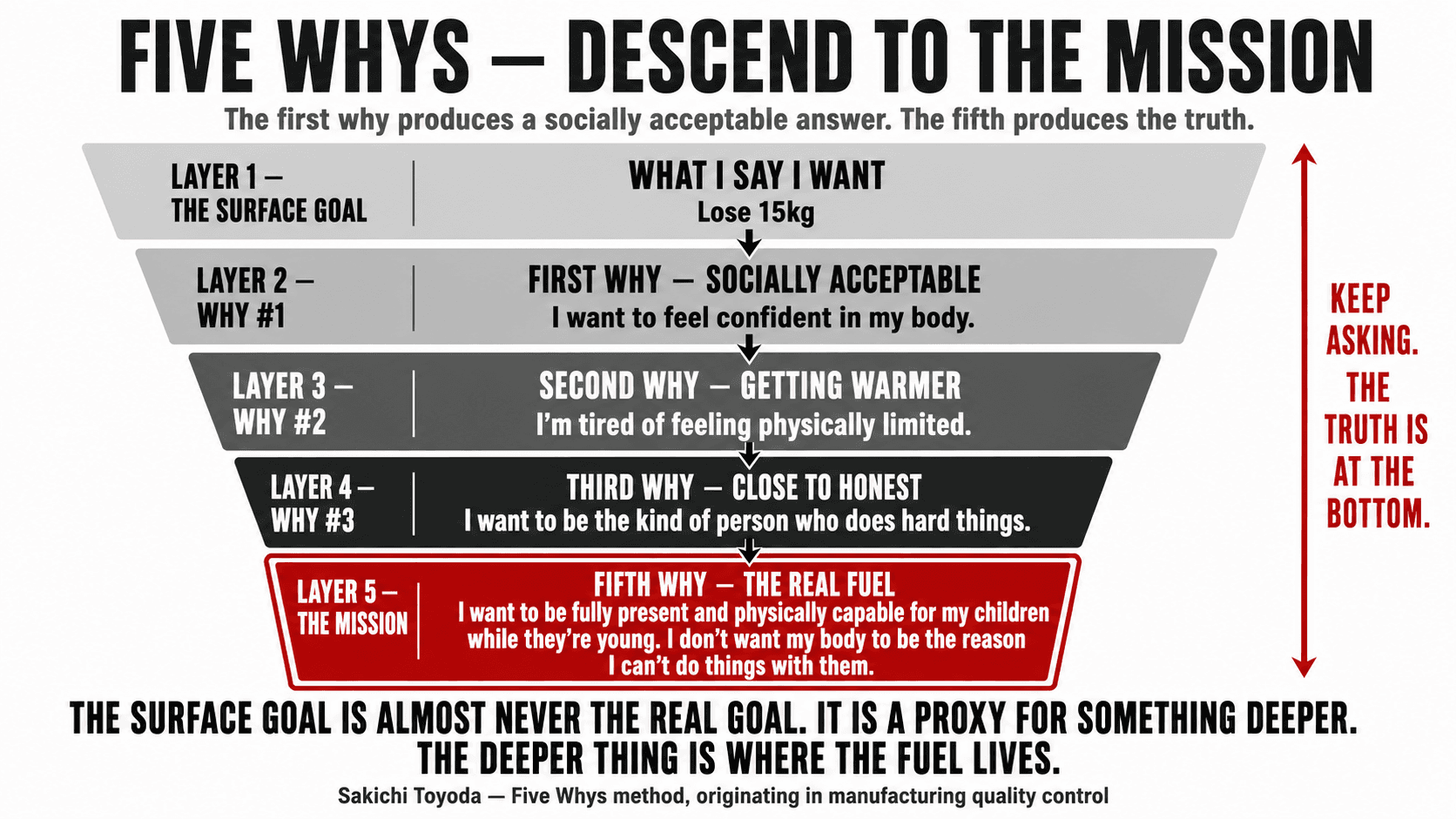
The technique of asking why five times, developed in manufacturing quality control by Sakichi Toyoda and subsequently applied across problem-solving and personal development contexts, is one of the most reliable tools for locating the genuine mission beneath a surface-level goal. The surface goal is almost never the real goal. It is a proxy for something that the person values more fundamentally, and that deeper value is the motivational resource that the surface goal cannot access. The five-why excavation is the process of descending through the layers of proxy to find the genuine one. (4)
The process is straightforward and requires only honesty and the willingness to keep asking the question past the point of comfort. The first why typically produces a socially acceptable answer. The second or third why begins to get closer to something real. The fourth or fifth why arrives at something that, when spoken, feels like genuine truth rather than a reasonable-sounding justification.
The Purpose Depth Table — The Five Why Excavation Applied to Four Common Health Starting Points
| Surface Goal (What) | The Depth Question | The Deeper Why (How far down?) | The Mission Layer (The real fuel) |
|---|---|---|---|
| Lose 15kg | Why does that matter? | I want to feel confident in my body. I want to have more energy. I am tired of feeling physically limited by my weight. | I want to be fully present and physically capable for my children while they are young. I do not want my body to be the reason I cannot do things with them. I want them to grow up seeing what a healthy relationship with a body looks like. |
| Get fit enough to run a half-marathon | Why does that matter? | I want to prove to myself that I can do something physically demanding. I want to show that I am capable of more than my current fitness suggests. | I want to rebuild my relationship with physical challenge after years of avoiding it. I want to be someone who does hard things on purpose. This is about recovering a version of myself I let go of and deciding it is still available. |
| Lower my blood pressure without medication | Why does that matter? | I do not want to be on medication for the rest of my life. I want to be in control of my health rather than managed by it. | My father died of a stroke at 62. I watched what that did to our family. I am going to be 58 next year. I am not going to let the same thing happen. My health is not optional. It is a commitment I made the day he died. |
| Build more muscle and improve body composition | Why does that matter? | I want to feel stronger and more capable. I have always been self-conscious about my body and I want that to change. | I want to stop apologising for taking up space. I have spent twenty years feeling like I had to make myself smaller physically and in every other way. Building this body is the most literal version of refusing to do that any more. |
The surface goal and the mission layer are both true. The surface goal gives the programme direction. The mission layer gives it permanence. A programme with only the surface goal runs out of fuel when the goal is distant, achieved, or insufficient. A programme with both never runs out of the fuel that matters most.
Frankl's Will to Meaning: What Happens to Health Behaviour When Purpose Is Present
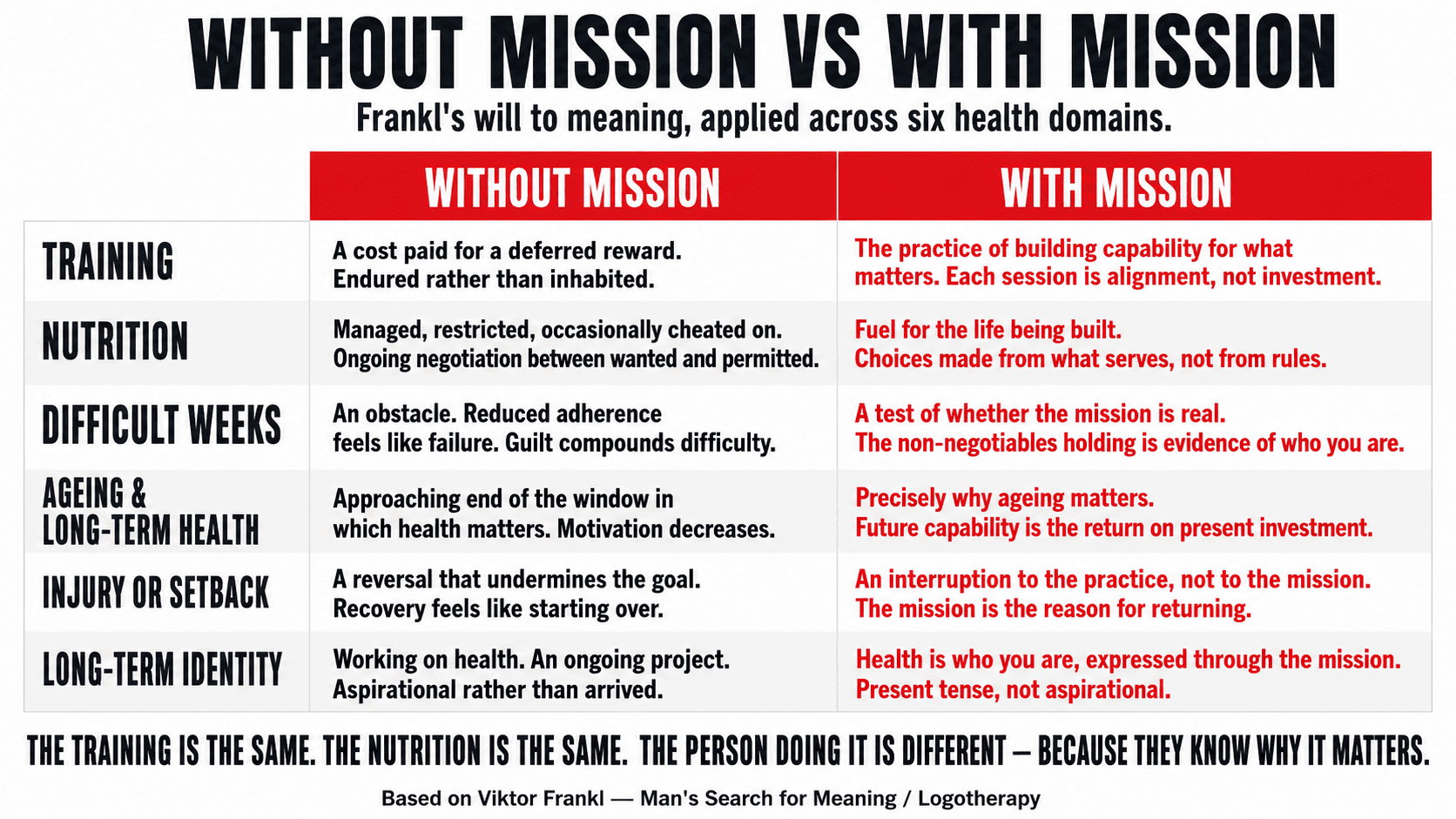
Frankl's central therapeutic argument was that the primary human motivational force is not pleasure, as Freud proposed, nor power, as Adler proposed, but meaning. The will to meaning is the deepest motivational driver available to a human being, and its presence or absence determines the person's relationship with suffering, difficulty, and sustained effort in a way that no other motivational source can replicate. The person with a compelling sense of meaning does not merely endure difficulty. They integrate it as part of the narrative of a life being lived in alignment with something that matters. (1)
Applied to health behaviour, Frankl's framework predicts something that the research on intrinsic motivation consistently confirms: people whose health behaviour is connected to a genuine sense of personal meaning sustain that behaviour across longer periods, through greater difficulty, and with higher rates of adherence during the challenging phases of a programme than people whose health behaviour is connected only to external reward or the avoidance of negative outcomes. The meaning is not merely a motivational addition to the programme. It is a different kind of programme entirely. One that the person does not do. One that the person is.
Frankl's Will to Meaning Applied to Health — What Each Health Domain Looks Like Without and With Purpose
| Health Domain | Without Purpose (Health as obligation or outcome) | With Purpose (Health as expression of mission) |
|---|---|---|
| Training | Training is a cost to be paid for the outcome of looking or feeling different. When the outcome feels distant, the cost feels disproportionate. Training is endured rather than inhabited. | Training is the practice of building and maintaining the physical capability to do what matters. Every session is an act of alignment with the mission rather than an investment in a deferred reward. |
| Nutrition | Food is managed, restricted, tracked, and occasionally cheated on. The relationship with food is one of ongoing negotiation between what is wanted and what is permitted. It is exhausting. | Food is fuel for the life being built. Nutritional choices are made from a framework of what serves the body and the mission rather than from rules and restriction. The relationship is intelligent rather than anxious. |
| Difficult weeks | A difficult week is an obstacle to the programme. Reduced adherence during a difficult week feels like failure against the goal and generates guilt that compounds the difficulty. | A difficult week is a test of whether the mission is real. Maintaining the non-negotiables through a genuinely difficult week is not an inconvenience. It is evidence of who you are. The mission is confirmed, not threatened, by difficulty. |
| Ageing and long-term health | Ageing is the approaching end of the window in which the health goal matters. The motivation decreases as the goal feels less achievable or less relevant. Long-term health investment feels futile. | The mission is precisely why ageing matters. Physical capability, cognitive function, and energy in later decades are the long-term return on the investment being made now. The horizon is not an obstacle. It is the point. |
| Injury or setback | Injury is a reversal of progress that undermines the goal and removes the motivational structure of the programme. Recovery feels like starting over. The setback can permanently end the programme. | Injury is an interruption to the practice but not to the mission. The mission is the reason for returning to training after recovery. It reorients the response to setback from exit to navigation. |
| Long-term identity | Health is something the person is working on. It is an ongoing project with an uncertain end point. The identity is one of aspiration rather than arrival. | Health is part of who the person is, expressed through the mission rather than pursued as an outcome. The identity is not aspirational. It is present-tense. It is simply how a person who cares about their mission lives. |
The transformation from the left column to the right is not a change in the programme. It is a change in the motivational architecture beneath the programme. The training is the same. The nutrition is the same. The person doing it is different, because they know why it matters.
The Neuroscience of Purpose: What Happens in the Brain When the Why Is Genuine
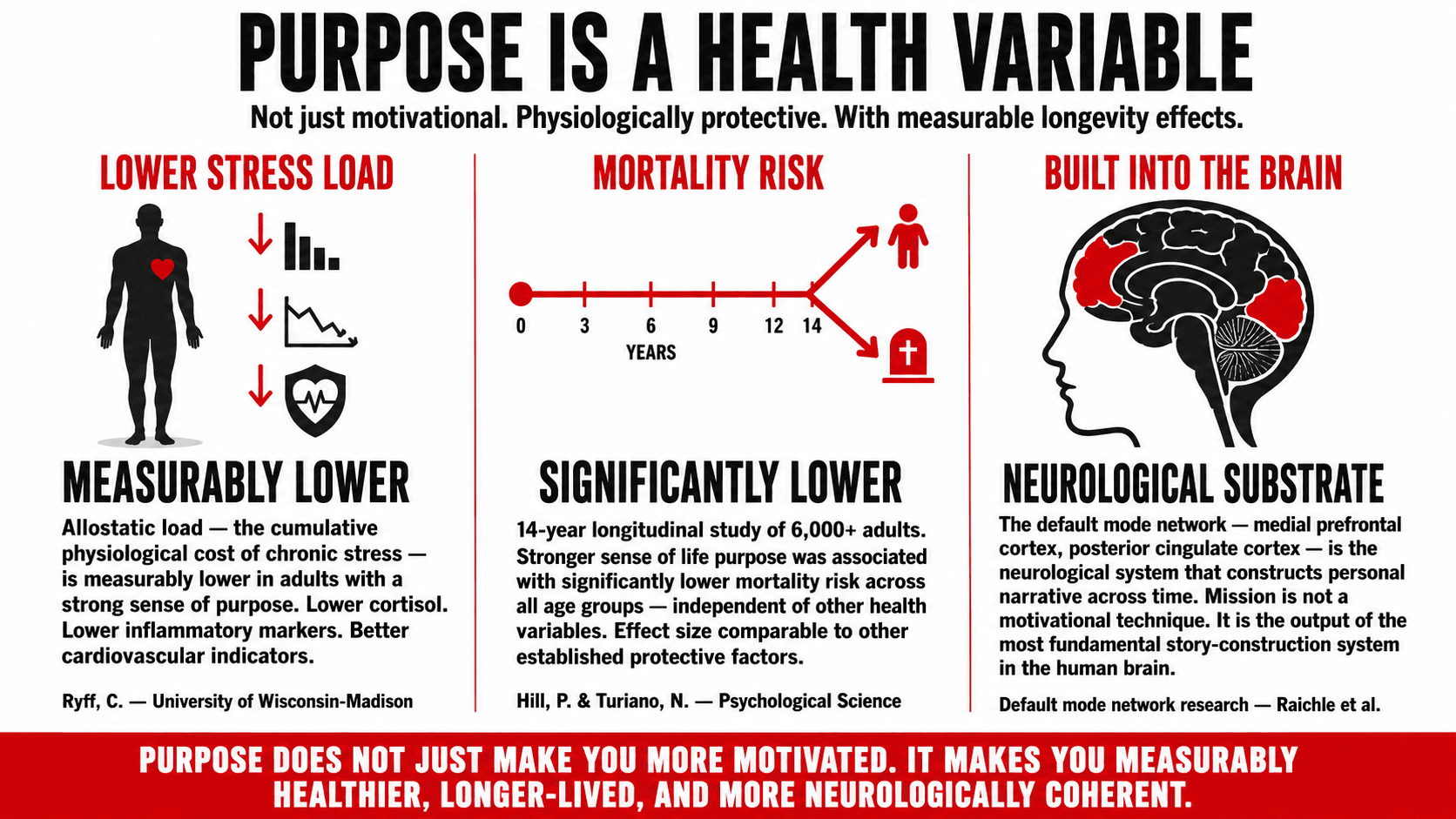
The neurological distinction between hedonic and eudaimonic motivation has measurable structural correlates. Research from Carol Ryff and colleagues at the University of Wisconsin-Madison found that eudaimonic wellbeing, defined as the sense of living a purposeful life aligned with deeply held values, was associated with significantly lower allostatic load, the cumulative physiological cost of chronic stress, than hedonic wellbeing measured alone. The person with a strong sense of purpose is not merely psychologically healthier. They are physiologically healthier, with measurably better stress hormone profiles, inflammatory marker levels, and cardiovascular indicators. (5)
Patrick Hill and Nicholas Turiano's longitudinal research on purpose and longevity tracked over six thousand adults over fourteen years and found that having a stronger sense of life purpose was associated with a significantly lower risk of mortality across all age groups, independent of other health variables. The effect size was comparable to other well-established protective factors for longevity. Purpose is not merely a motivational tool for health programmes. It is itself a health variable with direct physiological effects on the systems the programme is trying to optimise. (6)
The brain's default mode network, a set of interconnected regions including the medial prefrontal cortex and the posterior cingulate cortex that is active during self-referential thought, future simulation, and narrative self-construction, is the neurological substrate of mission-level thinking. When a person engages with questions about who they are, what they are here to do, and what their life is for, the default mode network is the system doing that processing. It is also the system most associated with the construction of a coherent personal narrative across time: the self-story that connects past, present, and future into a meaningful sequence. Mission is not simply a motivational technique. It is the product of the most fundamental narrative-construction system in the human brain. (7)
Key Insight: Purpose does not announce itself. It is found by asking the right questions with enough patience and honesty to go past the first comfortable answer. The question is not what do you want to achieve. It is what do you want your life to mean, and how does your health either serve or undermine that meaning? Sit with that question. Write the answer. Return to it when the programme is easy and when it is hard. The answer that remains consistent across both conditions is the real one. That is the mission.
Writing the Mission Statement: What It Is, What It Is Not, and How to Find It
A personal health mission statement is not an aspirational slogan or a life-coaching affirmation. It is a specific, personally honest articulation of the reason that the health investment being made matters at the level of genuine personal truth. It is written in the first person. It is specific enough to be meaningful and broad enough to sustain the full programme, not just the phase currently being worked through.
What makes a mission statement genuinely functional rather than merely inspirational is its emotional truth. The mission statement that produces a physiological response when read, that makes the person feel the weight of what they are committed to rather than simply the intent, is the one that will reach them at week fourteen when nothing else will. The mission statement that sounds impressive and produces nothing is an aspiration dressed in mission language.
The test of a genuine mission statement is what it does to the person's decision-making at the moments of greatest difficulty. The person who reads their mission statement at 6am on a Tuesday when they do not want to train, and who trains, has a genuine mission statement. The person who reads it and goes back to sleep has an aspiration statement. The difference is not in the words. It is in the depth of the truth behind them, and depth is found through the five-why excavation rather than through inspiration.
The mission statement itself is typically two to four sentences. It names who the person is, what they are committed to, who it is for, and why it matters at the level that is genuinely true. It does not need to be impressive to others. It needs to be irreducibly true to the person who wrote it.
Key Insight: Write your health mission statement this week. Start with the surface goal. Ask why five times. When you reach an answer that feels like genuine truth rather than a reasonable approximation of it, you have found the material. Write the mission statement from that material, in the first person, in present tense, as a description of the person you are in the process of becoming rather than the outcome you are pursuing. Keep it somewhere you will read it in the difficult weeks.
How the Mission Layer Is Built Into Every Long-Term Programme
The mission conversation is the deepest and often the most revealing conversation I have with any client, because it is the conversation in which the distance between the stated goal and the genuine motivation becomes visible. Most people arrive with a goal. Very few arrive with a mission. The goal is easy to state. The mission requires excavation.
I have sat with clients who arrived intending to discuss a training programme and found themselves articulating something about their father, their children, their mortality, their relationship with their own body across a lifetime, that they had not spoken aloud before. Those conversations are not diversions from the programme. They are the most important part of it, because they locate the motivational resource that no training plan, nutritional strategy, or habit architecture can provide: the reason that makes the whole structure worth building and worth maintaining when the conditions that other motivational sources require are absent.
The programme built on mission is not simply more motivated than the one built on goals alone. It is architecturally different. It has a foundation that reaches deeper than any difficulty the programme will encounter. Every element of this series, from the identity work through the habit architecture, the goal design, the neuroplasticity understanding, and the social environment management, is built to serve the mission. The mission is what they are all in the service of. And the mission is what makes them all worth doing when the going is hardest.
I work one-to-one with clients online globally. The mission conversation is always early. Because without the why, the how is eventually always optional.
Work with Me
Get a personalised coaching plan built around your goals, your schedule, and your life.
Enquire NowReferences
- Frankl VE. Man's Search for Meaning. Boston: Beacon Press; 1959.
- Sinek S. Start With Why: How Great Leaders Inspire Everyone to Take Action. London: Penguin; 2011.
- Ryan RM, Deci EL. On happiness and human potentials: a review of research on hedonic and eudaimonic wellbeing. Annual Review of Psychology. 2001; 52: 141–166.
- Ohno T. Toyota Production System: Beyond Large-Scale Production. Cambridge: Productivity Press; 1988.
- Ryff CD, Singer BH. Know thyself and become what you are: a eudaimonic approach to psychological wellbeing. Journal of Happiness Studies. 2008; 9(1): 13–39.
- Hill PL, Turiano NA. Purpose in life as a predictor of mortality across adulthood. Psychological Science. 2014; 25(7): 1482–1486.
- Andrews-Hanna JR. The brain's default network and its adaptive role in internal mentation. Neuroscientist. 2012; 18(3): 251–270.