
The Wrong Scoreboard Is Costing You Everything
The inner scoreboard for health and fitness is the concept that draws the sharpest possible line between two fundamentally different orientations toward performance: one that measures progress against other people and one that measures it against the previous version of yourself. Most people, operating in a culture saturated with social comparison, are running on the external scoreboard without having consciously chosen it. The Instagram feed provides a continuous stream of other people's results. The gym provides a direct comparison environment. The workplace provides a social mirror of what healthy and fit looks like among peers. The external scoreboard is not something the person decides to use. It is imposed by the environment and accepted by default.
The problem with the external scoreboard is not that it is motivating. In certain conditions and for certain people at certain points in a programme, it can be. The problem is that it is structurally unreliable as a primary performance measure, because the measurement reference point, other people, is entirely outside the person's control and has no fixed relationship with their own starting point, their physiology, their history, their circumstances, or their rate of progress. The person who measures their performance against someone who has been training for a decade, who has better recovery capacity, who has a faster metabolism, who started from a different baseline, is not getting accurate information about their own performance. They are getting demoralising noise.
John Wooden, considered by many sports writers the greatest coach in American sporting history, built his entire philosophy of performance around the internal standard rather than the external one. Wooden defined success not as winning against opponents but as the peace of mind that comes from knowing you made the effort to become the best you are capable of becoming. His teams consistently won, but he explicitly refused to make winning the measure of success because the winning was dependent on the quality of the opponent, which was outside his players' control. The only measure that was always within their control was whether they had exceeded their own previous standard. (1)
“Success is peace of mind which is a direct result of self-satisfaction in knowing you did your best to become the best that you are capable of becoming.”
— John Wooden
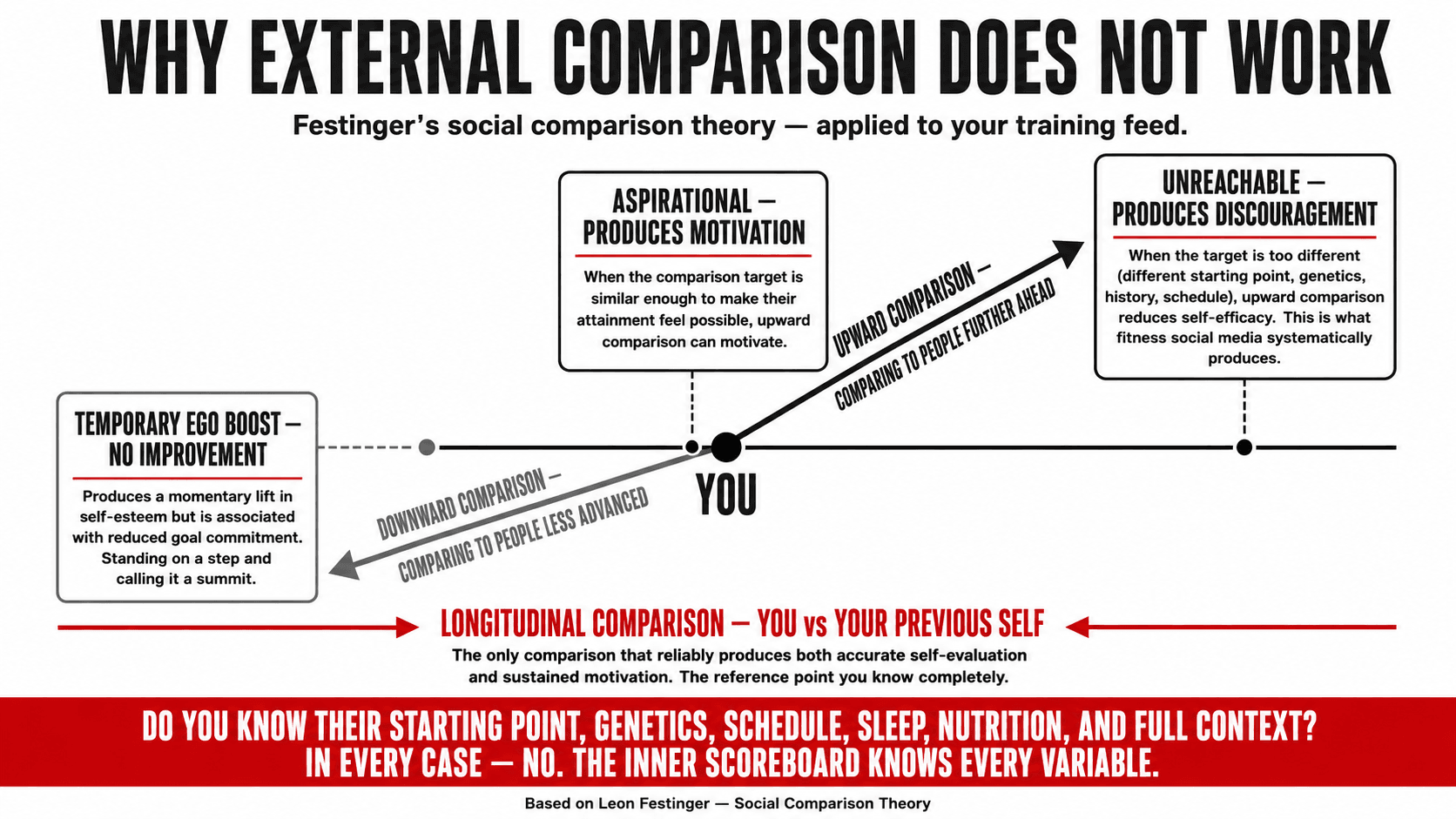
The Psychology of Social Comparison: Why the External Scoreboard Systematically Produces Discouragement
Leon Festinger's social comparison theory, developed in 1954 and extensively replicated since, established that humans have a drive to evaluate their opinions and abilities by comparing them to others, and that this drive is strongest in the absence of objective standards. In domains where objective performance standards are available, social comparison is less dominant. In domains where standards are unclear or subjective, social comparison fills the evaluative vacuum with information that is systematically skewed toward discouragement for anyone who is not at the top of the comparison group. (2)
Upward social comparison, comparing yourself to people who are further ahead, produces two distinct psychological responses depending on whether the comparison target is perceived as similar or different. When the comparison target is similar enough to be aspirational, upward comparison can produce motivation through the belief that their attainment is possible for you. When the comparison target is different enough to make their attainment appear unreachable, upward comparison produces discouragement and reduces self-efficacy. The fitness culture on social media is a near-perfect environment for the second kind of upward comparison: the images and results presented there are systematically selected for extremity, represent people with significantly different genetics, histories, resources, and training ages, and are frequently presented without the context that would make the comparison realistic. (3)
Downward social comparison, comparing yourself to people who are less advanced, produces a temporary boost in self-esteem but no improvement in performance and has been associated with reduced goal commitment in research contexts. The person who feels good about their progress relative to someone less advanced than them has used a comparison that requires no improvement of their own to maintain. It is the motivational equivalent of standing on a step and calling it a summit. The only comparison that reliably produces both accurate self-evaluation and sustained motivation toward improvement is the longitudinal comparison with the previous self. (4)
Key Insight: The next time you look at someone else's training performance, body composition, or health results and feel the familiar contraction of comparison, ask one question: do I know their starting point, their training history, their genetics, their schedule, their sleep, their nutrition, and the full context of the result I am comparing to my own? In every case the honest answer is no. The comparison is not between your result and theirs. It is between your result and a curated fragment of theirs. The inner scoreboard does not have this problem. You know every variable.
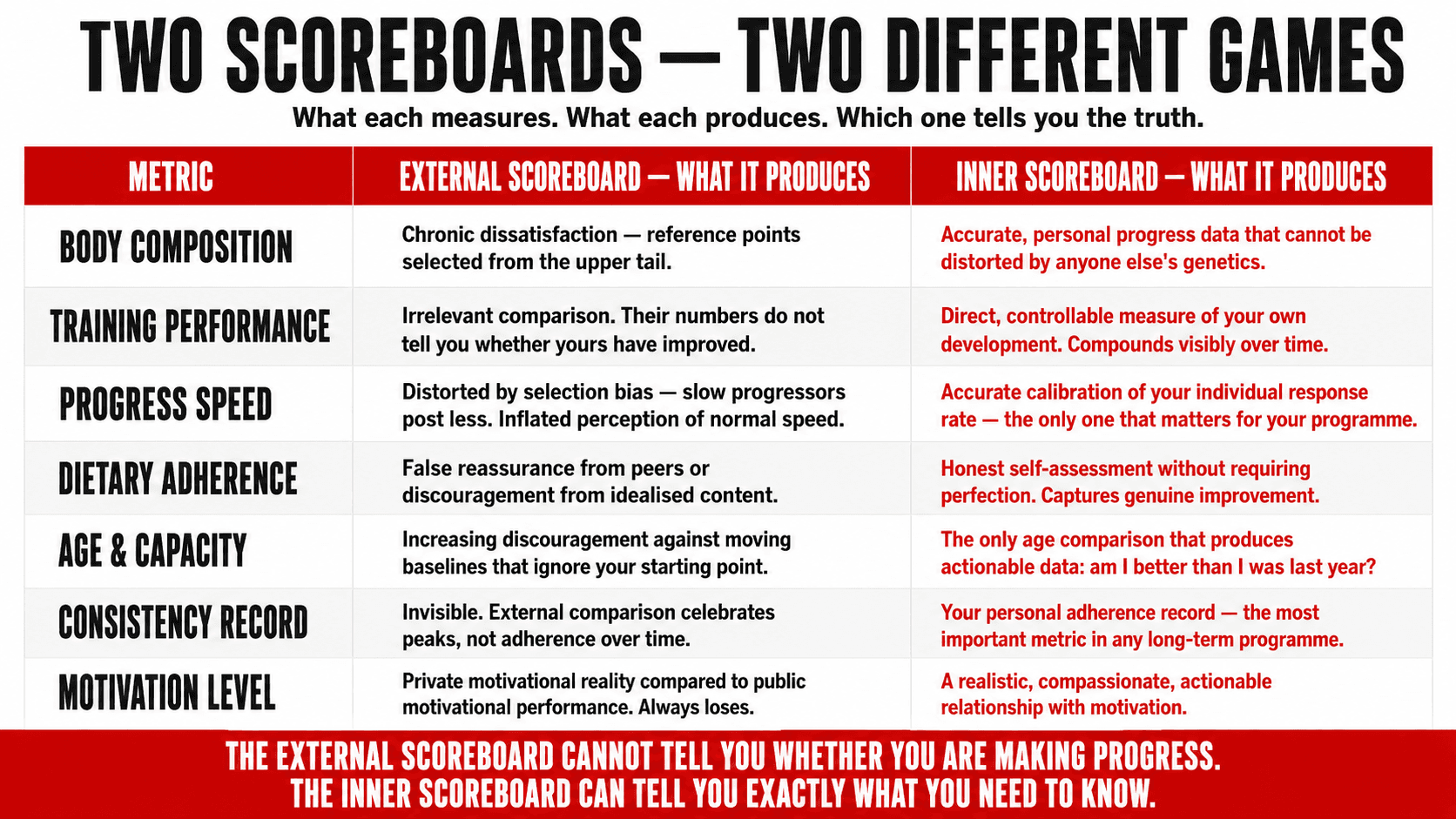
The Two Scoreboards: What Each Measures, What Each Produces, and Which One Wins
The external and internal scoreboards do not simply produce different emotional outcomes from the same performance data. They track different metrics entirely, making it impossible to be accurately informed about your own progress while running primarily on the external scoreboard. The diagram below maps both scoreboards across seven performance metrics, showing what each records and what each produces as a consequence.
The Two Scoreboards — External Comparison vs Internal Personal Record Across Seven Metrics
| Metric | External — What it records | External — What it produces | Internal — What it records | Internal — What it produces |
|---|---|---|---|---|
| Body composition | How your body compares to selected reference points in social media, gym environment, or peer group. | Chronic dissatisfaction for most people most of the time, because the reference points are selected from the upper tail of the comparison distribution. | How your body composition has changed from your own measured starting point across the programme timeline. | Accurate, specific, personally meaningful progress data that cannot be distorted by someone else's genetics or circumstances. |
| Training performance | Whether you lift more, run faster, or train harder than others visible in your environment. | Irrelevant comparison in most cases. The person who was stronger last year does not help you understand whether you are stronger than you were last month. | Whether you performed better this week than you performed last week, last month, or at your programme baseline. | A direct, controllable, continuously improvable measure of your own development that compounds visibly over time. |
| Progress speed | Whether your results are arriving at the same speed as other people's visible results. | Distorted by the selection bias of visible comparison: the slow progressors post less. The result is a systematically inflated perception of normal progress speed. | Whether your current progress rate is consistent with your own programme history and physiology. | Accurate calibration of your individual response rate, which is the only rate that is relevant to your programme design. |
| Dietary adherence | Whether your diet looks like the diets visible in your peer group, social media, or public health environment. | Either false reassurance from downward comparison with peers eating poorly, or discouragement from upward comparison with people presenting idealised dietary perfection. | Whether your nutritional approach is better than it was three months ago and whether today's choices are better than yesterday's. | Honest self-assessment that captures genuine improvement without requiring perfection as the baseline. |
| Age and capacity | Whether your performance and physique are comparable to people of the same age, or to a younger version of cultural ideals. | Increasing discouragement as a function of normal ageing when compared to cultural or peer baselines that are themselves moving. | Whether your capacity at 52 is better than your capacity at 51, measured on your own terms by your own standards. | The only age comparison that produces actionable and encouraging data: am I better than I was at this time last year? |
| Consistency record | Whether your training frequency compares to the schedules visible in others' public reporting. | Invisible in the external scoreboard, because consistency over time is almost never what external comparison celebrates. External comparison celebrates peaks. | Your personal adherence record: how many of your planned sessions happened, and how does this week's record compare to last month's? | The most important performance metric in any long-term programme, and one that is entirely invisible in external comparison but completely precise in internal measurement. |
| Motivation level | Whether your enthusiasm for the programme matches the apparent enthusiasm of people publicly engaging with health and fitness content. | The comparison of private motivational reality against public motivational performance. The reality rarely matches the performance. The comparison produces inadequacy. | Whether today's motivation is sufficient to execute today's minimum viable session, regardless of how it compares to week one or anyone else's Tuesday. | A realistic, compassionate, and actionable relationship with motivation that does not require peak states to sustain consistent behaviour. |
The external scoreboard cannot tell you whether you are making genuine progress on your programme. It can only tell you how you compare to a reference point that has no fixed relationship with your starting conditions, your physiology, or your actual rate of development. The internal scoreboard can tell you exactly what you need to know.
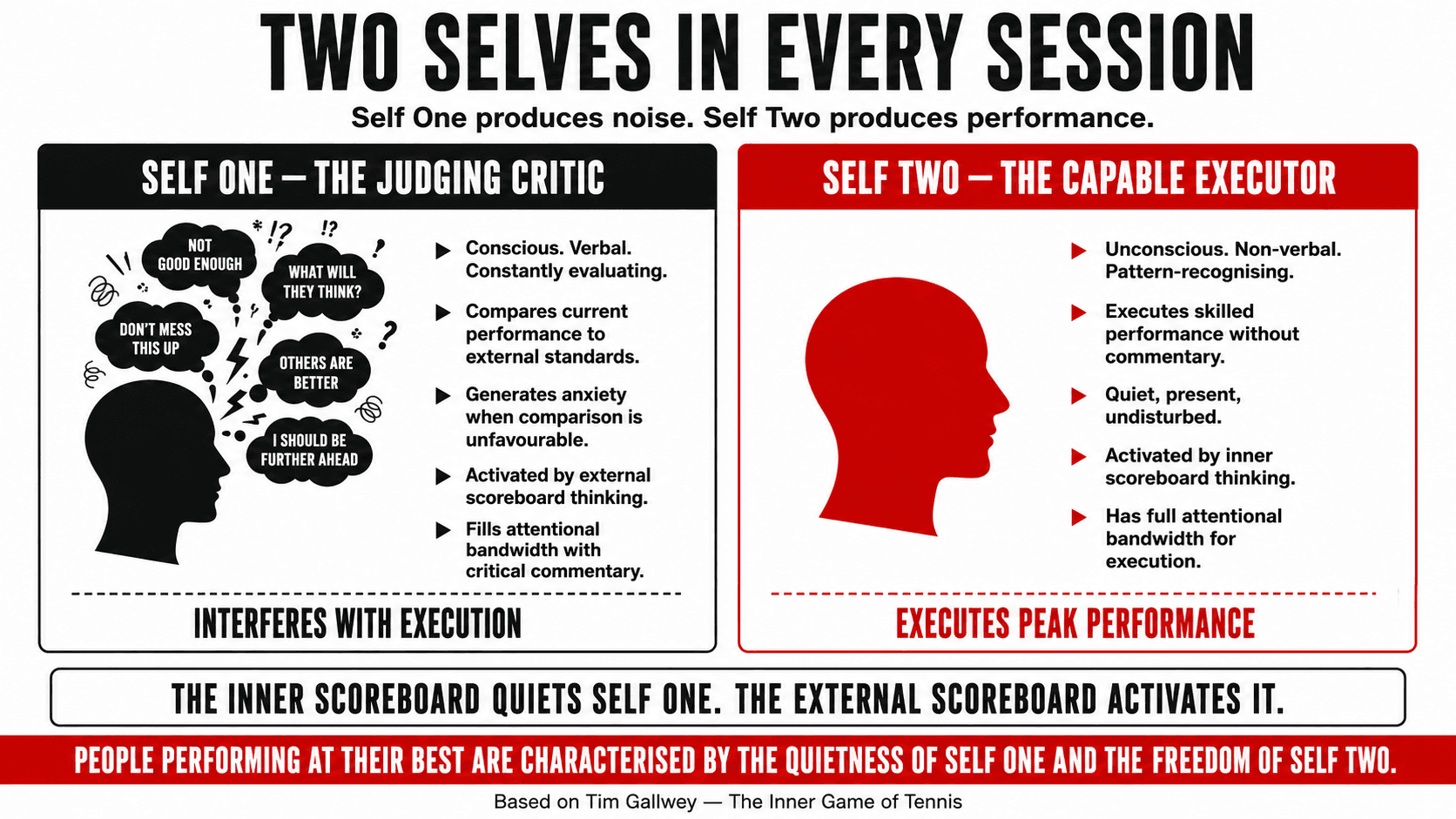
Tim Gallwey's Inner Game: The Self One and Self Two Framework
Tim Gallwey's Inner Game framework, developed through his work as a tennis coach and subsequently applied across golf, work, and life, provides one of the most practically useful models for understanding why external comparison is so persistently destructive to performance and why the internal orientation produces the opposite effect. Gallwey identified two selves operating simultaneously in any performance context: Self One, the conscious, critical, judging, instruction-issuing self that compares current performance to an external standard and generates anxiety and self-interference when the comparison is unfavourable; and Self Two, the unconscious, capable, pattern-recognising self that executes skilled performance most effectively when Self One is quiet. (5)
The internal dialogue of external comparison activates Self One at its most critical and most performance-undermining. The person comparing their body to an Instagram fitness account, their training to a faster gym member, or their progress speed to a colleague's visible results is running a continuous critical commentary that Gallwey's research suggests is the single most effective way to degrade performance. The internal noise of comparison not only produces discouragement. It physically interferes with the quality of execution by filling the attentional bandwidth that skilled physical performance requires with comparative evaluation that the body cannot use.
The inner scoreboard, by contrast, quietens Self One in a very specific way. When the only reference point is the previous version of yourself, the critical evaluative function has less material to work with. The question have I improved today rather than am I as good as them is a fundamentally less threatening question to the ego, and the threat response of the ego is precisely the Self One activation that Gallwey identified as the primary obstacle to peak performance. People performing at their best, in every physical discipline studied, are characterised by the quietness of Self One and the freedom of Self Two. The inner scoreboard is one of the most reliable practices available for producing that quietness. (5)
Key Insight: Before your next training session, set a single personal record target: one specific metric where you will measure your performance against your own previous best rather than against any external reference. It does not need to be dramatic. Two additional repetitions at the same weight. Ten seconds faster on the same interval. Five minutes longer at the same intensity. Record it. Return to it next week. The act of tracking your own personal records, without reference to anyone else's, shifts the entire psychological orientation of the session from performance for evaluation to performance for development.
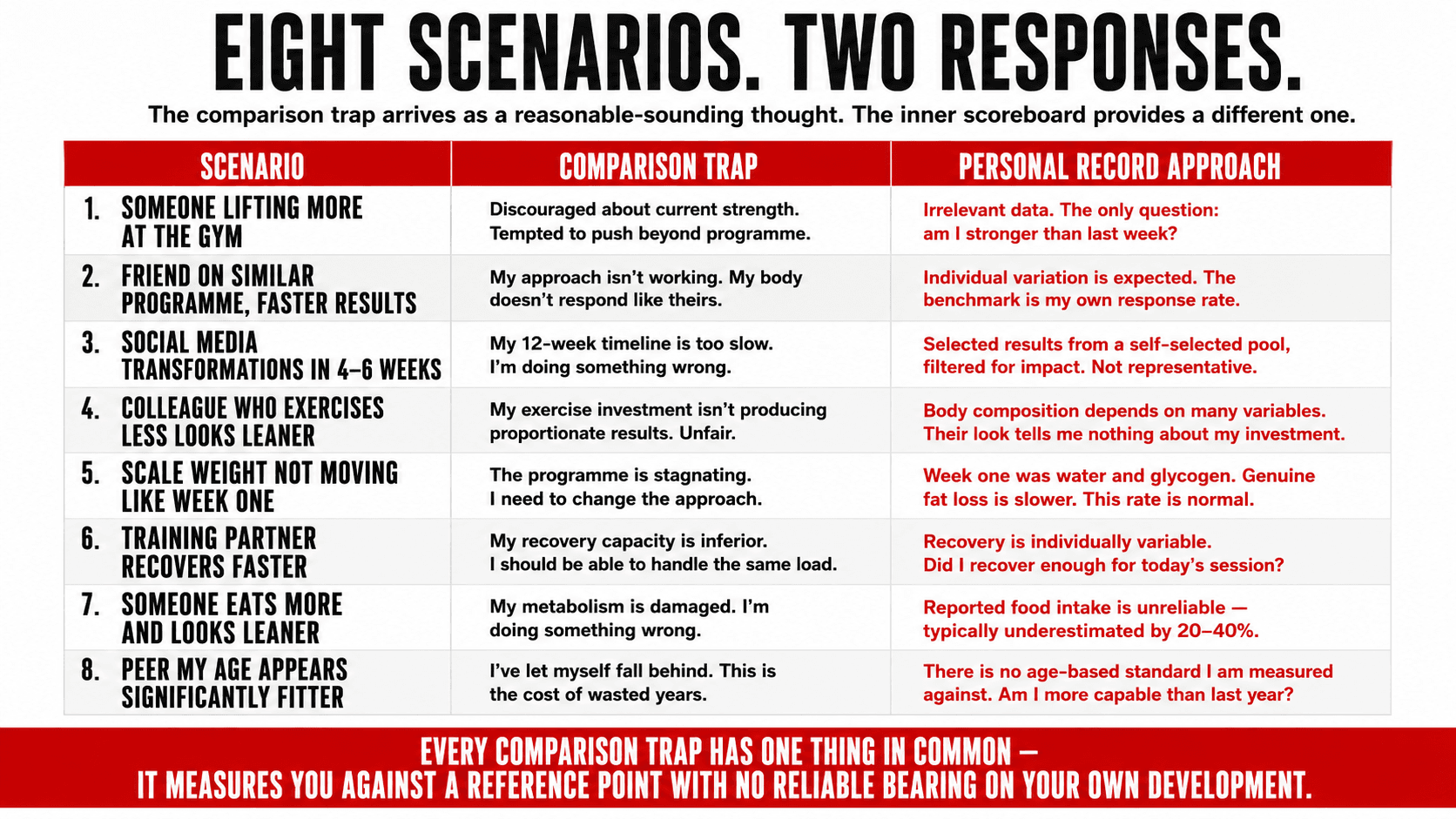
The Comparison Trap vs the Personal Record Approach: Eight Scenarios Compared
The comparison trap does not always arrive dramatically. It often arrives as a reasonable-sounding thought in a specific recurring situation, and the person who has not consciously chosen the inner scoreboard is susceptible to it in ways they may not have identified. The table below maps eight common health and fitness scenarios against the comparison trap response and the personal record approach, making the fork in the road visible before it is reached.
The Comparison Trap vs the Personal Record Approach — Eight Recurring Scenarios
| Scenario | The Comparison Trap (External scoreboard running) | The Personal Record Approach (Inner scoreboard only) |
|---|---|---|
| Someone at the gym is lifting significantly more weight | Discouragement about current strength levels measured against an irrelevant reference point. Possible response: ego-driven increase in weight beyond what the programme prescribes, risking injury. | Irrelevant data. Their strength is not a variable in my programme. The only relevant question is whether I am stronger than I was last week, and by how much. |
| A friend on a similar programme is getting faster visible results | My approach is not working as well as theirs. My programme is less effective. My body does not respond as well as their body. I should change what I am doing. | Individual variation in adaptation rate is well-documented and expected. Their rate is not a benchmark for mine. The benchmark is whether my own rate is consistent with my programme and my physiology. |
| Social media shows transformation results in a shorter timeframe | My twelve-week timeline is too slow. Other people are achieving visible results in four to six weeks. I am doing something wrong or my expectations are unrealistic. | Social media presents selected results from a self-selected pool of people who chose to post, filtered for visual impact. It is not a representative sample. My timeline is set by my starting point and my physiology, not by the content feed. |
| A colleague who exercises less appears to be leaner | My exercise investment is not producing proportionate results. I am working harder for less visible outcome. There is something unfair or wrong about this. | Body composition is determined by a combination of variables including genetics, diet, sleep, stress, and training. The visible leanness of someone who exercises less tells me nothing about the value of my exercise investment for my own physiology. |
| Scale weight is not moving as fast as the week-one rate of loss | The programme is stagnating. Early progress was promising but results have slowed to a disappointing rate. I need to change the approach. | Week-one weight loss is predominantly water and glycogen depletion. The rate of genuine fat loss in weeks four to twelve is always slower than week one and is not a decline in programme effectiveness. My own week-four rate compared to my own previous week-four rates is the relevant measure. |
| A training partner is recovering faster between sessions | My recovery capacity is inferior. I am less fit or less resilient than they are. I should be able to handle the same training load. | Recovery capacity is individually variable and determined by sleep, stress, nutrition, genetics, and training history. Their recovery rate is not a standard for mine. My standard is: did I recover adequately to perform well in today's session? |
| Someone mentions they eat more than I do and appears leaner | My metabolism is damaged or inferior. My caloric intake is unnecessarily restricted relative to what is possible. I am doing something wrong. | Metabolic rate is individually variable. Reported food intake is among the least reliable data available in health research: people consistently underestimate consumption by 20–40%. I am not in a position to draw any conclusion from this comparison. |
| A peer their own age appears significantly fitter | I have let myself fall significantly behind where I should be at my age. I am behind the curve. This is a consequence of wasted years. | There is no age-based fitness standard that I am measured against. The question is whether I am more capable this year than I was last year, and whether the trend of the comparison with my previous self is moving in the right direction. |
Every comparison trap scenario has one thing in common: it provides information about someone else's performance that has no reliable bearing on the evaluation of your own. The inner scoreboard eliminates the trap by removing the reference point that enables it.
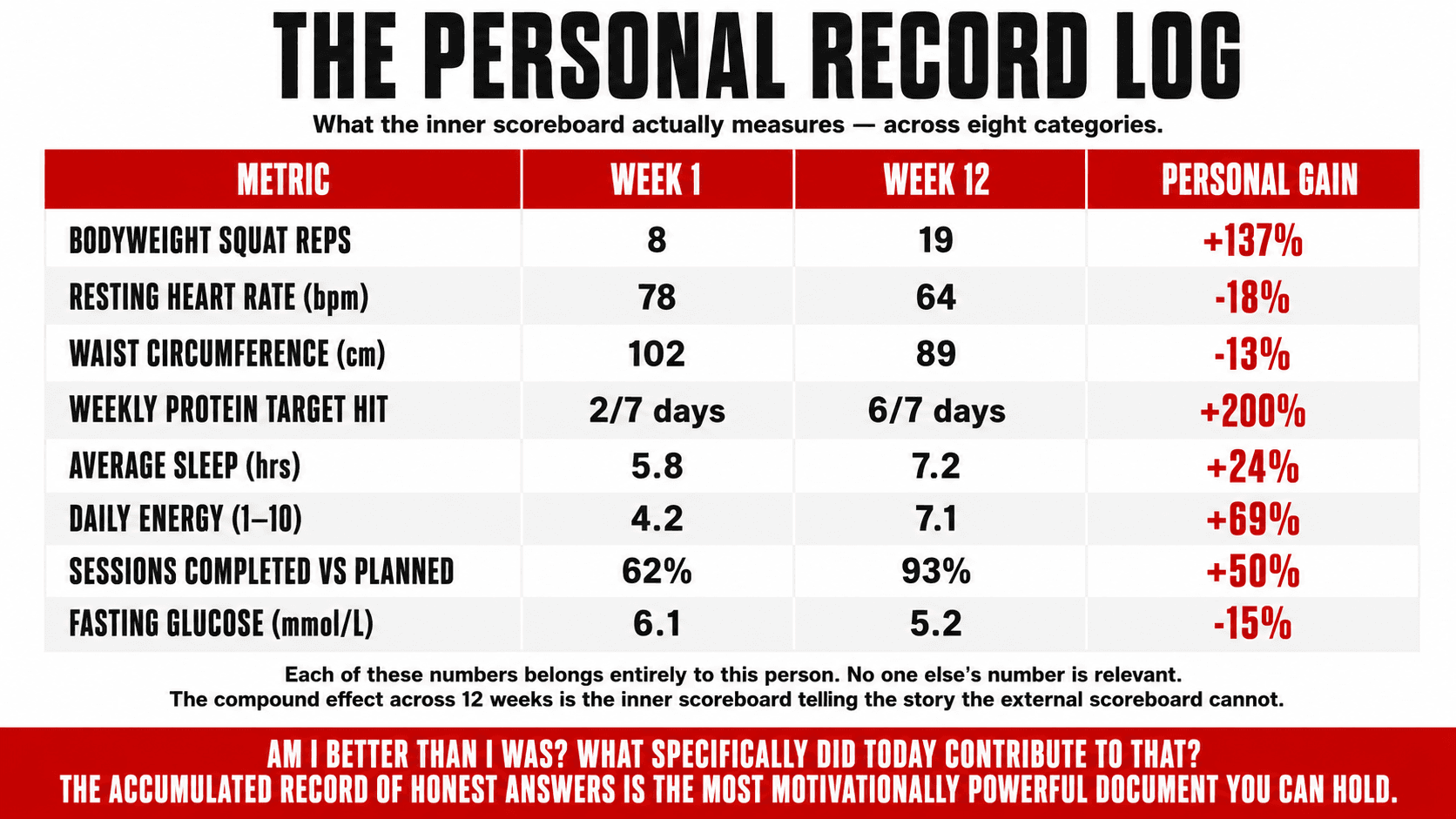
The Personal Record Log: Making the Inner Scoreboard Visible and Measurable
The inner scoreboard is not merely a philosophical position. It is a practical measurement system, and like any measurement system it produces its value through consistent application rather than occasional reference. The personal record log is the concrete implementation of the inner scoreboard: a running record of individual performance benchmarks across every domain of the health programme that allows the person to compare this week's performance exclusively to their own previous performance, with no external reference required or relevant.
The categories of personal record worth tracking extend well beyond training performance metrics. Body composition data compared to personal baseline. Resting heart rate compared to programme start. Training performance compared to programme week one. Sleep quality scores compared to pre-programme averages. Nutritional adherence percentage compared to the previous month. Energy levels self-rated against the pre-programme baseline. Blood marker improvements compared to programme-start values. Each of these metrics, tracked internally and compared only to personal baselines, creates a rich and accurate picture of genuine progress that the external scoreboard cannot capture and that the mirror cannot reliably show at any given moment.
The Personal Record Log — A Tracking Template for Inner Scoreboard Measurement
| Category | Metric | Week 1 Baseline | Current Week | Personal Gain | What This Number Actually Means |
|---|---|---|---|---|---|
| Training strength | Bodyweight squat reps | 8 | 19 | +137% | The neuromuscular adaptation and early hypertrophy produced by consistent progressive training from this specific starting point. This number belongs entirely to this person. No one else's number is relevant. |
| Cardiovascular | Resting heart rate (bpm) | 78 | 64 | -18% | Cardiac efficiency improvement from sustained aerobic conditioning. A lower resting heart rate at the same fitness level means the heart is doing more work per beat. This is a direct internal health marker that shows before the mirror does. |
| Body composition | Waist circumference (cm) | 102 | 89 | -13% | Visceral fat reduction that correlates with metabolic health improvement. This metric captures real body composition change independently of scale weight fluctuations driven by water and glycogen. Pure signal. |
| Nutrition | Weekly protein target days hit | 2/7 | 6/7 | +200% | Adherence to the most important nutritional variable in the programme. A personal record in consistency, not in perfection. Six days of the seven is a transformation in nutritional behaviour from the programme start. |
| Sleep | Average sleep duration (hrs) | 5.8 | 7.2 | +24% | The single most impactful recovery variable in the programme, now measuring at a level where growth hormone secretion, cortisol regulation, and appetite hormone balance are all significantly improved versus baseline. |
| Energy | Self-rated daily energy 1–10 | 4.2 | 7.1 | +69% | Subjective but consistently self-measured. The average across a week is more reliable than any single day. This number represents the compound effect of training adaptation, nutritional improvement, and sleep quality improvement operating simultaneously. |
| Programme consistency | Sessions completed vs planned | 62% | 93% | +50% | The most important metric in the entire programme and the one most invisible in external comparison. Consistency over time is the primary driver of compound health return. 93% execution across twelve weeks produces a different programme outcome than 62%. |
| Blood markers | Fasting glucose (mmol/L) | 6.1 | 5.2 | -15% | A metabolic health improvement that is clinically significant, invisible in the mirror, and entirely a function of the programme being executed. No external comparison can capture this. It is purely an internal personal record. |
The personal record log tells a story that no external scoreboard can tell: the specific, accurate, personally meaningful story of what this particular person has built from this particular starting point across this particular programme. This is the only story worth tracking.
Intrinsic vs Extrinsic Motivation: Why the External Scoreboard Undermines the Internal Drive
Edward Deci and Richard Ryan's self-determination theory provides the motivational science that explains why external comparison, beyond its inaccuracy as a performance measure, actively undermines the kind of motivation that sustains long-term health behaviour. Their research demonstrated that intrinsic motivation, motivation that comes from within the person and is driven by genuine interest, personal values, and the satisfaction of the activity itself, is significantly more sustaining and more associated with positive wellbeing than extrinsic motivation, which is driven by external reward, social approval, and the avoidance of negative judgement. (6)
External comparison is a form of extrinsic motivation in its most dependence-creating form: the person's sense of progress and adequacy depends entirely on variables outside their control. The measurement reference point, other people's results, can improve or worsen independently of anything the person does. The social approval sought through comparison can be withheld, withdrawn, or simply absent. The person whose motivation is primarily extrinsic is dependent on an external system for their sense of progress in a way that intrinsically motivated people are not, and that dependency creates fragility that the inner scoreboard eliminates.
Deci's overjustification effect research demonstrated something even more counterintuitive: introducing external rewards into activities that were previously intrinsically motivated reduces subsequent intrinsic motivation for those activities. The person who begins exercising because they genuinely enjoy movement and feel good about their health investment can have that intrinsic motivation undermined by the introduction of external comparison as the primary measure of their success. This is the neurological case against the external scoreboard that goes beyond its inaccuracy: it may actively erode the intrinsic motivation that would have sustained the behaviour indefinitely. (7)
Key Insight: The question that activates the inner scoreboard is not am I better than them. It is am I better than I was, and what specifically did today's effort contribute to that? Ask that question after every session. Write the answer. The accumulated record of honest answers to that question across twelve weeks is one of the most motivationally powerful documents available to any person in a health programme, because it captures the compound growth of their own specific development in a way that no external comparison can reach or distort.
The Competitive Advantage of the Inner Scoreboard: Why the People Who Stop Comparing Win
The counterintuitive finding across research on high performance in sport, music, and professional domains is that the people who achieve the most exceptional long-term development are characteristically less focused on external comparison than their less accomplished peers, not more. The explanation is practical rather than philosophical: the person running on the external scoreboard is allocating significant cognitive and emotional resources to a measurement system that provides inaccurate feedback and produces motivational fragility. The person running on the inner scoreboard is allocating all of those resources to the only measurement system that provides accurate feedback and produces the kind of autonomous motivation that compounds over years.
Matthew Syed's documentation of world-class performance development across multiple domains found that the most consistently excellent performers maintained an almost obsessive focus on their own previous performance as the primary benchmark. They were aware of what their peers were doing. They were not indifferent to competitive context. But their daily practice was oriented toward the internal standard rather than the external one, and this orientation produced a quality of deliberate practice that external comparison tends to disrupt. The person competing with their own previous best executes practice with a specificity and focus that the person competing with others rarely achieves, because their reference point is precise and their feedback loop is clean. (8)
Every client I have coached who has made the most significant and most durable transformations has at some point made the switch from the external scoreboard to the inner one. Some make it deliberately, through coaching or through the arguments made in this article. Others make it by necessity, after the external scoreboard has produced enough discouragement that they stop looking at it as a matter of self-protection. In either case, the switch produces the same effect: the comparison that was generating noise disappears, and the signal of genuine personal progress, previously obscured by that noise, becomes visible and becomes the measure. I work one-to-one with clients online globally. The inner scoreboard conversation is part of every programme where comparison is showing up as an obstacle.
Work with Me
Get a personalised coaching plan built around your goals, your schedule, and your life.
Enquire NowReferences
- Wooden J, Jamison S. Wooden on Leadership. New York: McGraw-Hill; 2005.
- Festinger L. A theory of social comparison processes. Human Relations. 1954; 7(2): 117–140.
- Vogel EA, Rose JP, Roberts LR, Eckles K. Social comparison, social media, and self-evaluation. Psychology of Popular Media Culture. 2014; 3(4): 206–222.
- Buunk AP, Gibbons FX. Social comparison: the end of a theory and the emergence of a field. Organizational Behavior and Human Decision Processes. 2007; 102(1): 3–21.
- Gallwey WT. The Inner Game of Tennis: The Classic Guide to the Mental Side of Peak Performance. New York: Random House; 1974.
- Deci EL, Ryan RM. Self-determination theory: a macrotheory of human motivation, development, and health. Canadian Psychology. 2008; 49(3): 182–185.
- Deci EL, Koestner R, Ryan RM. A meta-analytic review of experiments examining the effects of extrinsic rewards on intrinsic motivation. Psychological Bulletin. 1999; 125(6): 627–668.
- Syed M. Bounce: The Myth of Talent and the Power of Practice. London: Fourth Estate; 2010.