
The Real Reason Your Health Habits Have Never Stuck
Identity-based habits are the most misunderstood concept in personal change, and the one that explains more failed health transformations than almost any other single factor. Most people approach health change from the outside in. They pick an outcome: lose twenty kilograms, run a half marathon, drop two dress sizes. They design a behaviour to produce it: a training plan, a meal programme, a daily routine. They work hard at it for weeks, sometimes months, and then something disrupts the pattern. A holiday, a stressful period at work, an illness, a bad week. The habit collapses. The weight returns. The conclusion drawn is almost always the same: I do not have enough willpower. I am not the kind of person who can maintain this.
That conclusion is wrong. Willpower is not the problem. The level of change is the problem. Behaviour built on top of an unchanged identity is temporary by design. The moment the effort required to maintain the behaviour exceeds the available motivation, the behaviour reverts to the level of the identity underneath it. If you believe, at the level of your self-concept, that you are someone who struggles with their weight, who is not a gym person, who cannot sustain healthy eating long-term, then every successful week of training and every clean meal is simply you performing against your own self-image. That performance is exhausting. It is also inherently unstable.
The change that lasts is not a change in behaviour. It is a change in identity. And the order matters more than almost anything else in this conversation.
What Identity-Based Change Actually Means
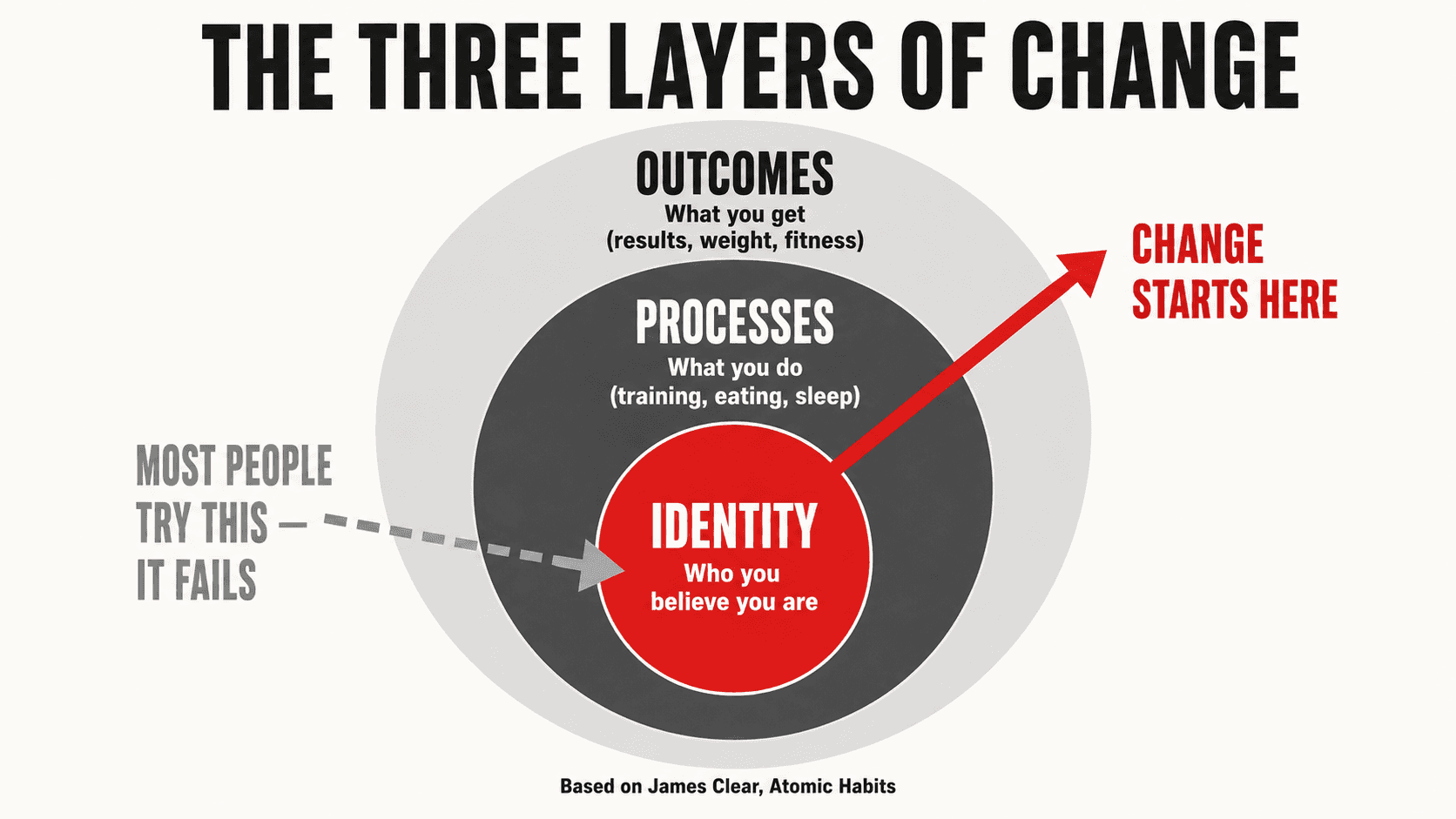
James Clear, in Atomic Habits, makes a distinction that I regard as one of the most practically important ideas in the entire body of personal development literature. He describes three layers of change: outcomes (the results you want), processes (the behaviours you perform), and identity (the beliefs you hold about yourself). Most people begin at the outer layer and work inward. They set an outcome goal, design a process to achieve it, and hope that their identity will shift along the way. A minority of people start from the inside out. They begin with the identity they want to embody, design processes consistent with that identity, and allow outcomes to emerge as the natural by-product of a sustained identity shift. The first approach is fragile. The second is self-reinforcing (1).
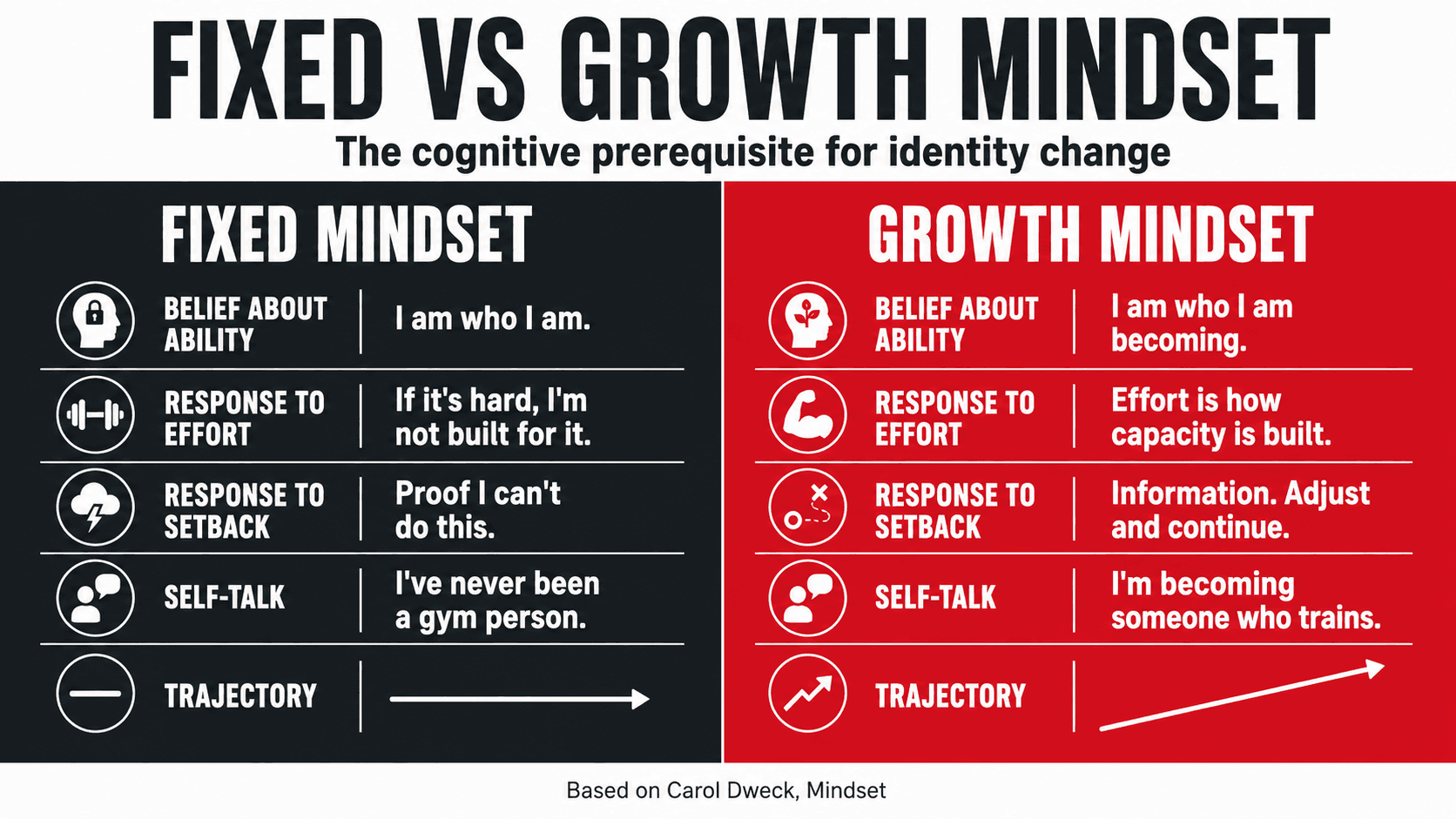
Carol Dweck's research on mindset arrives at a complementary conclusion from a different direction. Her work on fixed versus growth mindset demonstrates that the beliefs people hold about whether their qualities are fixed or changeable directly determine their response to challenge, failure, and setback. A person with a fixed mindset believes their capacity is predetermined: they are either an athletic person or they are not. A person with a growth mindset understands that capacity is built through effort and repetition. The identity shift from fixed to growth is not merely motivational. It is neurological. The brain literally behaves differently when it believes it is engaged in development rather than performance of a fixed trait (2).
“Every action you take is a vote for the type of person you wish to become.”
— James Clear, Atomic Habits
What these two bodies of work share is a foundational claim: the story you tell yourself about who you are is not a neutral observation. It is an active instruction to your nervous system about how to behave, what to pursue, and what to abandon when difficulty arrives. Change the story and the behaviour follows. Leave the story unchanged and the behaviour will eventually revert, regardless of how good the programme is.
The Identity Iceberg: Why Surface Change Is Always Temporary
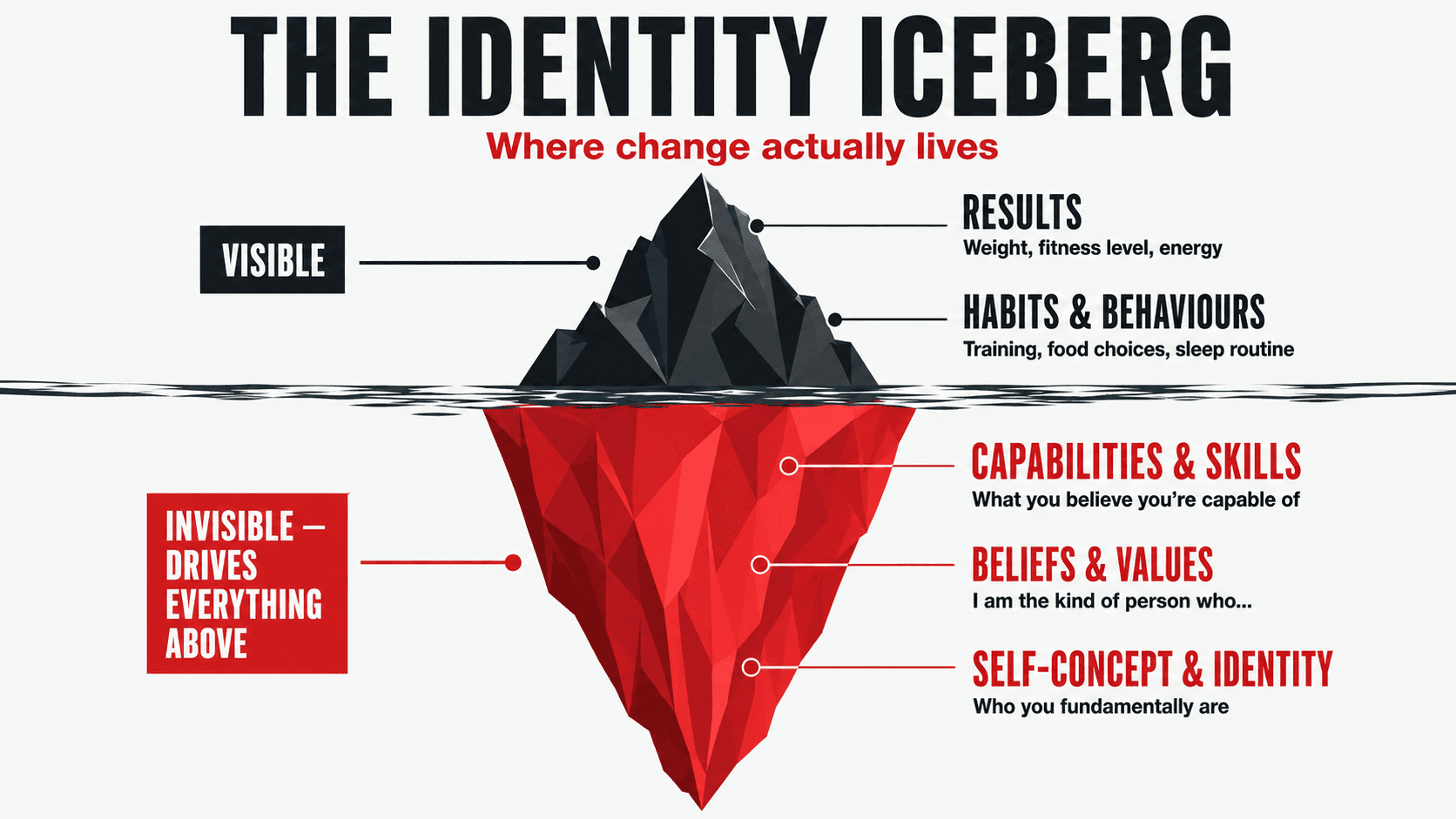
The most useful way to visualise the relationship between identity and behaviour is the iceberg model. Above the waterline, visible to the world and to the person themselves, are actions, habits, and results. Below the waterline, invisible in daily life but determining everything above it, are beliefs, values, self-concept, and identity. What most people try to change is above the waterline. What actually drives change is below it.
DIAGRAM: The Identity Iceberg — Where Change Actually Lives
| THE IDENTITY ICEBERG | Context | Role in Change |
|---|---|---|
| ABOVE THE WATERLINE | Visible to the world | Where most people try to create change |
| RESULTS | Body weight • Fitness level • Energy | Performance metrics • How you look |
| HABITS AND BEHAVIOURS | Training sessions • Food choices • Sleep routine | Daily movement • What you do consistently |
| ~ ~ ~ THE WATERLINE ~ ~ ~ | Most change efforts stop here | Most change failures originate below here | ||
| BELOW THE WATERLINE | Invisible | Where change must actually begin |
| CAPABILITIES AND SKILLS | What you believe you are capable of | The skills you believe you can develop • What feels possible for you |
| BELIEFS AND VALUES | I am the kind of person who… • Health matters because… | I deserve to feel… • My body is capable of… |
| SELF-CONCEPT AND IDENTITY | Who I believe I fundamentally am | The story I tell about myself • My relationship with my own body and health |
Identity is not fixed. It is built through accumulated evidence. Every action consistent with a new identity is a vote for that identity. Change the identity and the behaviour above the waterline becomes the natural expression of who you are, not a performance against who you used to be.
The critical point about the iceberg is the waterline itself. Most health programmes operate entirely above it. They are excellent programmes for changing behaviour given a supporting identity. The problem is that without the supporting identity, behaviour change driven purely by external rules and willpower is fighting the weight of everything below the surface. The iceberg always wins.
Key Insight: The next time a health habit collapses under pressure, do not ask: why did I lack the discipline? Ask instead: what identity was that behaviour inconsistent with? The answer to the second question tells you where the real work needs to happen.
The Cost of Building on the Wrong Foundation
I have worked with clients who have been through five, ten, sometimes fifteen years of cyclical success and failure with their health. They are not lazy people. They are not uninformed people. They are people who have been consistently trying to build new behaviour on top of an old identity, and who have been blaming themselves for the inevitable collapse that follows.
The psychological toll of repeated identity-behaviour mismatch is significant and cumulative. Each failed attempt reinforces the underlying belief that healthy living is not for someone like them. Each return to old patterns provides additional evidence for the limiting self-concept. The story gets stronger with every cycle, the walls get higher, and the effort required to maintain changed behaviour against an unchanged identity increases. This is not a motivation problem. It is a structural problem, and it requires a structural solution.
Outcome-based approaches to health change also produce a specific and damaging psychological pattern around success itself. When the outcome is reached, the goal is gone. The person who has lost the twenty kilograms no longer has a target driving the behaviour. If the identity has not shifted to support maintenance, the weight returns. Not because of failure, but because the behaviour was never rooted in who the person believed they were. It was rooted in a number on a scale that no longer exists as a motivator.
Outcome-Based vs Identity-Based: The Difference in Practice
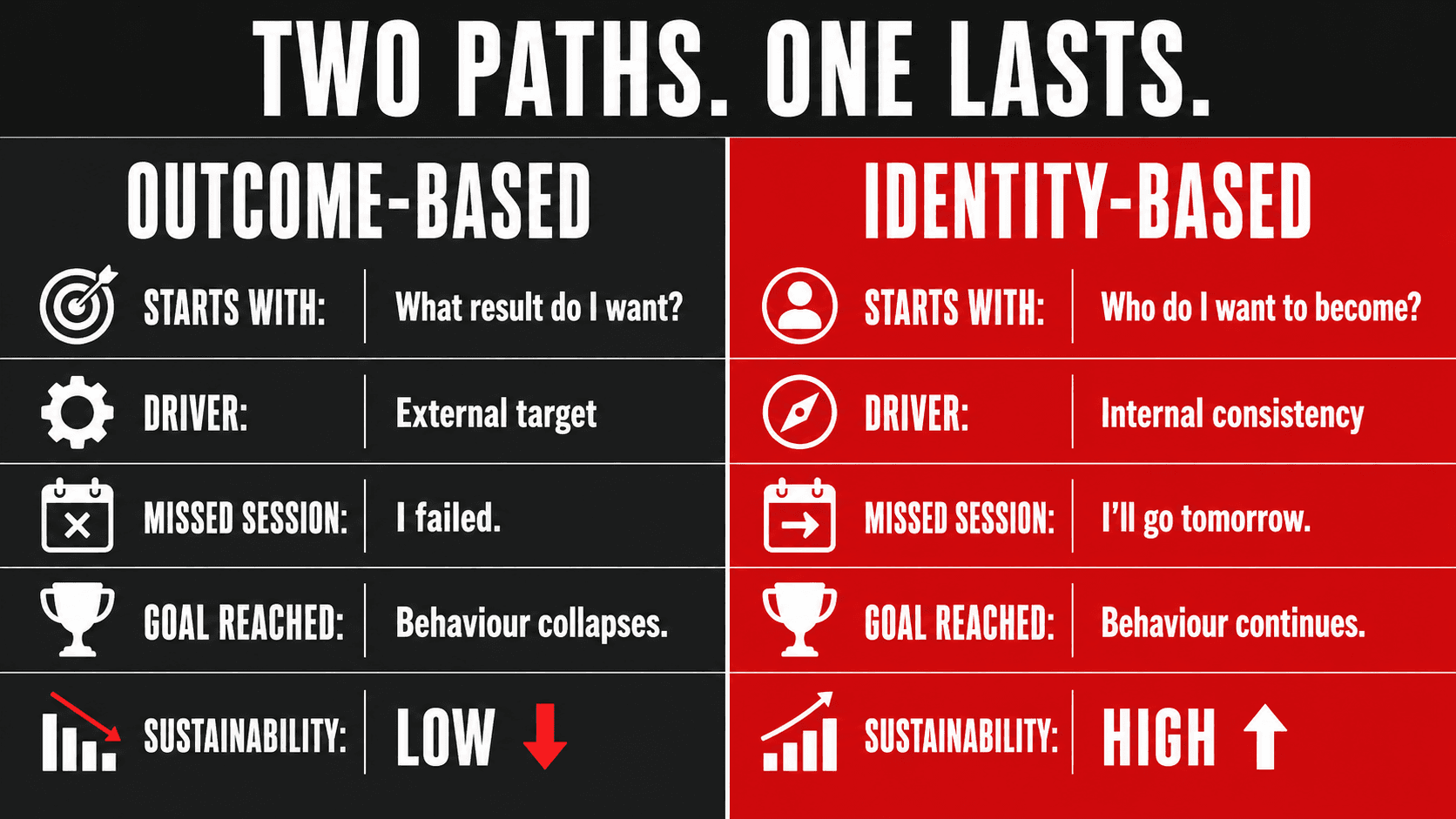
TABLE: Two Approaches to Health Change — What They Look Like and What They Produce
| Dimension | Outcome-Based Approach | Identity-Based Approach |
|---|---|---|
| Starting question | What result do I want? | Who do I want to become? |
| Primary driver | External target — a number, a date, a size | Internal consistency — acting like the person I am becoming |
| Relationship to habits | Habits are tools to reach the goal, then abandoned | Habits are votes for an identity, sustained indefinitely |
| Response to a missed session | I failed. I am bad at this. Maybe this is not for me. | People who train miss sessions. I will go tomorrow. |
| What happens when the goal is reached | The driver disappears. Behaviour destabilises. Weight returns. | The identity remains. The behaviour continues. |
| Relationship to difficulty | Difficulty is evidence that this is not sustainable | Difficulty is what building an identity requires |
| Long-term sustainability | Low — depends on sustained motivation and absence of disruption | High — rooted in self-concept which is self-reinforcing |
| How it feels | Like effort against resistance. Performing. Forcing. | Like congruence. Like being yourself. Natural over time. |
Both approaches can produce results in the short term. Only one produces results that last. The difference is not talent, discipline, or willpower. It is the level at which the change is rooted.
How Identity Actually Shifts: The Mechanism of Accumulated Evidence
The most common objection to identity-based change is the obvious one: if I do not already feel like a healthy person, how do I build the identity of one? This is the right question, and it has a clear, practical answer.
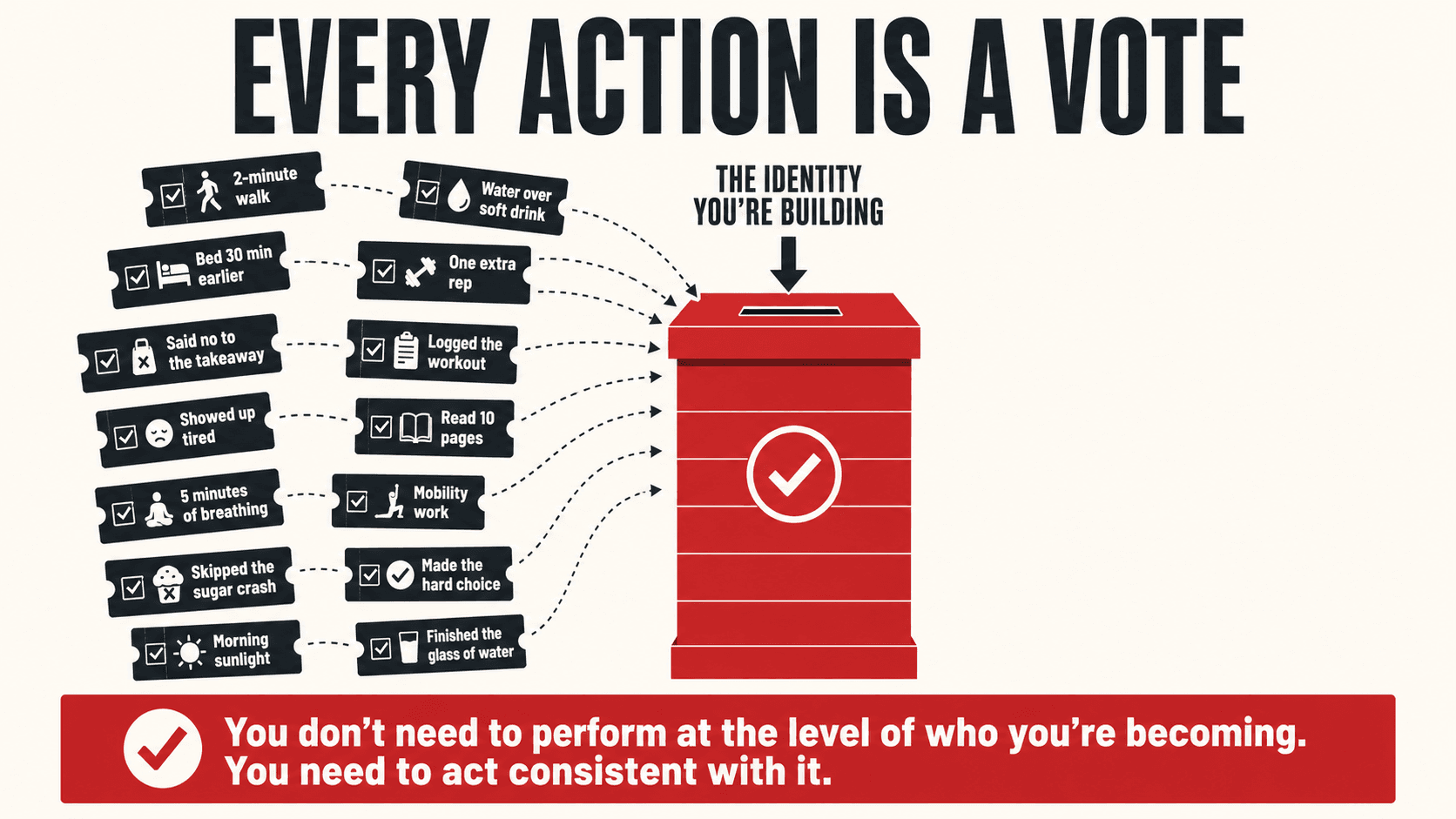
Identity is not declared. It is built through accumulated evidence. Clear's formulation is that every action you take is a vote for the person you are becoming. The person who trains once has cast one vote for the identity of someone who trains. The person who trains twice has cast two votes. This is not a magic transformation. In the early stages, the identity is not established. But each consistent action adds to a body of evidence that gradually shifts the self-concept from aspirational to actual. The turning point is when the behaviour no longer requires a decision because it is simply what you do.
This mechanism has a specific implication for how to respond to imperfection. Missing one training session does not undo the identity being built. It is one vote against, surrounded by many votes in favour. The response to an imperfect week is not shame and abandonment. It is returning to the behaviour as quickly as possible because that is what the identity you are building does. The worst outcome of a missed session is not the missed session itself. It is the story that begins after it: I knew I could not sustain this. That story, if believed, undoes the accumulated evidence far more effectively than any single missed session.
Key Insight: Start the identity shift with a question rather than a goal: What kind of person do I want to become with respect to my health? Write the answer down. Then ask: What would someone who genuinely holds this identity do today? Not tomorrow, not once they have lost weight, not once they feel ready. Today. The answer to that question is your next action.
Casting Votes: Small Actions as the Currency of Identity Change
One of the most liberating reframes in this framework is the reduction in the size of action required for meaningful identity change. You do not need to perform at the level of the identity you are building. You need to take actions that are consistent with it.
For someone building the identity of a person who prioritises their health, voting for that identity can look like a two-minute walk when there is no time for a training session. It can look like choosing water over a soft drink when everything else in the day has been imperfect. It can look like going to bed thirty minutes earlier than usual, or choosing the meal that serves them better over the one that does not. None of these individual actions are transformational in themselves. But each one is evidence. Each one strengthens the neural pathway of the new identity. Each one makes the next consistent action fractionally more automatic.
The athlete who has trained for ten years does not feel motivated to train every day. They train because it is who they are. The question of whether to train does not arise in the same way it does for someone who is fighting their identity to get to the gym. The goal of identity-based change is to move the behaviour from the category of effortful performance into the category of identity expression. That transition takes time, consistency, and patience. But it is fundamentally a different kind of effort from the white-knuckle willpower of outcome-based approaches, because the direction of travel is toward congruence rather than away from an uncomfortable current reality.
Key Insight: This week, instead of asking whether you feel like training, ask: what would the person I am becoming do right now? The answer is not always to train at maximum intensity. Sometimes it is to rest because a healthy person manages recovery intelligently. The question anchors the decision in identity rather than in momentary motivation.
The Growth Mindset as the Gateway to Identity Shift
Carol Dweck's fixed versus growth mindset research provides the cognitive prerequisite for identity-based change. A person with a fixed mindset about their physical capacity believes that their body, their metabolism, their athletic ability are fundamentally predetermined. In this framework, effort is not the path to capability. It is simply confirmation of limited natural ability: if I were really capable of this, it would not require so much effort. This belief makes sustained effort psychologically expensive and ultimately untenable (2).
The growth mindset is not simply a more optimistic perspective. It is a more accurate one. The science of neuroplasticity confirms that the brain and body respond to progressive challenge by building new capacity. The person who cannot sustain a running pace today is not demonstrating a fixed ceiling. They are demonstrating their current starting point, which changes with consistent practice. The identity shift from fixed to growth mindset is the cognitive prerequisite for building any other identity. It is the belief that the person you want to become is actually available to you.
In coaching practice, the shift from fixed to growth mindset is one of the most consequential conversations I have with new clients. The person who begins a programme believing that their body does not respond, that they are not built for fitness, that they are different from the people who have changed, is fighting their own neurology from the first session. The conversation about identity is not a soft preamble to the real work. It is the foundation on which everything else is built.
Where This Work Begins
The identity work is not separate from the physical work. It runs alongside it from the first session. I pay close attention to the language clients use about themselves, because language is not just a description of identity, it is an active construction of it. The client who says I have never been a morning person is making a fixed-identity statement. The client who says I am someone who finds mornings difficult right now but who is building a different relationship with them is making a growth-identity statement. The difference in language is the difference in trajectory.
Every programme I build is designed to generate evidence for the identity the client is constructing. The early sessions are deliberately achievable, not because the standard is low, but because early wins cast votes for a new self-concept in a critical window when the evidence for the new identity is thin and the evidence for the old one is thick. Progressive challenge follows when the identity has enough evidence to support it.
If you have tried and failed repeatedly to sustain healthy behaviour, and you have concluded that you lack the discipline or the genetics or the motivation for lasting change, I want to put a different explanation in front of you: you have been building above the waterline without attending to what is below it. That is a solvable problem. I work one-to-one with clients online globally. The identity conversation is where we begin.
Work with Me
Get a personalised coaching plan built around your goals, your schedule, and your life.
Enquire NowReferences
- Clear J. Atomic Habits: An Easy and Proven Way to Build Good Habits and Break Bad Ones. London: Random House Business; 2018.
- Dweck CS. Mindset: The New Psychology of Success. New York: Random House; 2006.
- Duhigg C. The Power of Habit: Why We Do What We Do and How to Change. London: Random House; 2012.
- Bandura A. Self-efficacy: The Exercise of Control. New York: Freeman; 1997.
- Hebb DO. The Organisation of Behavior: A Neuropsychological Theory. New York: Wiley; 1949.