
The debate between HIIT and steady state cardio has been raging in the fitness industry for years. Scroll through social media and you will find trainers claiming HIIT is the only way to burn fat, while others insist that low intensity walking is all you need. The truth, as with most things in fitness, is more nuanced than either side wants to admit. The real question is not which one is better. It is which one is better for you, right now, given your goals, your lifestyle, and your current level of training.
In this article, I am going to break down exactly what HIIT and steady state cardio are in plain, simple language. I will explain how each one affects your body, when to use each one, and how to fit them into a training programme that actually produces results. No jargon. No fads. Just evidence and experience.
First Things First: What Do These Terms Actually Mean?
Before I get into the comparison, let me define the terms clearly because they are thrown around constantly and often incorrectly.
| CARDIO TYPES EXPLAINED IN PLAIN LANGUAGE | |
|---|---|
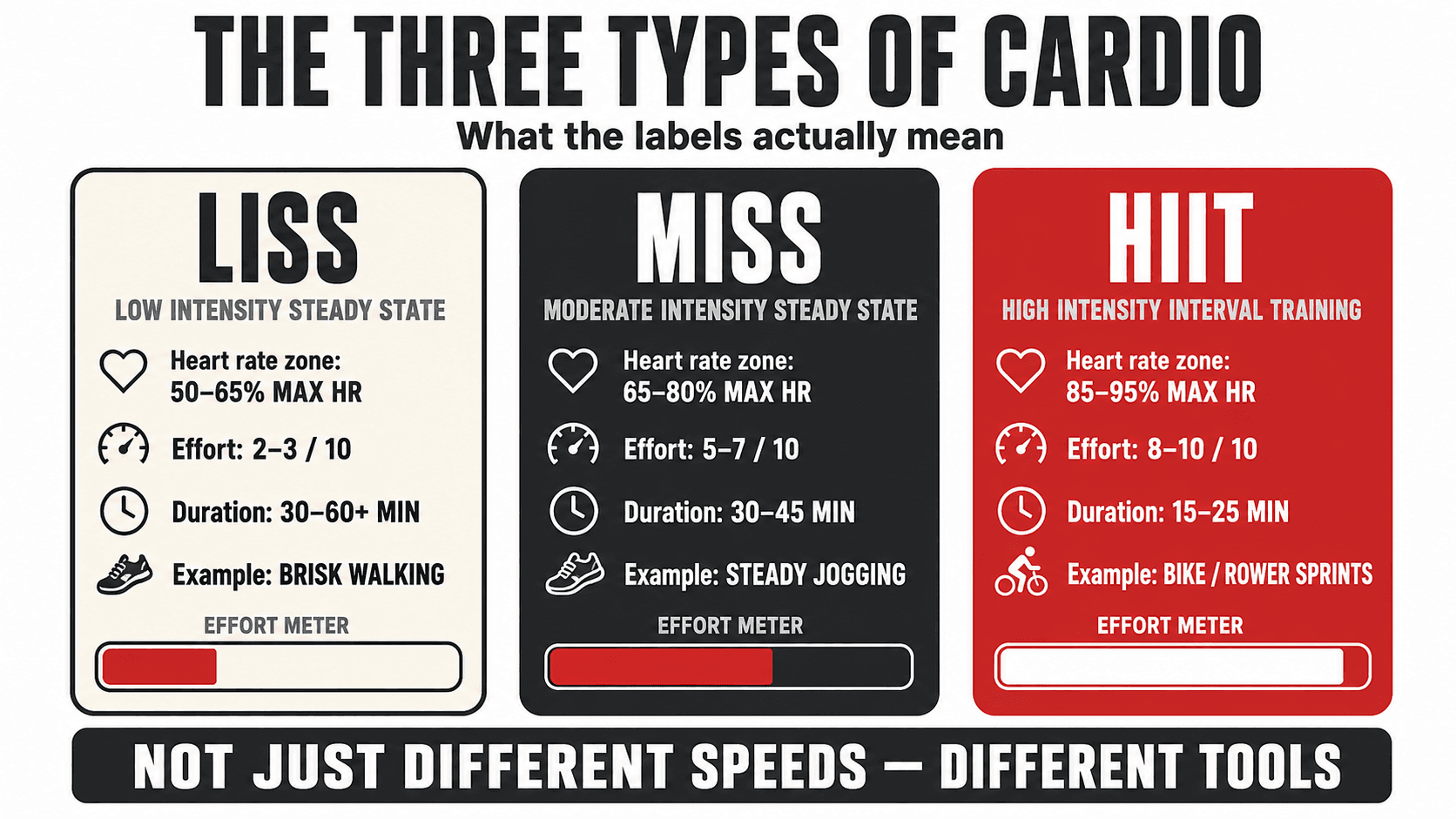
| HIIT | High Intensity Interval Training. Short bursts of maximum or near maximum effort followed by rest or very low effort periods. A HIIT session typically lasts 15 to 25 minutes. Think: sprinting for 20 seconds, resting for 40 seconds, repeating. |
| LISS | Low Intensity Steady State. Sustained activity at a low effort level for a longer duration. Think: a brisk 30 to 60 minute walk where you could hold a conversation throughout. |
| MISS | Moderate Intensity Steady State. Sustained activity at a moderate effort level. Think: a 30 to 45 minute jog at a consistent pace that feels challenging but maintainable. This is what most people mean when they say “cardio.” |
The critical distinction I want you to understand is this: these are not just different speeds of the same thing. They place fundamentally different demands on your body, use different energy systems, and produce different physiological adaptations. Getting this wrong is why so many people spin their wheels for months without results.
The Problem: Most People Are Doing the Wrong Type of Cardio for Their Goals
Here is what I see with the majority of new clients who come to me. They are doing moderate intensity steady state cardio, usually jogging on a treadmill or using a cross trainer, for 30 to 45 minutes, three to five times per week. They have been doing it for months. And they have very little to show for it.
The issue is not effort or consistency. These are often hardworking, committed people. The issue is that MISS is the least efficient form of cardio for body composition goals, and when overdone, it can actually work against you. A meta analysis published in the Journal of Strength and Conditioning Research found that concurrent endurance and resistance training, known as the interference effect, reduced strength and power gains compared to resistance training alone (1). In plain terms, too much moderate intensity cardio can directly undermine your ability to build or maintain muscle.
And here is the cruel irony: most people default to MISS because it feels like “proper exercise.” Sweating, breathing hard, watching the calorie counter tick up. It feels productive. But as I explained in my previous article, those calorie counters are wildly inaccurate, and the actual metabolic return on 45 minutes of steady jogging is far less impressive than most people believe (2).
Top Tip
If you have been jogging three to five times per week for more than six weeks and your body composition has not changed, that is strong evidence that your approach needs to change. More of the same will not fix a fundamentally flawed strategy.
What Most People Get Wrong About HIIT
On the other end of the spectrum, HIIT has been massively overhyped by the fitness industry. It has been marketed as the ultimate fat loss tool, and while it is genuinely effective, the way most people do it bears no resemblance to actual high intensity interval training.
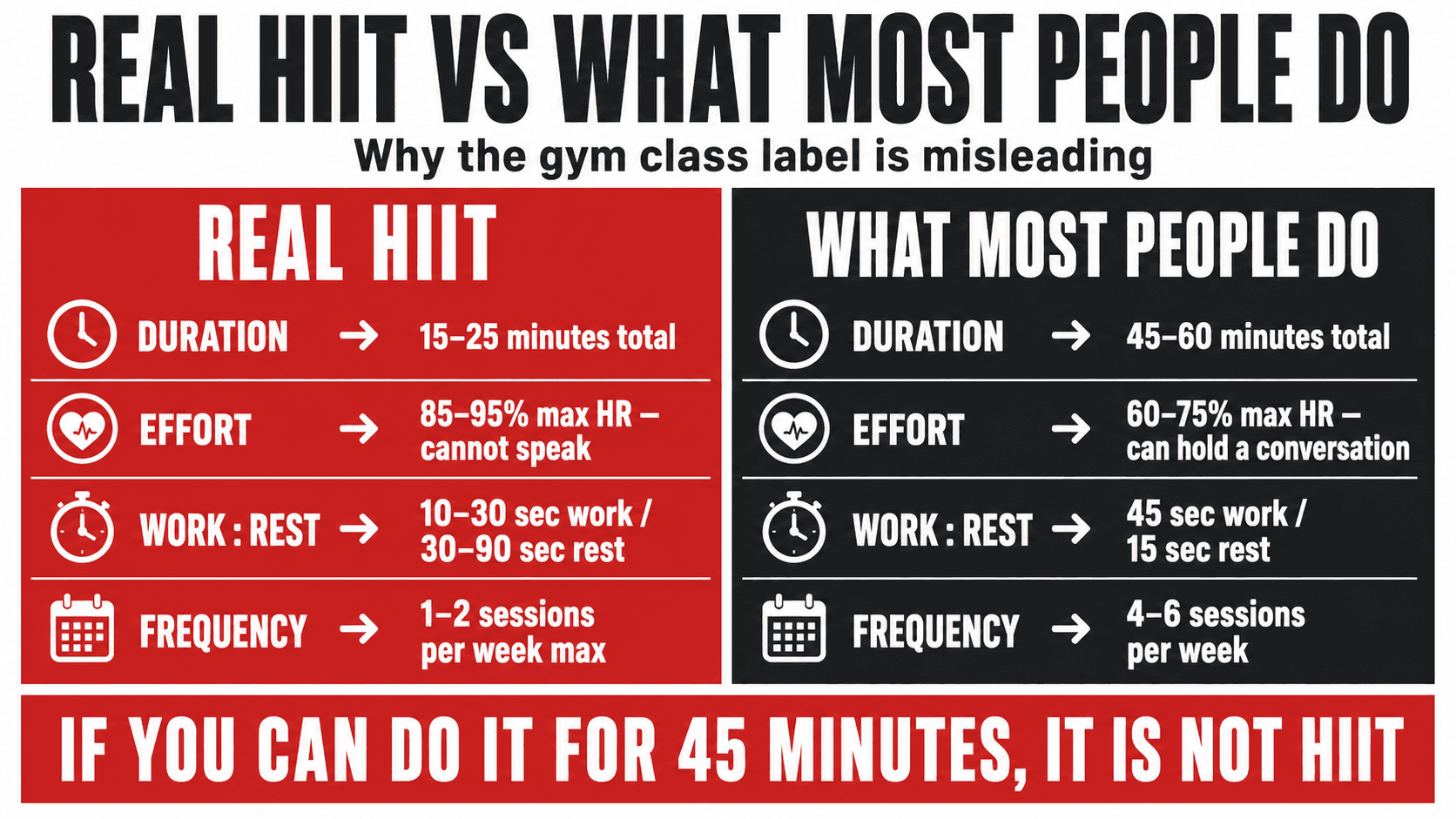
Let me be very direct about this. If you can do a “HIIT” class for 45 minutes, it is not HIIT. True HIIT requires maximum or near maximum effort during the work intervals. You should be unable to speak. Your heart rate should be at 85 to 95 percent of your maximum. And you should feel genuinely unable to continue after 15 to 25 minutes. The original research by Dr Izumi Tabata, whose protocol became one of the most famous HIIT formats in the world, used just four minutes of total work time, but at an intensity that pushed trained athletes to their absolute limit (3).
A study published in the British Journal of Sports Medicine compared HIIT to moderate intensity continuous training for fat loss and found that HIIT was associated with 28.5 percent greater reductions in total absolute fat mass (4). That is a significant difference. But the key word is intensity. The benefits only materialise when the effort is genuinely high. What most gyms call “HIIT” is really just circuit training at moderate intensity, which is fine but does not deliver the same metabolic advantages.
| REAL HIIT VS WHAT MOST PEOPLE ACTUALLY DO | |
|---|---|
| Real HIIT Duration | 15 to 25 minutes total session, including warm up and cool down |
| Fake “HIIT” Duration | 45 to 60 minutes, which is impossible at true high intensity |
| Real HIIT Effort Level | 85 to 95% of maximum heart rate during work intervals. You cannot speak. |
| Fake “HIIT” Effort Level | 60 to 75% of maximum heart rate. You can hold a conversation. |
| Real HIIT Work to Rest | Short work intervals (10 to 30 seconds) with equal or longer rest (30 to 90 seconds) |
| Fake “HIIT” Work to Rest | Often 45 seconds work, 15 seconds rest, which is just circuit training |
| Real HIIT Frequency | Maximum 1 to 2 sessions per week due to the recovery demand |
| Fake “HIIT” Frequency | 4 to 6 times per week, which would be impossible at genuine intensity |
Top Tip
If you want to do real HIIT, start with one session per week on a piece of equipment that allows quick transitions between work and rest, such as a stationary bike, rower, or assault bike. Sprint for 15 to 20 seconds at absolute maximum effort, then rest for 40 to 60 seconds. Repeat for 6 to 10 rounds. That is it. If you feel like you could do more, you did not go hard enough.
The Solution: How to Use Each Type of Cardio for Maximum Results
Now that you understand what these terms actually mean, let me show you how I use them in practice with my coaching clients. The answer to “HIIT or steady state?” is almost always “both, but in the right proportions and at the right time.”
LISS: Your Everyday Foundation
Low intensity steady state cardio, which in practical terms means brisk walking, should be the foundation of your daily movement. It is the form of cardio I prescribe most frequently and the one I use personally every single day.
The reason LISS is so valuable has nothing to do with calorie burning during the session, although it does contribute. The real value is threefold. First, it increases your Non Exercise Activity Thermogenesis, or NEAT, which is the total energy you burn outside of formal exercise. Research by Levine published in Best Practice and Research Clinical Endocrinology and Metabolism found that NEAT can vary by up to 2,000 calories per day between individuals and is one of the biggest determinants of whether someone maintains a healthy weight or gains fat (5). Second, walking aids recovery between resistance training sessions by promoting blood flow to working muscles without creating additional stress (6). Third, it has profound benefits for mental health, stress management, and sleep quality, all of which directly support fat loss through hormonal pathways.
| LISS Benefit | How It Helps Fat Loss | The Science |
|---|---|---|
| Increases daily NEAT | Burns 200 to 500+ extra calories per day without adding training stress | Levine JA. NEAT accounts for the majority of non resting energy expenditure (5) |
| Supports recovery | Promotes blood flow and nutrient delivery to muscles without impairing adaptation | Promotes parasympathetic nervous system activity (6) |
| Reduces cortisol | Lowers stress hormones that promote fat storage, especially around the midsection | Walking in nature shown to reduce cortisol by 12 to 16% (7) |
| Improves sleep | Better sleep quality supports growth hormone release and appetite regulation | Regular walking improves both sleep onset and sleep quality (8) |
| Sustainable long term | No recovery cost, no interference with training, can be done every day indefinitely | Risk of injury is negligible compared to running or high impact cardio |
Top Tip
If you currently do fewer than 7,000 steps per day, increasing to 8,000 to 10,000 steps will likely have a bigger impact on your fat loss than adding any formal cardio sessions. Walk to work, take the stairs, walk during phone calls, walk after meals. Build it into your life rather than treating it as a separate workout.

HIIT: Your Precision Tool
HIIT is not your daily cardio. It is a precision tool that you deploy strategically when you need an extra push. I typically introduce HIIT into a client's programme when three conditions are met: they are already resistance training consistently, their NEAT is at a good level (8,000 plus steps per day), and their fat loss has begun to plateau despite good nutrition adherence.
When used correctly, HIIT provides a metabolic stimulus that steady state cardio simply cannot match. A study in the Journal of Obesity found that HIIT significantly reduced total abdominal and visceral fat, the dangerous fat stored around your organs, even when total exercise volume was lower than moderate intensity groups (9). Another study in Medicine and Science in Sports and Exercise showed that the excess post exercise oxygen consumption, or EPOC, from a HIIT session elevated metabolic rate for up to 24 hours after the session ended (10). In plain terms, your body continues to burn extra calories long after you finish.
But and this is critical, HIIT is demanding. It taxes your central nervous system, your joints, and your recovery capacity. If you are also doing three to four resistance training sessions per week, adding more than one to two HIIT sessions creates a real risk of overtraining, poor recovery, elevated cortisol, and ultimately worse results, not better ones.
Important
More is not better with HIIT. One to two sessions per week is the maximum I prescribe for most clients. If you are already training with weights three to four times per week, you need to be extremely careful about total training volume. Overtraining does not just stall progress. It actively reverses it by disrupting sleep, appetite regulation, and hormonal balance.
MISS: The One I Use Least
Moderate intensity steady state cardio, your typical 30 to 45 minute jog, is the form I prescribe least often for fat loss and body composition clients. That does not mean it is bad. It simply means it has the poorest risk to reward ratio for the goals most of my clients have.
The interference effect is real and well documented. Wilson and colleagues published a meta analysis in the Journal of Strength and Conditioning Research confirming that concurrent endurance and resistance training impaired strength and power development (1). MISS is the primary driver of this interference because it conditions your body for endurance, which places competing demands against the strength and muscle building adaptations you are trying to create with resistance training.
However, I do use MISS in specific situations. If a client genuinely enjoys running or cycling, I will programme it in moderation because adherence always trumps perfection. If a client is training for a running event or a charity challenge, MISS is obviously necessary. And for some clients with very high stress levels, a gentle jog can serve a mental health purpose that outweighs its metabolic limitations.
The Head to Head Comparison: HIIT vs LISS vs MISS
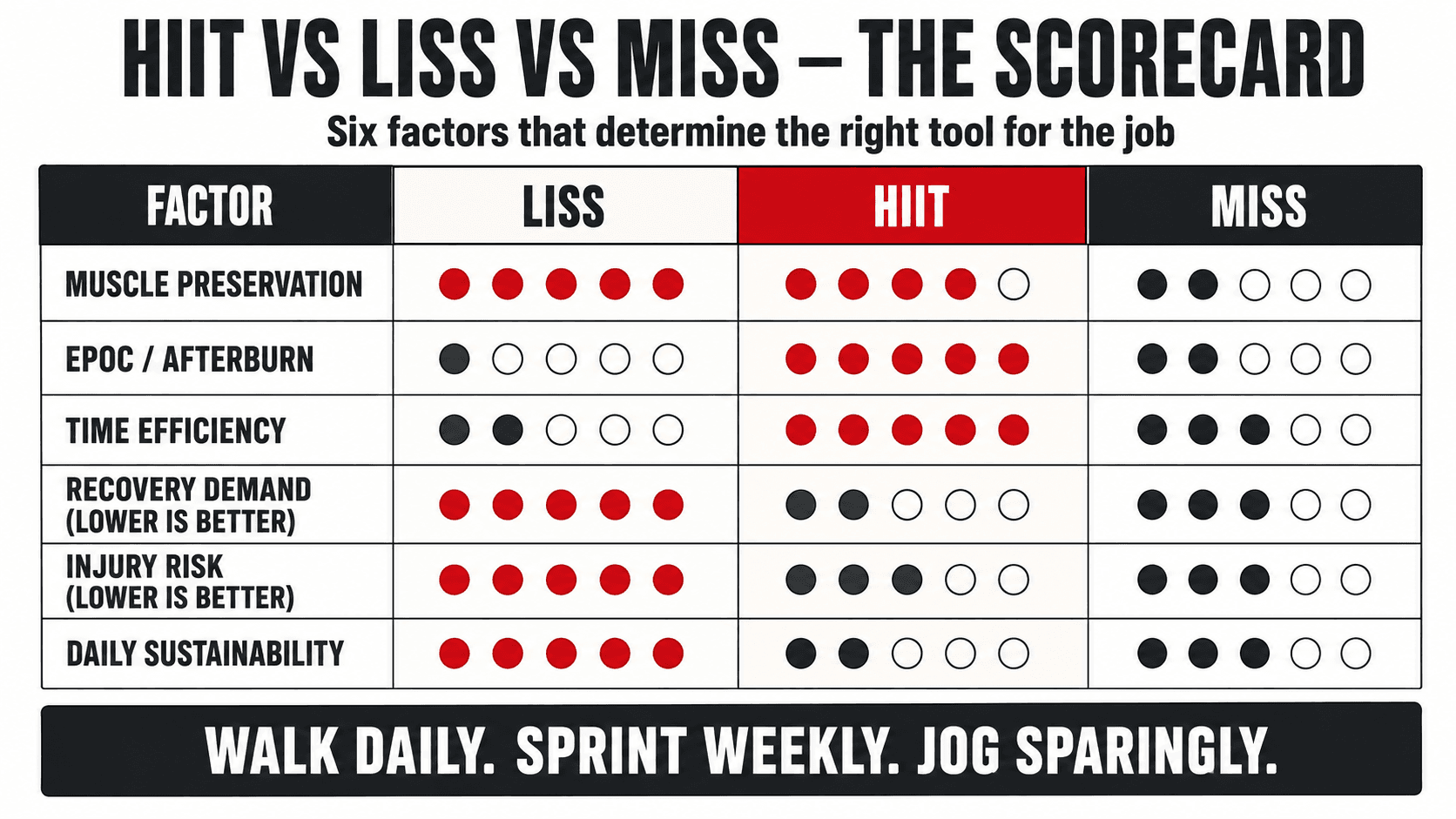
| Factor | LISS (Walking) | HIIT (Intervals) | MISS (Jogging) |
|---|---|---|---|
| Session Duration | 30 to 60+ minutes | 15 to 25 minutes | 30 to 45 minutes |
| Effort Level | Low (2 to 3 out of 10) | Very High (8 to 10 out of 10) | Moderate (5 to 7 out of 10) |
| Calories Burned Per Session | Low to moderate | Moderate to high | Moderate |
| Post Session Calorie Burn (EPOC) | Minimal | High: up to 24 hours (10) | Low to moderate |
| Impact on Muscle Retention | None (fully protective) | Minimal if limited to 1 to 2x per week | Can interfere with muscle retention if overdone (1) |
| Recovery Demand | None | High (needs 48+ hours between sessions) | Moderate |
| Injury Risk | Very low | Moderate (especially if form breaks down under fatigue) | Moderate (repetitive stress injuries common) |
| Interference with Weight Training | None | Minimal if scheduled correctly | Significant if done frequently (1) |
| Best For | Everyone. Daily movement foundation. Recovery support. | Plateaus. Time efficiency. Visceral fat reduction. | Endurance goals. Enjoyment. Mental health. |
| Recommended Frequency | 5 to 7 days per week | 1 to 2 sessions per week maximum | 1 to 2 sessions per week if desired |
How I Actually Programme Cardio for Fat Loss Clients
Theory is useful but what matters is how it translates into a real weekly schedule. Here is a practical example of how I might structure a week for a typical fat loss client who also resistance trains.
| Day | Training | Cardio | Steps Target |
|---|---|---|---|
| Monday | Resistance Training (full body) | None (walking to and from gym counts) | 8,000 to 10,000 |
| Tuesday | Rest from gym | LISS: 30 to 45 minute brisk walk | 10,000+ |
| Wednesday | Resistance Training (full body) | None | 8,000 to 10,000 |
| Thursday | Rest from gym | HIIT: 15 to 20 minutes on rower or bike (if needed) | 8,000 to 10,000 |
| Friday | Resistance Training (full body) | None | 8,000 to 10,000 |
| Saturday | Optional light activity | LISS: 45 to 60 minute walk, hike, or casual sport | 10,000+ |
| Sunday | Full rest | LISS: gentle walk if desired | 7,000+ |
Notice what this does not include: five days of cardio, hour long runs, or daily HIIT classes. The foundation is resistance training, supported by daily walking, with HIIT added only when needed as a precision tool. This structure works for men and women, for omnivores and vegetarians and vegans, and for clients from their 20s through to their 60s. The specific exercises, weights, and volumes change for each individual, but the overarching framework stays the same.
Top Tip
If you are currently doing five or more cardio sessions per week with no resistance training, do not try to change everything at once. Start by replacing two of those cardio sessions with resistance training. Keep the remaining cardio sessions and add more walking to your daily routine. Over four to six weeks, gradually shift the balance towards more resistance training and less formal cardio.

A Quick Note on Nutrition and Cardio
Your body runs on the fuel you give it, and the type of cardio you do interacts with your nutrition in important ways. HIIT is glycolytic, meaning it primarily burns carbohydrates for fuel during the session. If you are following a very low carbohydrate diet, your HIIT performance will likely suffer. LISS, on the other hand, relies predominantly on fat oxidation at lower intensities, which is one reason it pairs so well with almost any dietary approach (11).
Regardless of which form of cardio you use, protein remains the priority. As I always tell my clients, your protein intake should be built around your goals, not around your cardio. Aim for 1.4 to 2.0 grams per kilogram of body weight per day (12), sourced from whatever dietary background suits you. That means chicken and fish for omnivores, eggs and dairy for vegetarians, and tofu, tempeh, seitan, soy protein, pea protein, and lentils for those who are fully plant based.
Top Tip
If you do a HIIT session, eat a meal containing both protein and carbohydrates within two hours afterwards. This supports recovery and glycogen replenishment. A good example would be scrambled eggs on toast, a chicken and rice bowl, or a tofu stir fry with noodles.
YOUR QUICK REFERENCE CHEAT SHEET: HIIT VS STEADY STATE CARDIO
LISS (walking) should be your daily foundation. Aim for 8,000 to 10,000 steps every day.
Resistance training 2 to 4 times per week should be your primary exercise for fat loss and body composition.
HIIT should be used 1 to 2 times per week maximum, and only when genuinely needed to break a plateau.
MISS (jogging) should be used sparingly for fat loss goals. It can interfere with muscle building if overdone.
If you can do a “HIIT” session for 45 minutes, it is not HIIT. Real HIIT is 15 to 25 minutes and leaves you unable to continue.
Your nutrition, particularly protein intake, matters far more than which type of cardio you choose.
Never use gym machine calorie counters to decide how much to eat. Plan nutrition independently.
When in doubt, walk more and lift weights. This combination beats every other approach for long term body composition.
Where to Start
The HIIT versus steady state debate does not need to be a debate at all. Both tools serve a purpose. The key is understanding which one to use, when, and in what proportion. Most people need far more walking, far more resistance training, and far less moderate intensity cardio than they are currently doing.
The principles work across the board because they are based on physiology, not trends.
If you are unsure where to start, or if you have been stuck doing the same cardio routine with diminishing returns, that is exactly the kind of problem I solve every day. I coach one-to-one online globally, and every programme is built specifically for you. Get in touch through trperformancecoaching.com and let me help you build a programme that actually works.
Work with Me
Get a personalised coaching plan built around your goals, your schedule, and your life.
Enquire NowReferences
- Wilson JM, Marin PJ, Rhea MR, Wilson SMC, Loenneke JP, Anderson JC. Concurrent training: a meta-analysis examining interference of aerobic and resistance exercises. Journal of Strength and Conditioning Research. 2012; 26(8): 2293-2307.
- Ozemek C, Kirschner MM, Galanis CR, et al. Validity of commonly used cardio equipment calorie expenditure estimates during graded exercise testing. Journal of Sports Sciences. 2014; 32(11): 1070-1077.
- Tabata I, Nishimura K, Kouzaki M, et al. Effects of moderate-intensity endurance and high-intensity intermittent training on anaerobic capacity and VO2max. Medicine and Science in Sports and Exercise. 1996; 28(10): 1327-1330.
- Viana RB, Naves JPA, Coswig VS, et al. Is interval training the magic bullet for fat loss? A systematic review and meta-analysis comparing moderate-intensity continuous training with high-intensity interval training (HIIT). British Journal of Sports Medicine. 2019; 53(10): 655-664.
- Levine JA. Non-exercise activity thermogenesis (NEAT). Best Practice and Research Clinical Endocrinology and Metabolism. 2002; 16(4): 679-702.
- Dupuy O, Douzi W, Theurot D, Bosquet L, Dugue B. An evidence-based approach for choosing post-exercise recovery techniques to reduce markers of muscle damage, soreness, fatigue, and inflammation. Frontiers in Physiology. 2018; 9: 403.
- Li Q, Morimoto K, Nakadai A, et al. Forest bathing enhances human natural killer activity and expression of anti-cancer proteins. International Journal of Immunopathology and Pharmacology. 2007; 20(2 Suppl 2): 3-8.
- Kredlow MA, Capozzoli MC, Hearon BA, Calkins AW, Otto MW. The effects of physical activity on sleep: a meta-analytic review. Journal of Behavioral Medicine. 2015; 38(3): 427-449.
- Boutcher SH. High-intensity intermittent exercise and fat loss. Journal of Obesity. 2011; 2011: 868305.
- Greer BK, Sirithienthad P, Moffatt RJ, Marcello RT, Panton LB. EPOC comparison between isocaloric bouts of steady-state aerobic, intermittent aerobic, and resistance training. Research Quarterly for Exercise and Sport. 2015; 86(2): 190-195.
- Achten J, Jeukendrup AE. Optimizing fat oxidation through exercise and diet. Nutrition. 2004; 20(7-8): 716-727.
- Jager R, Kerksick CM, Campbell BI, et al. International Society of Sports Nutrition position stand: protein and exercise. Journal of the International Society of Sports Nutrition. 2017; 14: 20.