
It is one of the most common questions I get asked. “Tanvir, how much cardio do I actually need to do?” And I understand why it causes confusion, because the answer you get depends entirely on who you ask. The fitness industry will tell you one thing. The NHS guidelines will tell you another. Your mate who runs marathons will tell you something else entirely. Here is what I know for certain: the amount of cardio you really need is almost certainly less than you think, but the type and the way you structure it matters far more than the quantity.
This article is going to give you a clear, evidence based answer. Not a one size fits all prescription, because that does not exist, but a framework you can apply to your own situation regardless of your age, your fitness level, or your dietary background. I am going to explain what the research actually says, what the official guidelines get right and what they get wrong, and how I personally programme cardio for my clients to get the best results with the least wasted effort.
The Problem: Conflicting Advice From Every Direction
If you search “how much cardio should I do” online, you will get thousands of conflicting answers. The UK Chief Medical Officers recommend 150 minutes of moderate intensity aerobic activity per week, or 75 minutes of vigorous intensity activity, plus muscle strengthening activities on at least two days per week (1). That is the official government guideline. It sounds reasonable on paper. But here is the issue: those guidelines were written for general population health, not for body composition, not for fat loss, and not for people who are also doing resistance training.
On the other end of the spectrum, you have fitness influencers telling you to do an hour of cardio every day, or to do two a day sessions, or to do HIIT six times a week. This is not only unnecessary for most people, it is actively counterproductive for anyone whose primary goal is losing fat and building or maintaining muscle.
And then there is the group who will tell you that you do not need any cardio at all, that resistance training is the only thing that matters. While I agree that resistance training should be the priority, dismissing cardio entirely ignores its genuine benefits for cardiovascular health, mental wellbeing, and daily energy expenditure.
| THE SPECTRUM OF CARDIO ADVICE YOU WILL HEAR (AND WHAT IS ACTUALLY TRUE) | |
|---|---|
| Government Guidelines | 150 minutes moderate OR 75 minutes vigorous per week. Good baseline for health. Not optimised for body composition (1). |
| Fitness Industry Hype | “Do cardio every day.” “Two a day sessions.” “HIIT six times a week.” Overtraining risk. Unnecessary for fat loss. Unsustainable. |
| Anti Cardio Camp | “You do not need any cardio.” Partly true for body composition, but ignores genuine cardiovascular and mental health benefits. |
| The Evidence Based Middle Ground | Daily walking as a foundation, resistance training 2 to 4 times per week, strategic formal cardio only when needed. This is where the best results live. |
Top Tip
Be very cautious about taking cardio advice from anyone who does not ask about your goals first. How much cardio you need depends entirely on what you are trying to achieve. A blanket prescription of “do X minutes per week” is useless without context.

What Happens When You Get the Amount Wrong
Getting your cardio volume wrong in either direction has real consequences, and I have seen both extremes in my coaching practice.
Too Much Cardio: The Overtraining Trap
I have worked with clients who came to me doing five, six, even seven cardio sessions per week. Running, spin classes, boot camps, swimming. They were exhausted, their results had completely stalled, and many of them were gaining fat despite exercising more than ever. This is not a paradox. It is a predictable outcome of chronic overtraining.
When you do too much cardiovascular exercise, several things happen simultaneously. Cortisol, your primary stress hormone, becomes chronically elevated. Research published in the European Journal of Applied Physiology found that prolonged endurance training increased cortisol output and suppressed testosterone, creating a hormonal environment that favours fat storage and muscle breakdown (2). Your appetite regulation becomes disrupted, often leading to increased hunger and cravings that more than offset the calories you burned (3). Your resting metabolic rate can decline as your body sheds metabolically expensive muscle tissue to become more efficient at the endurance activity you are asking it to do (4). And your sleep quality often deteriorates, which further compromises recovery, hormonal balance, and fat loss.
THE OVERTRAINING SPIRAL: WHAT HAPPENS WHEN CARDIO VOLUME IS TOO HIGH
Excessive Cardio Volume
Training 5 to 7 cardio sessions per week, often moderate to high intensity. Total weekly exercise time exceeds recovery capacity.
Cortisol Becomes Chronically Elevated
The stress hormone stays high. This promotes visceral fat storage, impairs sleep, and breaks down muscle tissue (2).
Appetite Dysregulation
Hunger increases. Cravings for high calorie foods intensify. You eat back more than you burned, often without realising (3).
Muscle Loss Accelerates
Without adequate resistance training or recovery, lean tissue is sacrificed. Metabolism slows as a result (4).
Results Plateau or Reverse
Despite increasing effort, body composition worsens. The scale may not change, but body fat percentage creeps up.
The Response: Even More Cardio
Most people respond to the plateau by adding more cardio, which deepens the spiral further.
Top Tip
If you are doing more than four formal cardio sessions per week and your results have stalled or reversed, you are very likely in the overtraining spiral. The counterintuitive solution is to do less cardio, not more. Replace two to three of those sessions with resistance training and watch what happens over the next four to six weeks.

Too Little Movement: The Sedentary Risk
On the other end, doing no cardio or movement at all is equally problematic, just in different ways. The health risks of a sedentary lifestyle are well established. A landmark study published in The Lancet found that physical inactivity is responsible for approximately 6 percent of coronary heart disease cases, 7 percent of Type 2 diabetes cases, and 9 percent of premature mortality globally (5). These are not small numbers. If you are someone who works at a desk all day and does nothing outside of your resistance training sessions, your cardiovascular health is at risk regardless of how strong you are.
The key distinction here is between formal exercise and general daily movement. You do not need formal cardio sessions to avoid the health risks of inactivity. What you need is consistent daily movement, and the simplest, most effective form of that is walking.
The Solution: A Goal Based Framework for Cardio Volume
The amount of cardio you need is not a fixed number. It depends on your primary goal. I am going to break this down into four common goals that cover the vast majority of people I work with. Find the one that matches your situation and use it as your starting framework.
Goal 1: Fat Loss and Body Composition
This is the most common goal among my clients, and it is the one where cardio is most frequently overcomplicated. If your primary goal is to lose body fat and improve how you look, here is the hierarchy I follow.
THE FAT LOSS CARDIO HIERARCHY: PRIORITY ORDER
Step 1: Nail Your Nutrition
A moderate calorie deficit (300 to 500 calories below maintenance) with adequate protein (1.4 to 2.0g per kg body weight per day) is the foundation. Without this, no amount of cardio will produce lasting results (6).
Step 2: Resistance Train 2 to 4 Times Per Week
This preserves muscle, supports metabolism, and creates the body composition changes you actually want. Compound movements: squats, deadlifts, presses, rows, lunges.
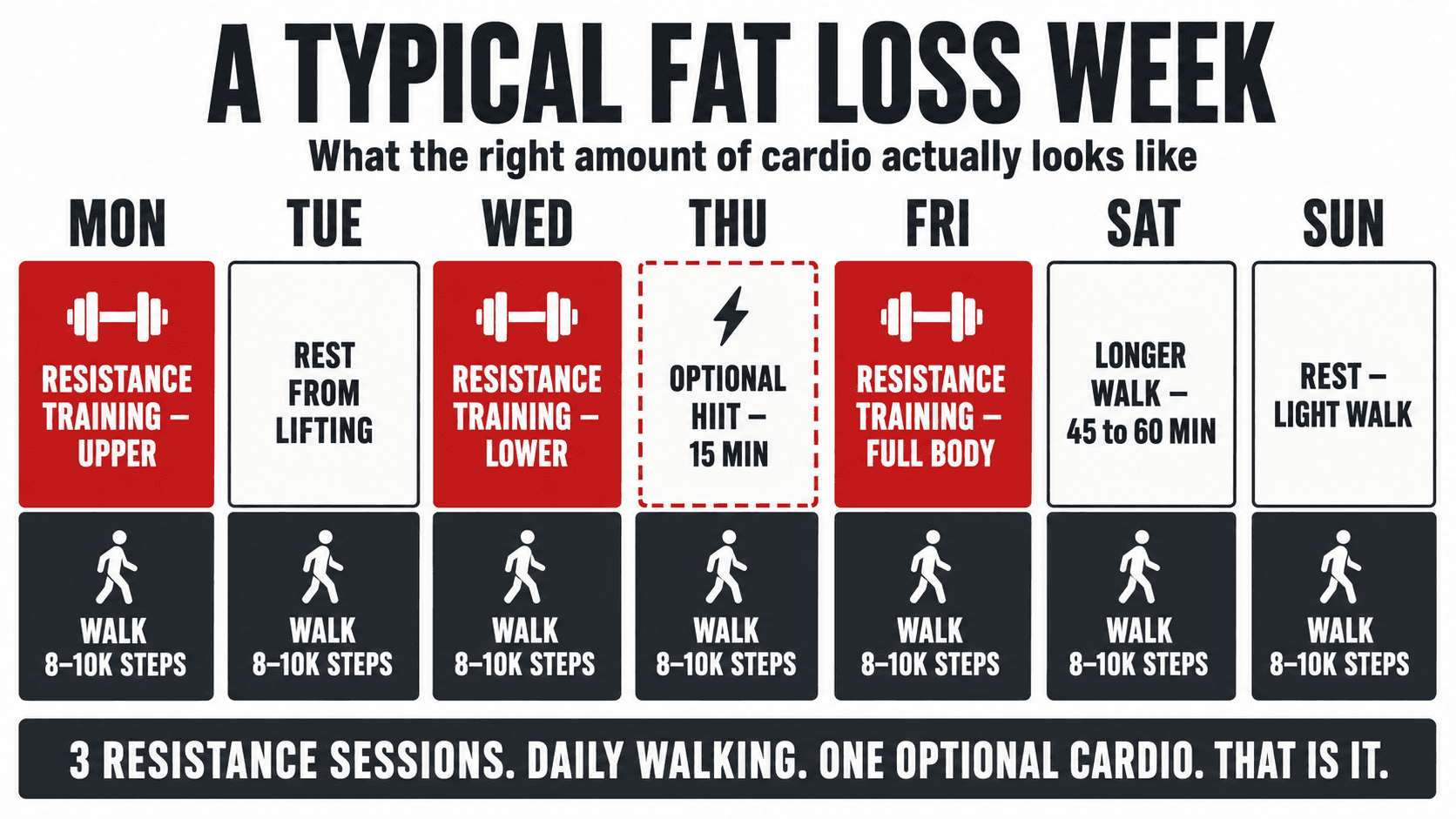
Step 3: Build Daily Steps to 8,000 to 10,000
Walking is the single most underrated fat loss tool. It burns meaningful calories, aids recovery, reduces stress, and has zero interference with your training (7).
Step 4: Add HIIT Only When Needed (1 to 2x Per Week)
If fat loss stalls despite good nutrition and training adherence, one to two short HIIT sessions per week can provide the extra metabolic stimulus to break through (8).
Step 5: Use MISS Sparingly If At All
Moderate steady state cardio (jogging) is a last resort for fat loss clients. It creates interference with resistance training and has diminishing returns (9).
In practical terms, most of my fat loss clients end up doing two to four resistance training sessions, daily walking, and zero to two formal cardio sessions per week. That is it. The results come from consistency with the fundamentals, not from piling on more and more exercise.
Top Tip
If you are at the beginning of a fat loss phase, do not add any formal cardio at all for the first two to four weeks. Get your nutrition right, start resistance training, build your daily steps, and see how your body responds. You may not need any formal cardio for weeks or even months. Keep it in reserve as a tool for when progress slows.
Goal 2: General Health and Longevity
If your primary goal is simply to be healthy, to reduce your risk of chronic disease, and to live a longer, more active life, the research is very clear on what works.
A comprehensive meta analysis published in the British Journal of Sports Medicine found that muscle strengthening activities were associated with a 10 to 17 percent lower risk of all cause mortality, cardiovascular disease, total cancer, diabetes, and lung cancer (10). Separately, research published in JAMA Internal Medicine found that even modest amounts of walking, as few as 4,400 steps per day in older women, were associated with significantly lower mortality compared to 2,700 steps per day (11). The benefits continued to increase up to approximately 7,500 steps per day before plateauing.
| Activity | Minimum for Health Benefits | Optimal Range | Diminishing Returns Beyond |
|---|---|---|---|
| Daily Walking | 4,400 steps per day (11) | 7,500 to 10,000 steps per day | Benefits plateau beyond 10,000 for most health markers |
| Resistance Training | 2 sessions per week (10) | 2 to 4 sessions per week | Beyond 4 sessions, recovery becomes the limiting factor for most people |
| Vigorous Cardio (HIIT) | None required for health | 1 to 2 sessions per week if desired | Beyond 2 sessions, overtraining risk increases significantly |
| Moderate Cardio (Jogging) | None required for health | 1 to 3 sessions per week if enjoyed | Beyond 3 sessions, interference effect impacts muscle and strength (9) |
Notice something important: the minimum effective dose for health benefits is remarkably achievable. You do not need to train like an athlete to dramatically reduce your risk of chronic disease. Two resistance training sessions per week and a daily walk of 30 to 45 minutes will get you most of the way there.
Top Tip
If health and longevity is your primary goal, your absolute minimum should be two resistance training sessions per week and a daily average of 7,500 steps. This combination alone puts you ahead of approximately 80 percent of the population in terms of chronic disease risk reduction.
Goal 3: Building Muscle While Staying Lean
If your primary goal is to add muscle while keeping body fat in check, your cardio should be deliberately minimised to protect recovery and avoid the interference effect. This does not mean doing nothing outside the gym. It means being strategic about what you do.
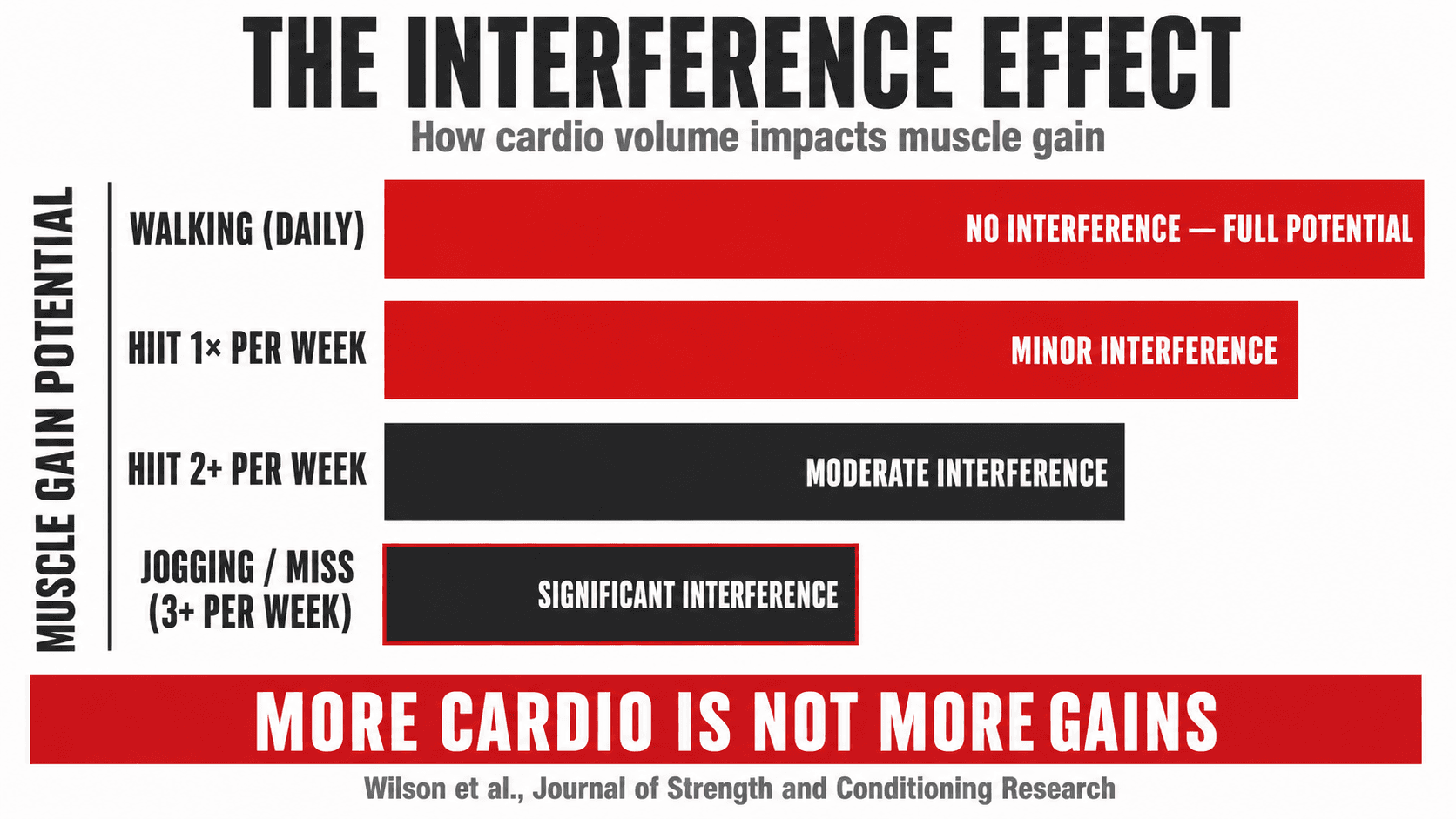
A study published in the Journal of Strength and Conditioning Research found that the interference effect was most pronounced when endurance training was performed at moderate to high intensities and for longer durations (9). Short duration, low intensity cardio such as walking had minimal impact on strength and hypertrophy outcomes. This aligns perfectly with what I see in practice: clients who walk daily and lift three to four times per week build muscle effectively. Clients who add three to four running sessions on top of their weight training often stall.
| Cardio Type | Impact on Muscle Building | Recommendation for Muscle Gain Goals |
|---|---|---|
| Walking (LISS) | Minimal to none. Supports recovery and general health. | Daily. 7,000 to 10,000 steps. Non negotiable. |
| HIIT (1x per week) | Minor if kept to one short session. Choose cycling over running to reduce eccentric muscle damage. | Optional. Use only if cardiovascular fitness is also a goal. |
| HIIT (2+ per week) | Moderate interference. Increases recovery demands and can impair leg training quality. | Avoid during dedicated muscle building phases. |
| Jogging / MISS | Significant interference. Promotes endurance adaptations that compete with hypertrophy (9). | Minimise or avoid entirely during muscle building phases. |
Top Tip
If your goal is muscle building, limit formal cardio to one HIIT session per week at most, preferably on a bike or rower rather than running to reduce eccentric muscle damage. Get your daily steps in through walking and focus the rest of your energy on training hard with weights and eating enough to support growth.
Goal 4: Managing a Health Condition
This is an area I specialise in. I work with clients who have Type 1 diabetes, Type 2 diabetes, hypertension, PCOS, and other metabolic conditions. For these individuals, the cardio prescription needs to be even more carefully considered because exercise interacts directly with medication, blood sugar management, and hormonal balance.
For clients with Type 2 diabetes, both resistance training and moderate walking have been shown to improve glycaemic control. A meta analysis in Diabetes Care found that structured exercise programmes, particularly those combining resistance training with aerobic exercise, reduced HbA1c by an amount clinically comparable to adding a second diabetes medication (12). For my diabetic clients, I typically programme two to three resistance training sessions, daily walking, and careful monitoring of blood glucose responses to different exercise types and intensities.
For clients with hypertension, moderate intensity walking and resistance training have both been shown to reduce blood pressure. Research in the Journal of the American Heart Association found that regular exercise reduced systolic blood pressure by an average of 5 to 7 mmHg in people with hypertension (13). That may not sound like much, but it is enough to reduce cardiovascular risk by 10 to 20 percent and is comparable to the effect of some first line blood pressure medications.
For women with PCOS, the combination of resistance training and walking addresses the insulin resistance and hormonal imbalances that drive the condition. I avoid prescribing excessive high intensity cardio for PCOS clients because the cortisol spike from intense exercise can exacerbate the hormonal dysfunction (14).
| Condition | Recommended Cardio Approach | What to Avoid |
|---|---|---|
| Type 2 Diabetes | Daily walking (8,000 to 10,000 steps) plus 2 to 3 resistance sessions. Monitor blood glucose around exercise. | Very high intensity exercise without glucose monitoring. Exercising on an empty stomach if on insulin or sulfonylureas. |
| Type 1 Diabetes | Similar to Type 2 but with careful insulin and carbohydrate management around sessions. Work closely with your diabetes team. | Unplanned intense exercise. Always carry fast acting glucose. |
| Hypertension | Daily walking plus 2 to 3 moderate intensity resistance sessions. Avoid breath holding during lifts (Valsalva). | Very heavy lifting to failure if blood pressure is uncontrolled. Check with GP before starting. |
| PCOS | Daily walking plus 2 to 3 resistance sessions. Limit HIIT to once per week maximum. | Excessive high intensity cardio which can spike cortisol and worsen hormonal imbalance (14). |
Important
If you have a diagnosed health condition, always work with your GP or specialist alongside a qualified coach. Exercise is medicine, but like all medicine it needs to be prescribed correctly. I work alongside my clients' medical teams to ensure their training supports their clinical management, never conflicts with it.
The Simple Summary: How Much Cardio by Goal
Let me make this as clear and practical as possible. Here is exactly what I recommend based on the current body of evidence.
| Your Goal | Resistance Training | Daily Walking | Formal Cardio Sessions Per Week |
|---|---|---|---|
| Fat Loss | 2 to 4 sessions per week | 8,000 to 10,000 steps daily | 0 to 2 (add only when needed) |
| General Health | 2 to 3 sessions per week | 7,500+ steps daily | 0 to 2 (for enjoyment or variety) |
| Muscle Building | 3 to 4 sessions per week | 7,000 to 10,000 steps daily | 0 to 1 (HIIT, bike or rower preferred) |
| Health Condition Management | 2 to 3 sessions per week (condition dependent) | 8,000 to 10,000 steps daily | 0 to 1 (condition and medication dependent) |
Look at those numbers. For every single goal, formal cardio sessions range from zero to two per week. The constants are resistance training and daily walking. That is not a coincidence. That is what the evidence consistently supports, and it is what I have seen produce the best results across hundreds of clients.
Top Tip
Print out or screenshot the summary table above and stick it somewhere you will see it. When you feel the urge to add a fourth, fifth, or sixth cardio session to your week, look at the table and remind yourself that more is not better. Better is better.

A Note on Nutrition: It Still Matters More Than Cardio
I cannot write an article about cardio volume without reiterating this point: no amount of cardio, whether too much or perfectly calibrated, will override poor nutrition. A study published in the American Journal of Clinical Nutrition found that dietary intervention produced three times more weight loss than exercise intervention alone over a 15 week period (15). Exercise enhanced the results when combined with good nutrition, but on its own it was a poor substitute.
As a lifelong vegetarian, I work with clients across every dietary background. Whether you eat meat, follow a vegetarian diet, or are fully plant based, the fundamentals are the same: adequate protein from sources like chicken, fish, eggs, Greek yoghurt, tofu, tempeh, seitan, soy protein, pea protein, lentils, and legumes. A moderate calorie deficit that you can sustain for months. Whole foods making up the majority of your intake. And consistency over perfection.
YOUR CARDIO VOLUME CHEAT SHEET
Daily walking of 8,000 to 10,000 steps is the foundation for every goal. Build this into your life, not as a separate workout.
Resistance training 2 to 4 times per week should always take priority over formal cardio.
Formal cardio sessions (HIIT or otherwise) should be 0 to 2 per week for most people and most goals.
If fat loss has stalled, fix nutrition first. Then increase steps. Then add one HIIT session. Formal cardio is the last tool, not the first.
More than 3 formal cardio sessions per week alongside resistance training puts you at risk of overtraining for most people.
If you have a health condition, work with your GP and a qualified coach to determine the right volume for you.
The NHS guideline of 150 minutes moderate activity per week is a population level health recommendation, not a body composition prescription.
Enjoy movement. If you love running, run. If you love cycling, cycle. But understand that enjoyment and optimal fat loss programming are not always the same thing.
Where to Start
If this article has made you realise that your current cardio volume is either too high or too low, the next step is simple: adjust. Do not try to overhaul everything at once. Make one change this week. If you are doing too much cardio, drop one session and replace it with a resistance training session. If you are doing too little, start with a daily 20 minute walk and build from there.
From executives who had no time for exercise to cardio addicts who were doing too much. From complete beginners to experienced gym goers. From meat eaters to vegetarians to vegans. The framework works because it is built on evidence and tailored to the individual.
If you want a programme built specifically for your goals, your lifestyle, your health history, and your dietary preferences, get in touch through trperformancecoaching.com. I coach one-to-one online globally, and every programme I write starts with understanding exactly where you are and exactly where you want to be.
Work with Me
Get a personalised coaching plan built around your goals, your schedule, and your life.
Enquire NowReferences
- UK Chief Medical Officers' Physical Activity Guidelines. Department of Health and Social Care. 2019.
- Hackney AC. Stress and the neuroendocrine system: the role of exercise as a stressor and modifier of stress. Expert Review of Endocrinology and Metabolism. 2006; 1(6): 783-792.
- King NA, Hopkins M, Caudwell P, Stubbs RJ, Blundell JE. Individual variability following 12 weeks of supervised exercise: identification and characterization of compensation for exercise-induced weight loss. International Journal of Obesity. 2008; 32(1): 177-184.
- Melanson EL, Keadle SK, Donnelly JE, Braun B, King NA. Resistance to exercise-induced weight loss: compensatory behavioral adaptations. Medicine and Science in Sports and Exercise. 2013; 45(8): 1600-1609.
- Lee IM, Shiroma EJ, Lobelo F, et al. Effect of physical inactivity on major non-communicable diseases worldwide: an analysis of burden of disease and life expectancy. The Lancet. 2012; 380(9838): 219-229.
- Hall KD, Heymsfield SB, Kemnitz JW, et al. Energy balance and its components: implications for body weight regulation. American Journal of Clinical Nutrition. 2012; 95(4): 989-994.
- Levine JA. Non-exercise activity thermogenesis (NEAT). Best Practice and Research Clinical Endocrinology and Metabolism. 2002; 16(4): 679-702.
- Boutcher SH. High-intensity intermittent exercise and fat loss. Journal of Obesity. 2011; 2011: 868305.
- Wilson JM, Marin PJ, Rhea MR, Wilson SMC, Loenneke JP, Anderson JC. Concurrent training: a meta-analysis examining interference of aerobic and resistance exercises. Journal of Strength and Conditioning Research. 2012; 26(8): 2293-2307.
- Momma H, Kawakami R, Honda T, Sawada SS. Muscle-strengthening activities are associated with lower risk and mortality in major non-communicable diseases: a systematic review and meta-analysis of cohort studies. British Journal of Sports Medicine. 2022; 56(13): 755-763.
- Lee IM, Shiroma EJ, Kamada M, Bassett DR, Matthews CE, Buring JE. Association of step volume and intensity with all-cause mortality in older women. JAMA Internal Medicine. 2019; 179(8): 1105-1112.
- Umpierre D, Ribeiro PA, Kramer CK, et al. Physical activity advice only or structured exercise training and association with HbA1c levels in type 2 diabetes: a systematic review and meta-analysis. JAMA. 2011; 305(17): 1790-1799.
- Cornelissen VA, Smart NA. Exercise training for blood pressure: a systematic review and meta-analysis. Journal of the American Heart Association. 2013; 2(1): e004473.
- Kogure GS, Miranda-Furtado CL, Silva RC, et al. Resistance exercise impacts lean muscle mass in women with polycystic ovary syndrome. Medicine and Science in Sports and Exercise. 2016; 48(4): 589-598.
- Miller WC, Koceja DM, Hamilton EJ. A meta-analysis of the past 25 years of weight loss research using diet, exercise or diet plus exercise intervention. International Journal of Obesity. 1997; 21(10): 941-947.