
Fat loss accountability is the one variable that separates the people who transform their bodies from the people who spend years talking about it. The pattern is always the same. The people who get results are not the ones with the best genetics, the most free time, or the most willpower. They are the ones who stop making excuses and start taking ownership. They track their food. They show up to train. They go to bed on time. They do the things they said they would do, even when they do not feel like it. And the people who stay stuck? They always have a reason. The reason changes from week to week but the outcome never does.
This is not a motivational speech. This is a biological reality. Your body fat does not know that you had a stressful week. It does not care that you were too busy to meal prep. It is completely indifferent to the fact that your friend brought cake into the office. Your metabolism operates on the laws of thermodynamics, not on the laws of good intentions. If you are not in a calorie deficit, you will not lose fat. If you are not consistent with your training, you will not change your body composition. If you are not sleeping enough, your hormones will work against you. These are not opinions. They are physiological facts. And the sooner you accept that, the sooner you will start making genuine progress.
What Happens When You Avoid Accountability
The cost of avoiding fat loss accountability is not just a few extra kilograms on the scale. It is years of frustration, wasted effort, declining health, and an ever-widening gap between where you are and where you want to be. I have seen it hundreds of times. Someone starts a diet on Monday, sticks to it for three or four days, has a blowout over the weekend, tells themselves they will start again next week, and repeats this cycle for months or even years. They are always starting. They never finish. And over time, the repeated failure erodes their confidence, their self-belief, and their willingness to even try again.

The research backs this up clearly. A meta-analysis of 27 weight loss intervention studies found that the overall adherence rate to structured fat loss programmes was just 60.5 percent (1). That means nearly 40 percent of people who actively sign up for a structured programme with professional support still fail to follow through. Without structure and accountability, the numbers are far worse. Only around 25 percent of people who lose weight through dieting maintain their results long term (2). The problem is not a lack of information. Everyone knows they need to eat less and move more. The problem is a lack of sustained, consistent action. And that is an accountability problem, not a knowledge problem.
Left unchecked, this cycle does not just keep you the same. It actively makes things worse. Repeated cycles of dieting and regaining, sometimes called weight cycling, are associated with adverse metabolic outcomes including increased visceral fat accumulation, greater insulin resistance, and unfavourable changes in body composition where each cycle results in less muscle and more fat (3). Every time you half-commit, blow up your diet, and start over, you are potentially making the next attempt harder than the last one. Your body is not punishing you. It is adapting to an inconsistent environment. The only way to break the cycle is to commit fully and take complete ownership of the process.
The Calorie Deficit Is Not Optional
Before we talk about strategies for accountability, we need to establish the non-negotiable foundation: you must be in a calorie deficit to lose body fat. There is no food, supplement, training programme, or biohack that overrides the first law of thermodynamics. If your energy intake exceeds your energy expenditure over a sustained period, you will gain fat. If your energy expenditure exceeds your intake, you will lose it. A systematic review and meta-analysis of 80 weight loss clinical trials with a minimum of one year follow-up found that interventions combining dietary energy restriction with exercise produced a mean weight loss of 5 to 8.5 kilograms in the first six months, with the degree of weight loss directly tied to the degree of adherence to the energy deficit (4). The diet itself mattered far less than whether people actually stuck to it.

This is a point that is so important I want to make it absolutely clear. A meta-analysis of 121 randomised controlled trials involving nearly 22,000 adults found minimal differences in weight loss outcomes between low carbohydrate and low fat diets at 6 months, and no significant differences at 12 months (5). The type of diet is largely irrelevant. The variable that predicts success is adherence. Whether you eat meat, are vegetarian, or are fully vegan, whether you prefer low carb or higher carb, whether you eat three meals or six, none of it matters if you cannot sustain a consistent energy deficit. Accountability is what turns a plan on paper into results on your body.
The Excuses I Hear Most Often and What Is Actually Going On
I want to be direct here because I think it helps. Below is a table of the most common excuses I hear from people who are not losing fat, alongside what is actually happening from a physiological and behavioural standpoint. This is not about being harsh. It is about being honest, because honesty is where change begins.
| The Excuse | The Reality |
|---|---|
| I barely eat anything and I still cannot lose weight | You are almost certainly eating more than you think. Research shows people underestimate calorie intake by 30 to 50 percent on average (6) |
| I do not have time to train | You have the same 24 hours as everyone else. Three 45-minute sessions per week is 2.25 hours. That is 1.3 percent of your week |
| I have a slow metabolism | Metabolic rate varies by roughly 200 to 300 calories between individuals of similar size. That is a single snack, not an insurmountable biological barrier (7) |
| I have tried everything and nothing works | You have tried many things inconsistently. Adherence, not variety, drives results (5) |
| Healthy food is too expensive | Rice, oats, lentils, beans, frozen vegetables, eggs, and tinned fish are among the cheapest foods available. Eating well does not require expensive supplements or organic superfoods |
| I will start on Monday | Delaying action is a form of avoidance. Every day you postpone is a day of continued caloric surplus. Start now, not perfectly, but now |
| It is genetic, my whole family is overweight | Genetics influence fat distribution and appetite regulation but they do not override energy balance. Your genes load the gun but your habits pull the trigger |
| I cannot give up the foods I love | Fat loss does not require perfection or elimination. It requires a sustained energy deficit. You can include the foods you enjoy within a controlled framework |
Why Self-Monitoring Is the Foundation of Fat Loss Accountability
If I could give you one single piece of advice that would dramatically increase your chances of losing fat and keeping it off, it would be this: track everything. Track your food. Track your training. Track your body weight. Track your steps. The research on self-monitoring and weight loss is overwhelmingly clear. A systematic review published in the Journal of the American Dietetic Association found a consistent and significant association between self-monitoring of dietary intake and successful weight loss across 22 studies (8). Those who tracked their food consistently lost substantially more weight than those who did not.
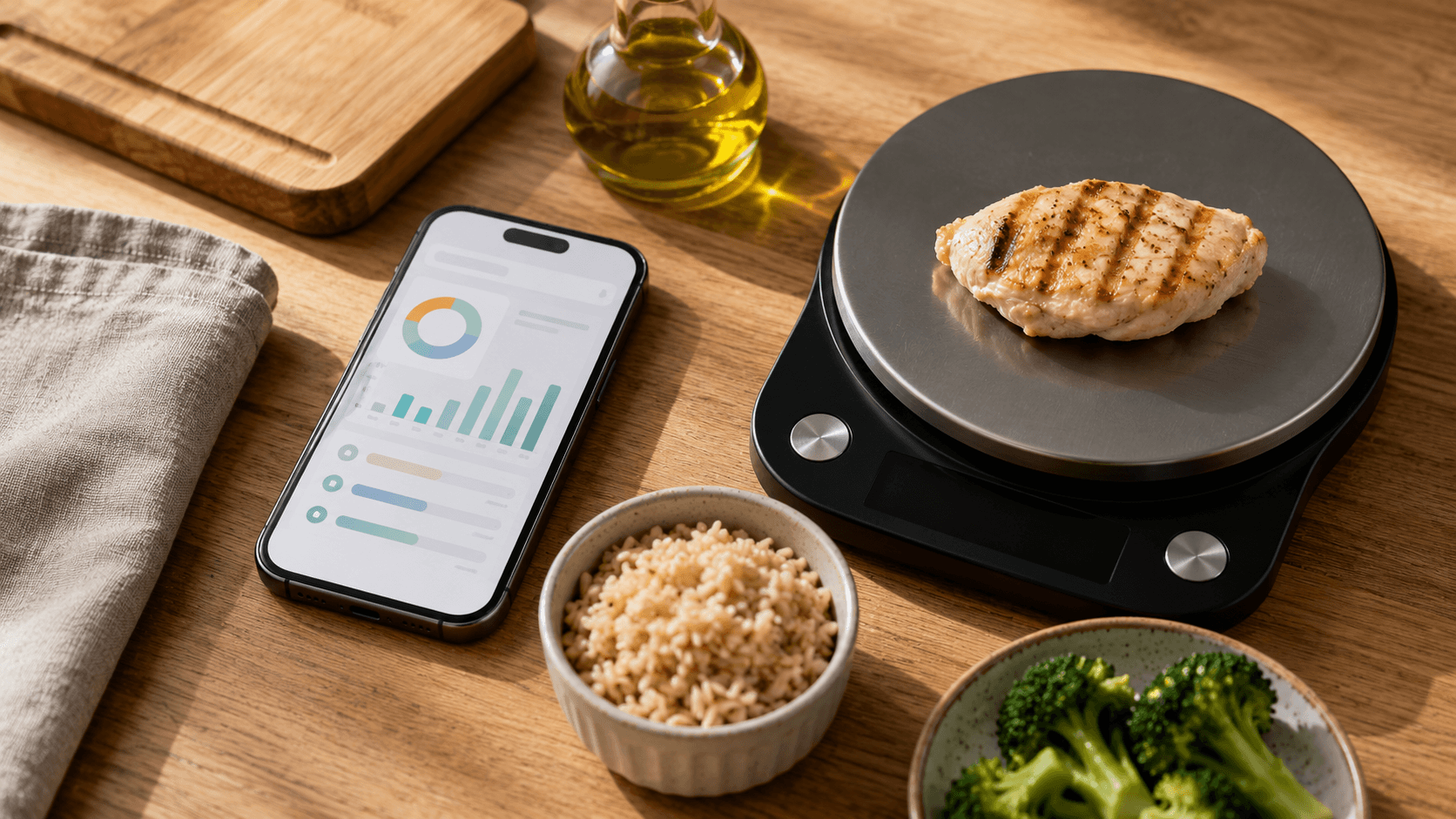
A more recent meta-analysis published in Obesity Reviews found that digital self-monitoring of both diet and physical activity produced a statistically significant mean weight loss of 2.87 kilograms more than interventions without self-monitoring (9). That is a meaningful difference, and it comes not from a different diet or a different training programme but simply from the act of paying attention to what you are doing. Self-monitoring works because it forces accountability. When you write down every meal, every snack, every drink, you can no longer hide from the truth. The biscuit you grabbed from the office kitchen, the extra handful of nuts, the oil you poured freely into the pan. It all counts and it all adds up. Tracking makes the invisible visible.
For my clients, I make food tracking a non-negotiable part of the first phase of coaching. Whether they use an app like MyFitnessPal, a simple food diary, or photograph every meal, the act of recording creates awareness and awareness creates change. Over time, as their nutritional literacy improves and their habits become more automatic, the level of tracking can be reduced. But in the beginning, when the gap between perception and reality is at its widest, tracking is the single most powerful tool available.
The Accountability Structures That Actually Work
Willpower is not a strategy. It is a finite resource that depletes throughout the day, and relying on it to sustain a fat loss phase over weeks and months is a recipe for failure. What works instead are external accountability structures: systems, routines, and relationships that keep you on track when motivation inevitably fades. The meta-analysis by Lemstra and colleagues found three factors that significantly improved adherence to weight loss programmes: supervised attendance, social support, and a focus on dietary modification rather than exercise alone (1). Let me break down what this means in practical terms.
External Accountability to Another Person
This is the single most effective accountability mechanism. When you know that someone is checking your food diary, reviewing your training log, and expecting you to show up, you behave differently than when you are left entirely to your own devices. This is exactly what I provide for my clients. They check in with me regularly. I review their food logs, their training data, their body composition progress, and I hold them to the standards they set for themselves. The research supports this approach. Programmes with supervised attendance had significantly higher adherence rates than those without supervision, with a rate ratio of 1.65 (1). That is a 65 percent improvement in adherence simply from having someone watching.
Structured Routines and Environment Design
You cannot rely on making good decisions in the moment when your environment is set up to make bad decisions easy. If your kitchen is full of high calorie snacks, you will eat them. If your gym bag is not packed the night before, you will skip the session. If your meals are not planned and prepped, you will order takeaway. Accountability is not just about discipline. It is about designing your environment so that the right behaviours are the default. I work with my clients to build weekly meal prep routines, training schedules locked into their diaries, and home environments that support rather than sabotage their goals.

Regular Weigh-Ins and Progress Tracking
Stepping on the scale is not about obsessing over a number. It is about data collection. A systematic review found that regular self-weighing was consistently associated with better weight loss and weight maintenance outcomes (8). I recommend daily morning weigh-ins under consistent conditions, tracking weekly averages rather than fixating on any single reading. Body weight fluctuates day to day based on hydration, sodium intake, digestion, and hormonal cycles. The weekly average trend is what matters. Avoiding the scale is not protecting your mental health. It is avoiding accountability.
Consistency Over Perfection
One of the biggest accountability traps I see is the all or nothing mentality. Someone eats one meal that was not on plan and decides the whole day is ruined, so they write off the rest of the week. This is catastrophic thinking and it is the fastest way to destroy a fat loss phase. A single meal over your calorie target is not a problem. A single bad day is not a problem. A week of untracked, uncontrolled eating because you decided one meal meant the whole week was a failure? That is the problem. Accountability means getting back on track at the very next meal, not the next Monday.
Your Fat Loss Accountability Framework
| Accountability Tool | What To Do | Why It Works |
|---|---|---|
| Food Tracking | Log everything you eat and drink daily using an app or diary | Makes invisible calories visible. Closes the gap between what you think you eat and what you actually eat (6, 8) |
| Daily Weigh-Ins | Weigh yourself every morning under the same conditions. Track weekly averages | Provides objective data on progress trends. Removes guesswork and emotional interpretation |
| Coach or Mentor | Check in regularly with someone who reviews your data and holds you accountable | Supervised programmes show 65% higher adherence rates than unsupervised ones (1) |
| Meal Preparation | Prepare meals in advance for at least 3 to 4 days at a time | Removes the need for in-the-moment decisions when willpower is low |
| Training Schedule | Lock training sessions into your calendar as non-negotiable appointments | Treats training as a commitment not an option. Reduces decision fatigue |
| Step Tracking | Wear a tracker and aim for 8,000 to 10,000 steps daily | Increases daily energy expenditure and provides a tangible daily target to hit |
| Progress Photos | Take photos every 2 to 4 weeks under the same conditions | Provides visual evidence of change that the scale cannot capture. Reinforces positive behaviour |
| Weekly Review | Review the previous 7 days honestly every Sunday. What went well? What did not? | Creates a feedback loop. Identifies patterns of non-adherence before they become habits |
The Conversation Nobody Wants to Have With Themselves
I am going to be blunt here because I think you need to hear it, and most people in your life will not say it to you. If you have been trying to lose fat for months or years and you have not succeeded, the problem is almost certainly not your thyroid, your genetics, your age, or your metabolism. The problem is that you have not been consistently adhering to the fundamentals. You have not been in a sustained calorie deficit. You have not been training with enough intensity or frequency. You have not been sleeping enough. You have not been honest with yourself about how much you are actually eating.
A landmark study published in the New England Journal of Medicine found that individuals who claimed to be diet resistant and unable to lose weight despite eating very little were, in reality, underestimating their calorie intake by an average of 47 percent and overestimating their physical activity by 51 percent (6). Let that sink in. People genuinely believed they were eating 1,200 calories a day when they were actually consuming closer to 2,000. They genuinely believed they were burning 600 calories in exercise when the real figure was closer to 300. The gap between perception and reality was enormous. And that gap is where your fat loss has been hiding.

This is not a moral failing. It is a well-documented cognitive bias. Humans are remarkably poor at estimating portion sizes, calorie content, and energy expenditure. This is precisely why tracking and external accountability are so critical. You cannot manage what you do not measure. And you cannot fix what you refuse to see. The first step in any successful fat loss journey is radical honesty. Not with me. Not with your partner. With yourself.
What Real Fat Loss Accountability Looks Like in Practice
I want to paint a clear picture of what accountability actually looks like when a client works with me, because there is a huge difference between knowing what to do and actually doing it.
When a new client starts with me, the first thing we establish is their baseline. I calculate their calorie and macronutrient targets based on their body composition, activity level, training frequency, and individual goals. For vegetarian and vegan clients, we build their protein intake around sources like tofu, tempeh, seitan, lentils, chickpeas, soy protein, pea protein, and dairy or dairy alternatives depending on their preferences. For omnivore clients, we include a full range of animal and plant sources. The specific food choices matter less than the total energy and macronutrient intake being hit consistently.
From there, accountability is built into every layer of the programme. Clients log their food daily and I review it. They follow a structured training plan and report their sessions. They weigh in regularly and submit their data. They check in with me at defined intervals and we review what is working, what is not, and what needs to change. There are no grey areas. There is no guessing. There is data, there is honesty, and there is course correction. That is what gets results. Not motivation. Not willpower. Systems and accountability.
The Bottom Line
Your body fat does not care about your excuses. It does not care about your intentions, your reasons, your schedule, or your feelings. It responds to one thing and one thing only: a sustained energy deficit created through controlled nutrition and consistent training, maintained over time. The difference between the people who achieve lasting fat loss and the people who do not is not knowledge. It is accountability. It is the willingness to track, to measure, to be honest, and to show up even when it is inconvenient.
The research is unambiguous. Self-monitoring dramatically improves fat loss outcomes (8, 9). External accountability through coaching and supervision increases adherence by 65 percent (1). Consistency of adherence predicts results more reliably than the type of diet followed (5). You do not need another diet plan. You need a system that holds you accountable to the plan you already have.
If you are ready to stop making excuses and start making progress, get in touch through trperformancecoaching.com. I work one-to-one with clients online globally. Whether you eat meat, are vegetarian, vegan, or somewhere in between, whether you need to lose 5 kilograms or 50, I will give you the structure, the plan, and the accountability you need to get the job done. No gimmicks. No quick fixes. Just evidence-based coaching, honest feedback, and relentless accountability. That is what works. That is what I do.
Work with Me
Get a personalised coaching plan built around your goals, your schedule, and your life.
Enquire NowReferences
- Lemstra M, Bird Y, Nwankwo C, Rogers M, Moraros J. Weight loss intervention adherence and factors promoting adherence: a meta-analysis. Patient Preference and Adherence. 2016; 10: 1547-1559.
- Montesi L, El Ghoch M, Brodosi L, Calugi S, Marchesini G, Dalle Grave R. Long-term weight loss maintenance for obesity: a multidisciplinary approach. Diabetes, Metabolic Syndrome and Obesity: Targets and Therapy. 2016; 9: 37-46.
- Strohacker K, Carpenter KC, McFarlin BK. Consequences of weight cycling: an increase in disease risk? International Journal of Exercise Science. 2009; 2(3): 191-201.
- Franz MJ, VanWormer JJ, Crain AL, et al. Weight-loss outcomes: a systematic review and meta-analysis of weight-loss clinical trials with a minimum 1-year follow-up. Journal of the American Dietetic Association. 2007; 107(10): 1755-1767.
- Ge L, Sadeghirad B, Ball GDC, et al. Comparison of dietary macronutrient patterns of 14 popular named dietary programmes for weight and cardiovascular risk factor reduction in adults: systematic review and network meta-analysis of randomised trials. BMJ. 2020; 369: m696.
- Lichtman SW, Pisarska K, Berman ER, et al. Discrepancy between self-reported and actual caloric intake and exercise in obese subjects. New England Journal of Medicine. 1992; 327(27): 1893-1898.
- Donahoo WT, Levine JA, Melanson EL. Variability in energy expenditure and its components. Current Opinion in Clinical Nutrition and Metabolic Care. 2004; 7(6): 599-605.
- Burke LE, Wang J, Sevick MA. Self-monitoring in weight loss: a systematic review of the literature. Journal of the American Dietetic Association. 2011; 111(1): 92-102.
- Berry R, Kassavou A, Sutton S. Does self-monitoring diet and physical activity behaviors using digital technology support adults with obesity or overweight to lose weight? A systematic literature review with meta-analysis. Obesity Reviews. 2021; 22(10): e13306.