
The Dad Bod Is Not a Joke: Why Fatherhood Is Wrecking Your Health and How to Fix It
By Tanvir Singh Rayet|TR PERFORMANCE COACHING
The dad bod has become a cultural shorthand — a gentle, self-deprecating way of describing the weight that accumulates after a man becomes a father. It is framed as harmless, even endearing. The reality is significantly less charming. What the dad bod actually represents, physiologically, is a convergence of risk factors — visceral fat accumulation, hormonal disruption, sleep deprivation, metabolic decline, and chronic inactivity — that increase the risk of serious disease.
This article is for fathers who are ready to stop laughing it off and start doing something about it. It covers what is actually happening to your body when you become a father, why it happens, what it leads to if left unaddressed, and what the practical minimum looks like to turn it around — without requiring you to train like an athlete or overhaul your entire life.
The Dad Bod Problem Nobody Wants to Talk About
Studies consistently show that men gain significant weight in the years following the birth of their first child. A large study published in Social Science and Medicine tracked over 10,000 men and found that those who became fathers gained an average of 3.5 to 4.5 kg in the two years following the birth of their first child — compared to childless men of the same age who remained stable or lost weight.
This is not a coincidence. Fatherhood creates a specific and predictable set of conditions that drive fat accumulation: chronically disrupted sleep, reduced time for exercise, changed eating patterns, increased alcohol consumption, elevated stress, and hormonal changes. The problem is that these factors do not resolve on their own. They persist, compound, and become the new normal.
The Research
- New fathers gain 3.5 to 4.5 kg on average in the two years post-birth (Social Science and Medicine, 2020)
- Testosterone levels in fathers drop by 30 to 40% in the first year after a child is born
- New parents lose an average of one hour of sleep per night in the first year — equivalent to chronic sleep restriction
- Physical activity in new fathers drops by up to 50% compared to pre-baby levels
- Visceral fat (the dangerous kind around the organs) is specifically associated with sleep-deprived, high-cortisol states

What the Dad Bod Actually Represents Physiologically
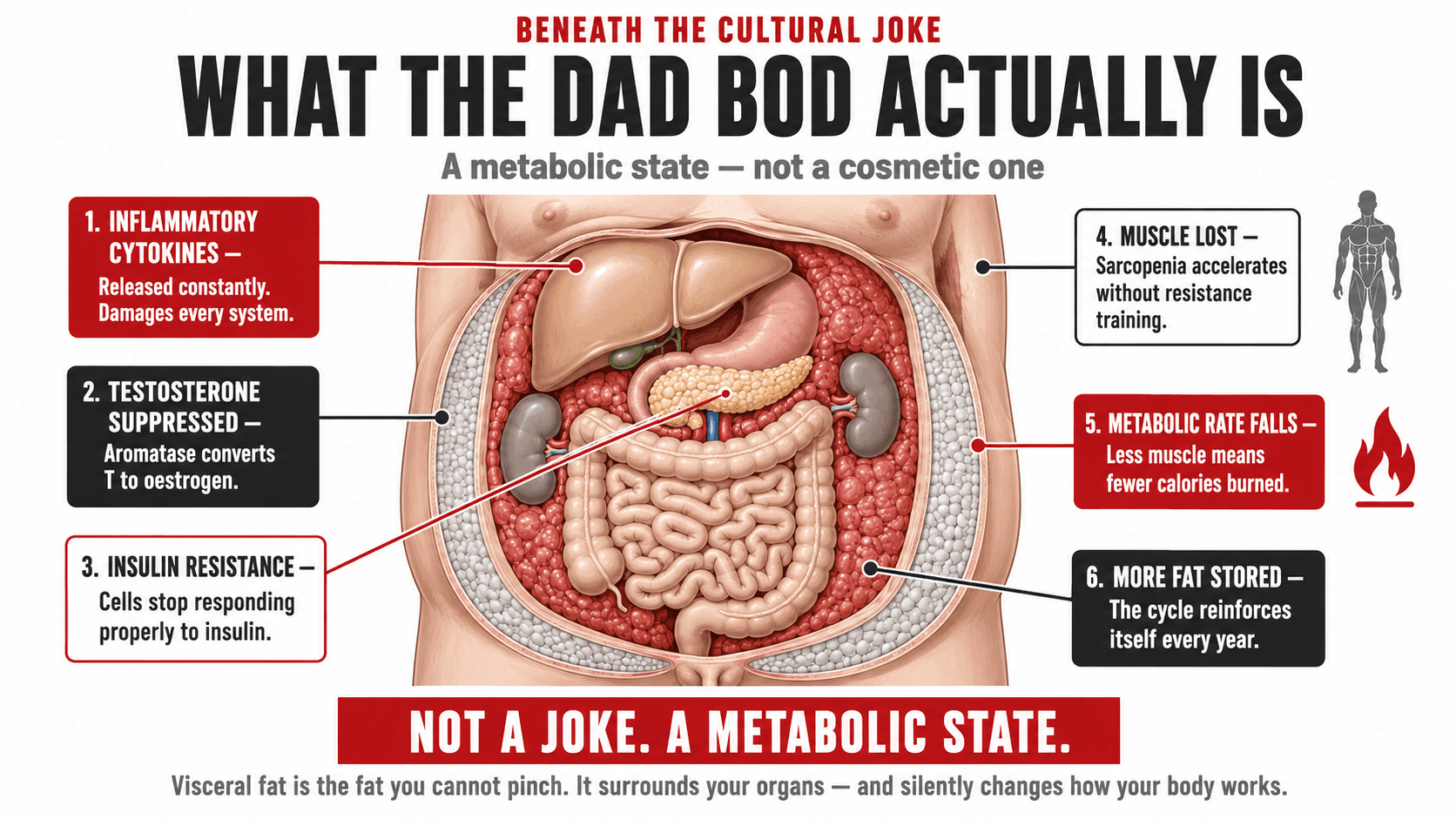
Body fat is not all equal. The fat that accumulates with the dad bod is predominantly visceral fat — fat stored around the abdominal organs. This is metabolically active tissue that secretes pro-inflammatory cytokines, disrupts insulin signalling, and directly impairs testosterone production. It is not just aesthetic. It is a metabolic state.
The dad bod is also associated with sarcopenia — the gradual loss of muscle mass that begins in a man's early 30s and accelerates sharply when physical activity drops. When you are not training, you are losing muscle. When you are losing muscle, your resting metabolic rate decreases. When your metabolic rate decreases, you store more fat even without eating more. The body composition shifts become self-reinforcing.
| Health Marker | When You Ignore It | When You Take Action | Target Range |
|---|---|---|---|
| Waist Circumference | Increases year on year, visceral fat builds around organs | Reduces with consistent training and caloric control | Below 94cm / 37 inches |
| Testosterone | Drops further with each year of inactivity, poor sleep, and high body fat | Rises with resistance training, improved sleep, fat loss | 300–1000 ng/dL (vary by lab) |
| Fasting Blood Glucose | Creeps upward with high sugar intake, inactivity, and visceral fat | Normalises with diet control and regular exercise | Below 5.6 mmol/L |
| Resting Blood Pressure | Elevates with stress, poor sleep, and excess weight | Reduces significantly with regular aerobic and resistance training | Below 130/80 mmHg |
| Resting Heart Rate | Remains elevated with deconditioning and chronic stress | Decreases as cardiovascular fitness improves | Below 70 bpm |
| Body Fat Percentage | Climbs annually without intervention | Reducible within weeks with caloric deficit and training | 10 to 20% for men |
Why Fatherhood Specifically Triggers the Decline
The lifestyle shift that comes with having children is unique. It is not just busyness — it is a specific restructuring of time, priorities, and identity. Most men who become fathers describe the same experience: the things that kept them healthy before — gym sessions, cooking, sleep, downtime — are the first things to go. They are replaced by childcare, work pressure, relationship strain, and exhaustion.
There is also a hormonal component that is not widely discussed. Research shows that testosterone levels in men drop significantly in the first year after becoming a father — thought to be an evolutionary mechanism that supports caregiving behaviour. Lower testosterone means lower drive to be physically active, reduced muscle protein synthesis, increased fat storage, and a lower baseline mood. The hormonal environment is literally working against you.
What Happens If You Leave It Unaddressed
The stakes are not trivial. Men who accumulate significant visceral fat in their 30s and 40s face substantially elevated risks of type 2 diabetes, cardiovascular disease, metabolic syndrome, sleep apnoea, and erectile dysfunction. They also face the psychological toll of feeling progressively less like themselves — lower energy, lower libido, less patience, reduced confidence.
This matters not just for the man himself, but for his family. The research on father health and child outcomes is unambiguous: physically active, healthy fathers produce more active children. A father who models physical activity, adequate sleep, and a healthy relationship with food creates a fundamentally different environment than one who does not. Your health is not just about you.
| Downward Spiral | Upward Spiral |
|---|---|
| Sleep deprivation raises cortisol | Better sleep lowers cortisol and raises testosterone |
| High cortisol drives visceral fat storage | Lower cortisol reduces abdominal fat storage |
| Visceral fat suppresses testosterone | Fat loss raises testosterone naturally |
| Low testosterone reduces motivation and muscle | Higher testosterone boosts drive and muscle synthesis |
| Less muscle means lower metabolic rate | More muscle means higher resting calorie burn |
| Lower metabolic rate increases fat gain | Higher metabolic rate makes fat loss sustainable |
| Increased fatigue, irritability, low confidence | Improved energy, mood, and self-efficacy |
| Less physical activity reinforces all of the above | Regular training reinforces all of the above |

The Minimum Effective Dose
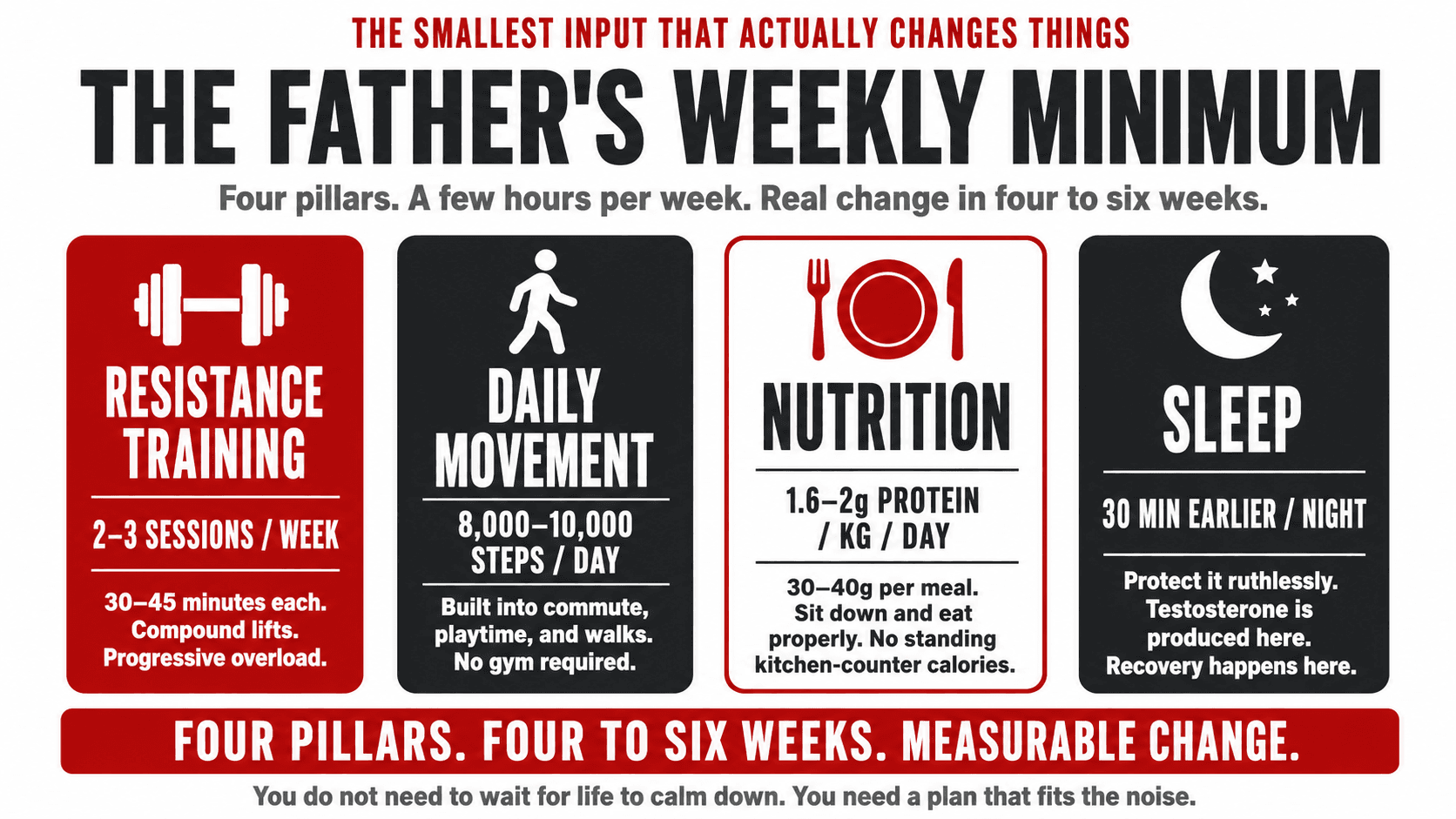
The barrier most fathers cite is time. And time is genuinely limited with young children. The goal here is not perfection — it is the minimum effective dose. The smallest consistent input that produces meaningful physiological change. Based on the evidence, that looks like this.
| Area | Minimum Effective Dose | Why It Works |
|---|---|---|
| Training | 2 to 3 resistance training sessions per week, 30 to 45 minutes each | Preserves and builds muscle mass, raises testosterone, increases metabolic rate, improves mood and sleep quality |
| Cardio | 8,000 to 10,000 steps daily, plus 1 to 2 low-intensity cardio sessions per week | Increases total energy expenditure, improves cardiovascular health, reduces visceral fat over time |
| Nutrition | Protein target of 1.6 to 2g per kg bodyweight, moderate caloric deficit of 300 to 500 kcal if fat loss is the goal | Preserves muscle during fat loss, improves satiety, regulates blood sugar, supports hormonal health |
| Sleep | Prioritise sleep over screens. Even 30 minutes more per night has measurable effects on cortisol and testosterone | Sleep is when testosterone is produced. Sleep is when muscle is repaired. Sleep is non-negotiable. |

Nutrition for Fathers: Simple, Sustainable, Effective
Most fathers do not fail on nutrition because they eat too much of the wrong things at dinner. They fail because of invisible calories — the half-eaten children's chicken nuggets, the biscuits with the afternoon tea, the larger wine pour at 9pm after bedtime. Awareness is the first step.
You do not need to weigh every gram or follow a specific diet. But you do need a framework. Here is one that works for busy fathers.
The Busy Father Nutrition Framework
- Protein first: Build every meal around a protein source — meat, fish, eggs, dairy, legumes. Aim for 30 to 40g per meal.
- Vegetables always: Fill half your plate with non-starchy vegetables. Fibre, micronutrients, and satiety.
- Control carb portions: You do not need to eliminate carbohydrates. Size the portion relative to your activity level that day.
- Limit liquid calories: Alcohol, juice, sports drinks, and large lattes are the fastest way to blow a caloric deficit. Swap for water or black coffee.
- Stop finishing the kids' plates: This one small habit change can save 200 to 400 kcal per day.
- Do not eat standing over the kitchen counter: Sit down, eat mindfully. Unconscious eating is where the excess comes from.
Sleep: The Variable You Keep Underestimating
With young children, perfect sleep is not always available. But there are still choices you are making that are making it worse than it needs to be. The phone at 11pm. The Netflix episode at midnight. The third glass of wine that fragments sleep architecture for the entire night.
Alcohol is particularly relevant here. It is the most common coping mechanism for tired, stressed fathers — and it is the most counterproductive one. Alcohol reduces REM sleep, elevates cortisol the following morning, suppresses testosterone production, and increases caloric intake. You feel like it is relaxing you. Physiologically, it is making everything worse.
Sleep Upgrade Checklist
- Set a consistent wake time — even at weekends
- Move your phone charger out of the bedroom
- Stop alcohol at least two hours before bed
- Keep the bedroom cool (around 18 degrees Celsius)
- Go to bed 30 minutes earlier than you currently do for two weeks and track the difference
- Take turns with your partner for the night wake-up shifts where possible
Why 'I'll Start When Things Calm Down' Is a Trap
Things will not calm down. They will change shape. The newborn phase ends and the toddler phase begins. School starts and the schedule shifts again. Teenagers arrive and life gets louder in different ways. There is no future version of your life where the conditions become perfect for starting. That version of fatherhood does not exist.
What actually happens when you wait is that the metabolic cost compounds. Every year of inactivity, every year of poor sleep and high stress and excess body fat, makes the physiological hole deeper and harder to climb out of. The best time to start was before you had children. The second best time is now.
Two resistance training sessions per week, a decent protein intake, and a modest improvement in sleep will produce measurable physical and psychological changes within four to six weeks. You do not need to wait for calm. You need a plan that fits the noise.
Quick Meal Prep Ideas for Fathers with No Time
Five High-Protein Meals in Under 20 Minutes
- Scrambled eggs and smoked salmon on sourdough: 35g protein, 10 minutes, no prep required.
- Greek yoghurt with berries, oats, and protein powder: 40g+ protein, 3 minutes, works as breakfast or post-training.
- Tinned salmon, rice cakes, and spinach: 30g protein, zero cooking, portable.
- Chicken thighs roasted with sweet potato and broccoli: Prep once on Sunday for three to four meals. 45g protein per serving.
- Turkey mince stir-fry with veg and noodles: 40g protein, 15 minutes, kid-friendly.
How I Work with Fathers
A significant portion of the men I work with are fathers. They typically come to me with a version of the same story: they used to be fitter, they know what they should be doing, but life keeps getting in the way. They are not looking for someone to tell them what they already know. They are looking for a structured plan, accountability, and someone who understands their constraints.
What I build for fathers is a programme designed around real life — two or three training sessions per week, a nutrition approach that does not require weighing every meal, and a check-in system that keeps them consistent without adding to their stress. The goal is not perfection. The goal is a sustainable physical identity that compounds over the coming years.
Your children are watching. The version of yourself you build now is the version they grow up seeing. That version matters.
References
- (1) Batsis JA, Villareal DT. Sarcopenic obesity in older adults: aetiology, epidemiology and treatment strategies. Nature Reviews Endocrinology. 2018; 14(9): 513-537.
- (2) Despres JP, Lemieux I. Abdominal obesity and metabolic syndrome. Nature. 2006; 444(7121): 881-887.
- (3) Leproult R, Van Cauter E. Effect of 1 week of sleep restriction on testosterone levels in young healthy men. JAMA. 2011; 305(21): 2173-2174.
- (4) Björntorp P. Do stress reactions cause abdominal obesity and comorbidities? Obesity Reviews. 2001; 2(2): 73-86.
- (5) Fox CS, Massaro JM, Hoffmann U, et al. Abdominal visceral and subcutaneous adipose tissue compartments: association with metabolic risk factors in the Framingham Heart Study. Circulation. 2007; 116(1): 39-48.
- (6) Westcott WL. Resistance training is medicine: effects of strength training on health. Current Sports Medicine Reports. 2012; 11(4): 209-216.
- (7) Morton RW, Murphy KT, McKellar SR, et al. A systematic review, meta-analysis and meta-regression of the effect of protein supplementation on resistance training-induced gains in muscle mass and strength in healthy adults. British Journal of Sports Medicine. 2018; 52(6): 376-384.
- (8) Abbasi B, Kimiagar M, Sadeghniiat K, et al. The effect of magnesium supplementation on primary insomnia in elderly: a double-blind placebo-controlled clinical trial. Journal of Research in Medical Sciences. 2012; 17(12): 1161-1169.
High-performance expertise, at your fingertips.
Evidence-based coaching advice delivered straight to your inbox.