Few topics in nutrition generate as much confusion, excitement, and self-sabotage as the cheat meal. The idea that you can diet all week and then eat whatever you want for a meal or even a full day without consequences is incredibly appealing. It is also, for most people, a trap. I have lost count of the number of clients who have come to me having stalled their fat loss completely because their weekend cheat meals were wiping out their entire weekly calorie deficit. At the same time, I have also seen clients who were so rigid with their diets that they never deviated at all, eventually burning out psychologically and abandoning their plan altogether. The truth, as it usually does, sits somewhere in the middle. Strategic overfeeding, when done correctly, can be a genuinely useful tool. But the difference between a strategic refeed and an uncontrolled binge is the difference between progress and self-sabotage.

Why Your Body Responds to Prolonged Dieting the Way It Does
To understand why refeeds can be useful, you need to understand what happens to your body during a sustained calorie deficit. When you consistently eat fewer calories than you burn, your body perceives this as a potential threat to survival and begins to make adaptive changes designed to conserve energy and slow the rate of fat loss. One of the most significant of these changes involves the hormone leptin, which is produced by your fat cells and plays a central role in regulating hunger, metabolic rate, and energy expenditure (1).
As body fat decreases and calorie intake remains restricted, leptin levels drop. This sends a signal to the brain that energy stores are running low, which triggers a cascade of metabolic adaptations including increased hunger, reduced non-exercise activity thermogenesis (NEAT), decreased thyroid hormone output, and a general downregulation of metabolic rate (2). This is often referred to as adaptive thermogenesis or metabolic adaptation, and it is one of the primary reasons why fat loss stalls after several weeks of dieting despite continued adherence to a calorie deficit. Research published in the American Journal of Clinical Nutrition has demonstrated that leptin levels can decline by as much as 50 percent within the first week of calorie restriction, well before any significant fat loss has occurred (3). Your body is essentially getting ahead of the problem.

What a Refeed Actually Is (and What It Is Not)
A refeed is a planned, controlled, short-term increase in calorie intake, predominantly from carbohydrates, designed to temporarily elevate leptin levels, replenish glycogen stores, provide a psychological break from dieting, and potentially mitigate some of the metabolic adaptations associated with prolonged energy restriction. A refeed is typically a single day, sometimes just a single meal, where carbohydrate intake is increased significantly while fat intake is kept moderate to low and protein intake remains consistent (4).

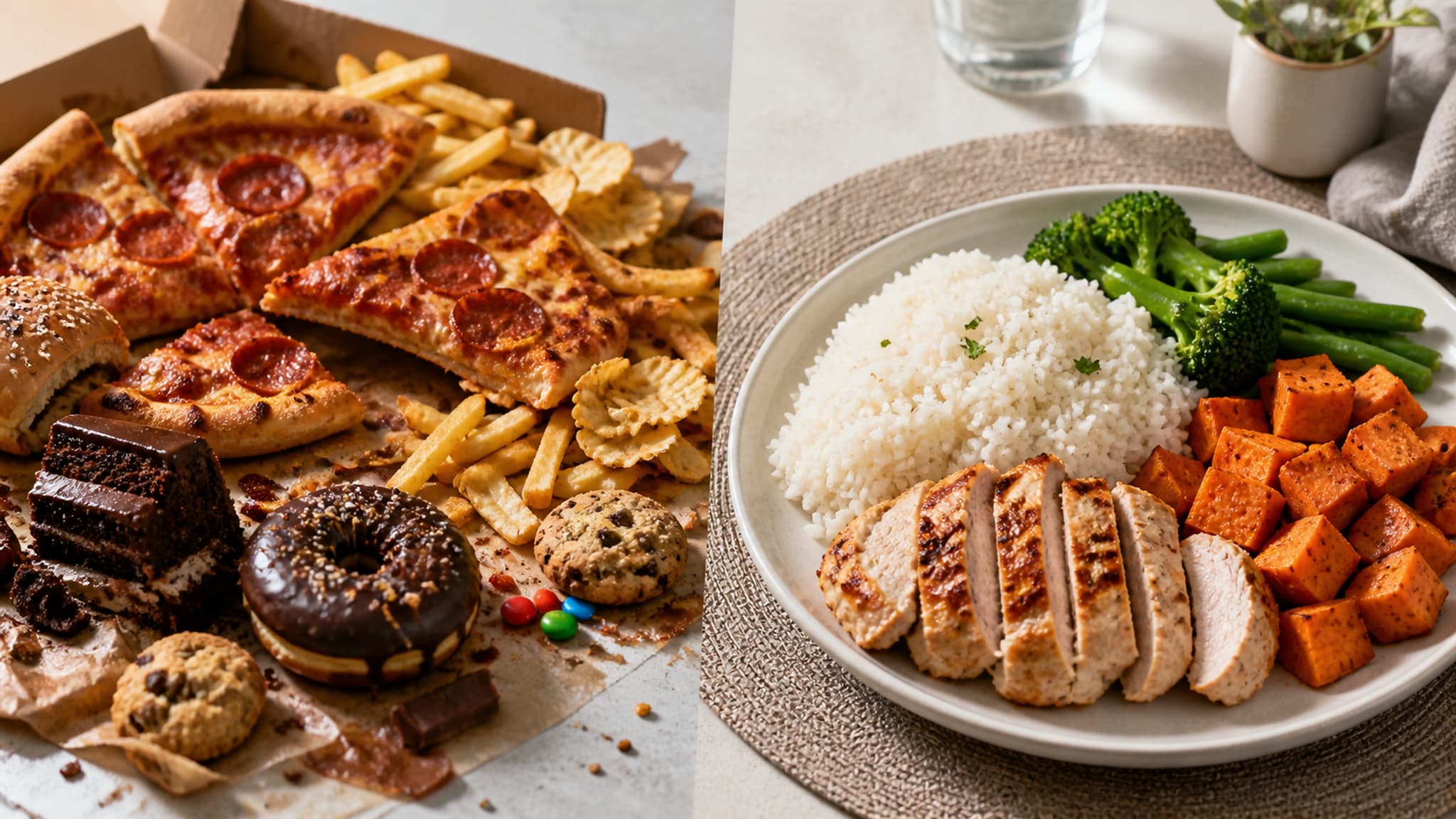
A refeed is not a cheat meal. A cheat meal, by common definition, is an unstructured, untracked, emotionally driven deviation from your nutrition plan where you eat whatever you want in whatever quantity you want. There is no macronutrient target. There is no calorie ceiling. There is no strategic purpose other than psychological relief. And while I understand the desire for that relief, the problem is that a single uncontrolled cheat meal can easily contain 3,000 to 5,000 calories or more, which is enough to erase several days of careful dieting in a matter of hours.
The Science Behind Carbohydrate-Focused Refeeds
The reason refeeds focus specifically on carbohydrates rather than fat is that leptin production is far more responsive to carbohydrate and overall energy intake than it is to dietary fat (5). Research has shown that high-carbohydrate overfeeding produces a significantly greater increase in circulating leptin levels compared to high-fat overfeeding at the same caloric surplus (6). Carbohydrates also have the added benefit of replenishing muscle glycogen stores, which directly supports training performance. If you have been dieting in a calorie deficit for several weeks and your workouts are suffering, a well-timed carbohydrate refeed can restore glycogen levels and help you train with the intensity needed to preserve lean muscle mass.

It is worth noting that the magnitude of the leptin response to a refeed is relatively modest and temporary, and I want to be honest about that. A single refeed day is not going to reverse weeks of metabolic adaptation. The evidence suggests that more prolonged diet breaks of one to two weeks at maintenance calories may be more effective for meaningful metabolic recovery (7). A study published in the International Journal of Obesity found that participants who took intermittent two-week diet breaks during a fat loss programme lost more fat and maintained more of their metabolic rate compared to those who dieted continuously (7). This is an approach I use with clients when the situation warrants it, alternating between deficit phases and maintenance phases to manage adaptation.
When and How I Programme Refeeds for Clients
I do not give every client a refeed from day one. If you are in the early stages of a fat loss phase and your body fat is still relatively high, you do not need a refeed. Your leptin levels are still adequate, your glycogen stores are not depleted, and the calorie deficit has not been sustained long enough for significant metabolic adaptation to occur. Introducing a refeed too early is often just an excuse to overeat, and I would rather build the discipline of consistent adherence first before introducing planned flexibility.
As a general framework, I begin considering refeeds when a client has been in a consistent calorie deficit for four to six weeks and is beginning to show signs of fatigue, declining training performance, persistent hunger, or stalled progress despite verified adherence. The leaner a client gets, the more frequently refeeds become necessary. Someone at 20 percent body fat might need a refeed every two to three weeks. Someone pushing below 12 percent body fat might need one every five to seven days.
The structure of a refeed for my clients is straightforward. Protein intake stays the same as any other day. Fat intake is reduced to moderate levels. Carbohydrate intake is increased to bring total calories up to approximately maintenance level, sometimes slightly above. The carbohydrate sources should be predominantly whole-food based: rice, oats, sweet potato, pasta, bread, fruit, and similar options. For vegetarian and vegan clients, this works particularly well because plant-based diets are naturally carbohydrate-rich, and refeeds can incorporate foods like lentil-based dishes, bean curries, wholegrain pilafs, and fruit-based desserts. The focus is on fuelling the body, not on indulgence for its own sake.
The Psychology of Cheat Meals and Why Language Matters
I have deliberately moved away from using the word ‘cheat’ with my clients, and I would encourage you to do the same. The language you use around food matters. Calling a meal a cheat implies that you are doing something wrong, that your diet is a set of rules you are breaking, and that guilt is an appropriate emotional response to eating food you enjoy. This is not a healthy relationship with food, and it is not a mindset that supports long-term sustainability (8).
I prefer to think in terms of planned flexibility. If a client has a dinner out, a birthday celebration, or a social event where they want to enjoy food without restriction, we plan for it. We might reduce calories slightly on the days surrounding the event. We make sure protein intake is prioritised earlier in the day. We accept that the meal will likely push calories above the daily target, and we account for that within the weekly picture. There is no guilt. There is no cheating. There is just planning and adjustment, which is exactly how nutrition should work in real life.
Common Mistakes That Derail Progress
The most common mistake I see is the cheat meal that becomes a cheat day, which becomes a cheat weekend. One meal at a restaurant turns into takeaway for lunch the next day, snacks throughout the afternoon, and another indulgent dinner that evening. Before you know it, you have consumed an additional 8,000 to 10,000 calories across the weekend and completely erased the 3,500-calorie weekly deficit you worked hard to create. This is not an exaggeration. I have tracked this pattern with clients and the numbers are often staggering.
The second common mistake is using refeeds as a reward. If you frame the refeed as a prize for being good all week, you create a psychological dynamic where the diet itself is the punishment and the food is the reward. This is a recipe for disordered thinking. Refeeds are a physiological tool, not an emotional crutch. They serve a metabolic purpose and should be treated as a structured part of the plan, not as a break from the plan.
The Bottom Line
Strategic refeeds, when implemented correctly, can support your fat loss by partially restoring leptin levels, replenishing glycogen, improving training performance, and providing psychological relief from the demands of sustained calorie restriction. Uncontrolled cheat meals, on the other hand, more often sabotage progress than support it. The difference lies in structure, intention, and self-awareness.
If you have been struggling with the cycle of strict dieting followed by binge eating, or if your fat loss has stalled and you are not sure how to break through, this is exactly the kind of problem I help clients solve every day. A properly structured nutrition plan includes built-in flexibility because I know that life does not stop because you are on a diet. If you want a plan that works with your life rather than against it, get in touch and let me show you how it is done.
Work with Me
Get a personalised coaching plan built around your goals, your schedule, and your life.
Enquire NowReferences
- Friedman JM, Halaas JL. Leptin and the regulation of body weight in mammals. Nature. 1998; 395(6704): 763-770.
- Rosenbaum M, Leibel RL. Adaptive thermogenesis in humans. International Journal of Obesity. 2010; 34(Suppl 1): S47-S55.
- Weigle DS, Duell PB, Connor WE, Steiner RA, Soules MR, Kuijper JL. Effect of fasting, refeeding, and dietary fat restriction on plasma leptin levels. Journal of Clinical Endocrinology and Metabolism. 1997; 82(2): 561-565.
- Campbell BI, Aguilar D, Colenso-Semple LM, et al. Intermittent energy restriction attenuates the loss of fat free mass in resistance trained individuals. A randomized controlled trial. Journal of Functional Morphology and Kinesiology. 2020; 5(1): 19.
- Dirlewanger M, di Vetta V, Guenat E, et al. Effects of short-term carbohydrate or fat overfeeding on energy expenditure and plasma leptin concentrations in healthy female subjects. International Journal of Obesity. 2000; 24(11): 1413-1418.
- Jenkins AB, Markovic TP, Fleury A, Campbell LV. Carbohydrate intake and short-term regulation of leptin in humans. Diabetologia. 1997; 40(3): 348-351.
- Byrne NM, Sainsbury A, King NA, Hills AP, Wood RE. Intermittent energy restriction improves weight loss efficiency in obese men: the MATADOR study. International Journal of Obesity. 2018; 42(2): 129-138.
- Tylka TL, Kroon Van Diest AM. The Intuitive Eating Scale-2: item refinement and psychometric evaluation with college women and men. Journal of Counseling Psychology. 2013; 60(1): 137-153.