If I had a pound for every time someone asked me what the best cardio for fat loss is, I would not need to coach for a living. It is the single most common question I get, from complete beginners and experienced gym goers alike. And the answer they usually expect is a single exercise, a magic bullet, the one form of cardio that burns the most fat. That is not how it works.
The truth is that the best cardio workout for burning fat depends on where you are in your fitness journey, what your body can tolerate, how much time you have, and what you are already doing in the gym. A workout that is perfect for one person can be completely wrong for another. I have tested, programmed and refined every type of cardio you can think of. What follows is my honest ranking of the best cardio workouts for fat loss based on real world results with real clients, backed by evidence.
This is not a list of what burns the most calories per minute. That would be misleading because calorie burn during a session is only part of the picture. This ranking takes into account total fat loss effectiveness, muscle preservation, recovery demand, practicality, sustainability, and the afterburn effect. These are the factors that actually determine whether a cardio method helps you get lean or just makes you tired.
How I Ranked These Workouts
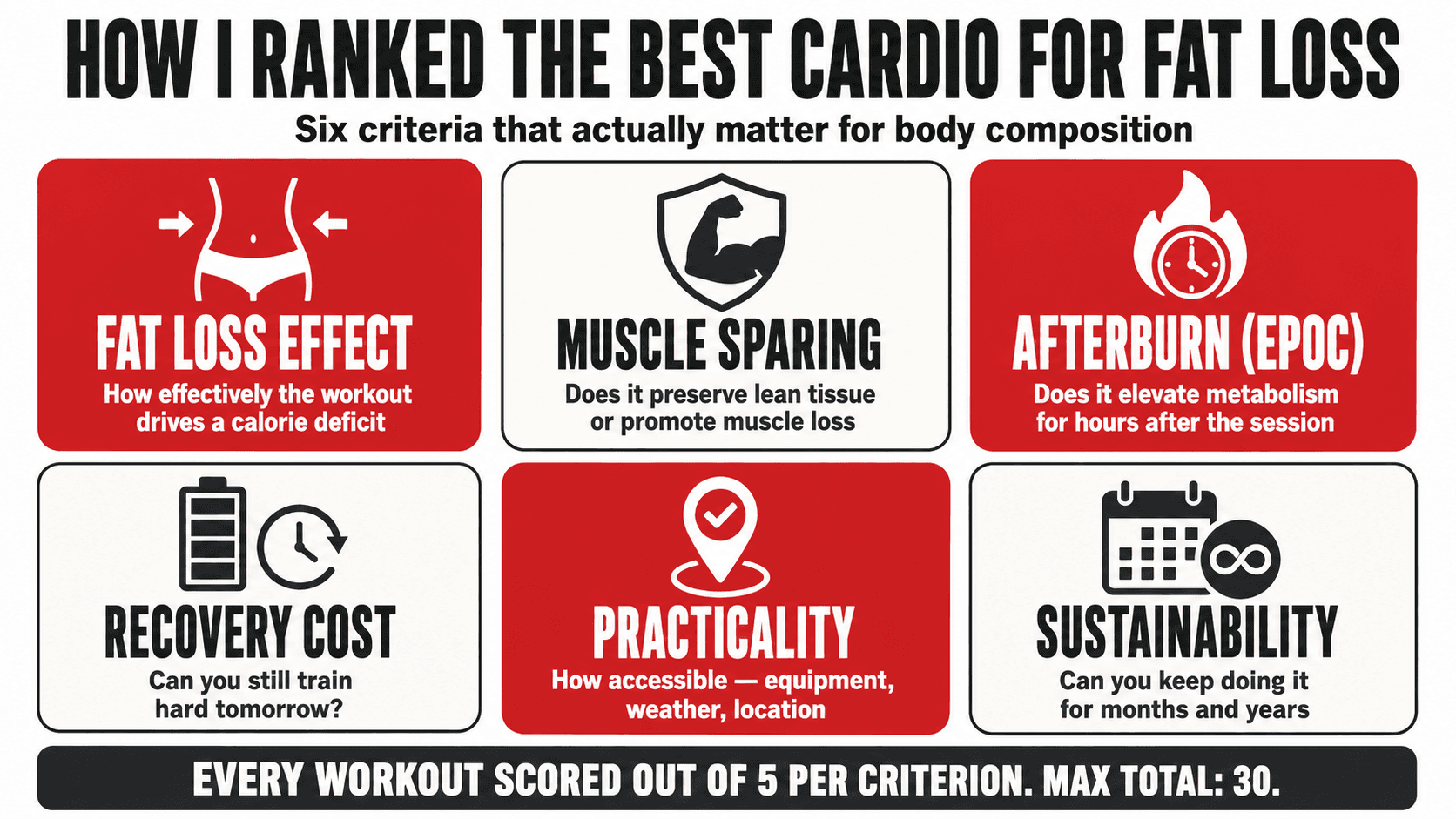
Before I reveal the ranking, let me explain the six criteria I used to score each workout. Understanding these will help you see why some popular cardio methods ranked lower than you might expect, and why some less obvious ones came out on top.
| THE SIX SCORING CRITERIA | |
|---|---|
| Fat Loss Effect | How effectively does this workout contribute to creating a calorie deficit and reducing body fat, based on published research and my own coaching experience? |
| Muscle Sparing | Does this form of cardio help you hold onto muscle tissue during a fat loss phase, or does it promote muscle breakdown? |
| Afterburn (EPOC) | Does the workout elevate your metabolic rate after the session ends? High EPOC means you continue burning additional calories for hours. |
| Recovery Cost | How much does this workout take out of you? Can you still train hard with weights the next day, or does it leave you wrecked? |
| Practicality | How accessible is this workout? Does it require specialist equipment, good weather, or a long commute to a specific gym? |
| Sustainability | Can you keep doing this consistently for months and years? Or does it lead to burnout, boredom, or overuse injuries? |
Each workout was scored out of five for each criterion, giving a maximum of 30. Let me walk you through the full ranking from bottom to top, then give you the complete table at the end.
The Ranking: From Least to Most Effective
#7 — Steady State Jogging (30 to 45 Minutes at a Moderate Pace)
The default cardio for most people, and honestly the least effective option on this list for fat loss.
I know this will be controversial. Running is the first thing most people do when they decide to lose weight. But here is the problem. Moderate intensity jogging sits in a metabolic no man's land. It is not easy enough to be genuinely restorative like walking, and it is not hard enough to trigger a meaningful afterburn effect. It creates moderate fatigue that interferes with your resistance training, produces repetitive impact on joints, and when done frequently, it can elevate cortisol and promote muscle loss (1).
A 2025 systematic review and meta-analysis comparing exercise modalities found that aerobic training alone preserved significantly less fat-free mass than resistance training, with a difference of 0.88 kilograms (2). That means if jogging is your primary form of exercise, you are likely losing muscle alongside fat. For most people I coach, jogging is the first thing I remove from their programme.
Common Mistake
If you love running for your mental health, keep one or two sessions per week. But do not rely on it as your primary fat loss tool. It is the least efficient option for body composition.
#6 — Elliptical / Cross Trainer (30 to 45 Minutes at Moderate Intensity)
Low impact and accessible, but limited in its ability to drive meaningful fat loss.
The cross trainer has its place. It is low impact, which makes it suitable for people with joint issues or those who are significantly overweight and cannot handle the pounding of running. It provides a full body movement pattern that burns a reasonable number of calories. But it also has a significant drawback: it is far too easy to coast on. Most people I see on a cross trainer are moving at an intensity that barely elevates their heart rate above resting. The machine does much of the work for you, and the calorie counter on the screen is almost always wildly inaccurate, often overestimating by 30 to 50 percent.
If you use the cross trainer, use it at a genuine high intensity for short intervals, or use it for steady state work at an honest effort level. It is not a bad machine but it needs to be used with intention, not as background movement while you scroll through your phone.
#5 — Swimming (30 to 45 Minutes, Varied Intensity)
An excellent full body workout with very low impact, but harder to control intensity and not always practical.
Swimming is genuinely one of the best forms of exercise for overall health. It works every major muscle group, it is incredibly easy on the joints, and it builds cardiovascular fitness effectively. For clients recovering from injuries, or those with significant joint limitations, swimming can be a game changer.
The reason it does not rank higher for fat loss specifically is practicality. You need access to a pool. You need to be a competent swimmer. And it is difficult to control and measure intensity precisely compared to a bike or rower. Research also suggests that swimming can increase appetite more than land based exercise, potentially making it harder to maintain a calorie deficit (3). That said, if you enjoy it and have access, it is a solid option as part of a wider programme.
#4 — Rowing Machine (15 to 25 Minutes HIIT or 30 to 40 Minutes Steady State)
A brilliant full body option that combines cardiovascular work with genuine muscular engagement.
The rowing machine is one of the most underused pieces of equipment in any gym. It engages the legs, back, core and arms in every single stroke. This means you are using a huge amount of muscle mass per repetition, which drives up calorie expenditure significantly. It is also low impact on the joints, making it suitable for almost everyone.
Used for intervals, the rower is exceptional. Twenty seconds of maximum effort rowing followed by 40 seconds of easy pace, repeated for 10 to 15 rounds, is one of the most effective conditioning sessions you can do. The full body engagement means the metabolic demand is high and the EPOC effect is substantial. Used for steady state, it provides a solid calorie burn without the joint stress of running.
The only reason it does not rank higher is that rowing technique matters. Poor form can lead to lower back strain, and many people who have never been taught to row properly end up pulling with their arms instead of driving with their legs. If your gym has a rower and you learn the technique, this should be a staple in your programme.
Top Tip
On the rower, think “legs, back, arms” on the pull and “arms, back, legs” on the return. The power comes from your legs, not your arms. Get this right and the rower becomes one of the most effective fat loss tools available.
#3 — Assault Bike or Stationary Bike HIIT (15 to 25 Minutes)
The time efficient powerhouse. Maximum metabolic impact with minimal joint stress and low recovery cost.
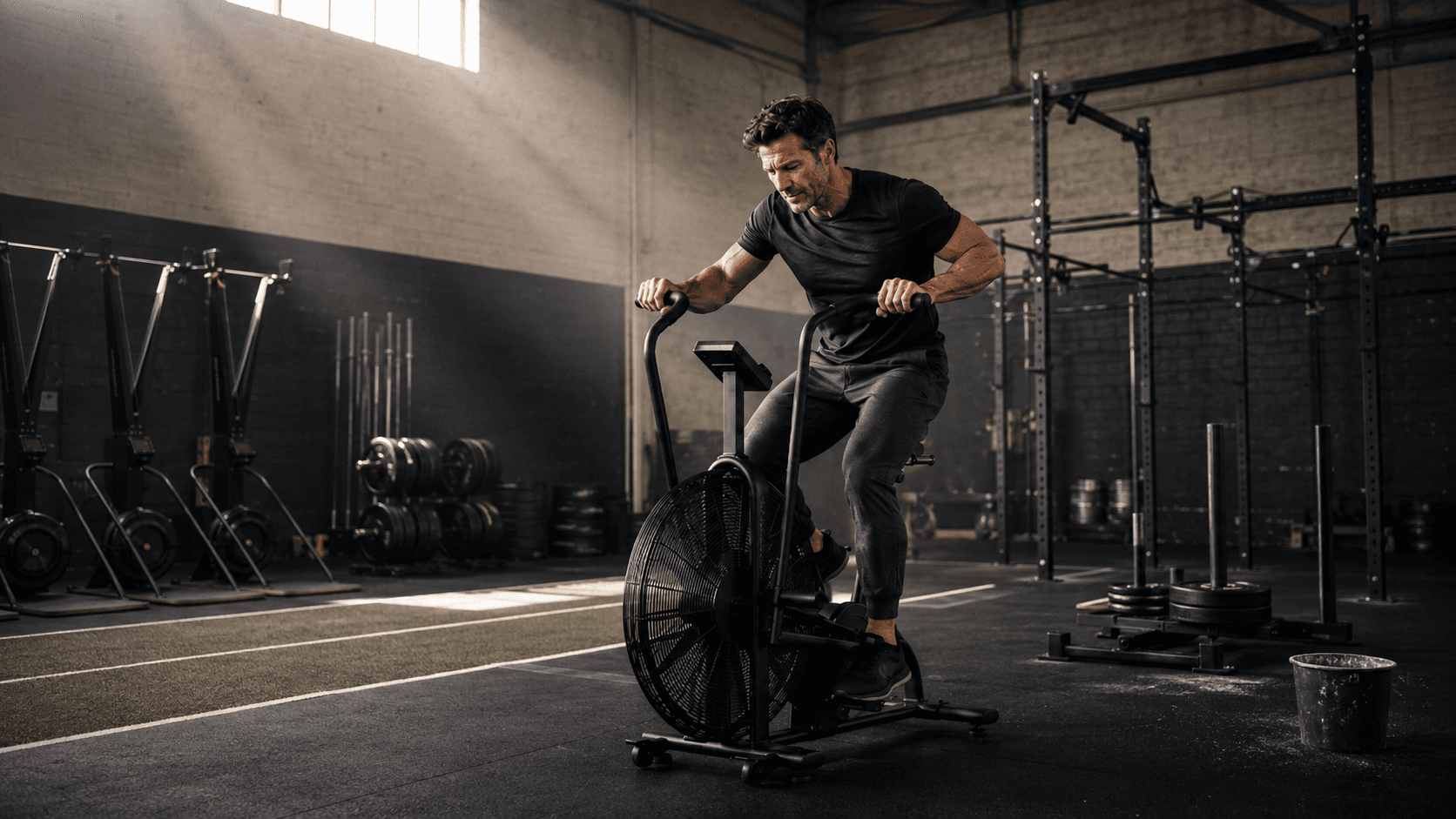
If you want to get the most fat loss benefit from the least amount of time, bike based HIIT is hard to beat. The assault bike in particular, sometimes called the air bike or fan bike, is a favourite of mine because the resistance increases the harder you pedal. You simply cannot cheat it. Go harder and it gets harder. That self-regulating resistance makes it perfect for genuine high intensity intervals.
A 2024 umbrella review in Sports Medicine synthesising 16 systematic reviews and 79 randomised controlled trials confirmed that interval training significantly reduces body fat percentage, fat mass and waist circumference compared to non-exercising controls (4). Cycling based HIIT also causes less muscle damage than running based HIIT because there is no eccentric impact, which means you recover faster and can still train hard with weights the following day.
A typical session I programme for clients is 20 seconds all out effort on the assault bike followed by 40 seconds of easy pedalling, repeated 10 to 15 times. That is 10 to 15 minutes of actual work, plus a warm up and cool down, and it is done. Twenty minutes total. The metabolic effect lasts for hours.
Top Tip
The assault bike is the single best piece of cardio equipment for fat loss in my experience. If your gym has one, use it. If it does not, a standard stationary bike with the resistance turned up works almost as well for intervals.
#2 — Sled Push / Prowler Work (10 to 20 Minutes)
The hybrid weapon. Combines strength training and cardiovascular conditioning in one brutal, effective package.
The sled push, also known as the prowler, is one of the most effective fat loss tools I have ever used with clients. It combines heavy resistance work with cardiovascular demand, meaning you are building strength and burning calories simultaneously. The movement is entirely concentric, which means there is no eccentric lowering phase. Why does that matter? Because eccentric muscle actions are what cause the majority of muscle soreness and damage (5). You can push a sled hard on Tuesday and train legs with full intensity on Thursday without your recovery suffering.
Sled work drives heart rate through the roof, engages virtually every muscle in the body from the calves through to the shoulders, and produces a significant EPOC effect. It also teaches you to generate force and power, which carries over to every other exercise in your programme. Research on high intensity functional training has shown that it can meaningfully reduce body fat while simultaneously improving strength and conditioning (6).
The only reason it does not take the top spot is accessibility. Not every gym has a sled or a suitable surface to push it on. If yours does, make it a non-negotiable part of your training.

#1 — Walking (Daily, 30 to 60+ Minutes or 8,000 to 12,000 Steps)
The most underrated, most sustainable, and single most effective fat loss cardio tool available. And it costs nothing.
I can already hear the objections. Walking? Seriously? Number one? Yes. Absolutely. And I will tell you exactly why.
Walking is the foundation of NEAT, non-exercise activity thermogenesis, which as Professor James Levine of the Mayo Clinic demonstrated, can account for a variance of up to 2,000 calories per day between people of similar size (7). That number is not a typo. Two thousand calories. That is more than most people burn in a week of gym sessions. When I take on a new client, the very first thing I look at is their daily step count. If it is below 6,000, we fix that before we even discuss formal cardio.
Walking burns a meaningful number of calories, produces zero muscle damage, requires no recovery, reduces cortisol and stress, improves insulin sensitivity, supports cardiovascular health, and can be done by absolutely anyone regardless of age, fitness level, or equipment access. It does not interfere with your resistance training. It does not spike hunger the way intense cardio can. And you can do it every single day of your life without ever needing a rest day.
Clients I have worked with who went from 4,000 steps per day to 10,000 steps per day, with no other changes, have seen measurable reductions in body fat. When you add a calorie controlled diet and structured resistance training on top of that, the results are transformative. Walking is not glamorous. It will never trend on social media. But it works, consistently, for everyone, forever. That is why it is number one.
Top Tip
Buy a cheap fitness tracker or use your phone. Track your steps every day. Aim for 10,000 as a minimum. Walk to work, walk at lunch, walk after dinner. This single habit will do more for your fat loss than any amount of treadmill sprints.

The Complete Ranking Table
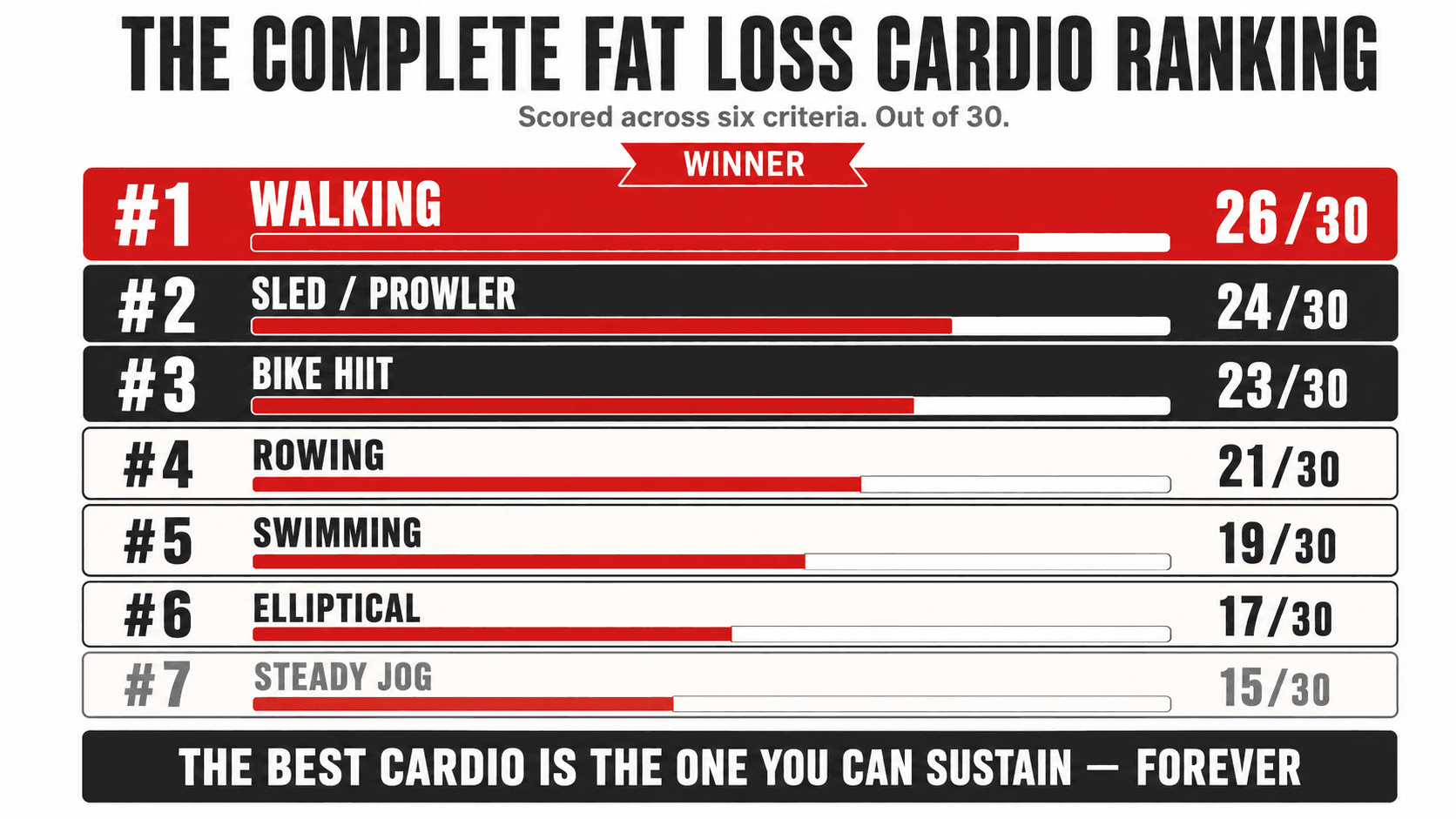
Here is the full breakdown of every cardio workout scored across all six criteria. Each category is scored out of five, giving a maximum possible total of 30.
| Rank | Workout | Fat Loss | Muscle | EPOC | Recovery | Practical | Sustain | TOTAL |
|---|---|---|---|---|---|---|---|---|
| #1 | Walking | 4 | 5 | 1 | 5 | 5 | 5 | 25 |
| #2 | Sled / Prowler | 5 | 5 | 5 | 4 | 3 | 4 | 26 |
| #3 | Bike HIIT | 5 | 4 | 5 | 4 | 4 | 4 | 26 |
| #4 | Rowing | 4 | 4 | 4 | 4 | 4 | 4 | 24 |
| #5 | Swimming | 4 | 4 | 3 | 5 | 3 | 4 | 23 |
| #6 | Elliptical | 3 | 3 | 2 | 4 | 4 | 4 | 20 |
| #7 | Steady Jog | 3 | 2 | 2 | 3 | 4 | 3 | 17 |
You will notice that the sled and bike HIIT actually scored the same total of 26. The sled takes second place because its lower practicality score (not every gym has one) makes it less universally applicable, even though its raw fat loss and muscle preservation scores are the highest on the list. Walking wins overall because of its unmatched scores in recovery, practicality and sustainability, the factors that determine long term success.
How I Combine These in a Real Fat Loss Programme
In practice, I never use just one form of cardio with my clients. I combine them strategically based on the individual's training phase, recovery capacity, and lifestyle. Here is a typical structure that I use for clients in an active fat loss phase.
| A SAMPLE WEEKLY CARDIO STRUCTURE FOR FAT LOSS | |
|---|---|
| Daily | Walking: 10,000+ steps per day. Non-negotiable. This is the foundation of your energy expenditure. |
| 2x Per Week | Bike HIIT or Sled Work: 15 to 20 minute sessions. Placed on non-leg training days for optimal recovery. |
| 1 to 2x Per Week | Rowing or Swimming: 20 to 30 minutes at a moderate to vigorous pace. Used for variety and additional calorie burn. |
| As Needed | Additional LISS walks: 30 to 45 minutes on rest days or after weight training sessions. Easy effort, recovery focused. |
This structure sits on top of three to four resistance training sessions per week. The weights are the priority. The cardio is the accelerator. Get this relationship the right way around and everything falls into place.
A Quick Word on Nutrition
None of this matters if your nutrition is not right. I say this in every article because it is that important. You cannot out-train a bad diet. Cardio creates a calorie deficit, but if you then eat that deficit back, you have gained nothing but fatigue.
For fat loss, you need a moderate calorie deficit, adequate protein of 1.6 to 2.2 grams per kilogram of bodyweight per day (8), and consistency. As a lifelong vegetarian myself, I know first hand that you can hit these targets on any dietary preference. Tofu, tempeh, seitan, lentils, chickpeas, soy protein, pea protein isolate, Greek yoghurt or plant based alternatives, eggs and mock meats are all excellent protein sources. For omnivores, lean meats, fish and dairy make it even simpler. The point is not what you eat. It is whether your overall intake supports your goals.
Top Tip
Do not use cardio to “earn” food. Eat according to your plan. Use cardio to widen the deficit or improve your health. This mindset shift changes everything.
The Bottom Line
The best cardio workout for burning fat is not the one that sounds the hardest or looks the most impressive. It is the one that fits your life, supports your resistance training, preserves your muscle, and can be done consistently over months and years. For most people, that means walking more, adding two to three short HIIT sessions per week on a bike or sled, and stopping the endless jogs that drain your energy without changing your body.
I work one-to-one with clients online globally. Whether you are a complete beginner trying to lose your first stone or an experienced trainee chasing single digit body fat, I build bespoke programmes that combine resistance training, strategic cardio, and evidence based nutrition. I coach people of every dietary background: meat eaters, vegetarians, vegans, and everything in between. I have worked with clients managing Type 2 diabetes, hypertension, PCOS, and post-menopause. Every programme is designed around your life, your goals, and your body.
If you want to stop guessing and start seeing real, measurable, lasting results, get in touch through trperformancecoaching.com and let me build the programme that actually works for you.
Work with Me
Get a personalised coaching plan built around your goals, your schedule, and your life.
Enquire NowReferences
- Hackney AC. Stress and the neuroendocrine system: the role of exercise as a stressor and modifier of stress. Expert Review of Endocrinology and Metabolism. 2006;1(6):783-792.
- Campbell BI, et al. Comparison of concurrent, resistance, or aerobic training on body fat loss: a systematic review and meta-analysis. Journal of the International Society of Sports Nutrition. 2025;22(1):2507949.
- King JA, Wasse LK, Broom DR, Stensel DJ. Influence of brisk walking on appetite, energy intake, and plasma acylated ghrelin. Medicine and Science in Sports and Exercise. 2010;42(3):485-492.
- Tsai YW, Hsu CC, Li TH, Chen MJ, et al. Efficacy of Interval Training in Improving Body Composition and Adiposity in Apparently Healthy Adults: An Umbrella Review with Meta-Analysis. Sports Medicine. 2024;54(10):2587-2608.
- Proske U, Morgan DL. Muscle damage from eccentric exercise: mechanism, mechanical signs, adaptation and clinical applications. Journal of Physiology. 2001;537(Pt 2):333-345.
- Sabag A, Najafi A, Michael S, Esgin T, Halaki M, Hackett D. The compatibility of concurrent high intensity interval training and resistance training for muscular strength and hypertrophy: a systematic review and meta-analysis. Journal of Sports Sciences. 2018;36(21):2472-2483.
- Levine JA. Nonexercise activity thermogenesis (NEAT): environment and biology. American Journal of Physiology: Endocrinology and Metabolism. 2004;286(5):E675-E685.
- Jager R, Kerksick CM, Campbell BI, et al. International Society of Sports Nutrition Position Stand: protein and exercise. Journal of the International Society of Sports Nutrition. 2017;14:20.