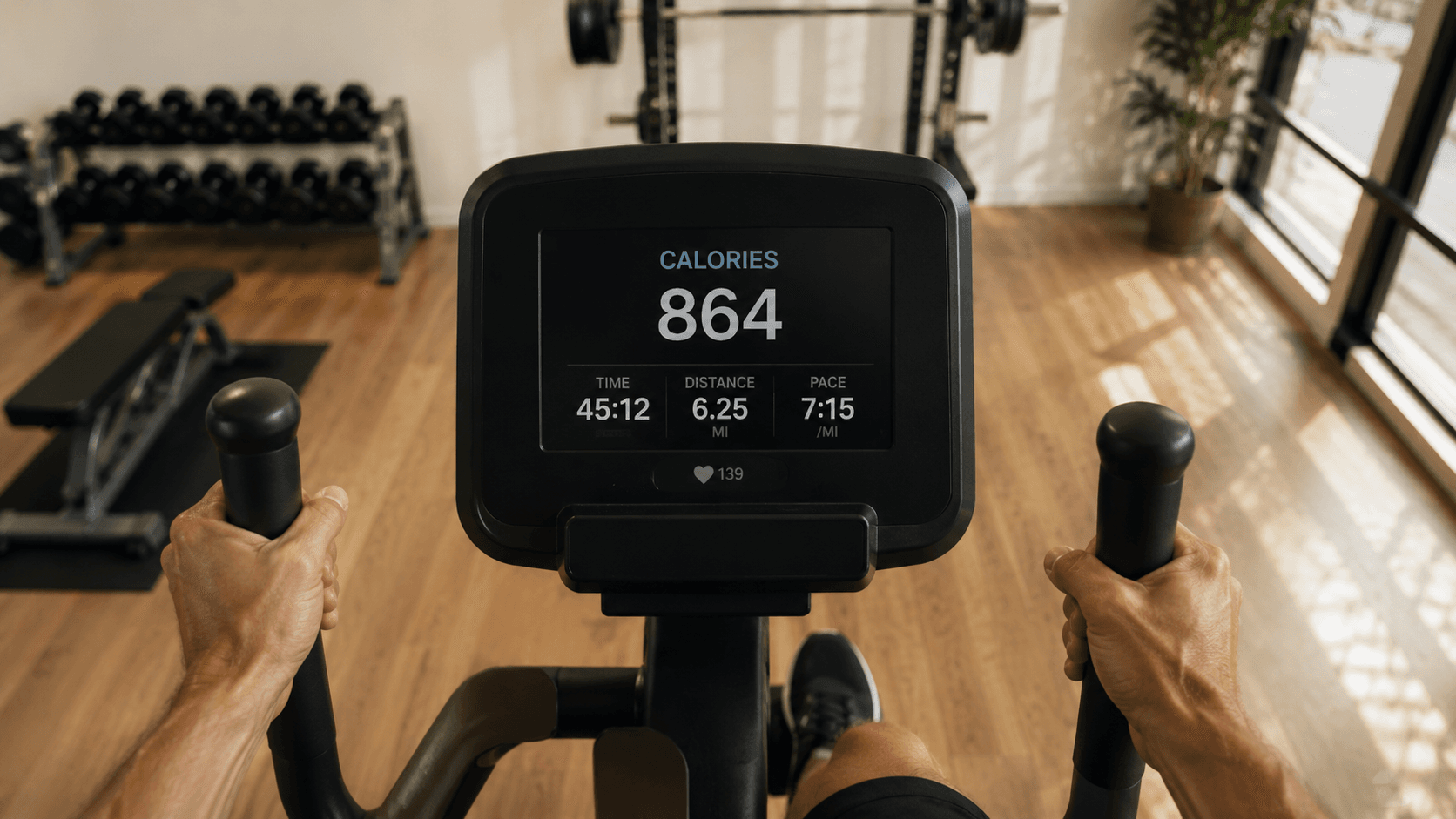
You finish 45 minutes on the treadmill, look down at the screen, and it tells you that you have burned 600 calories. You feel good. You feel like you have earned something. Maybe a bigger dinner, maybe a dessert, maybe the right to skip watching what you eat for the rest of the day. Except the machine is lying to you. Not slightly. Not by a small margin. It is overestimating your calorie burn by anywhere from 20 to 42 percent depending on which machine you are using (1). That 600 calorie number could be 350 in reality. And the decisions you make based on that inflated number are the very thing preventing you from losing fat.
People who are doing all the right things, showing up consistently, working hard, eating what they believe is the correct amount, but not making progress because their entire calorie equation is built on a number that was never accurate in the first place. If you have ever felt like you should be further along than you are despite doing regular cardio, this article will explain exactly why and what to do instead.
The Scale of the Problem
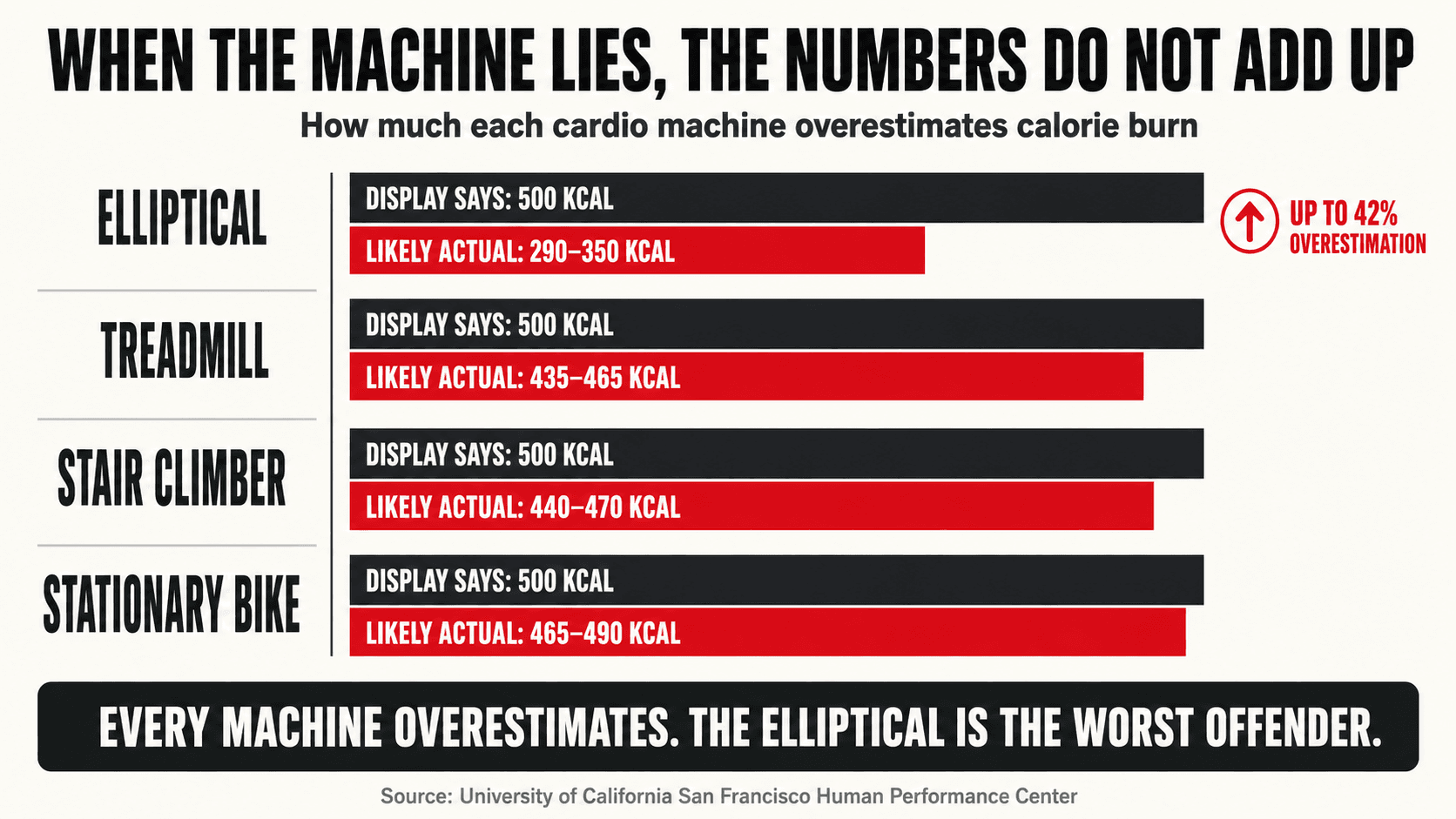
Research conducted at the University of California San Francisco Human Performance Center tested four types of cardio machine against indirect calorimetry, which is the gold standard method for measuring actual calorie expenditure. Every single machine overestimated. The elliptical was the worst offender at 42 percent over. Treadmills overestimated by 13 percent. Stair climbers by 12 percent. Even the stationary bike, which was the most accurate of the four, still overestimated by 7 percent (1). Professor John Porcari, who writes calorie burn equations for exercise equipment manufacturers, has stated that machines can be off by as much as 20 to 30 percent in either direction (2).
| Machine | Average Overestimation | If Display Says 500 kcal | Likely Actual Burn |
|---|---|---|---|
| Elliptical | Up to 42% | 500 kcal displayed | 290 to 350 kcal |
| Treadmill | Up to 13% | 500 kcal displayed | 435 to 465 kcal |
| Stair Climber | Up to 12% | 500 kcal displayed | 440 to 470 kcal |
| Stationary Bike | Up to 7% | 500 kcal displayed | 465 to 490 kcal |
The reasons are straightforward. Most machines use generic algorithms based on limited inputs, typically just your age and weight. They cannot account for your body composition, your fitness level, your movement efficiency, or whether you are leaning on the handles, which most people do. A deconditioned 85kg person with 30 percent body fat and a lean 85kg person with 15 percent body fat will burn dramatically different amounts of energy doing the same workout, but the machine will display the same number for both of them.
Top Tip
Never use the calorie number on a cardio machine to decide what or how much to eat. The number is unreliable and basing your nutrition on it will undermine your progress.
The Calorie Reward Trap
The inflated number on the screen does more than just misinform you. It actively changes your behaviour in ways that sabotage fat loss. Research has demonstrated that when people are told they have burned more calories during exercise, they eat more food afterwards, and specifically more energy dense, less nutritious food (3). In one study, participants who were told they had burned 265 calories consumed significantly more cookies and snacks than participants told they had burned 50 calories, even though both groups had burned exactly the same amount of energy. The belief that they had worked harder gave them psychological permission to eat more.
This is what I call the calorie reward trap. You see a big number on the screen, you feel you have earned extra food, and the extra food you consume exceeds the actual calories you burned by a significant margin. A 2010 study published in the Journal of Sports Medicine and Physical Fitness found that normal weight individuals overestimated their exercise energy expenditure by three to four times the actual amount. When asked to eat the caloric equivalent of what they had burned, their food intake was two to three times greater than their real expenditure (4). This means you could go for a 45 minute run, burn 300 actual calories, believe you burned 600, eat 500 calories of extra food as a reward, and end the day in a 200 calorie surplus instead of a 300 calorie deficit. Over a week that is a 3,500 calorie swing. Over a month it is 14,000 calories. That is the difference between losing a kilogram of fat and gaining one.
| THE MYTH | THE REALITY |
|---|---|
| I burned 600 calories on the treadmill so I can afford a bigger meal tonight. I have earned it. | You probably burned 350 to 450 real calories. If you eat an extra 500 calories based on the display number, you end the day in surplus, not deficit. |
What Actually Drives Fat Loss: Understanding Your Total Daily Energy Expenditure
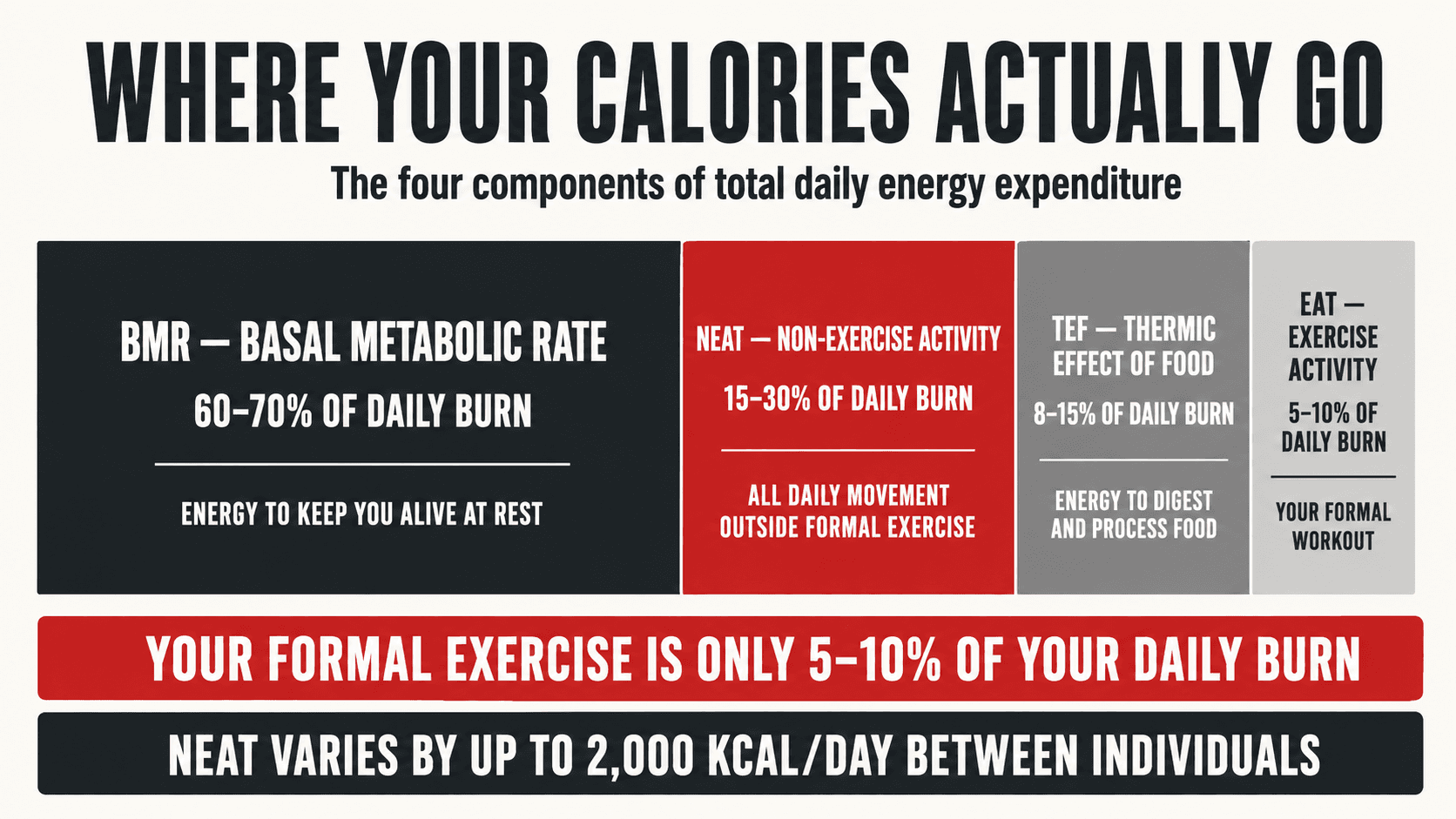
Most people dramatically overvalue their gym cardio session and dramatically undervalue everything else they do during the day. To understand why, you need to understand the four components of your total daily energy expenditure (TDEE).
| THE FOUR COMPONENTS OF TOTAL DAILY ENERGY EXPENDITURE | |
|---|---|
| BMR (60 to 70%) | Basal Metabolic Rate: the energy your body burns at complete rest to keep you alive. Breathing, circulation, cell repair, brain function. This is by far the largest component. |
| NEAT (15 to 30%) | Non-Exercise Activity Thermogenesis: the energy burned through all daily movement that is not formal exercise. Walking, standing, fidgeting, taking the stairs, housework, commuting, carrying shopping bags. |
| TEF (8 to 15%) | Thermic Effect of Food: the energy cost of digesting and processing the food you eat. Protein has the highest thermic effect at 20 to 30% of its calorie content. |
| EAT (5 to 10%) | Exercise Activity Thermogenesis: the energy burned during formal exercise sessions. Your gym workout, your run, your spin class. This is the smallest variable component. |
Read that last line again. Your formal exercise, the thing you put all your energy and attention into, accounts for only 5 to 10 percent of your total daily energy expenditure. Meanwhile, NEAT, the movement you do outside the gym, accounts for 15 to 30 percent and can vary between individuals by up to 2,000 calories per day (5). That is not a typo. Two people of similar size can differ in their daily non-exercise calorie expenditure by up to 2,000 calories based on how much they stand, walk, fidget, and move throughout their day.
Up to 2,000 kcal per day
The difference in NEAT between a highly active and a sedentary person of similar size (Levine 2002)
This is why I tell every single client: your cardio session matters far less than your daily step count. If you drive to the gym, sit on a bike for 30 minutes, drive home, and then sit for the rest of the day, you have barely moved the needle. If instead you walk 10,000 to 12,000 steps throughout the day, take the stairs, stand while you work, carry your shopping, and generally live an active life, your total energy expenditure will be vastly higher than any single gym cardio session could provide.
Top Tip
Your daily step count is a far more reliable and powerful fat loss tool than any cardio machine. It burns more total calories, is easier to sustain, does not require recovery, and cannot be overestimated by a screen.
What to Do Instead: The Seven Rules That Actually Work
Rule 1: Stop Eating Based on What the Machine Says
Your nutrition should be based on your calorie and protein targets for the day, set according to your body weight, your goal, and your activity level as a whole. Not adjusted meal by meal based on a number from a screen that could be off by 42 percent. Set your targets, eat to your targets, and let the exercise contribute to your overall deficit without trying to account for it in real time.
Rule 2: Prioritise Daily Steps Over Gym Cardio
A non-negotiable 10,000 steps per day will burn more total calories over the course of a week than three or four treadmill sessions. It elevates your NEAT, it does not require recovery time, it does not increase cortisol, and it does not compete with your resistance training. Walk to work, walk at lunch, walk after dinner, take the stairs, get off the bus one stop early. Make movement a feature of your life, not just something you do in the gym.

Rule 3: Resistance Training Before Cardio, Always
If your goal is fat loss and body composition change, resistance training must be the foundation. Resistance training preserves and builds lean muscle during a calorie deficit, increases your basal metabolic rate, and produces a significant EPOC effect (6). A 2022 meta-analysis in Obesity Reviews confirmed that resistance training was essential for preserving lean mass during calorie restriction, directly supporting long term fat loss outcomes (7). Cardio is the supplement, not the main course.

Rule 4: Choose Cardio That Preserves Muscle
If you are going to do dedicated cardio sessions, choose modalities that are lower impact and less catabolic. Walking at an incline, cycling, rowing, and the assault bike are all superior to prolonged running for fat loss because they produce less muscle damage and less interference with resistance training recovery. Heavy running during a calorie deficit is one of the fastest ways to lose muscle alongside fat.
Rule 5: Use Effort, Not Calories, as Your Measure of Intensity
Instead of chasing a calorie number on a screen, use rate of perceived exertion (RPE) or a heart rate monitor to gauge intensity. For steady state cardio, you should be able to hold a conversation but not sing. For interval work, you should be working at 8 to 9 out of 10 during work intervals. These are far more reliable indicators of whether you are training at the right intensity than any number the machine provides.
Rule 6: Eat Adequate Protein Regardless of What You Burn
Protein is the single most important macronutrient for body composition during fat loss. It preserves muscle, has the highest thermic effect of any macronutrient at 20 to 30 percent of its calorie content (8), and keeps you fuller for longer. Aim for 1.6 to 2.2 grams per kilogram of body weight per day regardless of how much cardio you do. For omnivores, that means chicken, fish, eggs, lean beef, and dairy. For vegetarians and vegans, it means tofu, tempeh, seitan, lentils, chickpeas, pea protein, soy protein, and plant based dairy alternatives. I am a lifelong vegetarian and I prioritise protein at every meal.
Rule 7: Track Trends, Not Single Sessions
The best measure of whether your approach is working is what happens to your body over weeks and months, not what a screen says after a single workout. Track your weight weekly, take measurements every two to four weeks, take progress photos monthly, and monitor how your clothes fit. If these are all moving in the right direction, your programme is working regardless of what any machine tells you.
| SEVEN RULES FOR REAL FAT LOSS | |
|---|---|
| 1 | Stop eating based on what the calorie display says. Set your nutrition targets independently. |
| 2 | Prioritise 10,000+ daily steps over dedicated cardio sessions. |
| 3 | Put resistance training at the centre of your programme. Cardio supports it, not the other way around. |
| 4 | Choose muscle-sparing cardio: incline walking, cycling, rowing, assault bike. |
| 5 | Use RPE or heart rate, not calories, as your measure of intensity. |
| 6 | Eat 1.6 to 2.2g protein per kg bodyweight daily. Omnivore, vegetarian, or vegan, no excuses. |
| 7 | Track body trends over weeks and months. Ignore single session numbers. |
A Sample Week That Gets Results
| SAMPLE FAT LOSS WEEK | |
|---|---|
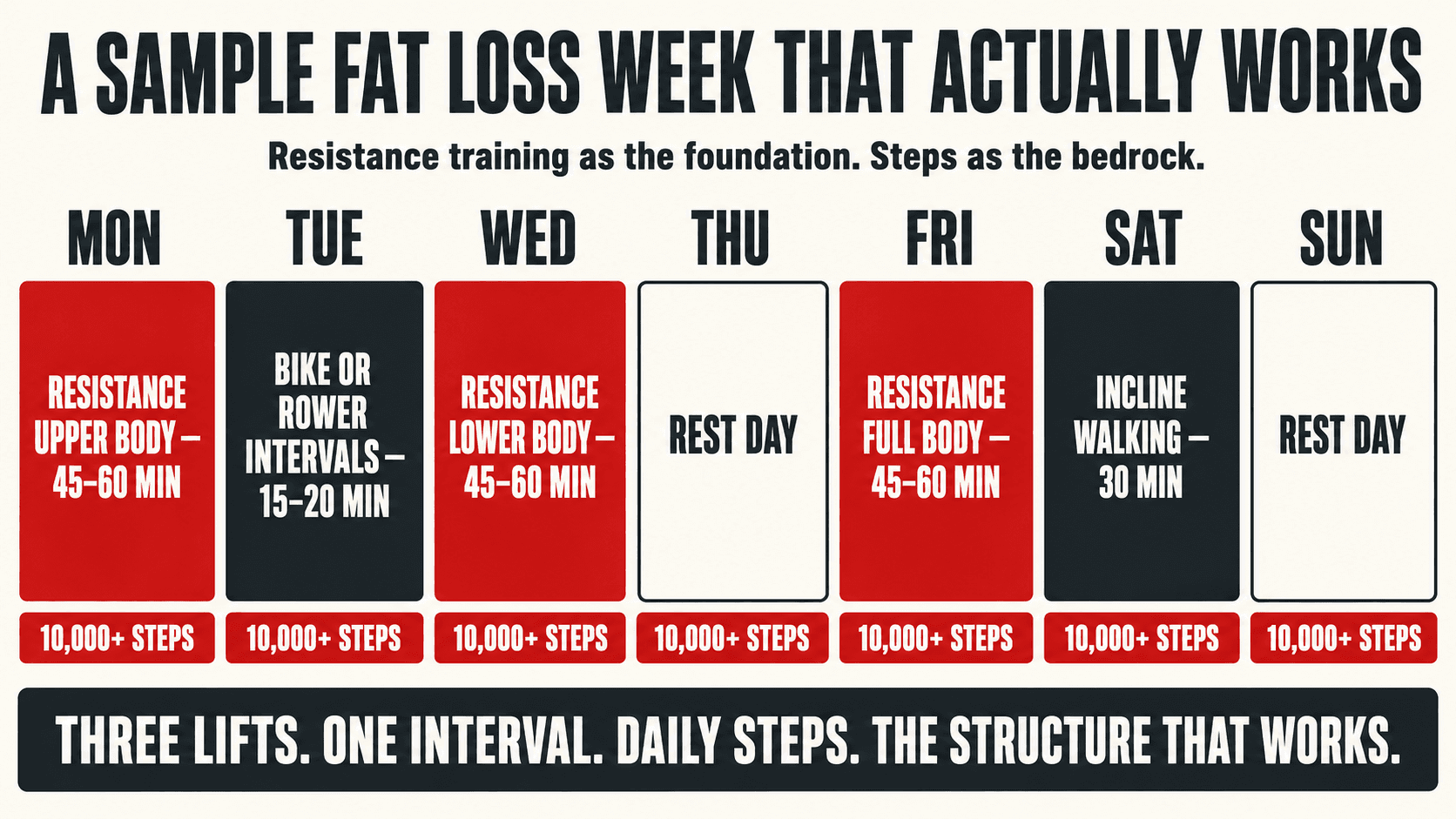
| MONDAY | Resistance training: upper body (45 to 60 min). 10,000+ steps. |
| TUESDAY | Assault bike or rowing intervals (15 to 20 min). 10,000+ steps. |
| WEDNESDAY | Resistance training: lower body (45 to 60 min). 10,000+ steps. |
| THURSDAY | Rest day. Walk only. 10,000+ steps. |
| FRIDAY | Resistance training: full body or push/pull (45 to 60 min). 10,000+ steps. |
| SATURDAY | Incline walking (30 min) or active recovery. 10,000+ steps. |
| SUNDAY | Rest day. Walk only. 10,000+ steps. |
Notice what is not in this plan. There is no 60 minute treadmill jog five times per week. There is no obsessing over calorie displays. There are three resistance sessions to build and preserve muscle, one to two short conditioning sessions for cardiovascular health and EPOC, a minimum of 10,000 steps every single day as the bedrock of daily energy expenditure, and two proper rest days. This structure, combined with a moderate calorie deficit and adequate protein, produces consistent and sustainable fat loss. It is the framework I use with every client I coach, adapted to their specific health conditions, training level, and dietary preferences.
The Bottom Line
The calorie number on your cardio machine is one of the least reliable pieces of information in any gym. It overestimates your burn, encourages you to overeat, distracts you from the things that actually drive fat loss, and creates a false sense of progress that keeps you stuck. The real drivers of fat loss are your daily calorie deficit, your protein intake, your resistance training, and your NEAT. Get those right and fat loss becomes straightforward. Ignore them in favour of chasing a number on a screen and you will spend months going nowhere.
I coach clients one-to-one online globally. Whether you are a meat eater, vegetarian, vegan, or anything in between. Whether you are managing diabetes, hypertension, PCOS, menopause, or you simply want to transform the way you look and feel. I build evidence based training and nutrition programmes that work in your real life, not in theory. If you are ready to stop guessing and start seeing results, get in touch through trperformancecoaching.com.
Work with Me
Get a personalised coaching plan built around your goals, your schedule, and your life.
Enquire NowReferences
- UCSF Human Performance Center. Accuracy of calorie counters on cardio exercise equipment. Reported by Good Morning America, 2010. Findings: elliptical overestimated by 42%, treadmill by 13%, stair climber by 12%, stationary bike by 7%.
- Porcari JP. Calorie expenditure estimation accuracy of cardiovascular exercise equipment. Exercise and Sport Science, University of Wisconsin-La Crosse. As cited in Center for Science in the Public Interest, 2024.
- McCaig DC, Hawkins LA, Rogers PJ. Licence to eat: information on energy expended during exercise affects subsequent energy intake. Appetite. 2016;107:323-329.
- Willbond SM, Laviolette MA, Duval K, Doucet E. Normal weight men and women overestimate exercise energy expenditure. Journal of Sports Medicine and Physical Fitness. 2010;50(4):377-384.
- Levine JA. Non-exercise activity thermogenesis (NEAT). Best Practice and Research Clinical Endocrinology and Metabolism. 2002;16(4):679-702.
- LaForgia J, Withers RT, Gore CJ. Effects of exercise intensity and duration on the excess post-exercise oxygen consumption. Journal of Sports Sciences. 2006;24(12):1247-1264.
- Lopez P, Taaffe DR, Galvao DA, Newton RU, et al. Resistance training effectiveness on body composition and body weight outcomes in individuals with overweight and obesity across the lifespan: A systematic review and meta-analysis. Obesity Reviews. 2022;23(5):e13428.
- Westerterp KR. Diet induced thermogenesis. Nutrition and Metabolism. 2004;1(1):5.
- Villablanca PA, Jarber JR, Sishi MN, et al. Nonexercise activity thermogenesis in obesity management. Mayo Clinic Proceedings. 2015;90(4):509-519.
- Shcherbina A, Mattsson CM, Waggott D, et al. Accuracy in wrist-worn, sensor-based measurements of heart rate and energy expenditure in a diverse cohort. Journal of Personalized Medicine. 2017;7(2):3.