
The Most Underestimated Variable in Your Health Transformation
Social contagion and health behaviour is one of the most thoroughly evidenced and most consistently overlooked determinants of whether a health programme succeeds or fails. The fitness industry focuses overwhelmingly on the individual: the individual’s programme, the individual’s nutrition, the individual’s mindset, the individual’s discipline. What it rarely addresses with the seriousness the evidence demands is the social environment that surrounds that individual and whose influence on their behaviour, beliefs, and sense of what is normal is measurably more powerful than any programme variable.
Jim Rohn’s observation that you are the average of the five people you spend the most time with is not a motivational aphorism. It is a summary of a social psychology literature that has grown substantially in the decades since Rohn popularised the idea. The people you spend the most time with are not simply witnesses to your health behaviour. They are active determinants of it, through mechanisms that operate at levels of influence ranging from the immediately conscious to the entirely automatic and invisible (1).
Nicholas Christakis and James Fowler’s landmark research on social networks and health behaviour demonstrated this with data that was startling in its specificity. Analysing the social networks of more than twelve thousand people across thirty-two years of data from the Framingham Heart Study, they found that obesity spread through social networks in a manner that closely resembled the spread of an infectious disease. A person’s risk of becoming obese increased by 57% if a close friend became obese, 40% if a sibling became obese, and 37% if a spouse became obese. The effect persisted across three degrees of social separation. The person you do not know, who is a friend of a friend of a friend, has a statistically measurable influence on your body weight (2).
“You are the average of the five people you spend the most time with.”
— Jim Rohn
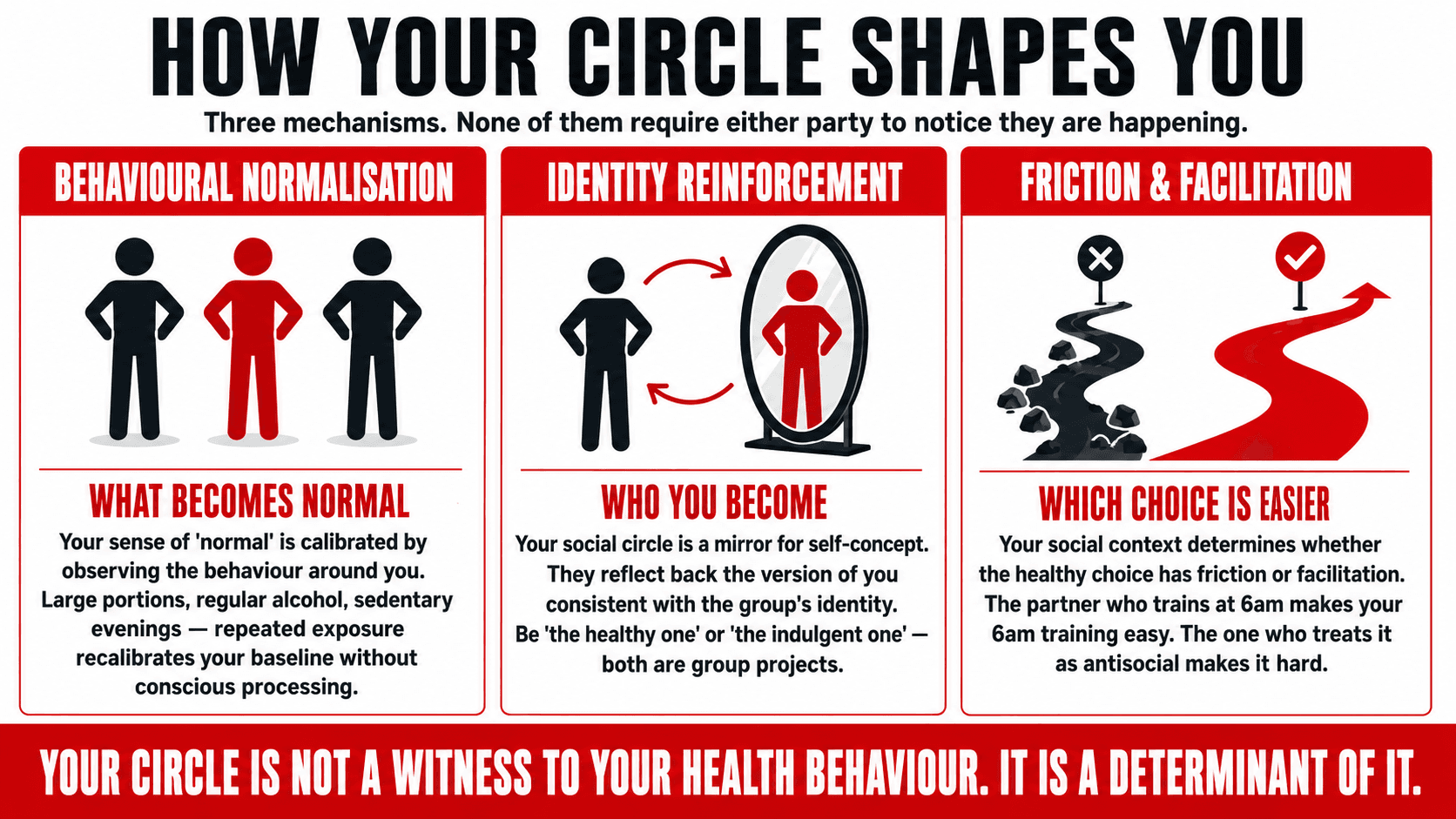
The Three Mechanisms: How the People Around You Change Your Health Without Either Party Noticing
The social contagion effect does not operate through a single mechanism. It operates through at least three distinct pathways, each of which is worth understanding because each requires a different response from the person who wants to manage the social influence on their health.
The first mechanism is behavioural normalisation. Human beings are social animals whose sense of what is normal, appropriate, and acceptable is calibrated primarily by observing the behaviour of the people around them. When the people in a person’s immediate social environment eat large portions, drink alcohol regularly, spend evenings sedentary, and treat exercise as an unusual or effortful choice, that pattern gradually becomes the person’s own baseline of normal. The recalibration does not require conscious processing. It occurs through repeated exposure, in precisely the same way that spending extended time in any cultural or subcultural environment gradually shifts what feels natural, expected, and unremarkable. The person who moves from a social environment where exercise is normal to one where it is unusual does not need to be told that exercise is unimportant. They absorb that message through behavioural observation (2).
The second mechanism is identity reinforcement. The social circle is a powerful mirror for self-concept. The people around you reflect back a version of who you are, and the version they reflect is the version that is consistent with the identity of the group. A person who is, within their primary social group, considered the healthy one, the fit one, or the one who takes care of themselves receives repeated social confirmation of that identity, which reinforces the behaviours consistent with it. A person who is considered the indulgent one, the one who never exercises, or the one who always has seconds receives an equally powerful social confirmation that works in the opposite direction. Social identity is not simply a personal psychological construct. It is a group project.
The third mechanism is practical friction and facilitation. The people you spend the most time with determine the contexts in which your health decisions are made. A social circle centred on sedentary leisure, alcohol, and large shared meals creates practical friction against healthy choices and practical facilitation of unhealthy ones. A social circle centred on active leisure, healthy shared meals, and mutual health investment creates the inverse friction pattern. The person who wants to train in the morning finds it significantly easier when their partner does the same than when their partner treats 6am training as an antisocial imposition. The practical dimension of social influence is not subtle. It shows up in every shared meal, every evening, and every weekend.
Key Insight: For one week, keep an honest log of the health-relevant social influences you encounter in your closest relationships. What do shared meals look like? What do social evenings produce in terms of food, alcohol, and physical activity? What language does your immediate social circle use about health, fitness, and the body? What is treated as normal, impressive, or excessive? The log will reveal the invisible baseline your social environment has set for you more accurately than any introspective exercise.
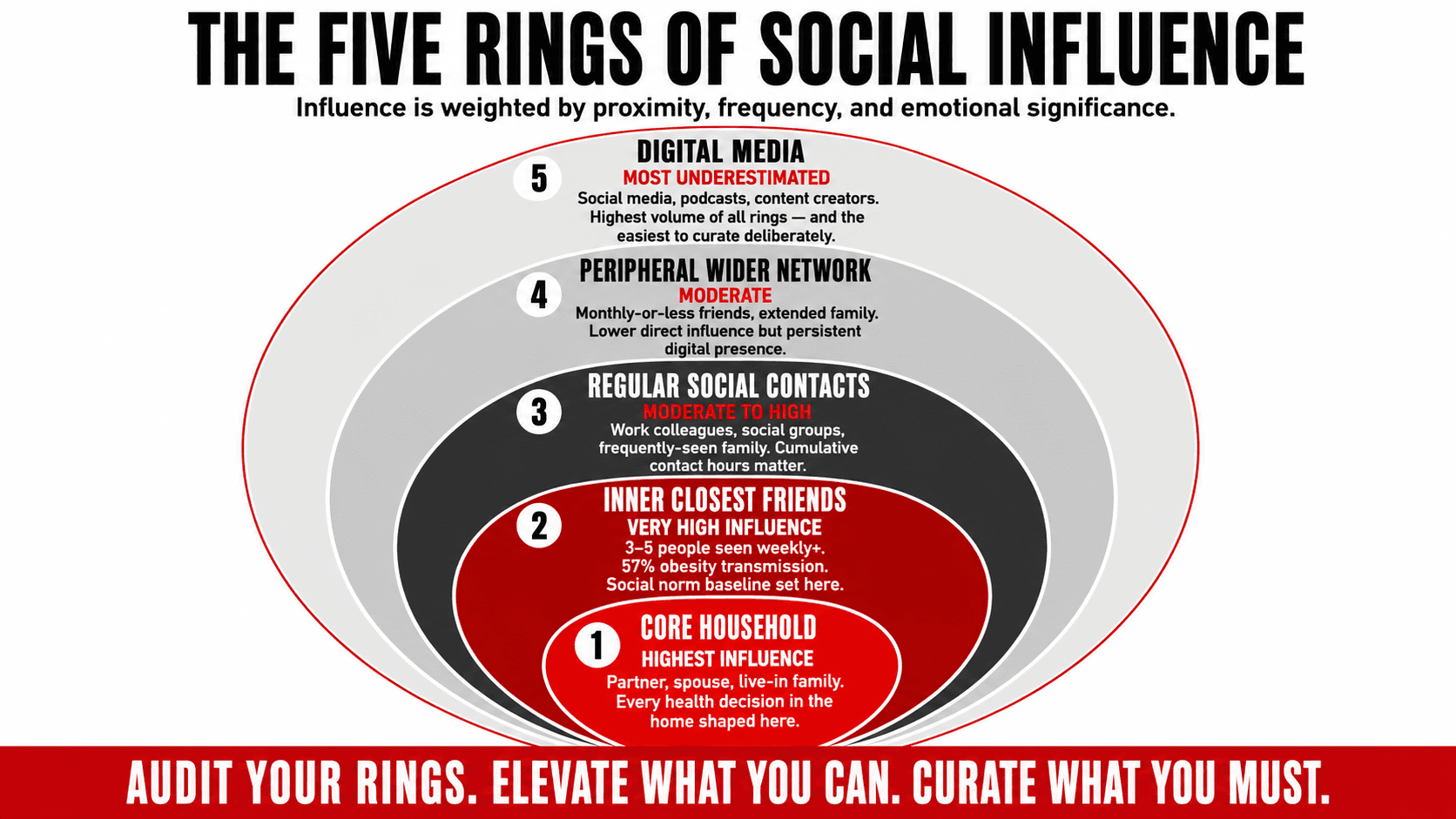
The Five Rings of Social Influence: Mapping the Network That Is Shaping Your Health
Social influence does not arrive uniformly from all relationships. It is weighted by proximity, frequency of contact, and emotional significance. The concentric rings model below maps the five levels of social influence from innermost and most powerful to outermost and most diffuse, with the mechanism of influence and the health impact at each level.
| Ring | Who | Mechanism of Influence | Health Impact |
|---|---|---|---|
| Ring 1 CORE HOUSEHOLD | Partner, spouse, live-in family. Daily physical proximity. Shared meals, shared evenings, shared environments. | The most powerful ring. Shared meals mean their nutritional defaults become yours. Their sleep schedule affects yours. Their relationship with exercise defines the household norm for physical activity. | Highest. Every health decision made in the home is shaped by this ring. |
| Ring 2 INNER CLOSEST FRIENDS | The three to five people you see weekly or more, speak to regularly, whose opinions carry significant personal weight. | 57% obesity transmission rate in Christakis and Fowler’s research. Identity mirror effect strongest here. Social permission for behaviours set at this level. Their definition of a good evening defines yours. | Very high. The social norm baseline is established here. |
| Ring 3 REGULAR SOCIAL CONTACTS | Work colleagues you interact with daily, social group members, family seen frequently. Significant cumulative contact hours. | Workplace food culture, social eating norms, and the language used about health and bodies in regular conversation all operate here. Peer pressure and social facilitation of specific behaviours. | Moderate to high. Cumulative contact hours make this ring significant. |
| Ring 4 PERIPHERAL WIDER NETWORK | Friends seen monthly or less, extended family, acquaintances with whom there is meaningful but infrequent contact. | Lower direct behavioural influence but significant identity comparison effect. Social media presence of this ring creates ongoing appearance and lifestyle comparison that affects self-concept. | Moderate. Lower contact frequency but persistent digital presence. |
| Ring 5 DIGITAL MEDIA AND DIGITAL ENVIRONMENT | Social media accounts followed, podcasts consumed, content creators engaged with, news media consumed regularly. | The most underestimated ring. The content consumed daily calibrates what looks normal for a body, what health behaviour is presented as standard, what aspirations are implanted. Curated deliberately, this ring can pull powerfully toward health. Curated passively, it often does the opposite. | Variable but very high volume. Easiest to curate deliberately. |
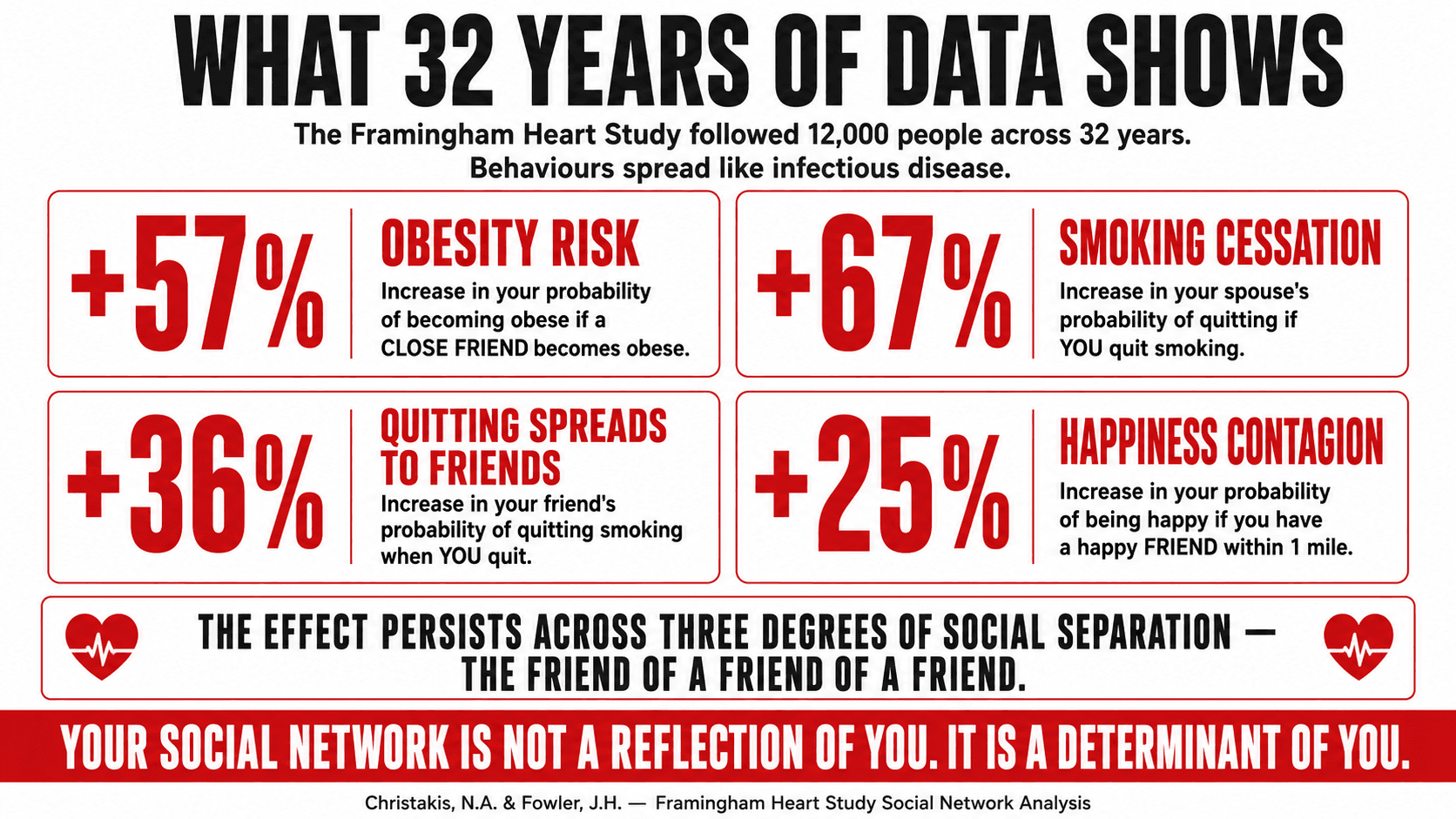
The Christakis and Fowler Data: What the Thirty-Two Years of Research Actually Shows
The Framingham Heart Study social network analysis is the most rigorous and most extensive study of social contagion effects on health behaviour ever conducted. Its findings on the spread of obesity are only part of the picture. The same research group found that smoking cessation spread through social networks: when a person quit smoking, their spouse’s probability of quitting increased by 67%, their sibling’s by 25%, and their friend’s by 36%. The behaviour change spread from the quitter through three degrees of social separation, affecting people who did not know each other and had no direct contact, purely through the cascading social influence of a single person’s decision to change (2).
Exercise habits showed similar contagion patterns. A person whose close friends engaged in regular physical activity was significantly more likely to do so themselves, beyond what could be explained by shared neighbourhood, shared gym access, or demographic matching. The social influence was demonstrably causal rather than simply correlational: when people in the network began exercising, their close contacts were more likely to begin exercising in subsequent measurement periods, even when controlling for all other variables. The most direct implication of this data for anyone pursuing a health transformation is both uncomfortable and actionable: the social network is not simply a reflection of the person. It is a determinant of them.
The happiness data from the same research extends the finding beyond health behaviour. Christakis and Fowler found that happiness itself spread through social networks in the same contagion pattern: having a happy friend who lives within a mile increases your probability of being happy by 25%. The emotional state, the sense of possibility, the default interpretation of difficulty as manageable or insurmountable, the basic level of optimism about the future, these qualities are not simply personal attributes. They are social products, shaped continuously by the emotional climate of the people most frequently encountered (3).
Key Insight: The implication of the Christakis and Fowler data is not that you should abandon relationships with people who are less healthy than you aspire to be. It is that you should be conscious about the social environment you are operating in and intentional about supplementing it with relationships that pull in the direction you are moving. You do not need to change your entire social circle. You do need to be honest about which relationships are elevating your health behaviour and which are normalising the undermining of it.
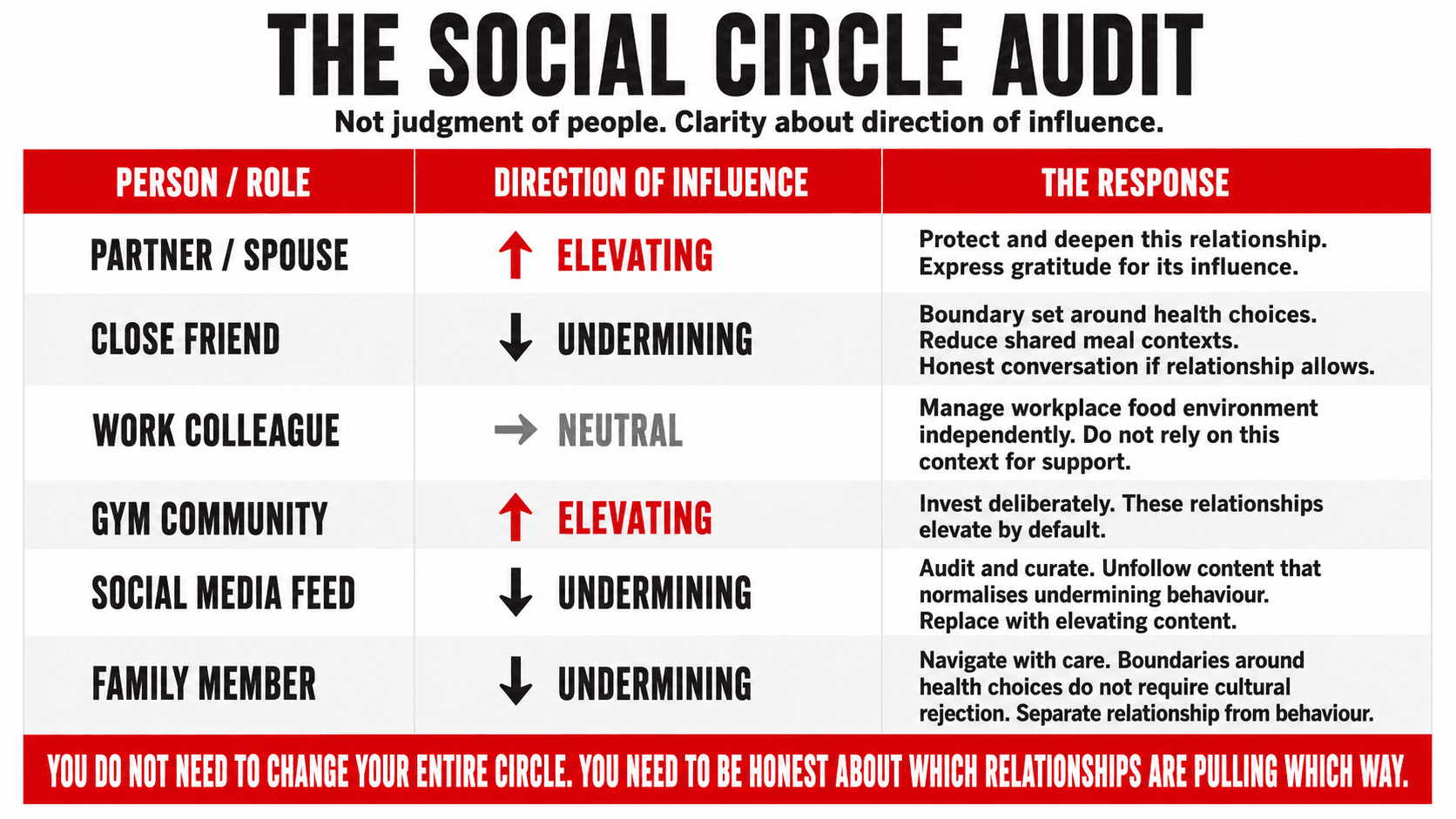
The Social Circle Audit: An Honest Mapping of Who Is Pulling With You and Who Is Pulling Against
The social circle audit is the most direct practical tool available for understanding the social determinants of your current health behaviour. It is not an exercise in judgment of the people in your life. It is an exercise in clarity about the direction of social influence so that you can manage it intelligently rather than be managed by it invisibly.
| Person / Role | Overall Influence | Impact on Your Health Behaviour | Response |
|---|---|---|---|
| Partner / spouse | Elevating — Toward | Shared healthy meals. Active leisure interests. Supportive of training schedule. Joint health investment. Reinforces the identity of being a healthy person within the household norm. | Protect and deepen this relationship. Express gratitude for its influence. |
| Close friend A | Undermining — Against | Social occasions centred on alcohol and large meals. Treats exercise as unusual. Subtle mockery of health choices in group settings. Reinforces the belief that heavy eating and regular alcohol are the normal baseline for their peer group. | Boundary setting around health choices. Reduce shared meal contexts where possible. Honest conversation if relationship allows. |
| Work colleague | Neutral | Workplace food culture centres on desk lunches and vending machine snacks. No active undermining but no support either. Treats health investment as not relevant to professional identity. | Manage workplace food environment independently. Do not rely on this context for health support. |
| Gym community | Elevating — Toward | Training partners whose presence makes the session non-negotiable. Shared investment in physical development. Mutual accountability. Normalises serious health investment. Regular exercise is the baseline here, not the exception. | Invest in this community deliberately. These relationships elevate by default. |
| Social media feed | Undermining — Against | Primarily entertainment content, sedentary lifestyle normalisation, and food content promoting quantity over quality. Calibrates expectations around body, food, and leisure in directions inconsistent with health goals. | Audit and curate. Unfollow content that normalises health-undermining behaviour. Replace with content that elevates. |
| Family member (regular) | Undermining — Against | Social gatherings centred on large meals as expressions of care and belonging. Resistance to portion or food quality changes framed as rejection. Complicates the identity shift because health investment can feel like cultural departure from family norms. | Navigate with care and respect. Boundaries around health choices do not require cultural rejection. Separate the relationship from the behaviour. |
Social Sabotage: Why the People Who Love You Most Can Be the Biggest Obstacle to Change
One of the most consistently reported experiences among people undergoing significant health transformations is the resistance they encounter not from strangers or acquaintances but from the people closest to them. Partners who become critical of new eating habits they initially claimed to support. Friends who make pointed jokes about the training schedule. Family members who interpret nutritional choices at shared meals as a personal rejection. This pattern is consistent enough and well-documented enough in the social psychology literature to have a clear explanation, and that explanation is important for anyone navigating a meaningful health transformation without the full support of their social environment.
The mechanism is change threat. When a person in a social group changes in a direction that the group has not collectively sanctioned, it creates implicit pressure on the other group members to examine their own behaviour in relation to the change. If your closest friend begins eating better, exercising consistently, and visibly improving their health, their change confronts you with the possibility that your own choices in those domains are less optimal than you have been comfortable assuming. The most common way to manage this discomfort is not to examine your own behaviour but to minimise the significance of the change, introduce friction to it, or frame it as excessive, joyless, or unsustainable. The sabotage is often not malicious. It is self-protective (4).
This is the argument for keeping significant health goals private, as discussed in Article 10 of this series. The person who announces their health transformation to their entire social circle before the identity shift has consolidated is inviting this social dynamic before they have the psychological infrastructure to manage it effectively. The person who makes the changes quietly, builds the evidence base in their own body and bloodwork, and allows the transformation to become visible through results rather than announcements is navigating the social resistance dynamic far more strategically.
Key Insight: If you are encountering social resistance to your health changes from people who are important to you, the most useful reframe is this: their resistance is almost always about their own relationship with health rather than about yours. It says nothing accurate about whether your approach is right, whether the change is sustainable, or whether the choice is worthwhile. It says something very specific about how your change is making them feel about their own choices. Respond to the relationship, not to the content of the resistance.
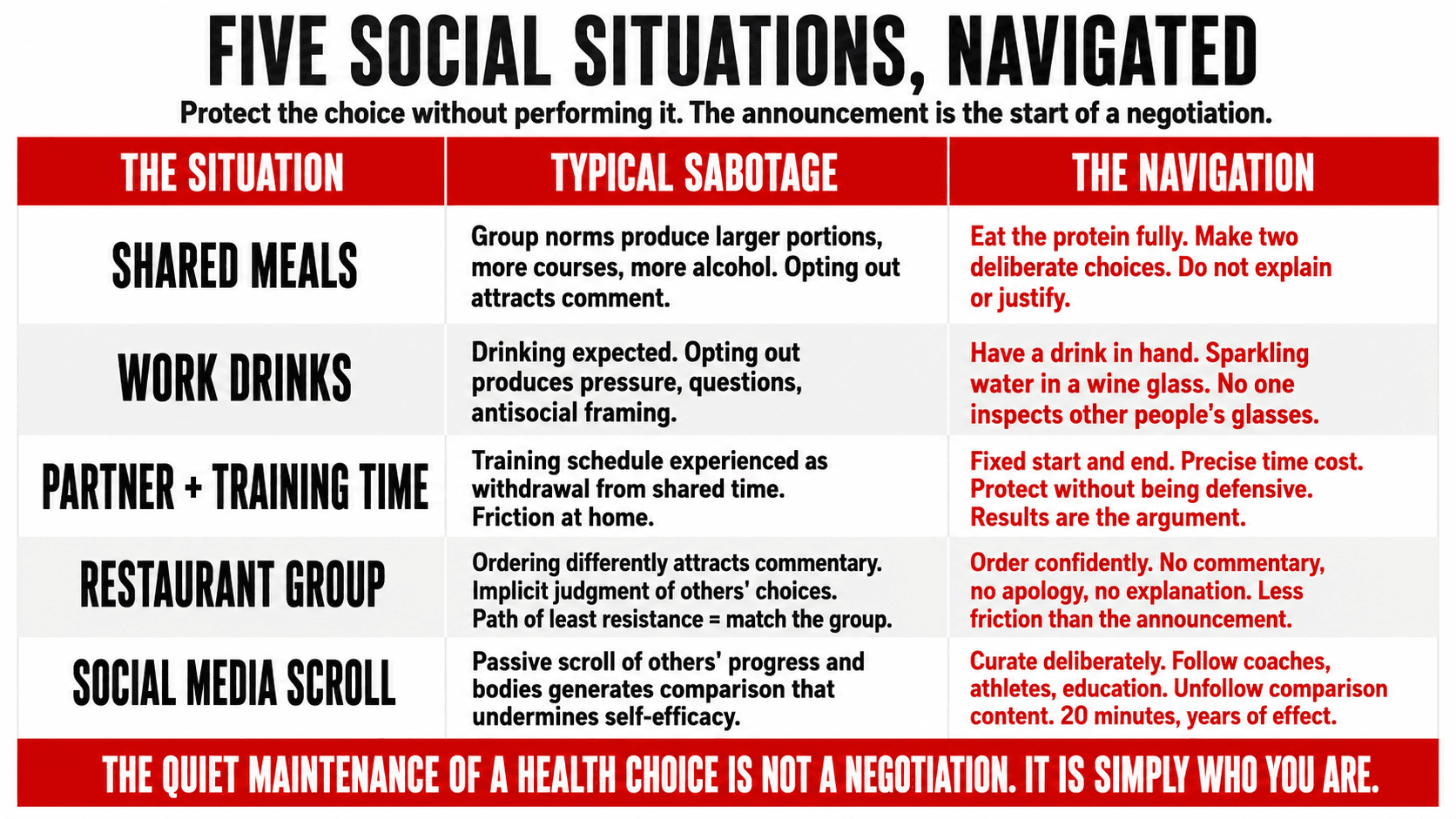
Navigating the Social Situations That Most Commonly Undermine Health Programmes
The five social situations most likely to produce health-undermining behaviour are not random. They are predictable, recurring, and navigable with advance preparation.
| Social Situation | The Sabotage Pattern | The Navigation Strategy |
|---|---|---|
| Shared meals with close friends or family | Group eating norms produce larger portions, more courses, more alcohol than the individual would choose independently. Opting out is experienced as socially disrupting and attracts comment. | Eat the protein component fully. Make two deliberate choices from what is available. Do not explain or justify choices. The person who eats differently without commentary attracts significantly less social friction than the person who announces their dietary framework. |
| Work social events centred on alcohol | Social expectation of drinking participation. Opting out or moderating produces questions, pressure, and the implicit suggestion that the person is antisocial or making a judgment about others’ drinking. | Have a drink in hand. It does not need to contain alcohol. Sparkling water in a wine glass ends the social pressure entirely. No one inspects other people’s glasses. The choice is private unless made public. |
| Partner resistance to schedule changes for training | Training sessions scheduled into morning or evening time produce friction with a partner who experiences the time investment as a withdrawal from shared time or domestic contribution. | Frame training as fixed, non-negotiable time with specific start and end points, not as an open-ended commitment that might run long. Be precise about the time cost. Protect the commitment without being defensive about it. Results that improve energy, mood, and physical capability are the argument. |
| Social peer pressure around food choices at restaurants or takeaways | Ordering differently from the group attracts commentary. The person who orders the salad when everyone else orders burgers is perceived as making an implicit judgment. The path of least resistance is to match the group. | Order confidently without commentary or explanation. You do not owe the group an explanation for what you eat. The person who orders differently without apology or announcement generates far less friction than the one who explains, justifies, or apologises for their choice. |
| Social media and the comparison environment | Passive scrolling of other people’s apparent progress, social lives, and bodies generates comparison that undermines self-efficacy and distorts the realistic timeline of health change. | Audit the social media environment with the same intentionality applied to the physical social environment. Curate deliberately. Follow accounts that provide education, genuine inspiration, or skill development relevant to your health goals. Unfollow accounts whose content produces comparison rather than elevation. |
The navigation principle across every social situation is the same: protect the health choice without performing it. The announcement of a health decision to a social group is the beginning of a negotiation. The quiet maintenance of a health choice is not a negotiation. It is simply who you are.
Elevating the Circle: How to Change Your Social Environment Without Changing Your Relationships
The response to the social contagion evidence is not to eliminate every relationship that is less than perfectly aligned with your health goals. Most relationships that matter cannot and should not be evaluated on the basis of their health influence alone. They exist for reasons that have nothing to do with exercise norms and food choices, and they provide things that health-aligned relationships alone do not.
The practical strategy is supplementation, not replacement. The person who adds a training community, a coach, a health-aligned friendship, or a social circle built around an active interest to their existing social environment does not need to subtract from that environment to benefit from the addition. The supplementary elevating relationships provide the social normalisation of health investment, the identity reinforcement of being someone for whom health is simply what you do, and the practical facilitation of healthy behaviour that may be absent from the primary social circle. The cumulative social environment shifts without requiring the dismantling of the relationships that compose it (5).
The digital environment deserves specific attention as the most easily curated and most consistently underestimated ring of social influence. The social media feed is a chosen social environment that most people assemble passively and then inhabit as though it were fixed. It is not fixed. Every account followed is a deliberate introduction of a social influence into the immediate environment. A feed that contains coaches, athletes, researchers, and people actively living the health identity the person aspires to provides a continuous low-level social normalisation of that identity. A feed dominated by sedentary entertainment and food content does the opposite. The curation takes twenty minutes. Its cumulative influence is measured in years.
Key Insight: This week, identify one relationship or community you could add to your social environment that would provide social normalisation for the health identity you are building. A training group, a running club, an online community of people pursuing similar health goals, a coaching relationship with someone who has built the health and physical capability you are moving toward. You do not need to leave any existing relationship to add this one. You need only to make the addition deliberately rather than waiting for it to happen by accident.
How the Social Environment Is Addressed in Every Programme I Build
The social environment conversation is part of every initial client assessment, because the programme I build has to be executable in the actual social life the person is living, not in an idealised version of it. A nutritional strategy that cannot survive a weekly dinner with close friends is not a sustainable strategy. A training programme that requires the household to reorganise itself around it will generate relationship friction that undermines the programme before the results arrive.
I am not designing a programme in spite of the social environment. I am designing it to navigate the social environment intelligently, because that environment is both the greatest threat to the programme’s sustainability and, if managed correctly, one of the most powerful sources of support for it. The client whose household is aligned, whose closest relationships are elevating, and whose digital environment is curated deliberately does not need more discipline than the client whose social environment is working against them. They need less. The social environment has taken over some of the work that would otherwise require conscious effort and motivation.
If the social environment around you is making your health goals harder rather than easier, that is not a personal failing. It is a structural problem with a structural solution. I work one-to-one with clients online globally. The social environment strategy is built into the programme from the first session.
Work with Me
Get a personalised coaching plan built around your goals, your schedule, and your life.
Enquire NowReferences
- Rohn J. Seven Strategies for Wealth and Happiness. New York: Crown Business; 1996.
- Christakis NA, Fowler JH. The spread of obesity in a large social network over 32 years. New England Journal of Medicine. 2007; 357(4): 370–379.
- Fowler JH, Christakis NA. Dynamic spread of happiness in a large social network: longitudinal analysis over 20 years in the Framingham Heart Study. British Medical Journal. 2008; 337: a2338.
- Leahey TM, Larose JG, Fava JL, Wing RR. Social influences are associated with BMI and weight loss intentions in young adults. Obesity. 2011; 19(6): 1157–1162.
- Wing RR, Jeffery RW. Benefits of recruiting participants with friends and increasing social support for weight loss and maintenance. Journal of Consulting and Clinical Psychology. 1999; 67(1): 132–138.
- Bandura A. Social Learning Theory. Englewood Cliffs: Prentice-Hall; 1977.
- Cialdini RB. Influence: The Psychology of Persuasion. New York: Harper Business; 2006.