
You Have Been Told the Wrong Story About Ageing
If you are over 40 and reading this, chances are you have been told some version of the same story your entire adult life. That getting older means slowing down. That aches and pains are just part of the deal. That your best years of physical fitness are behind you. I hear this from almost every new client who walks through my door, and I am going to tell you straight: it is not true. Strength training over 40 is not just possible, it is one of the most powerful things you can do for your body, your mind, and your long term health.
The reality is that from around the age of 30, your body begins to lose muscle mass at a rate of roughly 3 to 8 percent per decade, a process known as sarcopenia (1). By the time you reach your 50s and 60s, this accelerates significantly. But here is the critical part that most people never hear: this is not inevitable. The research is overwhelmingly clear that the primary driver of age related muscle loss is not ageing itself. It is inactivity (2).
What Happens If You Do Nothing
Let me be direct with you. If you are over 40 and you are not doing any form of resistance training, the consequences are serious and they compound over time. I am not saying this to frighten you. I am saying it because I have seen it happen to too many people who left it too late to act.
Muscle loss does not just mean you look less toned. It means your metabolism slows down, because muscle is metabolically active tissue. Less muscle means fewer calories burned at rest, which means fat gain becomes easier and harder to reverse (3). It means your bones weaken, because without the mechanical loading that resistance training provides, bone mineral density declines and your risk of osteoporosis increases (4). It means your joints become less stable, your posture deteriorates, and your risk of falls and fractures climbs significantly as you move into your 60s and beyond.
Beyond the physical, there is the metabolic damage. Loss of lean tissue is directly linked to increased insulin resistance, higher blood pressure, elevated blood sugar, and greater risk of developing Type 2 diabetes and cardiovascular disease (5). If you already have conditions like hypertension or pre diabetes, doing nothing will only make them worse.
I have worked with clients who came to me in their late 40s and 50s with blood pressure medication they thought they would be on for life, with blood sugar levels creeping into dangerous territory, with energy so low they could barely get through a working day. In almost every case, the root cause was the same: years of muscle loss, poor nutrition, and no structured training.
The Inactivity Spiral: How Doing Nothing Makes Everything Worse
This is a vicious cycle and it is one that most people over 40 are stuck in without realising it. The less you move, the weaker you get. The weaker you get, the harder movement feels. The harder movement feels, the less you do. Breaking this cycle is not complicated, but it does require a decision to start.
What Happens to Your Body Decade by Decade Without Strength Training
| Age Range | What Starts to Happen | Common Consequences |
|---|---|---|
| 30s | Muscle mass begins declining at 3 to 5% per decade. Metabolism starts to slow. Recovery from activity takes longer. | Gradual weight gain, especially around the midsection. Energy dips. Early signs of reduced fitness. |
| 40s | Muscle loss accelerates. Hormonal shifts begin (testosterone decline in men, perimenopause in women). Bone density starts to reduce. | Noticeable fat gain, joint stiffness, reduced strength. Risk of hypertension and pre diabetes increases. |
| 50s | Sarcopenia becomes more pronounced. Significant hormonal changes (menopause in women, continued testosterone decline in men). Insulin sensitivity drops. | Higher body fat percentage, weaker bones, increased risk of Type 2 diabetes, cardiovascular issues, and depression. |
| 60s+ | Muscle loss can reach 3% per year if untrained. Balance and coordination decline. Chronic inflammation increases. | Falls, fractures, loss of independence, chronic disease, frailty. Dramatically reduced quality of life. |
The table above is not a prediction of your future. It is a picture of what happens when nothing changes. The entire point of this article is to show you that every single one of those outcomes is preventable.
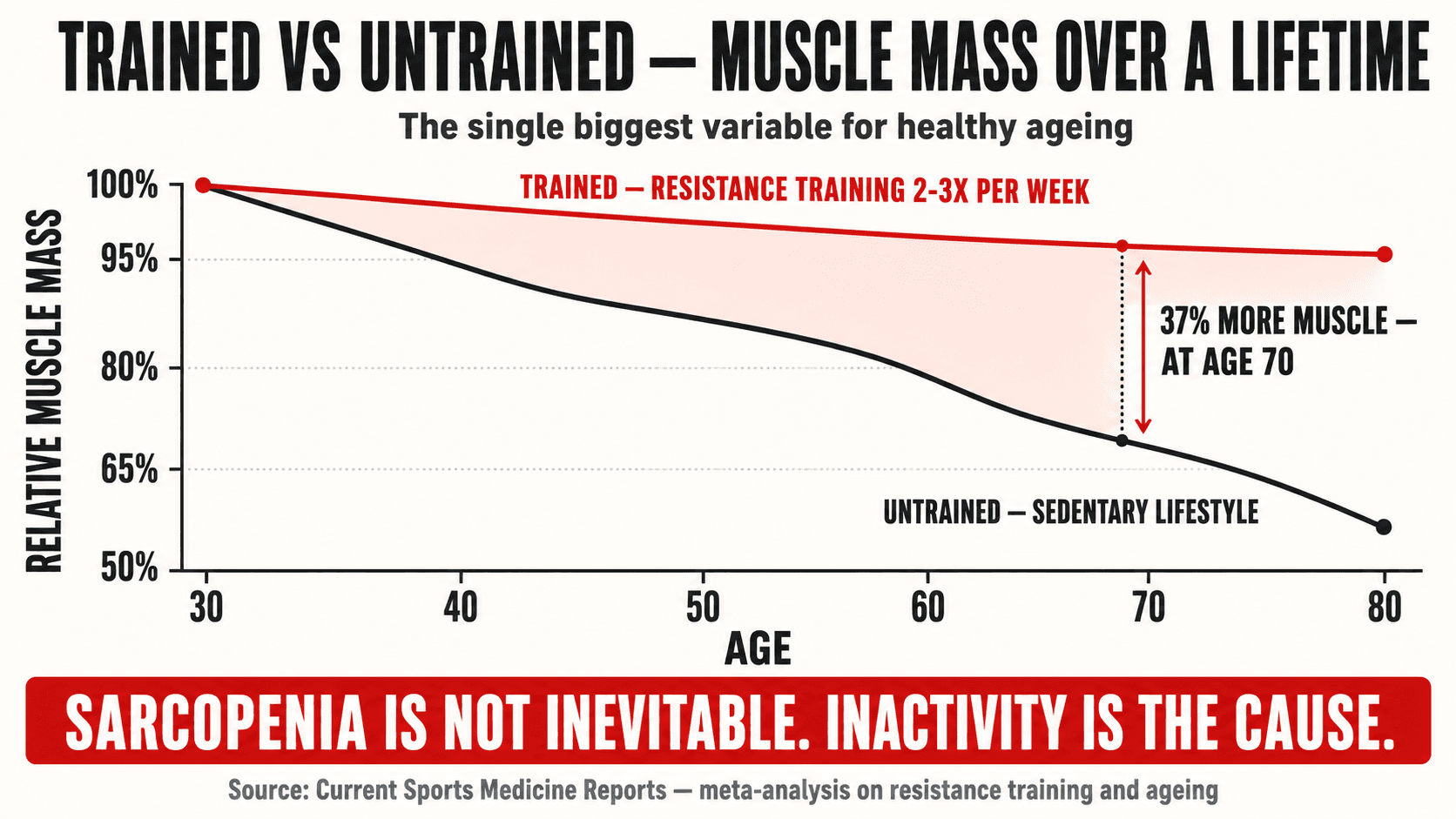
Why Strength Training Is the Single Best Investment You Can Make After 40
I am a performance coach. I have helped hundreds of clients over 40 build strength and transform their body composition. I work one-to-one with clients online globally. I have worked with clients across every age group, every fitness level, and every dietary background from meat eaters to lifelong vegetarians and vegans. And if there is one thing I would tell every single person over 40, it is this: pick up some weights and learn how to use them properly.
Resistance training is not just about looking better, although that is a welcome benefit. A landmark review published in Current Sports Medicine Reports found that consistent resistance training improves muscular strength, increases resting metabolic rate, reduces body fat, lowers blood pressure, improves blood lipid profiles, enhances insulin sensitivity, and increases bone mineral density (6). No single pill, supplement, or diet can deliver all of those outcomes simultaneously.
Top Tip
You do not need to train every day. Two to three well structured resistance training sessions per week is enough to see significant changes in your body composition, strength, and health markers.
The Results Pyramid: What Actually Matters Most
There is a hierarchy to getting results. Most people obsess over the things at the top of the pyramid, the things that matter least, while ignoring the foundations. Here is how it really works, from most important at the base to least important at the peak.
| SUPPLEMENTS |
| MEAL TIMING |
| TRAINING PROGRAMME |
| NUTRITION • SLEEP • CONSISTENCY |
Most people get this upside down. They buy supplements before they have sorted their diet. They worry about meal timing before they have trained consistently for more than two weeks. The base of the pyramid is where 80 percent of your results come from. Get your nutrition right, sleep properly, and show up consistently. Everything else is fine tuning.
How to Start Strength Training Over 40 If You Have Never Lifted Before
If you have never picked up a weight in your life, the thought of walking into a gym can feel intimidating. I understand that completely. But I want you to know that strength training is for everyone, regardless of your starting point. The key is to begin with the fundamentals and progress gradually.
In simple terms, strength training means using resistance, whether that is your own bodyweight, dumbbells, barbells, cables, or machines, to challenge your muscles. When you challenge a muscle, it adapts by getting stronger. Over time, with the right nutrition and recovery, it also grows. This process is exactly the same whether you are 25 or 65. The only difference is that as we get older, we need to be smarter about how we train.
The Five Foundational Movement Patterns
Every effective training programme is built around five basic movement patterns. Think of these as the building blocks. You do not need fancy exercises or complicated routines. You need to master these five patterns and get progressively stronger at them over time.
| Movement | What It Means | Examples | Why It Matters Over 40 |
|---|---|---|---|
| Squat | Bending at the hips and knees to lower your body, then standing back up. | Goblet squat, leg press, bodyweight squat to a box. | Keeps your legs strong for walking, stairs, and getting up from a chair. Protects your knees and hips. |
| Hinge | Bending forward from the hips while keeping your back straight, then standing tall. | Romanian deadlift, kettlebell deadlift, hip thrust. | Strengthens your lower back, glutes, and hamstrings. Prevents back pain and improves posture. |
| Push | Pressing a weight away from your body, either horizontally or overhead. | Dumbbell chest press, push ups, overhead press. | Builds upper body strength for everyday tasks. Supports shoulder health and bone density. |
| Pull | Pulling a weight towards your body. | Seated row, lat pulldown, dumbbell row. | Counteracts rounded posture from desk work. Strengthens the back and improves shoulder stability. |
| Carry / Core | Holding a weight while walking, or bracing your midsection under load. | Farmer's walk, plank, pallof press, suitcase carry. | Improves balance, grip strength, and core stability. Directly reduces fall risk. |
Top Tip
If you are brand new to training, start with machines and bodyweight movements. Machines guide the movement for you and reduce the risk of injury while you build confidence and learn proper form.

Training Principles That Matter Most After 40
Progressive Overload: The Non Negotiable Rule
Progressive overload simply means doing a little more over time. This could mean adding a small amount of weight, performing one or two extra repetitions, or increasing the range of motion. Without progressive overload, your body has no reason to adapt and you will plateau. Research consistently shows that progressive resistance training produces significant increases in muscle mass and strength in older adults, including those over 60 and 70 (7). The key is consistency and patience, not intensity from day one.
How Progressive Overload Works
| Start | Month 1 | Month 2 | Month 3 | Month 4+ |
|---|---|---|---|---|
| 25kg x 10 | 30kg x 12 | 35kg x 12 | 40kg x 12 | Continued progression… |
You do not need to add weight every session. Some weeks you add a repetition. Some weeks you improve your technique. The point is that over months and years, the direction of travel is always upward. That is how strength is built after 40.
Top Tip
Keep a training log. Write down every exercise, every weight, and every set and rep. If you are not tracking, you are guessing, and guessing does not get results.
Recovery Is Not Optional
One of the biggest mistakes I see in clients over 40 is training too hard, too often, without enough recovery. When you were 25, you could get away with poor sleep, skipped meals, and back to back training days. After 40, your body still adapts brilliantly to training, but it needs more time to do so. Sleep is where the magic happens. Growth hormone, which is essential for muscle repair and fat metabolism, is released primarily during deep sleep (8). If you are sleeping less than seven hours a night, you are limiting your results regardless of how well you train.
Top Tip
Aim for seven to nine hours of sleep per night. If you struggle with sleep, start by setting a consistent bedtime, reducing screen time in the hour before bed, and keeping your bedroom cool and dark.
The Training Cycle: How Your Body Actually Changes
Many people think results happen in the gym. They do not. The gym is where you apply the stimulus. The results happen during recovery. Here is how the cycle works.
| 1. Train | 2. Eat |
|---|---|
| Challenge your muscles with resistance. Create the stimulus for change. | Provide the raw materials. Protein repairs muscle. Carbs restore energy. |
| 4. Repeat | 3. Sleep |
| Do it again. Consistency over weeks and months is what transforms your body. | This is when your body actually builds muscle and burns fat. 7 to 9 hours minimum. |
Warm Up Properly Every Single Session
I cannot stress this enough. A proper warm up is not five minutes on the treadmill. It is a structured process that prepares your joints, muscles, and nervous system for the work ahead. A good warm up for someone over 40 should include five minutes of light cardiovascular activity to raise your heart rate, followed by dynamic stretches that take your joints through their full range of motion, and then one or two lighter sets of the first exercise in your session to prepare the specific muscles you are about to train. This reduces injury risk significantly and actually improves your performance during the session.
Nutrition for Strength Training Over 40
Training is only half the equation. Without the right nutrition, you will not build muscle, you will not recover properly, and you will not lose body fat efficiently. I coach clients across every dietary background, from meat eaters to lifelong vegetarians to strict vegans, and the principles remain the same for everyone. The specifics of what you eat will differ, but the foundations are universal.
Protein: The Most Important Nutrient for Muscle After 40
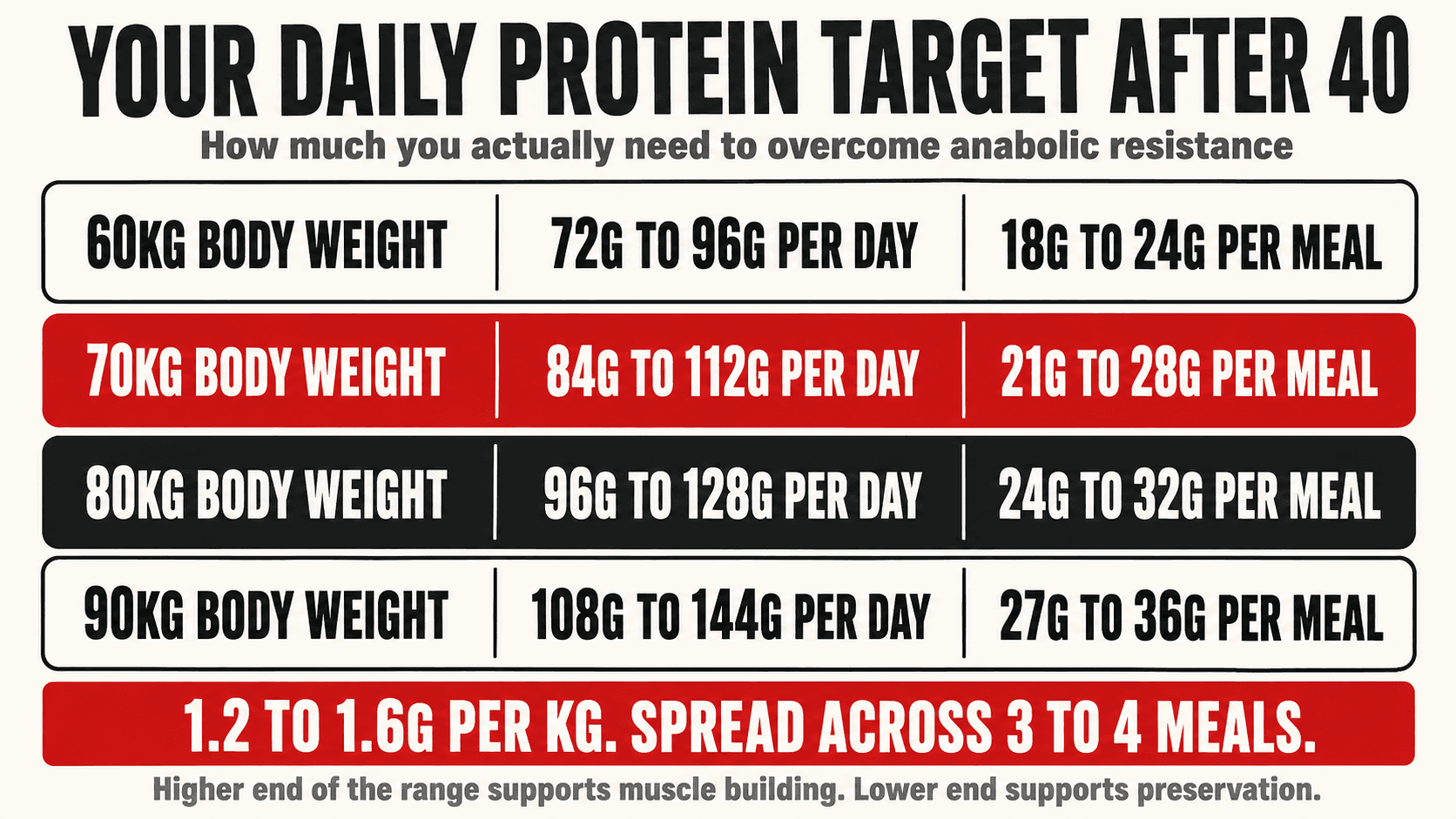
Protein is the raw material your body uses to build and repair muscle tissue. As you age, your muscles become less efficient at using protein for this purpose, a phenomenon researchers call anabolic resistance (2). What this means in practical terms is that you need more protein than a younger person to achieve the same muscle building effect. The current research suggests that adults over 40 should aim for 1.2 to 1.6 grams of protein per kilogram of bodyweight per day, spread across three to four meals (9). For a person weighing 80kg, that means roughly 96 to 128 grams of protein daily.
Anabolic Resistance: Why You Need More Protein as You Age
This diagram shows the concept in the simplest possible terms. When you eat a meal containing protein, your body uses that protein to repair and build muscle. But as you get older, your body becomes less responsive to that signal. You need a bigger dose of protein to trigger the same muscle building response that a younger person gets from a smaller dose.
| Aged 25 | Aged 45+ |
|---|---|
| 20g protein per meal / Strong muscle building response / Muscles respond quickly and efficiently | 30 to 40g protein per meal / Same muscle building response / Muscles need a stronger signal to respond |
Protein Sources at a Glance: Options for Every Dietary Background
| Omnivore Sources | Vegetarian Sources | Vegan Sources | Protein per Serving (approx) |
|---|---|---|---|
| Chicken breast (150g) | Greek yoghurt (200g) | Tofu, firm (150g) | 30 to 40g |
| Salmon fillet (150g) | Eggs, 3 large | Tempeh (150g) | 25 to 35g |
| Lean beef mince (150g) | Cottage cheese (200g) | Seitan (100g) | 25 to 35g |
| Turkey breast (150g) | Paneer (100g) | Lentils, cooked (200g) | 18 to 30g |
| Whey protein shake | Whey protein shake | Pea protein shake | 20 to 30g |
| Prawns (150g) | Soy milk (500ml) | Edamame beans (150g) | 15 to 25g |
| Tinned tuna (120g) | Lentils, cooked (200g) | Mock meats (varies) | 15 to 25g |
Top Tip
If you are vegetarian or vegan and struggling to hit your protein targets, combining a plant based protein shake with whole food sources like tofu, tempeh, and lentils across the day is a reliable strategy. You do not need to get all your protein from one meal.
Do Not Fear Carbohydrates
I see this constantly. People over 40 cut carbohydrates drastically because they have been told carbs make you fat. This is not how it works. Carbohydrates are your body's primary fuel source for resistance training. If you strip them out completely, your training performance will suffer, your recovery will be compromised, and your mood and energy will drop. The issue is never carbohydrates themselves. It is the type, the quantity, and the context in which you eat them. Whole grain rice, oats, sweet potatoes, fruits, and legumes are all excellent sources that support your training and your health. What you want to reduce is highly processed, low nutrient carbohydrate sources like sugary cereals, white bread, crisps, and confectionery.
Hydration and Micronutrients
As you age, your sense of thirst diminishes, which means many people over 40 are chronically mildly dehydrated without realising it. Dehydration impairs strength, reduces cognitive function, and slows recovery. Aim for a minimum of two litres of water daily, more if you are training hard or in warm environments. Alongside hydration, pay attention to your micronutrient intake. Vitamin D, magnesium, calcium, and omega 3 fatty acids are commonly deficient in adults over 40, and all of them play direct roles in muscle function, bone health, and inflammation management (10).
Top Tip
Get your Vitamin D levels tested by your GP. Deficiency is extremely common in the UK, particularly during autumn and winter, and it directly affects your muscle function, bone health, and immune system.
Strength Training with Health Conditions
One of the most common concerns I hear from clients over 40 is whether they can train with an existing health condition. In the vast majority of cases, the answer is not only yes, but that training is one of the most effective things you can do to manage that condition. Let me be clear: you should always get medical clearance from your GP before starting a new training programme. But once you have that clearance, here is what the evidence shows.
| Condition | How Strength Training Helps | What to Be Aware Of |
|---|---|---|
| Type 2 Diabetes | Increases insulin sensitivity, improves blood glucose control, reduces HbA1c levels. Building muscle creates more storage capacity for glucose (11). | Monitor blood sugar before and after training. Adjust medication timing with your GP as fitness improves. |
| Type 1 Diabetes | Improves overall glucose management, cardiovascular health, and body composition. Resistance training tends to produce more stable blood glucose responses than cardio. | Blood glucose monitoring is essential. Work with your specialist to adjust insulin around training sessions. |
| Hypertension | Regular resistance training has been shown to reduce resting systolic blood pressure by 5 to 10 mmHg in hypertensive adults (12). | Avoid holding your breath during lifts. Focus on controlled breathing throughout every repetition. |
| PCOS | Reduces insulin resistance, supports weight management, improves hormonal balance. Strength training is particularly beneficial for managing PCOS symptoms (13). | Consistency matters more than intensity. Focus on progressive resistance training combined with good nutrition. |
| Joint Pain / Arthritis | Strengthens the muscles around the joint, reducing load on the joint itself. Improves mobility and reduces pain over time. | Start with lighter loads and higher repetitions. Avoid movements that cause sharp pain. Modify range of motion as needed. |
| Menopause / Post Menopause | Combats accelerated bone loss, reduces body fat, improves mood and sleep quality, supports cardiovascular health during hormonal transition. | Prioritise compound movements and include impact exercises where appropriate for bone health. Recovery may take slightly longer. |
Top Tip
If you have a chronic health condition and you have been told to rest or avoid exercise, I would strongly encourage you to seek a second opinion. The evidence overwhelmingly supports strength training as medicine for most chronic conditions. The key is having the right programme, designed by someone who understands your condition.

What a Simple Training Week Looks Like
I always tell clients that simplicity is your best friend when you are starting out. Below is a framework for what a sensible training week might look like for someone over 40 who is new to strength training. This is not a prescriptive programme because everyone's needs are different, but it gives you a clear picture of how to structure your week.
| Day | Focus | Example Movements | Duration |
|---|---|---|---|
| Monday | Full Body Strength (Session A) | Goblet squat, dumbbell chest press, seated row, plank. | 45 to 60 minutes |
| Tuesday | Active Recovery | 30 minute walk, light stretching, or yoga. | 30 to 45 minutes |
| Wednesday | Rest | Complete rest or very gentle movement. | N/A |
| Thursday | Full Body Strength (Session B) | Romanian deadlift, overhead press, lat pulldown, farmer's walk. | 45 to 60 minutes |
| Friday | Active Recovery | Swimming, cycling, or a brisk walk. | 30 to 45 minutes |
| Saturday | Full Body Strength (Session C) or Active Recovery | Leg press, dumbbell row, hip thrust, pallof press. | 45 to 60 minutes |
| Sunday | Rest | Complete rest. | N/A |
Top Tip
Two sessions per week is the minimum effective dose. Three is ideal. More than four resistance sessions per week is rarely necessary or beneficial for someone over 40 who is not a competitive athlete.

The Five Most Common Mistakes People Over 40 Make When They Start Training
Mistake 1: Going too heavy too soon. Your ego is not your friend in the gym. Start lighter than you think you need to. Learn the movements properly. Build your base. The weights will go up naturally over the weeks and months if you are consistent and patient.
Mistake 2: Ignoring nutrition. You cannot out train a poor diet. If you are training three times a week but eating poorly, you will not see the results you deserve. Prioritise protein, eat enough whole foods, and stop looking for shortcuts.
Mistake 3: Only doing cardio. Cardio has its place. It is good for heart health, mood, and general fitness. But it does not build muscle, it does not strengthen bones, and it does not reverse sarcopenia. If you only have time for one type of exercise, make it resistance training.
Mistake 4: Skipping warm ups and cool downs. This is not optional after 40. Your tendons, ligaments, and joints need preparation. Five to ten minutes of targeted warm up at the start and some light stretching at the end will keep you training consistently for years.
Mistake 5: Training without a plan. Walking into a gym and doing whatever feels right that day is not training. It is exercise. There is a difference. Training follows a structured plan with progression built in. Exercise is random activity. Both are better than sitting on the sofa, but only structured training will deliver the results you are looking for.
Exercise vs Training: Know the Difference
| Exercise | Training |
|---|---|
| Random activity / No progression built in / Based on how you feel that day / Better than nothing / Results: unpredictable | Structured programme / Progressive overload built in / Based on a plan with clear goals / Far better than nothing / Results: measurable and consistent |
Both are better than the sofa. But only training delivers lasting transformation.
Top Tip
If you take nothing else away from this article, take this: consistency beats intensity every single time. Three moderate sessions per week for a year will transform your body. Three intense weeks followed by three months off will achieve nothing.
Where to Start
I am a performance coach. I have helped hundreds of clients over 40 build strength and transform their body composition. I work one-to-one with clients online globally. I am a lifelong vegetarian myself, and I coach clients of all dietary backgrounds, whether you eat meat, are vegetarian, vegan, or anywhere in between.
If you are over 40 and you know it is time to take your health seriously, I can help. I work one-to-one with clients online globally. Every programme I build is tailored to you, your body, your health, your goals, and your life. No templates. No generic plans. Just evidence based coaching that gets real, lasting results.
If anything in this article has resonated with you and you want to find out how I can help, get in touch through my website at trperformancecoaching.com and let us have a conversation about where you are now and where you want to be.