
Every January, every pre-holiday panic, every Monday morning restart, the same pattern plays out across the country. Millions of people reach for quick fix diets promising rapid, dramatic weight loss in unrealistically short timeframes. Juice cleanses, detox teas, 800 calorie meal replacement plans, cabbage soup diets, fat burning supplements, waist trainers, 21 day transformations. The quick fix diets vs sustainable fat loss debate should not even be a debate at this point, because the evidence is overwhelming and it all points in the same direction. Quick fixes do not work long term. They never have. And the people selling them to you know that.
I have lost count of the number of clients who have come to me after years of failed quick fix attempts. The story is always the same. They lost weight rapidly on some extreme protocol, felt awful throughout, could not sustain it, regained everything they lost plus a few extra kilograms, and ended up heavier and more demoralised than when they started. Some of them have been through this cycle five, ten, even fifteen times. Every failed attempt erodes their confidence and reinforces the belief that they are incapable of change. But they are not incapable. They have simply been using the wrong tools.
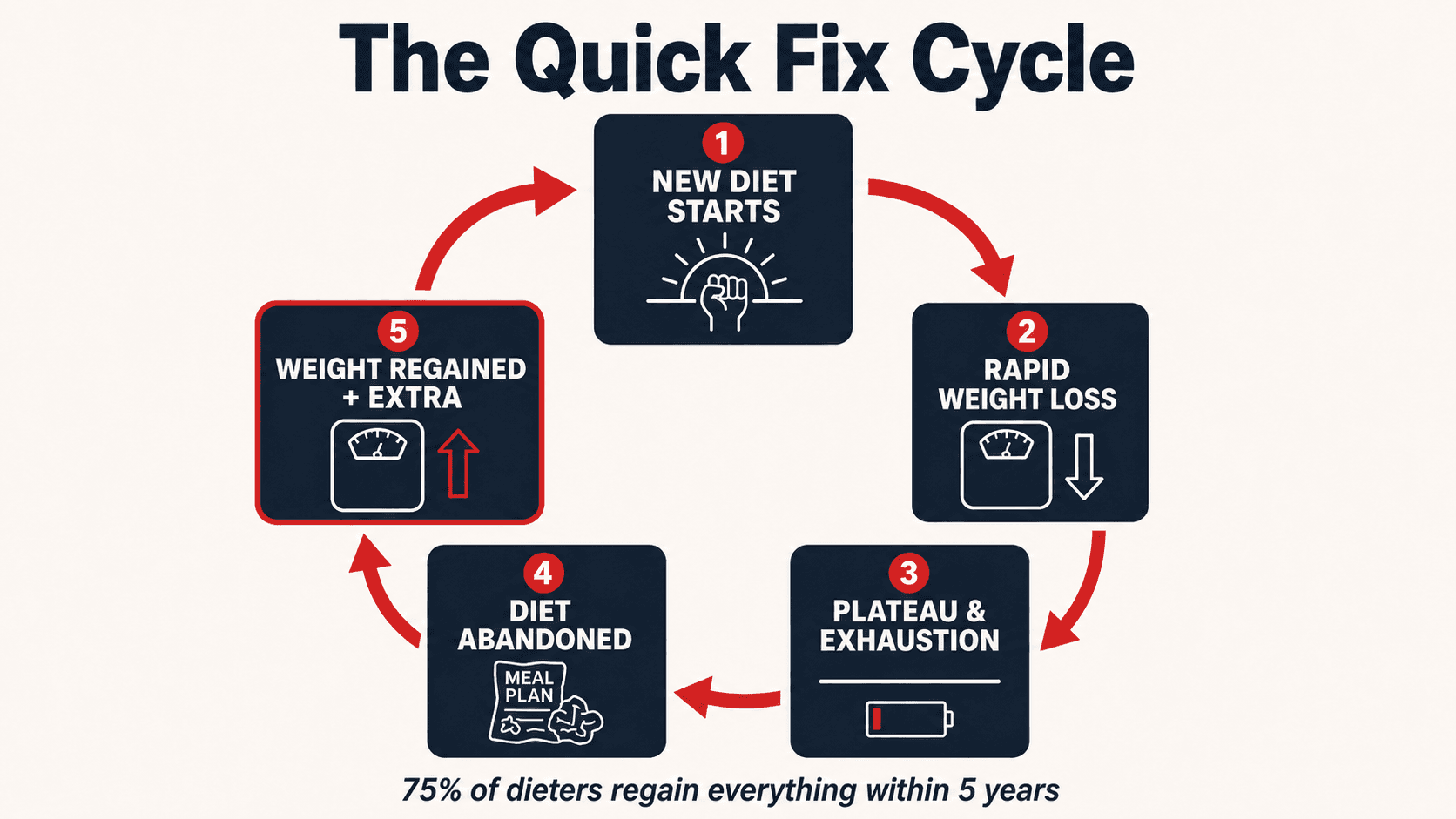
Why Quick Fix Diets Fail: The Science of Weight Regain
The appeal of a quick fix is obvious. Who would not want to lose a stone in two weeks? The problem is that the weight lost through extreme caloric restriction is not primarily body fat. When you slash your calorie intake to 800 or fewer calories per day, a significant proportion of the weight you lose comes from water, glycogen, and lean muscle tissue rather than stored body fat (1). Your body is not stupid. When it detects a severe energy shortage, it does not simply burn through its fat stores at maximum speed. It downregulates your metabolic rate, increases hunger hormones, reduces spontaneous physical activity, and cannibalises muscle tissue for energy. From an evolutionary standpoint, this is a survival mechanism. From a body composition standpoint, it is a disaster.
A meta-analysis published in the American Journal of Clinical Nutrition examined long-term weight loss maintenance following structured weight loss programmes. The researchers found that individuals maintained only 67 percent of their initial weight loss at one year, 44 percent at two years, and just 21 percent at five years (2). The trajectory is clear. Without a sustainable approach, the vast majority of weight lost through aggressive dieting is regained within a few years. Another meta-analysis comparing very low calorie diets (VLCDs) to conventional low calorie diets found that VLCDs did not produce greater long-term weight loss despite producing faster initial results (3). The initial speed of loss was irrelevant because the regain was equally fast.
Only around 25 percent of people who lose weight through dieting maintain their results long term (4). Three quarters of dieters end up back where they started or worse. This is not because they lack willpower. It is because extreme approaches create extreme metabolic and hormonal responses that drive weight regain with remarkable predictability.
What Extreme Dieting Does to Your Body
When you understand what happens inside your body during an extreme caloric restriction, the failure of quick fix diets stops being surprising and starts being inevitable. Here is what the research tells us.
Your metabolic rate drops beyond what is explained by weight loss alone. This phenomenon, known as adaptive thermogenesis or metabolic adaptation, means your body burns fewer calories than predicted for your new body weight. Research on participants of extreme weight loss programmes has shown that metabolic rate can remain suppressed for years after the diet ends, making weight maintenance significantly harder (5). Your body essentially becomes more efficient at storing energy and more resistant to losing it.
Your hunger hormones shift against you. Ghrelin, the hormone that stimulates appetite, increases significantly during caloric restriction, while leptin, the hormone that signals fullness and satiety, decreases (6). This hormonal shift creates a biological drive to eat that goes far beyond normal hunger. It is not a lack of discipline. It is your endocrine system screaming at you to replenish lost energy stores. Studies have shown that these hormonal changes can persist for at least 12 months after a diet ends, even after the lost weight has been fully regained (6).
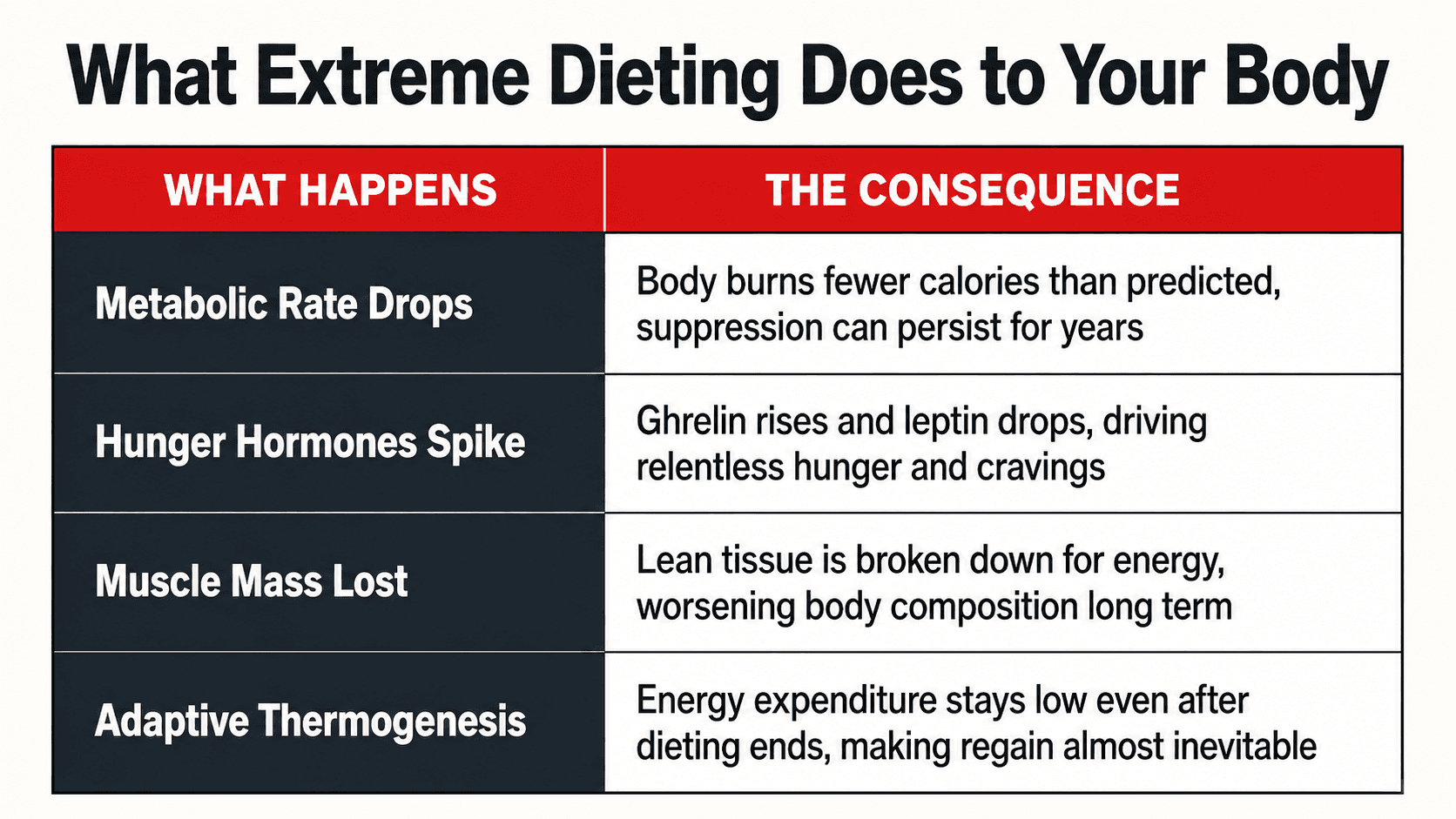
You lose muscle mass alongside fat. Without adequate protein intake and resistance training stimulus, aggressive caloric restriction results in significant lean tissue loss. A systematic review published in the Journal of the American Dietetic Association found that the proportion of weight lost as lean mass increases when the caloric deficit is more severe, when protein intake is inadequate, and when resistance training is absent (7). Losing muscle reduces your basal metabolic rate, worsens your body composition even at a lower body weight, and impairs your ability to maintain fat loss over time. This is one of the most damaging consequences of quick fix diets and one of the least understood by the general public.
Quick Fix Approach vs Sustainable Approach: A Direct Comparison
| Quick Fix Approach | Sustainable Approach | |
|---|---|---|
| Calorie Deficit | Extreme. Often 800 kcal or below. Creates metabolic crisis | Moderate. 400 to 600 kcal below maintenance. Sustainable and manageable |
| Rate of Weight Loss | Rapid initial loss. Primarily water, glycogen, and muscle | Steady 0.5 to 1 kg per week. Primarily body fat |
| Protein Intake | Often inadequate. Many plans ignore protein entirely | Prioritised at 1.6 to 2.2 g per kg body weight to preserve muscle |
| Resistance Training | Usually absent or replaced by excessive cardio | Central to the programme. 2 to 4 sessions per week |
| Muscle Preservation | Significant lean mass loss due to severe restriction and no training stimulus | Lean mass preserved or even gained due to adequate protein and training |
| Hunger and Cravings | Extreme. Hormonal disruption drives relentless hunger and cravings | Controlled. Adequate calories and protein keep appetite manageable |
| Metabolic Rate | Drops significantly through adaptive thermogenesis | Maintained as closely to baseline as possible |
| Food Variety | Highly restrictive. Eliminates food groups or relies on meal replacements | Flexible. Includes all food groups from all dietary backgrounds |
| Sustainability | Days to weeks. Most people cannot sustain this beyond 2 to 4 weeks | Months to years. Designed to become a permanent lifestyle |
| Long-Term Results | 75% of people regain all weight lost within 2 to 5 years (2, 4) | Significantly better maintenance when combined with behaviour change and accountability (8) |
| Psychological Impact | Creates a cycle of restriction, failure, guilt, and restarting | Builds confidence, nutritional literacy, and long-term self-efficacy |
What Sustainable Fat Loss Actually Looks Like
Sustainable fat loss is not exciting. It is not dramatic. It will not make headlines or go viral on social media. It is a moderate calorie deficit, adequate protein, structured resistance training, sufficient sleep, managed stress, and consistent execution over months and years. That is the formula. It has always been the formula. And it works for every single person who commits to it, regardless of their starting point, their age, their genetics, or their dietary preferences.
A landmark network meta-analysis of 121 randomised controlled trials involving nearly 22,000 adults compared 14 popular named dietary programmes including low carbohydrate, low fat, Mediterranean, Atkins, DASH, Zone, and others. The results showed minimal differences between diets at 6 months and no significant differences at 12 months (8). The diet that works is the diet you can sustain. That is the single most important finding in the entire weight loss literature, and it applies equally to omnivores, vegetarians, and vegans.

When I build a fat loss programme for a client, I start with their maintenance calories and subtract 400 to 600 calories per day. That is enough to produce a steady loss of 0.5 to 1 kilogram per week, which is overwhelmingly body fat when protein is adequate and resistance training is in place. I set protein at 1.6 to 2.2 grams per kilogram of body weight per day. For vegetarian and vegan clients, we build this around tofu, tempeh, seitan, lentils, chickpeas, soy protein, pea protein, and dairy or dairy alternatives. For omnivore clients, we include a full range of animal and plant sources. The remaining calories are split between carbohydrates and fats based on training demands, personal preferences, and any medical considerations such as insulin resistance or PCOS.
Resistance training is non-negotiable. I programme two to four sessions per week depending on the client’s schedule, training history, and recovery capacity. This protects lean muscle mass during the deficit, maintains metabolic rate, improves insulin sensitivity, and ensures that the weight being lost is predominantly fat, not muscle. Daily step count targets of 8,000 to 10,000 steps provide additional energy expenditure without the recovery cost of structured cardio.
How to Spot a Quick Fix Diet: The Red Flags
If you are ever unsure whether a diet plan is a quick fix or a legitimate approach, the following red flags will help you identify it immediately. If a programme triggers more than two or three of these, walk away.
| Red Flag | Why It Is a Problem |
|---|---|
| Promises rapid weight loss (e.g. lose a stone in 2 weeks) | Rate of fat loss is limited by biology. Anything beyond 1 kg per week at most is water, glycogen, or muscle |
| Eliminates entire food groups without medical reason | Unnecessary restriction reduces adherence and nutrient intake without improving outcomes (8) |
| Relies on a single product or supplement | No supplement replaces a calorie deficit. Products are profit-driven, not evidence-driven |
| Provides fewer than 1,000 kcal per day without medical supervision | Severe restriction causes muscle loss, metabolic adaptation, and hormonal disruption (1, 5, 6) |
| No mention of protein targets or resistance training | Without these, a large proportion of weight lost will be lean tissue, not fat (7) |
| Uses before and after photos with no timeframe or context | Extreme short-term results are not reflective of sustainable outcomes |
| No personalisation to your individual needs | A generic plan cannot account for your metabolism, preferences, training level, or medical history |
| Requires you to buy proprietary meal replacement products | Real food from any dietary background is more sustainable, more nutritious, and more affordable |
| No accountability, coaching, or ongoing support structure | The maintenance phase is harder than the loss phase. Without support, regain is almost guaranteed (4, 9) |
Why the Maintenance Phase Matters More Than the Fat Loss Phase
Here is something that most quick fix programmes never tell you: losing the weight is the easy part. Keeping it off is where the real challenge lies. A meta-analysis of weight maintenance studies found that continued contact with health professionals, structured behavioural support, and ongoing self-monitoring were the strongest predictors of long-term weight maintenance (9). The studies that produced the best maintenance outcomes were those where the relationship between the client and the coach did not end when the initial weight loss phase finished. Those that relied on the individual maintaining results alone, without structure or support, had far higher rates of regain.
This is why I structure my coaching as a long-term partnership, not a short-term transaction. The fat loss phase is just the beginning. Once a client reaches their target, we transition into a maintenance phase where calories are gradually increased back to maintenance level, training is adjusted to support their new body composition, and we continue to monitor body weight, measurements, and habits to catch any early signs of drift before they become a problem. It is this ongoing structure and accountability that separates a permanent transformation from a temporary one.

The Bottom Line
Quick fix diets do not produce lasting results. The evidence is unambiguous. Extreme caloric restriction leads to muscle loss, metabolic adaptation, hormonal disruption, and weight regain in the vast majority of cases. After five years, the average dieter has regained nearly 80 percent of their initial weight loss (2). The only approach that produces lasting change is a moderate, sustainable calorie deficit combined with adequate protein, structured resistance training, behaviour change, and long-term accountability. It is slower. It is less dramatic. And it works.
If you have spent years cycling through quick fix diets and you are ready for something that actually lasts, get in touch. I work one-to-one with clients online globally. Whether you eat meat, are vegetarian, vegan, or somewhere in between, I will build you a personalised, evidence-based programme designed not just for the fat loss phase but for keeping the results permanently. No meal replacements. No magic supplements. No 21-day gimmicks. Just a structured plan, real food, hard training, and relentless accountability. That is what transforms bodies. That is what I do.
Work with Me
Get a personalised coaching plan built around your goals, your schedule, and your life.
Enquire NowReferences
- Cava E, Yeat NC, Mittendorfer B. Preserving healthy muscle during weight loss. Advances in Nutrition. 2017; 8(3): 511-519.
- Anderson JW, Konz EC, Frederich RC, Wood CL. Long-term weight-loss maintenance: a meta-analysis of US studies. American Journal of Clinical Nutrition. 2001; 74(5): 579-584.
- Tsai AG, Wadden TA. The evolution of very-low-calorie diets: an update and meta-analysis. Obesity. 2006; 14(8): 1283-1293.
- Montesi L, El Ghoch M, Brodosi L, Calugi S, Marchesini G, Dalle Grave R. Long-term weight loss maintenance for obesity: a multidisciplinary approach. Diabetes, Metabolic Syndrome and Obesity: Targets and Therapy. 2016; 9: 37-46.
- Fothergill E, Guo J, Howard L, et al. Persistent metabolic adaptation 6 years after The Biggest Loser competition. Obesity. 2016; 24(8): 1612-1619.
- Sumithran P, Prendergast LA, Delbridge E, et al. Long-term persistence of hormonal adaptations to weight loss. New England Journal of Medicine. 2011; 365(17): 1597-1604.
- Weinheimer EM, Sands LP, Campbell WW. A systematic review of the separate and combined effects of energy restriction and exercise on fat-free mass in middle-aged and older adults: implications for sarcopenic obesity. Nutrition Reviews. 2010; 68(7): 375-388.
- Ge L, Sadeghirad B, Ball GDC, et al. Comparison of dietary macronutrient patterns of 14 popular named dietary programmes for weight and cardiovascular risk factor reduction in adults: systematic review and network meta-analysis of randomised trials. BMJ. 2020; 369: m696.
- Montesi L, El Ghoch M, Brodosi L, Calugi S, Marchesini G, Dalle Grave R. Weight maintenance after dietary weight loss: systematic review and meta-analysis on the effectiveness of behavioural intensive intervention. Nutrients. 2022; 14(6): 1259.