
If you are a man over 30 and you have not thought seriously about the foundations of your health, this article is for you. The truth is, most men coast through their 30s and 40s assuming that feeling more tired, gaining weight around the middle, and losing the strength they once had is simply what happens when you get older. It is not. These are warning signs. They are signals that your body is changing, and if you do not respond, the consequences will catch up with you. The pattern is almost always the same. They wait too long, they ignore the signals, and by the time they take action the job is ten times harder than it needed to be.
What Happens When You Ignore the Foundations
Here is what the research tells us. After the age of 30, men begin to lose muscle mass at a rate of approximately 3 to 8 percent per decade (1). After 60, that rate accelerates further (2). This is not just about looking different in the mirror. Muscle is metabolically active tissue. The less muscle you carry, the fewer calories your body burns at rest, the easier it becomes to gain fat, and the harder it becomes to lose it. At the same time, if you are sedentary, eating convenience food, sleeping poorly, and carrying chronic stress, your body begins to store fat in the most dangerous place possible: around your organs.
This is called visceral fat, and it is not the same as the fat you can pinch on your stomach. Visceral fat sits deep inside the abdominal cavity, wrapping around your liver, kidneys, and intestines. Research published in the journal Circulation found that visceral fat accumulation is strongly associated with metabolic syndrome, a cluster of conditions including elevated blood pressure, high blood sugar, abnormal cholesterol, and increased waist circumference (3). The MESA study, one of the largest multi-ethnic cardiovascular studies conducted, demonstrated that visceral fat predicted metabolic syndrome risk regardless of overall body weight, age, or ethnicity (4). In other words, you can look perfectly fine on the outside and be a metabolic time bomb on the inside.
Top Tip
Do not rely on your bathroom scales or BMI to tell you how healthy you are. Waist circumference is a far better indicator of disease risk. If your waist measures above 94cm, you are in the at-risk zone. Above 102cm, you are in the high-risk zone.
Cardiovascular disease remains the leading cause of death in men in the United Kingdom (5). Type 2 diabetes is rising sharply. And the link between these conditions and body composition, specifically excess visceral fat and low muscle mass, is overwhelming. The problem is that most men do not get regular health checks, do not know their blood pressure or cholesterol numbers, and assume that because they feel okay, they are okay. By the time symptoms appear, the damage has often been accumulating silently for years.
Body Composition Risk Zones for Men
| Marker | Healthy Range | At-Risk Zone | High-Risk Zone |
|---|---|---|---|
| Waist Circumference | Below 94cm | 94cm to 102cm | Above 102cm |
| Body Fat Percentage | 10 to 20% | 21 to 25% | Above 25% |
| BMI (Limited Usefulness) | 18.5 to 24.9 | 25 to 29.9 | Above 30 |
| Visceral Fat Rating | 1 to 9 | 10 to 14 | 15 and above |
Note: BMI does not distinguish between muscle and fat. A man with high muscle mass and low body fat can register as ‘overweight’ on BMI while being in excellent health. Body fat percentage and waist circumference are far more useful markers.
The Five Pillars of Men's Health
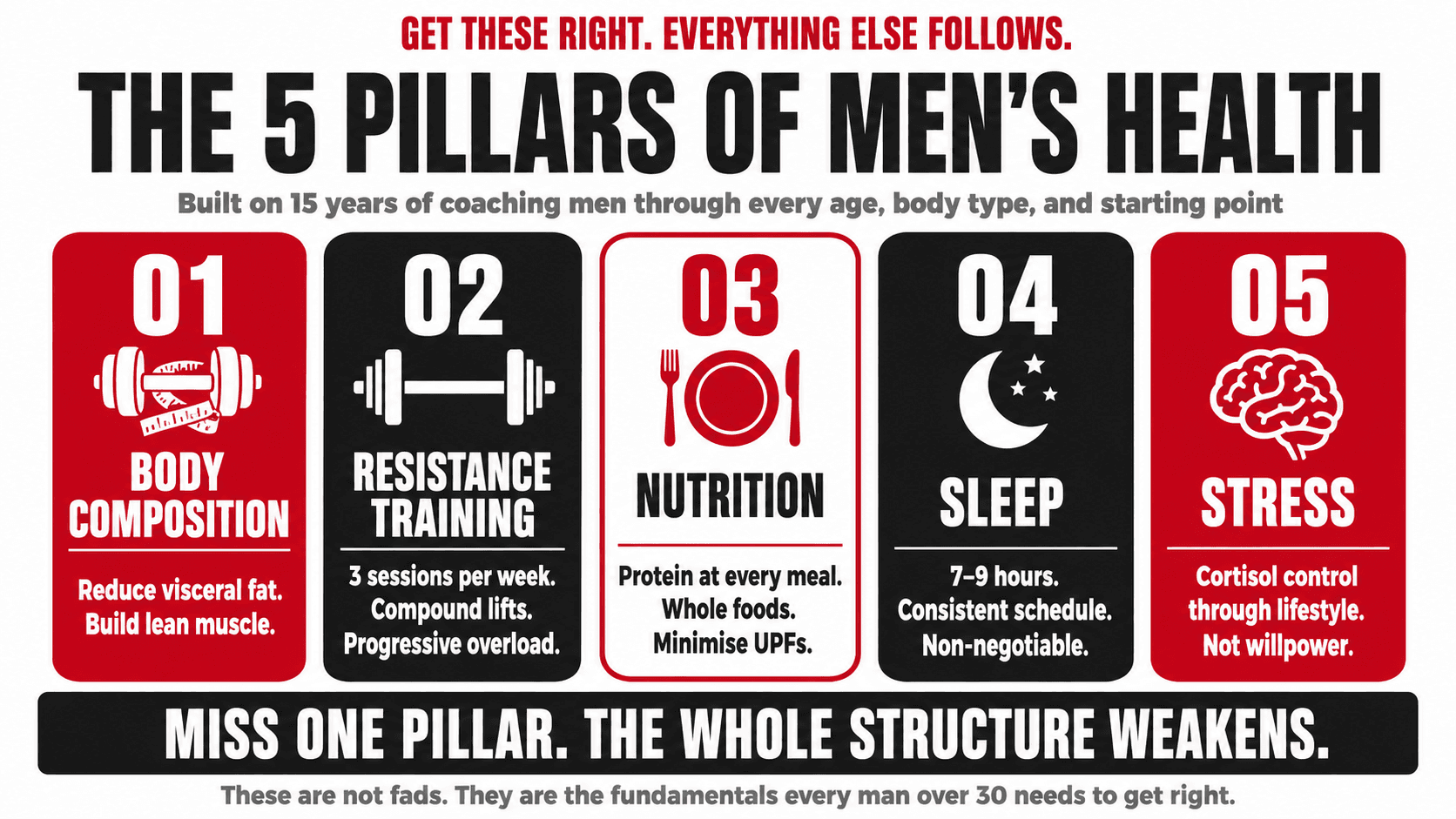
Men's health always comes back to five pillars. When these five areas are addressed properly, everything else follows. When even one of them is neglected, progress stalls and health deteriorates. These are not fads. They are not trends. They are the fundamentals that every man needs to get right.
THE 5 PILLARS OF MEN'S HEALTH
- 1. Body Composition — Reduce visceral fat, build lean muscle mass
- 2. Resistance Training — The single most important form of exercise for men
- 3. Nutrition Quality — Protein, whole foods, fibre, micronutrients
- 4. Sleep — 7 to 9 hours, non-negotiable for hormones and recovery
- 5. Stress Management — Cortisol control through lifestyle, not willpower
Pillar 1: Body Composition
I have said this to every client I have ever worked with: your weight does not tell me how healthy you are. Your body composition does. Body composition refers to the ratio of lean muscle mass to body fat. Two men can weigh exactly the same and have completely different health profiles. One might carry 15 percent body fat with solid muscle mass and excellent metabolic markers. The other might carry 30 percent body fat with very little muscle and be on the path to insulin resistance, high blood pressure, and cardiovascular disease. BMI cannot distinguish between these two men. Body fat percentage and waist circumference can.
The concept of ‘skinny fat’, or what researchers call normal weight obesity, is one of the most dangerous and overlooked health conditions in men. A study published in the European Heart Journal found that individuals with normal BMI but high visceral fat had cardiovascular risk comparable to those classified as clinically obese (6). If you look ‘fine’ in a shirt but carry no muscle and have a soft midsection, you need to take this seriously.
Top Tip
Get your body composition measured properly. Ask your gym about bioelectrical impedance analysis or, better still, request a DEXA scan through your GP or privately. A single measurement gives you a baseline you can track and improve.
Pillar 2: Resistance Training
If I could only give one piece of advice to every man over 30, it would be this: start resistance training and never stop. I am not talking about casual gym visits where you sit on a few machines and check your phone. I am talking about structured, progressive resistance training with compound movements, performed consistently at least three times per week.
The 2025 ICFSR global consensus on exercise recommendations for healthy ageing identified progressive resistance training as indispensable for maintaining and improving functional capacity, particularly for preserving muscle mass, bone density, and metabolic health (7). Resistance training improves insulin sensitivity, reduces blood pressure, supports healthy testosterone levels, increases bone mineral density, and has been shown to improve cognitive function and reduce symptoms of anxiety and depression (8)(9).
None of this is achieved by cardio alone. Cardiovascular exercise is valuable for heart health and endurance, but it does not build muscle, it does not increase bone density in the same way, and it does not reverse the metabolic decline that comes with age-related muscle loss. If you are over 30 and your only form of exercise is running or cycling, you are missing the most powerful tool available to you.
Top Tip
If you are brand new to resistance training, start with three full-body sessions per week built around compound movements: squat variations, hinge patterns (deadlifts or Romanian deadlifts), pressing movements (bench press, overhead press), and pulling movements (rows, pull-ups). Master the basics before anything else.

Pillar 3: Nutrition Quality
I am not going to tell you to follow a specific diet. I am going to tell you to eat properly. For most men, this means three things: eat enough protein, eat whole foods, and stop relying on convenience food.
Protein is the most critical macronutrient for men's health, particularly as you age. Research suggests that older adults benefit from protein intakes of 1.2 to 1.6 grams per kilogram of body weight per day, well above the standard RDA of 0.8g/kg, which was never designed for optimal health or body composition (10). Protein supports muscle protein synthesis, helps preserve lean mass during fat loss, improves satiety, and has a higher thermic effect than carbohydrates or fat, meaning your body burns more energy digesting it.
For men who eat meat, fish, and dairy, hitting protein targets is relatively straightforward with chicken, turkey, fish, eggs, Greek yoghurt, and lean red meat. For vegetarian and vegan men, the options are equally effective when chosen correctly. Tofu, tempeh, seitan, soy protein isolate, pea protein, lentils, chickpeas, and high-quality mock meats all provide excellent protein. The key for plant-based men is to ensure variety across the day to cover all essential amino acids and to pay particular attention to leucine intake, which is the amino acid most responsible for triggering muscle protein synthesis (11).
Top Tip
A simple starting point: aim for a palm-sized portion of protein at every meal. For most men, this means 30 to 40 grams of protein per sitting, spread across three to four meals per day. Track your intake for one week to see where you actually stand. Most men I work with are shocked at how little protein they eat.
Beyond protein, the quality of your overall diet matters enormously. The convenience food industry is the single biggest threat to men's health. Ultra-processed foods are engineered to be hyperpalatable, meaning they override your natural fullness signals and drive you to overeat. They are calorie-dense but nutrient-poor. They drive inflammation, disrupt blood sugar regulation, and contribute directly to visceral fat accumulation (12). The fix is not complicated. Cook more meals at home. Base your diet around whole foods: vegetables, fruits, lean proteins, legumes, whole grains, nuts, seeds, and healthy fats. This is not about perfection. It is about consistently making better choices.

Pillar 4: Sleep
Sleep is the most underrated pillar of men's health. I have worked with men who train hard, eat well, and still cannot shift body fat or build muscle. The first question I always ask is: how much are you sleeping? The answer is almost always five to six hours, sometimes less.
A landmark study from the University of Chicago found that restricting sleep to five hours per night for just one week reduced testosterone levels in healthy young men by 10 to 15 percent (13). To put that in context, testosterone naturally declines by about 1 to 2 percent per year after the age of 30. One week of poor sleep can replicate a decade of natural hormonal decline. Beyond testosterone, sleep deprivation increases cortisol (your stress hormone), increases ghrelin (the hunger hormone), decreases leptin (the satiety hormone), impairs insulin sensitivity, and reduces muscle protein synthesis (14). You cannot out-train or out-eat bad sleep.
Top Tip
Set a consistent sleep and wake time seven days a week. Keep your bedroom cool (16 to 18 degrees Celsius), dark, and free of screens for at least 30 minutes before bed. Cut caffeine after 2pm. These simple changes can transform your sleep quality within a week.

Pillar 5: Stress Management
Most men are taught to push through stress. More hours, more effort, more output. But your body does not distinguish between the stress of a work deadline and the stress of being chased by a predator. The hormonal response is the same: cortisol floods your system. In short bursts, this is normal and adaptive. Chronically, it is destructive.
Chronic elevated cortisol drives visceral fat storage, particularly around the abdomen (15). It suppresses testosterone. It breaks down muscle tissue. It disrupts sleep. It impairs immune function and raises blood pressure. You can train perfectly and eat perfectly and still not see the results you expect if your stress is unmanaged. I always address stress with my clients because without managing it, everything else works at half capacity.
Practical stress management does not mean meditation retreats or expensive wellness programmes. It means walking for 10 to 15 minutes after your main meals (which also improves blood sugar regulation), setting boundaries around work hours, periodising your training so you are not constantly pushing at maximum intensity, prioritising sleep, and occasionally doing something you enjoy that has nothing to do with productivity. It sounds simple because it is. The hard part is actually doing it consistently.
Top Tip
A 10 to 15 minute walk after lunch and dinner is one of the simplest and most effective things you can do for both blood sugar management and stress reduction. It costs nothing, requires no equipment, and the evidence behind it is robust. Start today.
Where to Start: A Practical Framework
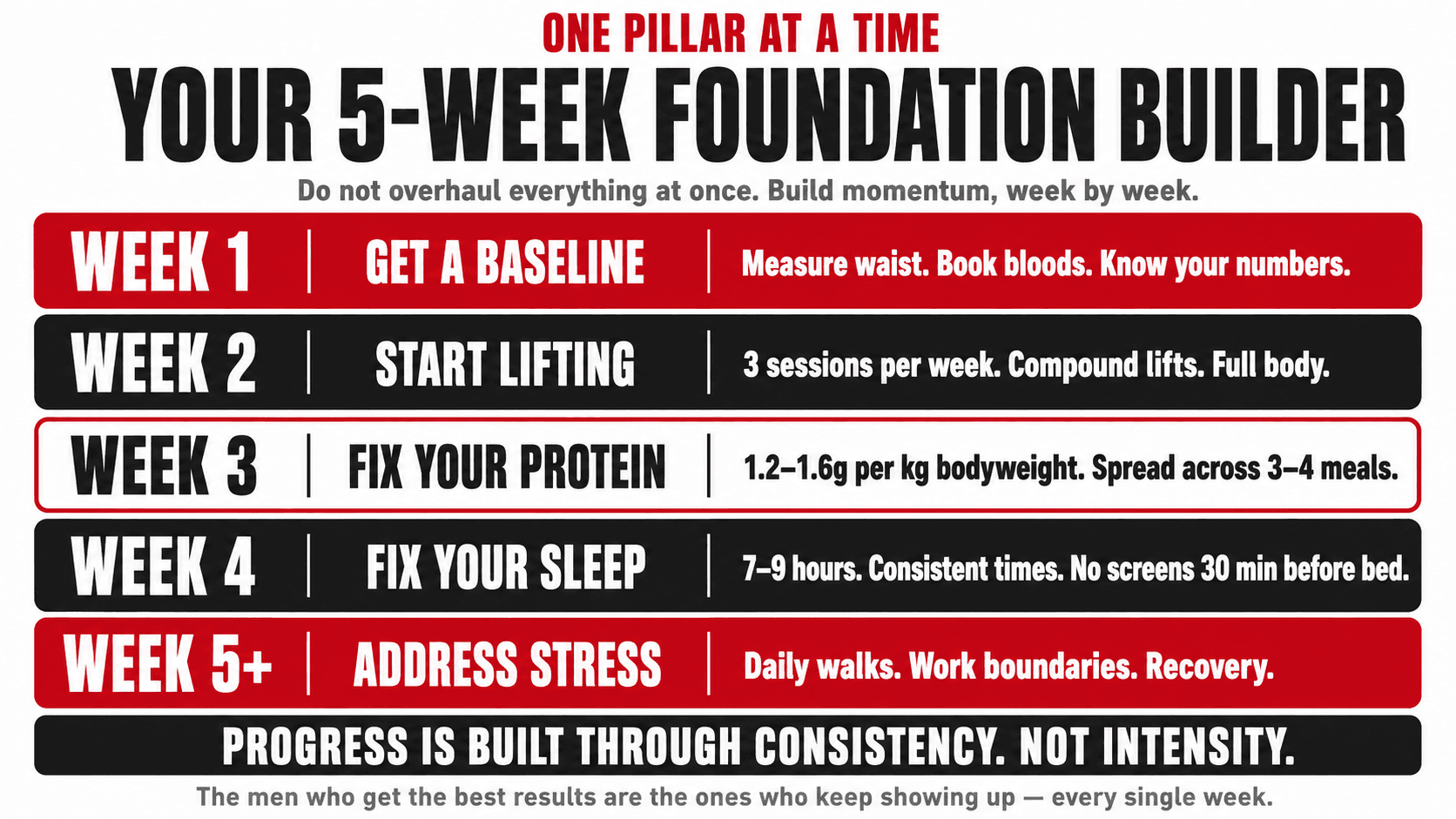
If you have read this far and you are thinking ‘this is me’, here is what I want you to do. Do not try to overhaul everything at once. That approach fails every time. Instead, focus on one pillar at a time and build momentum.
Week 1: Get a baseline. Measure your waist circumference. Book a blood test with your GP and request fasting glucose, HbA1c, lipid profile, blood pressure, testosterone (if symptomatic), and full blood count. You cannot improve what you do not measure.
Week 2: Start resistance training. Three sessions per week. Full body. Compound movements. If you are unsure how to structure this, work with a qualified coach who will teach you proper form and progressive overload.
Week 3: Address your protein intake. Track it for seven days. Adjust until you are consistently hitting 1.2 to 1.6 grams per kilogram of body weight per day, spread across three to four meals.
Week 4: Fix your sleep. Consistent schedule. Cool, dark room. No caffeine after 2pm. No screens 30 minutes before bed.
Week 5 onwards: Address stress. Add daily walks. Set work boundaries. Review your training load to ensure you are recovering properly.
Top Tip
Progress is built through consistency, not intensity. The men who get the best results are not the ones who go hardest for two weeks and burn out. They are the ones who show up, do the work, and keep showing up. Every single week.
How I Can Help
I am a performance coach. I have helped hundreds of men through body transformations and health improvements. I work one-to-one with clients online globally. Whether you are a busy executive who has let things slip, a father who has put everyone else first, or a man in his 30s who has never set foot in a gym, I will build a plan around your life, your goals, and your starting point. I am a lifelong vegetarian myself, so I understand nutrition across every dietary background. I coach men who eat meat, men who are vegetarian, men who are vegan, and everything in between. The principles are the same. The application is tailored to you.
If anything in this article resonated with you, take the first step. Get in touch through trperformancecoaching.com and let us have a conversation about where you are and where you want to be.
Work with Me
Get a personalised coaching plan built around your goals, your schedule, and your life.
Enquire NowReferences
- (1) Volpi E, Nazemi R, Fujita S. Muscle tissue changes with aging. Current Opinion in Clinical Nutrition and Metabolic Care. 2004;7(4):405-410.
- (2) von Haehling S, Morley JE, Anker SD. An overview of sarcopenia: facts and numbers on prevalence and clinical impact. Journal of Cachexia, Sarcopenia and Muscle. 2010;1(2):129-133.
- (3) Despres JP. Cardiovascular disease under the influence of excess visceral fat. Critical Pathways in Cardiology. 2007;6(2):51-59.
- (4) Shah RV, Murthy VL, Abbasi SA, et al. Visceral adiposity and the risk of metabolic syndrome across body mass index: the MESA Study. JACC Cardiovascular Imaging. 2014;7(12):1221-1235.
- (5) British Heart Foundation. UK Factsheet. BHF Cardiovascular Disease Statistics. 2023.
- (6) Neeland IJ, Turer AT, Ayers CR, et al. Dysfunctional adiposity and the risk of prediabetes and type 2 diabetes in obese adults. JAMA. 2012;308(11):1150-1159.
- (7) Izquierdo M, de Souto Barreto P, Arai H, et al. Global consensus on optimal exercise recommendations for enhancing healthy longevity in older adults (ICFSR). Journal of Nutrition, Health and Aging. 2025;29(1):100401.
- (8) Westcott WL. Resistance training is medicine: effects of strength training on health. Current Sports Medicine Reports. 2012;11(4):209-216.
- (9) Gordon BR, McDowell CP, Hallgren M, et al. Association of efficacy of resistance exercise training with depressive symptoms. JAMA Psychiatry. 2018;75(6):566-576.
- (10) Phillips SM, Chevalier S, Leidy HJ. Protein ‘requirements’ beyond the RDA. Applied Physiology, Nutrition, and Metabolism. 2016;41(5):565-572.
- (11) van Vliet S, Burd NA, van Loon LJ. The skeletal muscle anabolic response to plant- versus animal-based protein consumption. Journal of Nutrition. 2015;145(9):1981-1991.
- (12) Monteiro CA, Cannon G, Levy RB, et al. Ultra-processed foods: what they are and how to identify them. Public Health Nutrition. 2019;22(5):936-941.
- (13) Leproult R, Van Cauter E. Effect of 1 week of sleep restriction on testosterone levels in young healthy men. JAMA. 2011;305(21):2173-2174.
- (14) Dattilo M, Antunes HK, Medeiros A, et al. Sleep and muscle recovery. Medical Hypotheses. 2011;77(2):220-222.
- (15) Bjorntorp P. Do stress reactions cause abdominal obesity and comorbidities? Obesity Reviews. 2001;2(2):73-86.