Post-Menopause Is Not the End of Anything
Menopause body composition is a phrase that for too many women carries an undertone of inevitability: the weight that arrives and stays, the muscle that disappears, the energy that does not return to what it was. Menopause has been presented to generations of women as a biological full stop, a point after which decline is the dominant trajectory and the best that can be hoped for is graceful management of the inevitable.
That narrative is wrong. I have coached women in their 50s and 60s who have achieved the best body composition of their adult lives in the years following menopause. Not because they discovered a secret or found a shortcut, but because they finally understood what their body needed and gave it precisely that. The post-menopausal body responds powerfully to the right stimulus. The problem has never been the physiology. It has been the approach.
What I am going to give you in this article is the same framework I use with post-menopausal clients. What is happening hormonally and why. What the consequences of the oestrogen withdrawal are, and which of those consequences are genuinely inevitable versus which are the entirely preventable result of doing less of the right things. And what the evidence supports for building strength, preserving bone, protecting the heart, and sustaining the energy and quality of life that every woman deserves in this stage of her life.
Post-menopause is not the end of looking and feeling your best. For many women, with the right programme and the right understanding, it is the beginning of it.
What Happens to the Body When Oestrogen Withdraws
Menopause is defined as twelve consecutive months without a menstrual period. At this point, oestrogen has settled at a new, consistently lower baseline rather than the fluctuating pattern of perimenopause. The ovaries are no longer the primary source of oestrogen production. The adrenal glands and fat tissue continue to produce small amounts of oestrogen through aromatisation of androgens, which is one of the reasons that body composition and adrenal health remain relevant to oestrogen levels even after menopause.
The withdrawal of oestrogen has consequences across virtually every body system, and understanding these consequences specifically is what allows a post-menopausal woman to target her lifestyle interventions precisely. These are not abstract risks. They are measurable, physiologically documented changes that either occur rapidly without intervention or are substantially modified by the right approach.
THE POST-MENOPAUSE METABOLIC SHIFT
What Oestrogen Withdrawal Drives
Oestrogen Withdraws at Menopause
01
Muscle & Metabolism
Muscle protein synthesis rate falls. Muscle mass begins declining at an accelerated rate (up to 1 to 2% per year without intervention). Strength falls with it. Metabolic rate falls as muscle mass is lost. The calorie intake that maintained weight pre-menopause now produces weight gain. Visceral fat accumulates specifically as oestrogen no longer directs fat toward peripheral storage.
02
Bone Density
Bone density declines at an accelerated rate: 2 to 3% per year in the early post-menopausal years without intervention. Fracture risk at the hip and spine rises progressively.
03
Cardiovascular Risk
Cardiovascular risk increases. Oestrogen's anti-inflammatory, vasodilatory, and lipid-modulating effects are lost. LDL cholesterol rises. Blood pressure tends to increase. Inflammatory markers rise.
04
Insulin Resistance
Insulin resistance worsens. Blood glucose management deteriorates. Type 2 diabetes risk rises. Visceral fat further drives inflammatory signalling.
Without intervention, each system compounds the others. With the right lifestyle foundation, all of these trajectories can be significantly modified or reversed.
I want to be direct about why I lay this out so plainly. Not to frighten, but because I have found that women who understand exactly what is at stake approach the lifestyle work with a different level of commitment than women who are only told that menopause might cause weight gain and their bones might get a bit thinner. These are not minor inconveniences. They are serious health risks that require a serious, sustained response. And that response is available and effective.
Top Tip
The single most important thing a post-menopausal woman can do for her long-term health is start or continue a progressive resistance training programme. Not yoga. Not walking alone, though walking is valuable. Resistance training with progressive loading, targeting the large muscle groups, performed three to four times per week. This intervention addresses muscle loss, bone density, insulin resistance, cardiovascular health, and metabolic rate simultaneously. Nothing else comes close in breadth of benefit.
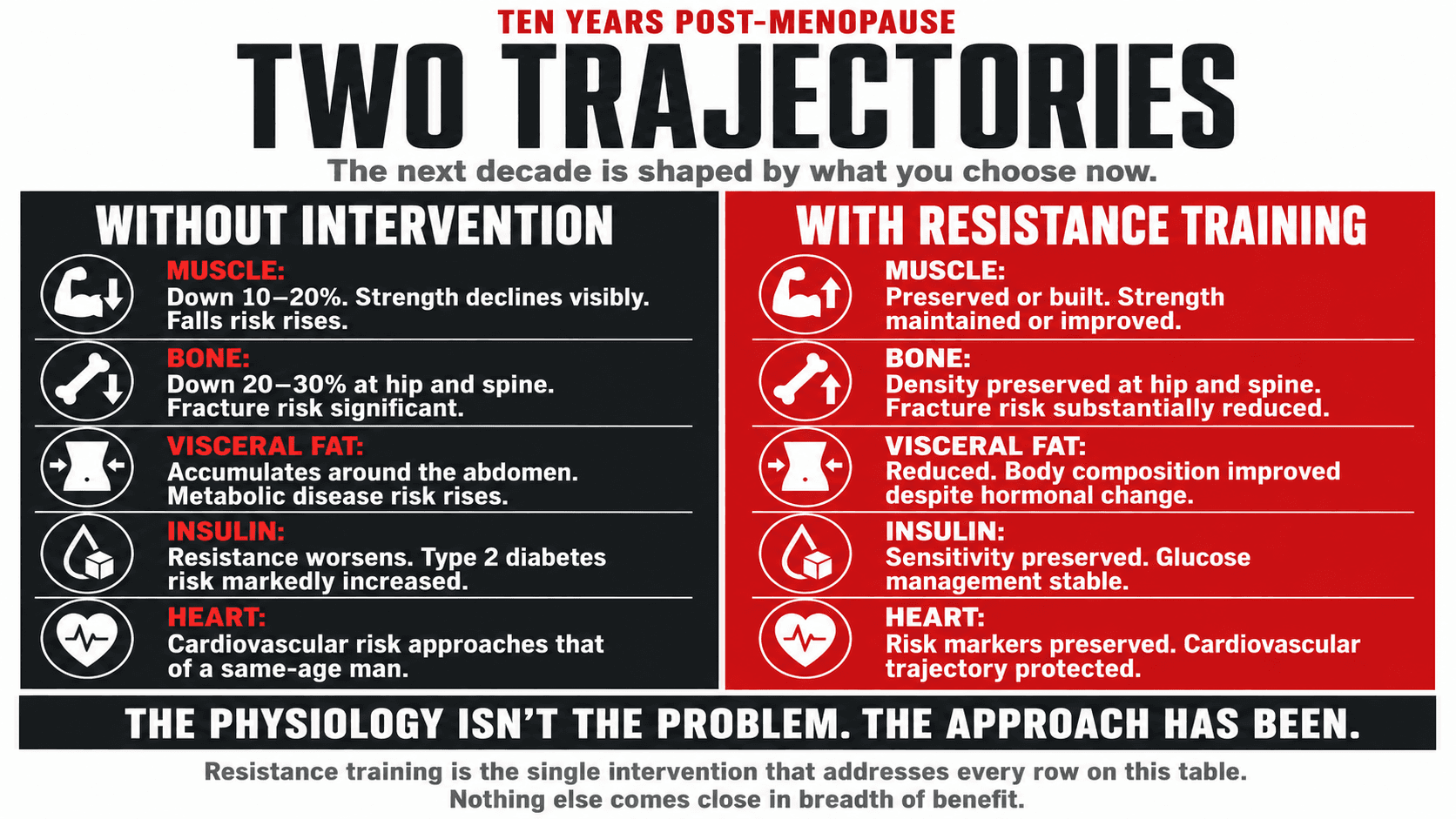
Without Intervention vs With Lifestyle Management: A Direct Comparison
The contrast between what happens to post-menopausal health with and without active lifestyle management is not subtle. The following table makes this comparison explicit, because I think every woman at or approaching menopause deserves to see it plainly.
| Health Marker | Without Intervention | With Resistance Training, Nutrition, and Lifestyle |
|---|---|---|
| Muscle mass | Loss of 1 to 2% per year accelerates after menopause. Significant sarcopenia by the mid to late 60s. Reduced strength, falls risk, metabolic slowdown. | Resistance training preserves and in many cases builds muscle mass even in the 50s and 60s. Sarcopenia is not inevitable. It is the consequence of inactivity. |
| Body fat and visceral fat | Visceral fat accumulates as oestrogen no longer directs fat to peripheral storage. Body fat increases particularly around the abdomen. Metabolic disease risk rises. | Resistance training combined with adequate protein and modest calorie management prevents the visceral fat accumulation that oestrogen withdrawal would otherwise accelerate. |
| Bone density | 2 to 3% annual loss in early post-menopause without intervention. Osteoporosis is a common consequence within ten to fifteen years. Hip fracture risk in later decades is significant. | Resistance training is the most evidence-supported non-pharmacological intervention for post-menopausal bone density maintenance. Adequate calcium and vitamin D are essential alongside. |
| Cardiovascular risk | LDL cholesterol rises. Blood pressure increases. Inflammatory markers elevate. Within ten years of menopause a woman's cardiovascular risk approaches that of a man of the same age. | Resistance training and cardiovascular exercise, a Mediterranean-style dietary pattern, and management of body composition all meaningfully reduce post-menopausal cardiovascular risk. |
| Insulin resistance | Oestrogen's insulin-sensitising effect is lost. Blood glucose management deteriorates. Type 2 diabetes risk increases substantially in the decade after menopause. | Building muscle mass through resistance training is the most powerful structural intervention for insulin sensitivity. Post-meal walking and low GI nutrition support this further. |
| Energy and mood | Sleep disruption, low mood, and fatigue often persist post-menopause, compounded by poor physical health, isolation, and the absence of the hormonal support structures that previously modulated these. | Regular resistance training is one of the most consistent interventions for mood, energy, and sleep quality in post-menopausal women, independent of changes in body composition. |
| Cognitive health | Oestrogen supports cerebral blood flow and neuronal function. Its withdrawal increases dementia risk over decades. Cognitive decline is a long-term consequence of hormonal and vascular changes. | Exercise, particularly combination resistance and aerobic training, is the most evidence-supported lifestyle intervention for cognitive health in post-menopausal women. |
Every single row in the 'without intervention' column describes an avoidable outcome or a significantly modifiable trajectory. The lifestyle response to menopause is not a nice-to-have. It is the difference between two profoundly different health trajectories across the next twenty to thirty years.
Resistance Training Post-Menopause: The Evidence Is Unambiguous
The evidence for resistance training in post-menopausal women is among the most robust in the exercise science literature. Study after study, in women in their 50s, 60s, and beyond, demonstrates that progressive resistance training builds muscle mass, preserves and improves bone density at the hip and spine, reduces visceral fat, improves insulin sensitivity, lowers blood pressure, improves mood and cognitive function, and reduces the risk of falls and fractures.
The LIFTMOR randomised controlled trial, published in the Journal of Bone and Mineral Research, is one of the most cited studies in this area. It demonstrated that high-intensity progressive resistance and impact training in postmenopausal women with low bone density produced significant improvements in bone mineral density at the femoral neck and lumbar spine, alongside substantial improvements in functional strength and physical performance, without adverse events (1). This was not gentle exercise. It was high-intensity resistance training in women aged 58 to 75. The response was clear and clinically meaningful.
Muscle mass responds to training stimulus in post-menopausal women, though the response is somewhat slower than in younger women due to the reduced anabolic environment. This means that higher protein intake, higher training volume, and longer timelines for assessing progress are appropriate. Research suggests that post-menopausal women require protein at the upper range of recommendations, 1.8 to 2.2 grams per kilogram of bodyweight per day, to achieve equivalent rates of muscle protein synthesis to younger women at lower intakes (2). This is not an obstacle. It is a target.
For post-menopausal women who have never trained with weights, the adaptation response in the first three to six months is typically significant. Neuromuscular efficiency improves rapidly, and the body composition response to a consistent programme with adequate protein is meaningful even in women who begin in their 60s. The evidence for starting late is considerably more encouraging than the cultural narrative about ageing suggests.
Top Tip
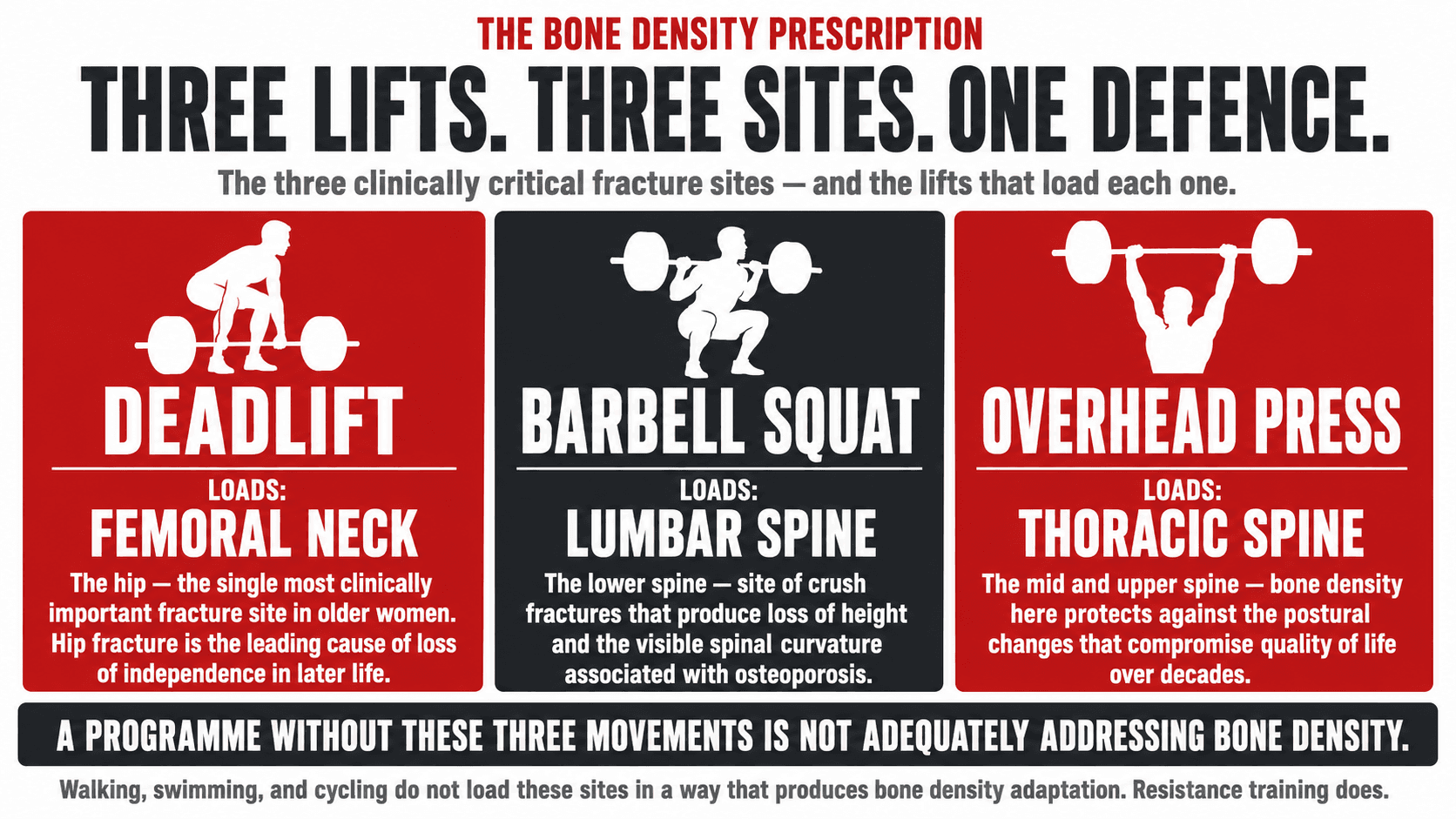
The three exercises that produce the most relevant bone density stimulus at the hip and spine in post-menopausal women are the deadlift and its variations, the barbell or goblet squat, and the overhead press. These movements load the femoral neck, lumbar spine, and thoracic spine respectively, which are the three sites of greatest clinical fracture risk. A programme that does not include spinal and hip loading is not adequately addressing bone density. Make these movements the foundation.
Nutrition Post-Menopause: Recalibrating What Your Body Needs
The nutritional requirements of a post-menopausal woman are different from those of a woman in her 30s, and failing to adjust the approach is one of the most common reasons that well-intentioned women do not get the results they are working for. The adjustments are not dramatic, but they are specific and they matter.
Protein is the most critical macronutrient at this stage, and the requirement is higher than most women realise. The anabolic resistance that develops with age and hormonal change means that the same protein intake that maintained muscle in a 35-year-old produces less muscle protein synthesis in a 55-year-old. Targeting 1.8 to 2.2 grams per kilogram of bodyweight per day, distributed across three to four meals, is the evidence-supported approach (2). For plant-based women, the leucine content of each meal becomes particularly important: tofu, tempeh, edamame, soy protein isolate, and pea protein are the highest-leucine plant sources and should form the core of each meal's protein contribution.
Calcium at 1,000 to 1,200mg per day is essential for post-menopausal bone health. The oestrogen that previously facilitated calcium absorption and bone deposition is gone, and dietary calcium intake becomes proportionally more important. Dairy products are high in bioavailable calcium, but women eating plant-based diets can meet this requirement through fortified plant milks, calcium-set tofu, kale, broccoli, white beans, almonds, and sesame seeds. Calcium supplementation at doses above 500mg per day carries some controversy regarding cardiovascular risk from certain oral supplement forms; obtaining calcium from food first is preferable, with supplementation filling gaps rather than replacing diet (3).
Vitamin D at 1,000 to 2,000IU per day is appropriate for virtually every woman in the UK post-menopause. Vitamin D is essential for calcium absorption, immune function, muscle function, and mood. The UK Public Health England guidance recommends supplementation at 400IU for all adults, but menopause specialists and bone health researchers consistently advocate for higher doses in this population given the accelerated bone loss and the functional role of vitamin D in muscle contraction and falls prevention.
Omega 3 fatty acids, particularly DHA and EPA, support cardiovascular health, reduce inflammation, and have emerging evidence for cognitive protection in post-menopausal women. For plant-based women, algae-derived omega 3 providing DHA and EPA directly is the most efficient route. Walnuts, flaxseed, and chia seeds provide ALA, which converts to DHA and EPA at low rates. The direct algae source is preferable for reliability.
The most common nutritional mistake in post-menopausal women is eating less food in an attempt to manage the weight that menopause has brought. Eating less without the specific support of adequate protein and resistance training simply accelerates muscle loss and metabolic slowdown. The result is a smaller but compositionally worse body: lower muscle, similar or higher fat percentage, lower bone density, and a metabolism that has adjusted downward to meet the reduced intake. More protein and structured training is the direction. Not less food.
Top Tip
If you are post-menopausal and your weight has increased despite eating the same or less than you did before menopause, your metabolic rate has fallen in step with the muscle mass you have lost. Reducing food further does not solve this. Building muscle through resistance training and eating adequate protein to support that muscle rebuilds the metabolic rate that makes managing body composition possible without chronic restriction. This process takes three to six months to become measurably apparent. It requires patience and a genuine change in approach.

HRT Post-Menopause: What the Evidence Says Now
I covered the historical fear around HRT and the current evidence position in the perimenopause article. Here I want to be specific about the post-menopausal context, because the decision about HRT at this stage is somewhat different from the perimenopausal conversation.
For women who are within ten years of their final menstrual period and under the age of 60, the current consensus from the British Menopause Society, NICE, and the International Menopause Society is that the benefits of body-identical HRT for symptom management, bone protection, and cardiovascular health generally outweigh the risks. This is the window of maximum benefit for HRT initiation, and the evidence for cardiovascular protection is strongest when HRT is started in this early post-menopausal period (4).
For women who are more than ten years post-menopause or over the age of 60 and who have not previously used HRT, the calculation is more nuanced. The benefit-risk profile is less clearly favourable for women starting HRT for the first time at this stage, and the decision requires an individualised clinical conversation with a GP or menopause specialist rather than a general recommendation. This is not a reason to dismiss the possibility. It is a reason to have an informed, current conversation.
The lifestyle interventions described throughout this article, resistance training, protein nutrition, calcium, vitamin D, omega 3, and sleep, remain relevant and beneficial regardless of whether HRT is part of the management strategy. HRT and lifestyle work together, with each amplifying the effect of the other. The combination of body-identical HRT and a well-designed resistance training programme produces better body composition and bone density outcomes than either intervention alone.
Top Tip
If you have not yet discussed HRT with a clinician and are within ten years of your menopause, this conversation is worth having before you assume that lifestyle alone is sufficient. HRT, particularly transdermal oestrogen with body-identical progesterone, is a highly effective adjunct to the lifestyle foundation described in this article. The British Menopause Society website has a Find a Menopause Specialist tool. A private consultation costs approximately £200 to £300 and provides an evidence-based, individualised assessment.
Sleep Post-Menopause: Protecting the Foundation
Sleep difficulties that begin in perimenopause do not automatically resolve at menopause. For many women, the reduction in hot flushes that occurs once oestrogen stabilises at its lower level does bring some improvement. But the structural changes to sleep that accompany ageing, reduced deep sleep, earlier morning waking, more fragmented sleep architecture, continue and in some cases worsen in the post-menopausal years.
The hormonal and sleep connections remain clinically important post-menopause. Poor sleep in post-menopausal women is associated with worsened insulin resistance, elevated cortisol, increased inflammatory markers, higher cardiovascular risk, and accelerated cognitive decline. The causal relationships run in both directions: poor health worsens sleep, and poor sleep worsens health. Sleep is not a passive background variable. It is the overnight biological recovery that either supports or undermines every other health intervention.
The practical approach to sleep protection post-menopause combines the universal sleep hygiene foundations with the specific additions that are most relevant to this stage: a consistent wake time anchored seven days per week, a cool sleeping environment, avoidance of alcohol in the evening, magnesium glycinate before bed, and where appropriate, the discussion of HRT with a clinician. Resistance training itself improves sleep quality in post-menopausal women through multiple mechanisms including reduced anxiety, improved body temperature regulation, and the fatigue from genuine physical effort that supports sleep onset.
Top Tip
Alcohol is one of the most significant and most consistently overlooked disruptors of sleep quality in post-menopausal women. Even one to two units in the evening suppresses REM sleep and deep sleep in the second half of the night, when growth hormone is released in its largest pulse and when the most restorative sleep architecture occurs. If your sleep quality is poor and you drink alcohol in the evenings, reducing or eliminating evening alcohol is the highest-yield single change you can make before adding supplements or medications.
The Post-Menopause Rebuild Plan
THE POST-MENOPAUSE REBUILD PLAN
Five Pillars. One Trajectory.
01
Resistance Training
- 3 to 4 sessions per week
- Compound movements: squats, deadlifts, rows, presses
- Progressive overload always
- Hip and spinal loading for bone
- Adequate recovery built in
- Start now regardless of age
02
Protein Nutrition
- 1.8 to 2.2g per kg per day
- Distribute across 3 to 4 meals
- Leucine-rich sources priority
- Plant-based: tofu, tempeh, soy, pea protein, lentils
- Post-workout protein window
- Never skip protein for weight
03
Bone Nutrients
- Calcium: 1,000 to 1,200mg per day
- Vitamin D: 1,000 to 2,000IU per day
- Food first, supplement gaps
- Fortified plant milk, tofu, kale, broccoli
- Vitamin K2 supports calcium metabolism
- Review with GP if bone density low
04
Sleep and Recovery
- Consistent wake time daily
- Cool bedroom: 16 to 18 degrees
- No alcohol in the evening
- Magnesium glycinate before bed
- Deload training weeks
- Address sleep with GP if severe
05
Medical Review
- Discuss HRT if within 10 years of menopause
- Annual cardiovascular screening
- DEXA scan for bone density
- HbA1c and fasting glucose annually
- Lipid panel: LDL, HDL, triglycerides
- Find a menopause specialist if needed
Post-menopause is not a reason to do less. It is a reason to do the right things consistently and with precision. All five pillars work together. A gap in any one of them limits the effectiveness of the others.
What Is Genuinely Possible Post-Menopause
I want to end the main body of this article with what I have witnessed in fifteen years of coaching women through and beyond menopause, because I think the cultural narrative around what is possible at this stage is so pessimistic that many women do not even try the things that would change everything.
I have worked with clients who achieved the best body composition of their adult lives in their late 50s and early 60s. Women who had never lifted a weight, who started after menopause, who built meaningful muscle mass, reduced visceral fat, normalised blood pressure, and improved their HbA1c to the point where their GP reduced or removed medication. Women who came to me in their 60s convinced that they were past the point where anything would work, and who discovered that the right programme, applied with appropriate precision and genuine effort, produced transformations that surprised even them.
These outcomes are not exceptional. They are what the physiology produces when it is given what it needs. The post-menopausal body is not a failing system. It is a system operating in a new hormonal environment that requires a recalibrated response. Provide that response and the results reflect it.
Top Tip
The conversation I want every post-menopausal woman to have with herself is not whether it is too late to start. It is what the next twenty years looks like with the right foundations in place versus without them. The difference between those two trajectories is large enough, and clear enough in the evidence, that it warrants taking seriously right now. You do not need to be at your worst to decide to be at your best.
How I Work With Post-Menopausal Women
Post-menopause is one of the client groups I work with most consistently and with the greatest satisfaction, because the results that are achievable when the approach is correct are genuinely transformative. The programme I build accounts for the elevated protein requirement, the bone loading priority, the cardiovascular health markers, the recovery needs at this stage, and the specific dietary background of each client.
The conversation with a post-menopausal client begins not with how much weight she wants to lose, but with where her muscle mass, bone density, cardiovascular health markers, and metabolic health currently sit, because these are the variables that determine what the programme needs to prioritise and in what sequence. Getting this assessment right is the difference between a programme that looks like every other programme and one that actually reflects the physiology of the person it was built for.
If you are post-menopausal and ready to build the health, strength, and body composition you deserve in this stage of your life, I work one-to-one with women online globally. The programme will be designed specifically for you. No generic plan. No generic timeline. Just the right approach, applied with precision and accountability.