
If you are searching for the reasons not losing fat despite feeling like you are doing everything right, you are not alone. Fat loss plateaus affect approximately 85 percent of people who attempt to lose weight (1). You start a programme, you see initial results, and then everything grinds to a halt. The scale stops moving. Your clothes feel the same. Your waist measurement refuses to budge. And the temptation to either slash your calories to dangerously low levels or abandon the effort entirely becomes overwhelming.
I have worked with hundreds of men and women, from meat eaters to vegetarians to vegans, from healthy individuals to those managing type 2 diabetes, type 1 diabetes, PCOS, and hypertension. Fat loss plateaus are not occasional inconveniences. They are an inevitable part of the process. Every single client I have ever coached has experienced one. The difference between those who break through and those who give up is understanding why the plateau happened and knowing exactly what to do about it.
The frustrating reality is that your body does not want to lose fat. From an evolutionary perspective, stored body fat is a survival asset. Your physiology is wired to resist depletion of that asset through a cascade of metabolic and hormonal adaptations that become more pronounced the longer you diet and the leaner you get (2). Understanding these mechanisms is not just academic. It is the foundation for breaking through every plateau you will ever face. Here are the five real reasons your fat loss has stalled and, more importantly, exactly how to fix each one.
Your Fat Loss Stall: A Quick Diagnostic
Before diving into the detail, use this diagnostic table to quickly identify which of the five reasons is most likely stalling your progress. Work through each row and be honest with yourself about where you stand.
| Reason | What Is Happening | Key Warning Sign | The Fix |
|---|---|---|---|
| 1. Eating more than you think | Calorie intake has crept up through portion drift, untracked extras, and weekend overcompensation | Weight stable despite feeling like you are in a deficit | 7 days of precise food tracking with weighed portions |
| 2. NEAT has dropped | Daily movement has declined subconsciously as your body conserves energy during dieting | Step count has fallen by 2,000 or more from baseline | Reset step target to 8,000 to 10,000 per day and track daily |
| 3. Metabolic adaptation | Your body has reduced energy expenditure beyond what weight loss alone would predict | Plateau persists despite confirmed adherence and stable NEAT | Implement a 1 to 2 week diet break at maintenance calories |
| 4. Water retention masking progress | Cortisol, sodium, hormonal cycles, or training stress are causing fluid retention that hides real fat loss | Weight flat or up but waist measurement is stable or decreasing | Wait 2 to 3 weeks. Assess trend not individual data points |
| 5. Dieting too long | Prolonged restriction has maximised adaptive responses and adherence fatigue | More than 12 to 16 weeks of continuous dieting with declining results | Take a structured maintenance phase of 4 to 8 weeks |
Reason 1: You Are Eating More Than You Think
This is the most common reason for a fat loss stall and it is the one nobody wants to hear. The research on this is unambiguous. A landmark study published in the New England Journal of Medicine examined individuals who described themselves as diet resistant, claiming they could not lose weight despite eating fewer than 1,200 calories per day. When their actual intake was measured objectively using doubly labelled water, they were underreporting their calorie intake by an average of 47 percent and overreporting their physical activity by 51 percent (3). Their metabolic rates were completely normal. They were not broken. They were eating far more than they believed.
This is not about dishonesty. It is about the well documented cognitive biases that affect how all humans perceive food intake. Portions gradually increase over time without conscious awareness, a phenomenon called portion drift. Cooking oils, sauces, dressings, and liquid calories are routinely omitted from mental calculations. Weekend eating often undoes the deficit achieved during the week. A study comparing trained dietitians with untrained individuals found that even the dietitians underreported their intake by an average of 223 calories per day (4). If nutrition professionals make these errors, the general population makes them to a far greater degree.
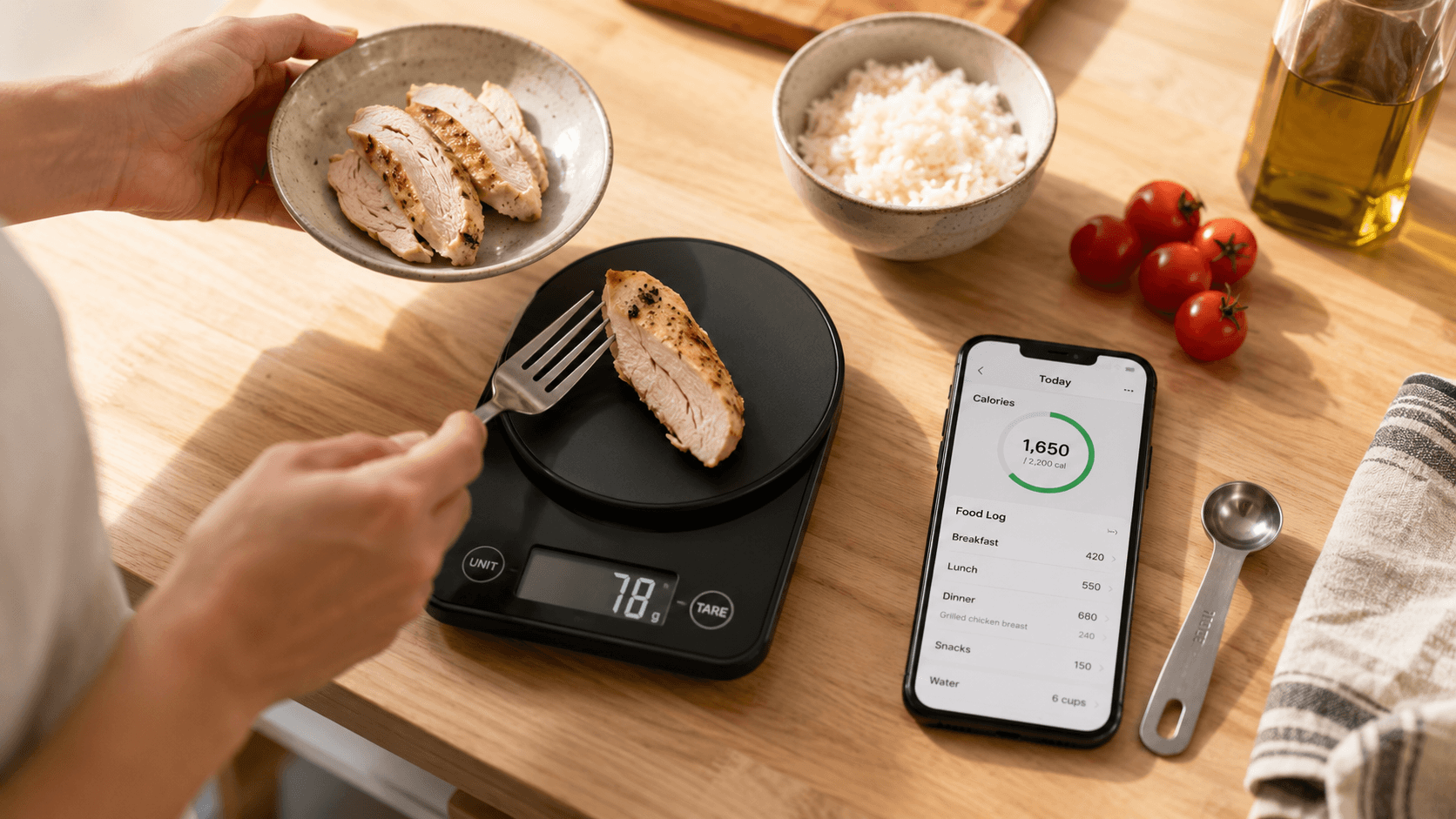
The hidden calories that catch people out most frequently are cooking fats and oils, sauces and dressings, beverages (particularly alcohol, fruit juices, and milk-based coffees), handfuls and tastes during cooking, bites from other people's plates, and the general upward drift of portion sizes over weeks and months. Whether your diet centres on chicken and rice, tofu stir fries, lentil curries, or tempeh bowls, these same invisible calories apply to everyone regardless of dietary preference.
Track your food intake with precision for seven consecutive days, including the weekend. Use a digital food scale and a calorie tracking app. Weigh everything. Log everything, including the oil you cook with, the milk in your coffee, the handful of nuts from the kitchen counter, the bites you take from your child's plate, and the drinks you have on Friday evening. This seven day audit will almost certainly reveal the hidden calories that are erasing your deficit. In my experience, this single intervention is enough to restart fat loss in the majority of stalled clients.
Reason 2: Your NEAT Has Dropped Without You Realising
Non-exercise activity thermogenesis, or NEAT, is the energy you burn through all daily movement outside of formal exercise. It includes walking, standing, fidgeting, taking the stairs, doing housework, and every other physical movement that is not a structured workout. NEAT is one of the first casualties of a prolonged calorie deficit. Your body subconsciously reduces your daily movement to conserve energy. You fidget less, stand less, take fewer steps, and move more slowly. This adaptive reduction in NEAT can amount to several hundred calories per day (5), silently narrowing the calorie deficit you thought you had.
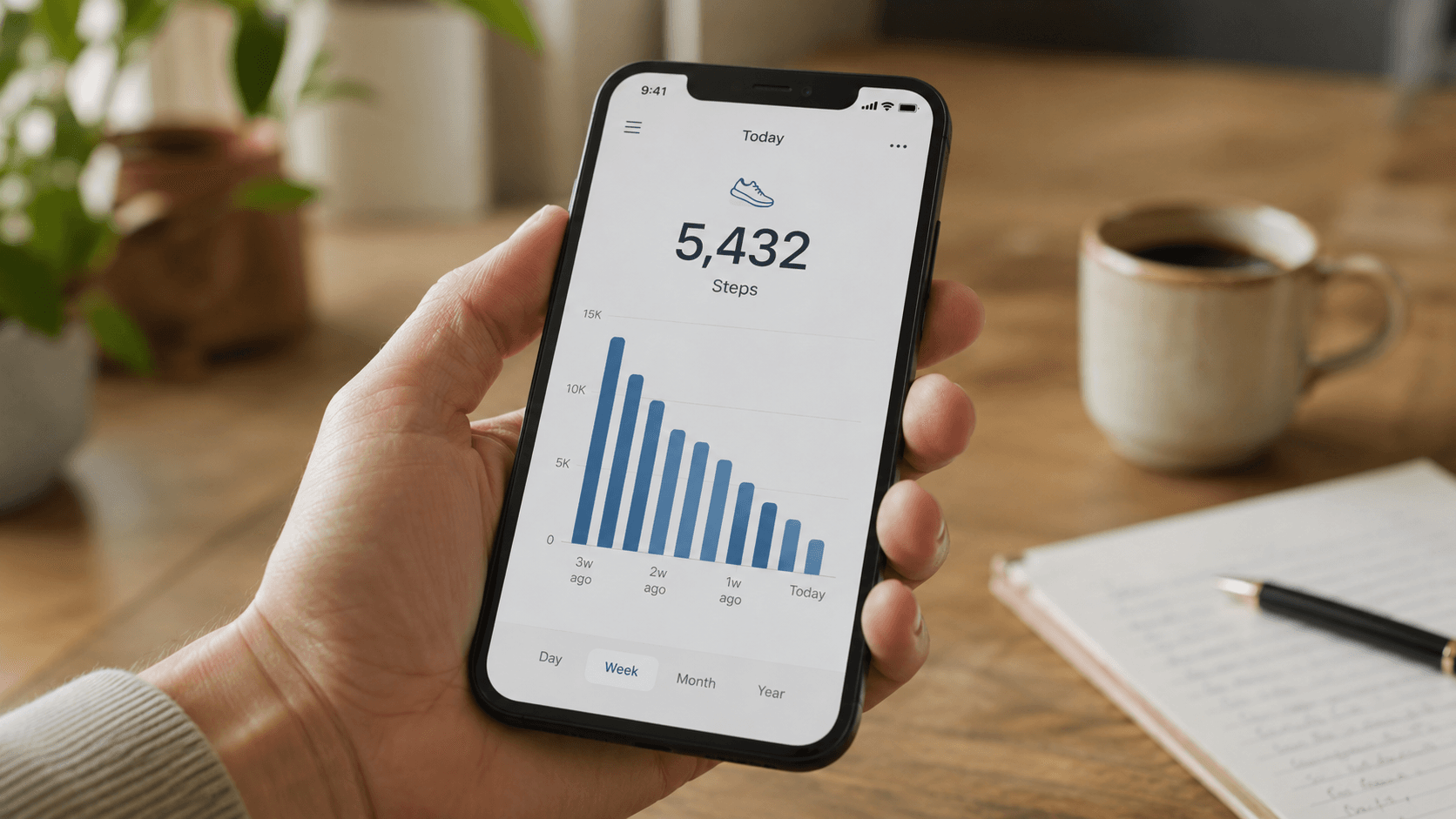
I track daily step counts with every client for exactly this reason. It is remarkably common for someone to start a fat loss phase at 9,000 to 10,000 steps per day and drift down to 5,000 or 6,000 steps within six to eight weeks without any conscious decision to move less. That decline alone can eliminate 200 to 300 calories of daily expenditure, enough to completely stall fat loss even if food intake has not changed at all.
Check your average daily step count over the past two weeks and compare it to where you started. If it has dropped by more than 1,500 to 2,000 steps, your NEAT has declined meaningfully. Reset your daily step target to your baseline level or higher. Walk after meals. Stand at your desk. Take the stairs. Use movement as your first response to a plateau, not calorie cutting. Increasing NEAT by 2,000 steps per day adds roughly 100 to 150 calories of expenditure with minimal fatigue or recovery cost, making it far more sustainable than reducing food further.
Reason 3: Metabolic Adaptation Has Closed the Gap
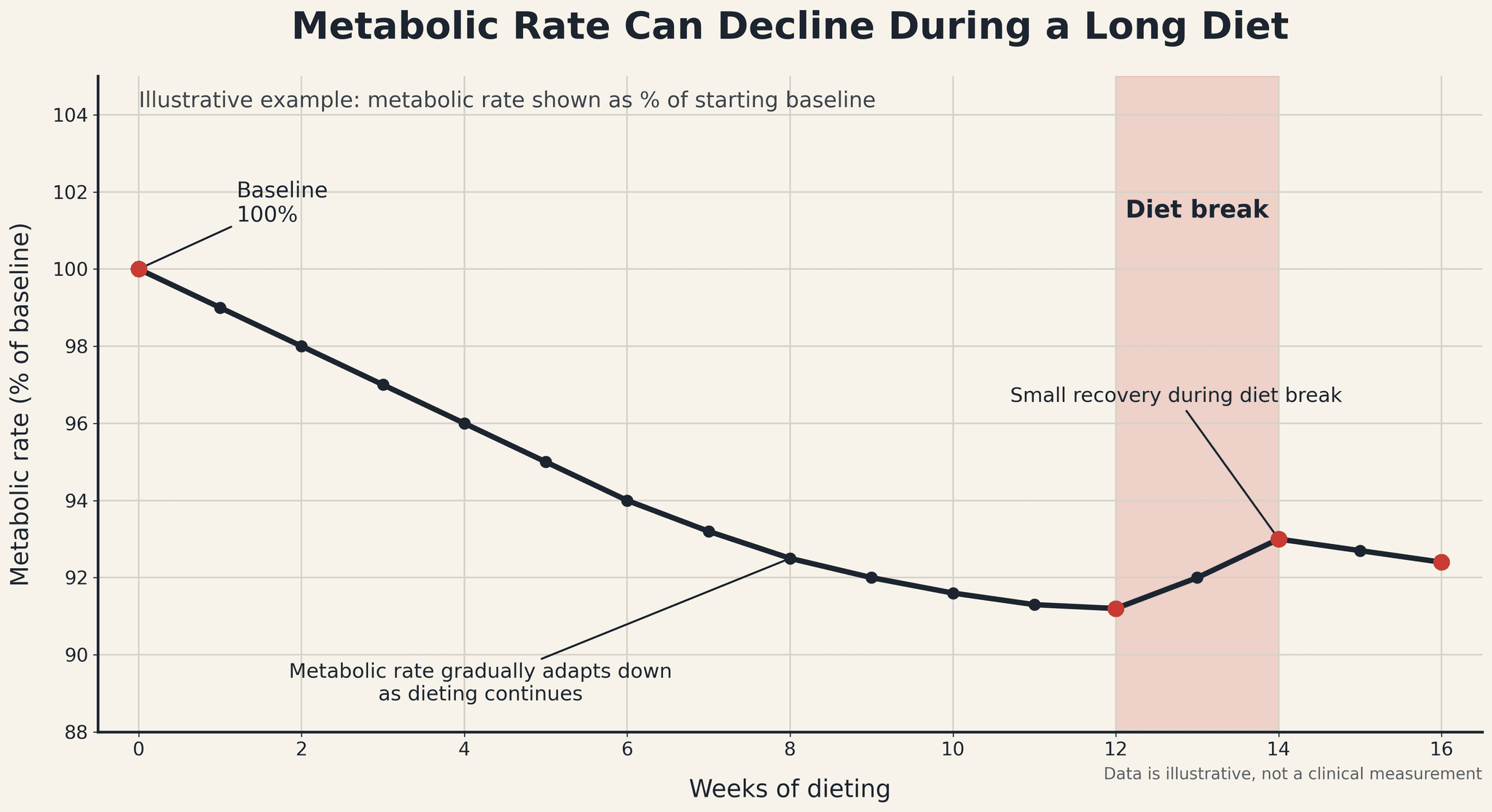
When you diet, your body does not passively allow fat loss to continue indefinitely. It fights back. Total daily energy expenditure decreases by approximately 15 percent following a 10 percent loss of body weight, and this decline exceeds what the loss of body mass alone would predict (6). This excess reduction, known as adaptive thermogenesis or metabolic adaptation, reflects a genuine downregulation of metabolic processes designed to conserve energy. Your basal metabolic rate drops as thyroid hormones, leptin, and sympathetic nervous system activity decline. Your muscles become more mechanically efficient, meaning they perform the same work with fewer calories. And your hunger hormones shift to increase appetite and drive food seeking behaviour (2).
A study examining contestants from a well known televised weight loss competition found that six years after the programme, participants retained a significant degree of metabolic adaptation, with resting metabolic rates approximately 500 calories per day lower than expected for their body size (7). While this was an extreme example involving rapid, aggressive weight loss, the principle applies at a smaller scale to anyone who has been dieting for an extended period. The magnitude of adaptation tends to be proportional to the severity and duration of the energy deficit (2).
How Metabolic Adaptation Slows Your Fat Loss
This table breaks down the components of your total daily energy expenditure and how each one is affected by sustained dieting. Understanding which components are declining helps you target the right fix.
| Component | What It Is | % of Daily Burn | What Happens During Dieting |
|---|---|---|---|
| BMR (Basal Metabolic Rate) | Calories burned at rest to keep you alive | 60 to 70% | Drops approximately 5% beyond what weight loss alone would predict as thyroid and leptin decline |
| NEAT (Non-Exercise Activity) | All daily movement outside formal exercise | 15 to 25% | Declines significantly as the body subconsciously reduces movement to conserve energy |
| TEF (Thermic Effect of Food) | Energy used to digest, absorb, and process food | 8 to 10% | Decreases proportionally because you are eating less total food |
| EAT (Exercise Activity) | Calories burned during structured workouts | 5 to 10% | Muscles become more mechanically efficient, burning fewer calories for the same workout |
If your food intake is genuinely accurate, your NEAT is maintained, and fat loss has still stalled for more than two to three weeks, implement a structured diet break. This means increasing your calorie intake to estimated maintenance level for one to two weeks while continuing to train and monitor your weight. Research suggests that intermittent periods of eating at maintenance during a prolonged diet may help attenuate the decline in metabolic rate and improve long term fat loss outcomes (8). A diet break is not a reward or a cheat. It is a strategic tool that allows your hormones and metabolic rate to partially recover before you resume your deficit.
Reason 4: Water Retention Is Masking Your Real Progress
This is the plateau that is not actually a plateau, and it catches people out constantly. Your body retains water for a wide range of reasons: high sodium intake, increased carbohydrate consumption (each gram of glycogen binds approximately 3 grams of water), intense resistance training which causes inflammation and fluid retention in damaged muscle tissue, menstrual cycle fluctuations in women, elevated cortisol from stress or sleep deprivation, and even changes in ambient temperature and hydration patterns.
It is entirely possible, and in fact common, to be losing fat consistently while your scale weight remains flat or even increases for one to three weeks at a time. I have seen clients lose measurable waist circumference over a two week period while the scale showed a gain of one kilogram. The fat loss was real. The water retention was temporary. If they had only relied on the scale, they would have concluded their diet was not working and either panicked or quit.
The menstrual cycle is a particularly significant factor for women. Progesterone rises during the luteal phase (the two weeks before a period) and promotes water retention that can mask several weeks of genuine fat loss. I always advise my female clients to compare their weight against the same point in the previous cycle rather than against the previous week. This single change in perspective prevents enormous amounts of unnecessary frustration.
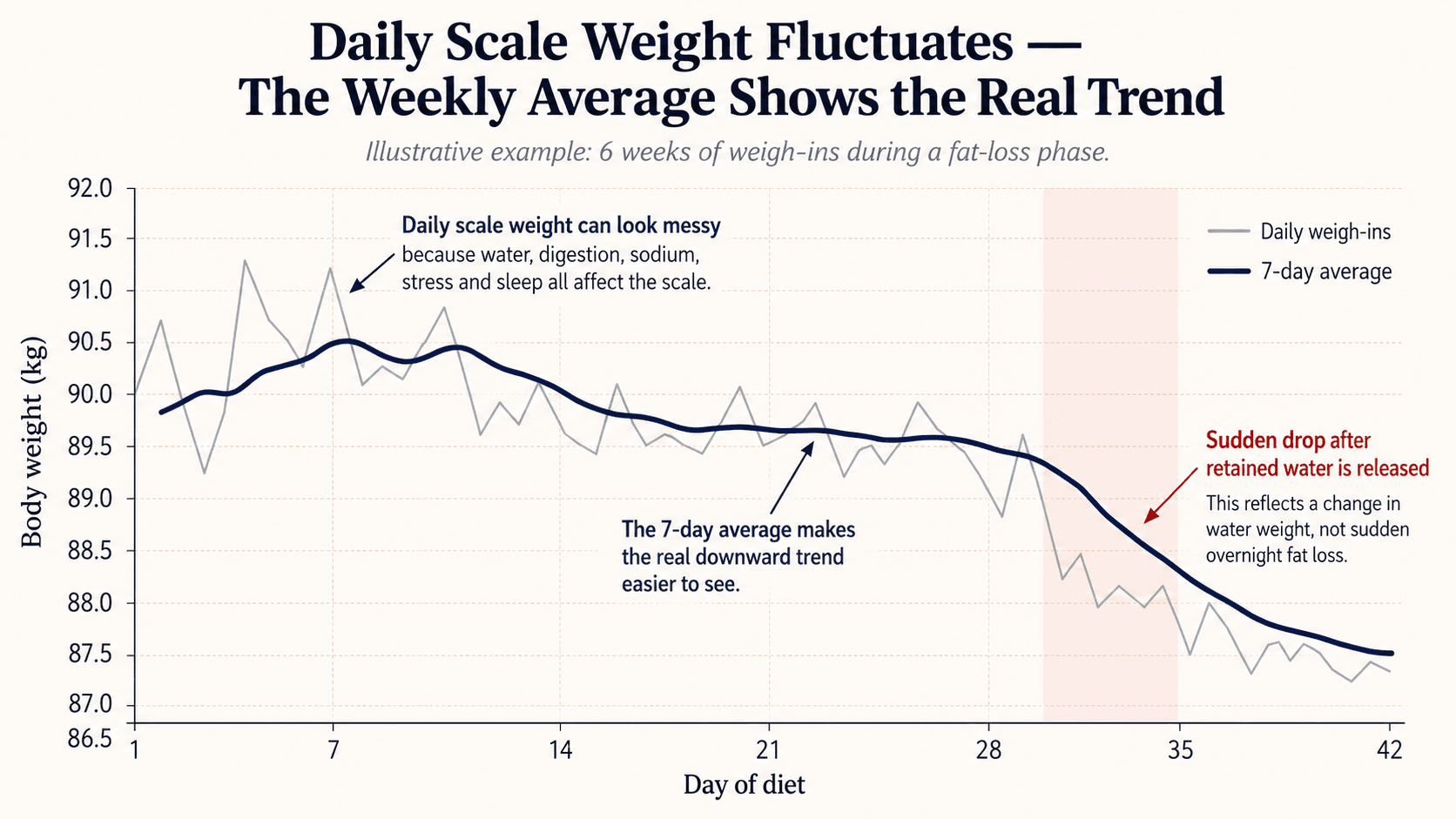
Track your weekly average weight, not your daily weight, and combine it with fortnightly waist circumference measurements. If your waist measurement is stable or decreasing and your average weight is flat, you are almost certainly still losing fat beneath the water retention. Be patient. The water will release, often suddenly and dramatically in what people sometimes call a whoosh effect where the scale drops 1 to 2 kilograms seemingly overnight. Cortisol driven water retention is particularly common among the busy executives and stressed professionals I coach. Address the stress and the sleep and the water often follows.
Reason 5: You Have Been Dieting for Too Long Without a Break
Sustained calorie restriction beyond 12 to 16 weeks accumulates adaptive responses that become progressively harder to overcome. Leptin, the hormone that signals satiety and supports metabolic rate, declines proportionally with fat loss and duration of dieting. Thyroid hormones decrease, reducing metabolic rate. Ghrelin, the hunger hormone, increases, driving appetite. Testosterone declines in men, and menstrual irregularities can occur in women. Sleep quality often deteriorates. Mood and motivation decline. Training performance suffers. The psychological burden of dietary restraint grows heavier with every passing week (9).
A study published in the New England Journal of Medicine tracked hormonal changes in participants after a 10 week weight loss programme and found that many of these hormonal disruptions persisted for at least 12 months after the diet ended (9). This is not a trivial adaptation. Your endocrine system is fundamentally altered by prolonged restriction, and it takes time and strategic management to recover.
This is why I never programme continuous dieting phases of more than 12 to 16 weeks for my clients. After that period, even with excellent adherence, the diminishing returns and mounting side effects make continued restriction counterproductive. The smarter approach, and the one supported by research, is to cycle between periods of active fat loss and periods of maintenance.
If you have been dieting for more than three to four months continuously, take a structured maintenance phase of four to eight weeks. Increase your calories to maintenance level. Keep training. Keep monitoring. Keep your protein high at 1.6 to 2.2 grams per kilogram of bodyweight from sources like chicken, fish, eggs, Greek yoghurt, tofu, tempeh, seitan, lentils, soy protein, or pea protein depending on your dietary preference. Allow your body to stabilise at its new weight. Allow your hormones to recover. Allow your psychology to reset. When you return to a deficit after this maintenance phase, your body will respond far better than it would if you had simply tried to grind out more weeks of restriction.
How to Troubleshoot Your Plateau: Step by Step
When fat loss stalls, work through these steps in order. This is the exact sequence I use with my own clients. Do not skip to step 4 before ruling out steps 1 and 2. The most common cause is almost always the simplest one.
| Step | Action | What You Are Looking For |
|---|---|---|
| 1 | Track food intake precisely for 7 days with a digital scale | Hidden calories, portion drift, weekend overconsumption, untracked liquid calories or cooking oils |
| 2 | Check your daily step count against your baseline from the start of the programme | A decline of 1,500 to 2,000 or more steps per day indicating reduced NEAT |
| 3 | Compare weekly average weight AND waist circumference over a 3 week period | Waist decreasing while weight is flat suggests water retention masking real fat loss. A true plateau shows both metrics stalled |
| 4 | Assess diet duration. Have you been dieting for more than 12 to 16 weeks continuously? | If yes, schedule a 4 to 8 week maintenance phase before resuming your deficit |
| 5 | If steps 1 to 4 are all addressed and the stall persists, implement a 1 to 2 week diet break at maintenance calories | Allows hormonal and metabolic recovery. Resume your deficit after the break and reassess progress over the following 3 weeks |
Top Tips: Breaking Through Your Fat Loss Plateau
Never slash your calories as the first response to a plateau. The most common mistake I see is people immediately cutting food further when their fat loss stalls. This usually makes the problem worse by accelerating metabolic adaptation, increasing hunger, reducing training performance, and promoting muscle loss. Always investigate the real cause before making any dietary changes.
Use a food scale, not your eyes, for at least one week every month. Even if you do not track daily long term, a periodic calibration week with a food scale keeps your portion awareness accurate and prevents the gradual calorie creep that causes most stalls.
Set your step target as a floor, not a ceiling. Your minimum daily step count should be treated with the same discipline as your calorie target. If you fall short during the working day, make it up with an evening walk. NEAT is your most flexible and sustainable tool for widening your deficit without eating less.

Weigh yourself daily but only assess the weekly average trend. Individual daily weigh ins are noisy and misleading. Your weekly average, taken from seven daily measurements, is the number that matters. Assess progress over rolling two to four week windows, not day to day.
Measure your waist circumference fortnightly. The tape measure is often a more reliable indicator of fat loss than the scale, particularly during periods of water retention or body recomposition. A decreasing waist with a stable weight means you are losing fat and either retaining water or building muscle. That is progress.
Plan diet breaks proactively, not reactively. Schedule a one to two week maintenance phase every 8 to 12 weeks of active dieting. Do not wait until you are exhausted, starving, and miserable. Proactive diet breaks maintain your metabolic health, your adherence, and your psychological resilience for the next phase of fat loss.
Women should compare monthly weight trends, not weekly. The menstrual cycle creates predictable fluctuations in water retention that can mask two to three weeks of genuine fat loss. Compare your weight at the same point in consecutive cycles for the most accurate picture of progress.
Keep protein high throughout a plateau, regardless of dietary preference. Aim for 1.6 to 2.2 grams per kilogram of bodyweight daily from sources appropriate to your diet. For omnivores this includes chicken, fish, eggs, and dairy. For vegetarians and vegans, prioritise tofu, tempeh, seitan, lentils, chickpeas, soy protein, and pea protein. Maintaining high protein preserves muscle mass, supports satiety, and keeps the thermic effect of food as high as possible during a deficit (10).
The Bottom Line
Fat loss plateaus are not a sign that your body is broken. They are a predictable, physiological response to sustained calorie restriction. In most cases, the stall is caused by one of five factors: you are eating more than you think, your daily movement has declined, metabolic adaptation has narrowed your deficit, water retention is masking genuine progress, or you have been dieting too long without a break. The solution is almost never to eat less. The solution is to investigate systematically, identify the real cause, and apply the appropriate fix.
If your fat loss has stalled and you are tired of guessing why, get in touch through trperformancecoaching.com. I work one-to-one with clients online globally. Whether you eat meat, are vegetarian, vegan, or somewhere in between, whether you are managing a medical condition like diabetes or PCOS or simply want to get leaner and healthier, I will identify exactly what is holding you back and build a plan to break through it. No guesswork. No fads. Just systematic, evidence based coaching that gets results.
Work with Me
Get a personalised coaching plan built around your goals, your schedule, and your life.
Enquire NowReferences
- StatPearls. Management of Weight Loss Plateau. National Center for Biotechnology Information. 2024.
- Trexler ET, Smith-Ryan AE, Norton LE. Metabolic adaptation to weight loss: implications for the athlete. Journal of the International Society of Sports Nutrition. 2014; 11(1): 7.
- Lichtman SW, Pisarska K, Berman ER, et al. Discrepancy between self-reported and actual caloric intake and exercise in obese subjects. New England Journal of Medicine. 1992; 327(27): 1893-1898.
- Champagne CM, Bray GA, Kurtz AA, et al. Energy intake and energy expenditure: a controlled study comparing dietitians and non-dietitians. Journal of the American Dietetic Association. 2002; 102(10): 1428-1432.
- Levine JA. Non-exercise activity thermogenesis (NEAT). Best Practice and Research Clinical Endocrinology and Metabolism. 2002; 16(4): 679-702.
- Rosenbaum M, Leibel RL. Adaptive thermogenesis in humans. International Journal of Obesity. 2010; 34(Suppl 1): S47-S55.
- Fothergill E, Guo J, Howard L, et al. Persistent metabolic adaptation 6 years after The Biggest Loser competition. Obesity. 2016; 24(8): 1612-1619.
- Byrne NM, Sainsbury A, King NA, Hills AP, Wood RE. Intermittent energy restriction improves weight loss efficiency in obese men: the MATADOR study. International Journal of Obesity. 2018; 42(2): 129-138.
- Sumithran P, Prendergast LA, Delbridge E, et al. Long-term persistence of hormonal adaptations to weight loss. New England Journal of Medicine. 2011; 365(17): 1597-1604.
- Jager R, Kerksick CM, Campbell BI, et al. International Society of Sports Nutrition position stand: protein and exercise. Journal of the International Society of Sports Nutrition. 2017; 14: 20.