
Becoming a father changes everything. Your sleep disappears overnight. Your time is no longer your own. Your priorities shift in ways you could never have predicted, and the body you once had starts slipping away so gradually that you barely notice it happening until one day you catch yourself in a mirror or a photograph and barely recognise the person staring back. Fat loss for busy fathers is one of the most common challenges I deal with in my coaching, and it is one of the most misunderstood. The problem is not that fatherhood makes it impossible to stay in shape. The problem is that the strategies most men relied on before children simply do not work anymore, and nobody teaches them how to adapt.
I have coached fathers of newborns running on three hours of sleep, fathers of teenagers juggling 60 hour work weeks with school runs and weekend sport commitments, and fathers who had let 10, 15, 20 or more kilograms creep on over the course of a decade and had no idea where to start getting it back off. The pattern is always the same. They know they need to change. They know their health matters. But the gap between knowing and doing feels impossibly wide when every hour of the day is already accounted for.

Why Fathers Gain Fat and Why It Matters More Than You Think
The weight gain that follows fatherhood is not a coincidence and it is not simply about eating too much. It is the result of a cascade of physiological and behavioural changes that stack on top of each other. Sleep deprivation, which is virtually guaranteed in the early years of parenthood, has a profound effect on body composition. A study published in the Annals of Internal Medicine found that restricting sleep to 5.5 hours per night in a calorie deficit resulted in 55 percent less fat loss and 60 percent more lean mass loss compared to sleeping 8.5 hours, even when total calorie intake was identical (1). Sleep deprivation increases ghrelin (the hunger hormone), decreases leptin (the satiety hormone), impairs insulin sensitivity, and elevates cortisol, all of which create an internal environment that actively promotes fat storage and muscle breakdown (2).
On top of the hormonal disruption, the behavioural shifts are enormous. You are more stressed, which drives cortisol higher and makes you crave calorie dense comfort foods (3). You have less time to train, so structured exercise drops off. You have less time to prepare food, so convenience eating increases. You are more likely to finish your child's leftovers, drink more alcohol in the evenings to wind down, and move far less during the day because your non-exercise activity (NEAT) collapses under the weight of a sedentary desk job combined with evenings spent on the sofa because you are too exhausted to do anything else.
The result, over months and years, is a slow but relentless increase in body fat, a gradual loss of muscle mass, declining energy, and a deterioration in metabolic health markers that most men do not even know about until a doctor flags something concerning at a routine check-up. Research published in the journal Obesity found that fathers gain significantly more weight than childless men over the transition to parenthood, independent of other lifestyle factors (4). This is not about willpower. It is about physiology, environment, and the absence of a realistic plan that accounts for the reality of life with children.
Why the “I Will Get Back in Shape When Things Calm Down” Approach Fails Every Time
Here is the hard truth I share with every father who comes to me. Things are not going to calm down. The chaos of early parenthood transitions into the chaos of school years, which transitions into the chaos of teenage years, which transitions into the chaos of ageing parents and career peaks and everything else life throws at you. If you wait for the perfect window to get your health back on track, you will be waiting forever, and the consequences of inaction accumulate silently the entire time.
Carrying excess visceral fat is not just an aesthetic issue. It is a metabolic health issue. Visceral fat is biologically active tissue that secretes inflammatory cytokines, disrupts insulin signalling, and increases your risk of type 2 diabetes, cardiovascular disease, hypertension, and certain cancers (5). A meta-analysis published in The Lancet found that for every 5 unit increase in BMI above 25, overall mortality increased by approximately 30 percent, with particularly strong associations for cardiovascular and metabolic causes of death (6). Your children need you healthy. They need you energetic. They need you present and capable for decades to come. Letting your health slide is not just a personal issue. It is a family issue.

The Realistic Approach That Actually Works for Fathers
The first thing I do with any father I coach is throw out the all-or-nothing mindset. You do not need two hours in the gym six days a week. You do not need a meal prep empire that takes up your entire Sunday. You do not need to follow some extreme diet that has you eating out of Tupperware at your child's birthday party. What you need is a small number of non-negotiable habits executed consistently within the constraints of your actual life. That is it. Consistency within realistic parameters beats intensity within unsustainable ones every single time.
Fat loss, regardless of your life circumstances, comes down to maintaining a sustained calorie deficit while preserving lean muscle mass. A systematic review published in the Journal of the International Society of Sports Nutrition confirmed that protein intake of 1.6 to 2.2 grams per kilogram of body weight per day, combined with resistance training, is optimal for maintaining muscle mass during a calorie deficit (7). The specific method you use to achieve that deficit is far less important than your ability to sustain it over weeks and months. For fathers, this means the approach has to be simple, flexible, and compatible with family life.
Nutrition That Fits Around Family Life
The biggest nutritional mistake I see fathers make is trying to eat a completely separate diet from their family. This creates friction, takes more time, costs more money, and almost always collapses under the pressure of daily life. A far better approach is to build your nutrition around the same whole foods your family eats, with some strategic adjustments that take minimal effort.
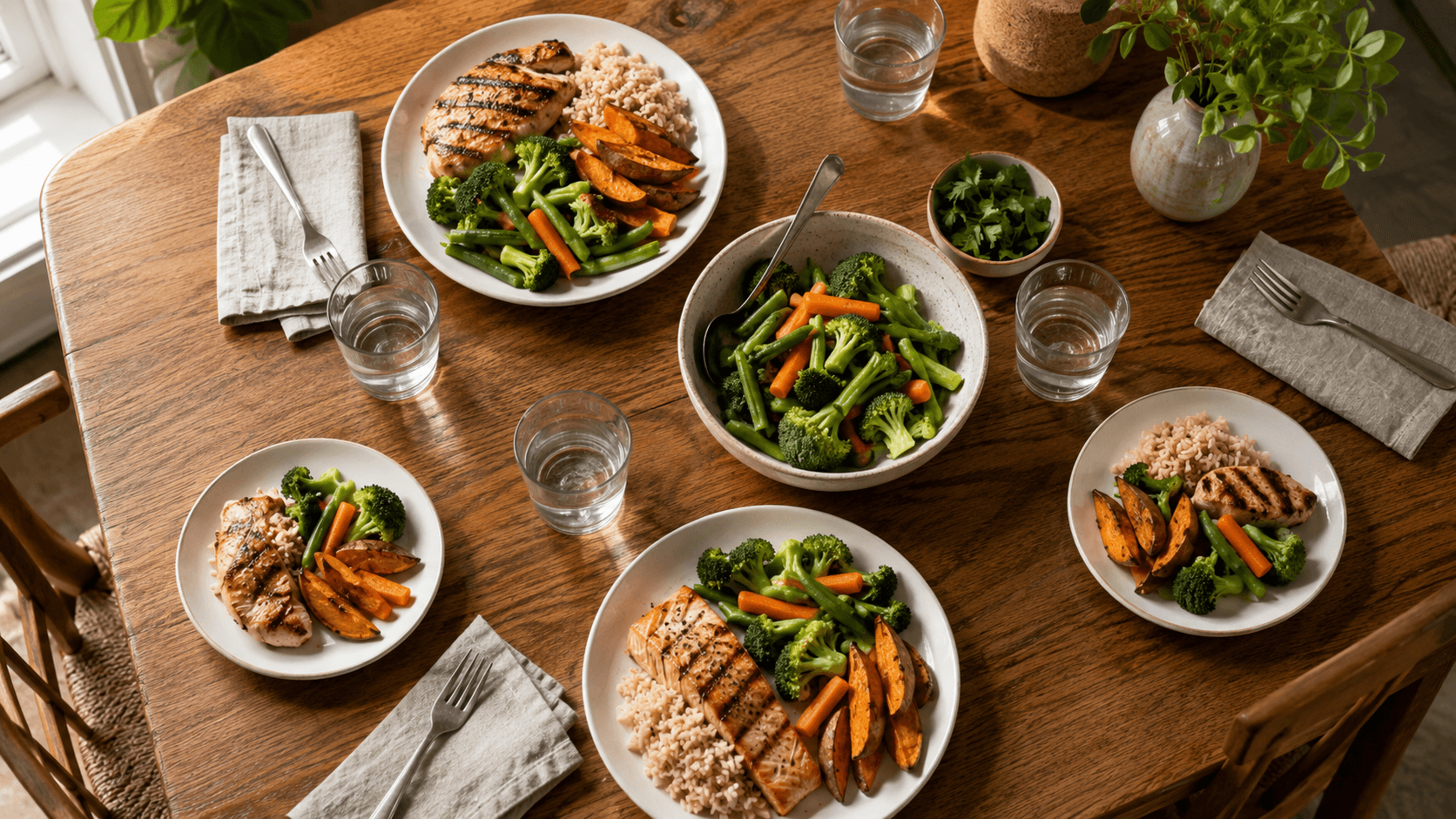
Protein is your anchor. Every meal you eat should contain a substantial protein source. For omnivores this means chicken, fish, eggs, lean red meat, Greek yoghurt, and cottage cheese. For vegetarians and vegans, and this is something I am particularly well placed to advise on as a lifelong vegetarian myself, it means tofu, tempeh, seitan, lentils, chickpeas, black beans, edamame, soy protein, pea protein, and high protein dairy alternatives like soy yoghurt. A meta-analysis published in the American Journal of Clinical Nutrition found that higher protein diets significantly improved satiety, reduced ad libitum calorie intake, and improved body composition during energy restriction (8). In practical terms, eating enough protein keeps you fuller for longer, protects your muscle mass while you lose fat, and makes the whole process more sustainable because you are not constantly fighting hunger.
Build your meals around protein plus vegetables plus a moderate portion of complex carbohydrates. This template works at breakfast (eggs or a protein smoothie with oats and spinach), at lunch (chicken or tofu with rice and vegetables), at dinner (fish or lentil curry with sweet potato and greens), and at every meal in between. You eat what the family eats, you just pay closer attention to portion sizes and make sure protein is always the centrepiece. If your children are having pasta, you have a smaller portion of pasta with a larger portion of protein and a big side of vegetables. If you are at a family restaurant, you order the grilled option with extra vegetables instead of the deep fried option with chips. These are not dramatic changes. They are small, intelligent adjustments that add up massively over time.
Training When Time Is the One Thing You Do Not Have
I am not going to pretend that finding time to train as a father is easy. It is not. But I am going to tell you that you need less time than you think, and the research supports this. A meta-analysis published in Sports Medicine found that training each muscle group twice per week with as few as 4 to 6 working sets per session was sufficient to produce significant increases in muscle mass and strength in trained individuals (9). That translates to three full body resistance training sessions per week, each lasting 30 to 45 minutes, as a perfectly adequate stimulus for building and maintaining lean muscle during a fat loss phase.
Three sessions per week. Not seven. Not six. Three. That is roughly two hours of training per week. If you cannot find two hours per week for your health, the issue is not time. It is priority. And I say that without judgement because I understand the demands of parenthood, but the reality is that two hours per week to protect your health, your energy, your longevity, and your ability to be present for your family is not a luxury. It is a necessity. Train early before the house wakes up, train during a lunch break, train in the evening after the children are in bed, or train at the weekend while your partner has the children. Find the window that works for your schedule and protect it.
The training itself should be built around compound movements that give you the most return on your time investment. Squats, deadlifts, presses, rows, lunges, and pull-ups (or assisted variations) should form the foundation of every session. These movements recruit the most muscle mass, generate the greatest metabolic and hormonal response, burn the most calories, and build functional strength that directly translates to everyday life as a parent, picking up children, carrying car seats, running around in the garden, and maintaining the energy to keep up with them for years to come. A study published in the Journal of Strength and Conditioning Research found that compound resistance training produced significantly greater improvements in fat-free mass, metabolic rate, and functional performance compared to isolation-based training protocols (10).
The Power of NEAT: The Easiest Calorie Burn You Are Ignoring
For time-poor fathers, non-exercise activity thermogenesis (NEAT) is one of the most powerful and most overlooked fat loss tools available. NEAT refers to all the energy you expend through daily movement that is not structured exercise: walking, taking the stairs, standing, playing with your children, doing housework, and generally being physically active throughout the day. Research published in Science demonstrated that NEAT can vary by up to 2,000 calories per day between individuals of similar size, making it a far larger contributor to total daily energy expenditure than most people realise (11).
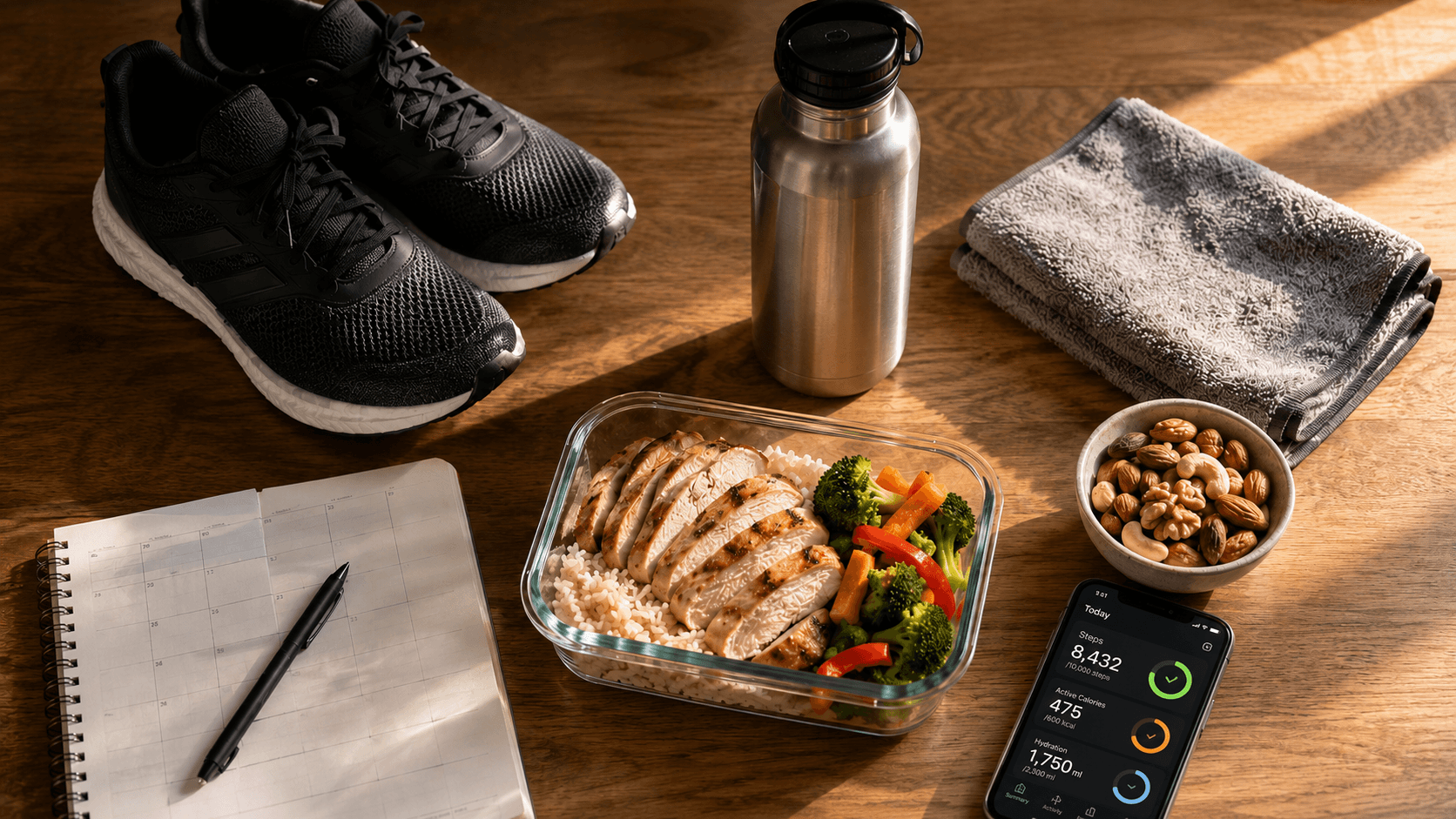
As a father, you have a built-in advantage here that most people do not think about. Playing with your children is NEAT. Walking them to school is NEAT. Carrying a toddler around the house is NEAT. Taking them to the park at the weekend instead of sitting in front of the television is NEAT. I encourage every father I work with to aim for a daily step target of at least 8,000 to 10,000 steps and to actively look for ways to move more throughout the day. Walk during phone calls. Take the stairs at work. Park further from the school gates. Walk to the shops instead of driving. These are not dramatic interventions. They are small behavioural shifts that collectively have a significant impact on your energy expenditure and, over time, your body composition.

Sleep: Make the Most of What You Can Get
I am realistic about sleep advice for fathers, especially those with young children. Telling you to get eight hours of unbroken sleep is pointless if you have a baby who wakes up three times a night. But there are things you can do to maximise the quality of the sleep you do get, and this matters enormously for fat loss and overall health. A review published in the European Journal of Clinical Nutrition found that short sleep duration was consistently associated with increased calorie intake, greater appetite for energy dense foods, and reduced diet quality (12).
Prioritise sleep hygiene ruthlessly. Minimise screen time for at least 30 minutes before bed. Keep your bedroom cool and dark. Avoid caffeine after midday. If you are sharing night duties with your partner, structure it so that at least one of you gets a consolidated block of sleep on alternating nights rather than both of you getting fragmented sleep every night. And when your children are older and sleep improves, do not fill that recovered time with late night television or scrolling. Reclaim it for actual rest. Sleep is not a luxury for fathers. It is the single most impactful recovery tool you have, and its effects on hormones, appetite regulation, cognitive function, and training performance make it a direct contributor to your ability to lose fat and keep it off.
Top Tips for Fat Loss as a Busy Father
Set Your Protein Target and Hit It Every Day. Aim for 1.6 to 2.2 grams of protein per kilogram of body weight spread across your meals. This is the single most important nutritional habit for fat loss, muscle preservation, and appetite control. Use simple, high protein foods that require minimal preparation, such as eggs, Greek yoghurt, pre-cooked chicken, tinned fish, tofu, and protein shakes when needed (7).
Train Three Times Per Week With Compound Movements. Thirty to 45 minutes of resistance training built around squats, presses, rows, and deadlifts is enough to maintain and build muscle while in a calorie deficit. Protect your training time the way you protect a work meeting. It is not optional. It is essential (9).
Move More Throughout the Day. Set a daily step target of 8,000 to 10,000 steps and actively look for opportunities to walk, stand, and play. NEAT is the biggest variable in your daily energy expenditure outside of your basal metabolic rate, and increasing it costs you no additional time in the gym (11).
Eat the Same Food as Your Family With Strategic Adjustments. You do not need a separate meal plan. You need to eat real, whole food meals built around protein and vegetables with sensible portions of carbohydrates and fats. Make protein the centrepiece of every meal and eat more vegetables. That is the adjustment. Keep it that simple.
Stop Finishing Your Children's Leftovers. This is one of the most common sources of hidden calories for fathers. Those extra fish fingers, half-eaten sandwiches, and leftover chips add up quickly. Clear the plate into the bin, not into your stomach. It is not waste. It is protecting your progress.
Manage Your Alcohol. The evening glass of wine or beer that becomes two or three is one of the biggest saboteurs of fat loss for fathers. Alcohol is calorie dense (7 calories per gram), impairs sleep quality, reduces testosterone, increases appetite, and makes you more likely to make poor food choices the following day (13). You do not have to eliminate it, but you do have to be honest about how much you are consuming and the impact it is having.
Prioritise Sleep Quality Over Quantity. You cannot always control how long you sleep, but you can control the conditions. Cool room, dark room, no screens before bed, no caffeine after midday. When you do get the opportunity to sleep, make sure the quality is as high as possible (12).
Manage Stress Before It Manages You. Chronic stress elevates cortisol, promotes visceral fat storage, disrupts sleep, and drives overeating. Walking, training, getting outdoors, and setting boundaries around work hours are all practical strategies that reduce stress and directly support fat loss. You cannot pour from an empty cup. Looking after yourself is not selfish. It is the foundation that everything else rests on (3).
The Bottom Line
Fat loss as a busy father is not about finding the perfect programme or the perfect window of time. It is about accepting the reality of your current life and building a small number of sustainable habits within it. Eat enough protein. Lift weights three times a week. Move more every day. Sleep as well as you can. Manage your stress. Cut the hidden calories from alcohol and leftovers. These are not glamorous interventions. They will not sell magazines or go viral on social media. But they work. They work because they are simple enough to do consistently, and consistency is the only thing that produces lasting results.
Your body did not change overnight when you became a father, and it will not change overnight when you decide to take it back. But it will change. The research is clear, the physiology is straightforward, and I have seen it happen hundreds of times with clients who were convinced their situation was different, that they were too busy, too tired, or too far gone. They were not. And neither are you.
If you are a father who is ready to take control of your health, your body composition, and your energy, and you want a plan that is built specifically around your life, your schedule, and your goals, get in touch. I understand exactly what it takes to help busy fathers transform their health without sacrificing time with their family. I work one-to-one with clients online globally, across every dietary background. The best time to start was years ago. The second best time is now.
Work with Me
Get a personalised coaching plan built around your goals, your schedule, and your life.
Enquire NowReferences
- Nedeltcheva AV, Kilkus JM, Imperial J, Schoeller DA, Penev PD. Insufficient sleep undermines dietary efforts to reduce adiposity. Annals of Internal Medicine. 2010; 153(7): 435-441.
- Spiegel K, Tasali E, Penev P, Van Cauter E. Brief communication: sleep curtailment in healthy young men is associated with decreased leptin levels, elevated ghrelin levels, and increased hunger and appetite. Annals of Internal Medicine. 2004; 141(11): 846-850.
- Epel E, Lapidus R, McEwen B, Brownell K. Stress may add bite to appetite in women: a laboratory study of stress-induced cortisol and eating behavior. Psychoneuroendocrinology. 2001; 26(1): 37-49.
- Umberson D, Liu H, Mirowsky J, Reczek C. Parenthood and trajectories of change in body weight over the life course. Social Science and Medicine. 2011; 73(9): 1323-1331.
- Despres JP. Body fat distribution and risk of cardiovascular disease: an update. Circulation. 2012; 126(10): 1301-1313.
- Whitlock G, Lewington S, Sherliker P, et al. Body-mass index and cause-specific mortality in 900 000 adults: collaborative analyses of 57 prospective studies. The Lancet. 2009; 373(9669): 1083-1096.
- Morton RW, Murphy KT, McKellar SR, et al. A systematic review, meta-analysis and meta-regression of the effect of protein supplementation on resistance training-induced gains in muscle mass and strength in healthy adults. British Journal of Sports Medicine. 2018; 52(6): 376-384.
- Leidy HJ, Clifton PM, Astrup A, et al. The role of protein in weight loss and maintenance. American Journal of Clinical Nutrition. 2015; 101(6): 1320S-1329S.
- Schoenfeld BJ, Ogborn D, Krieger JW. Dose-response relationship between weekly resistance training volume and increases in muscle mass: a systematic review and meta-analysis. Journal of Sports Sciences. 2017; 35(11): 1073-1082.
- Paoli A, Gentil P, Moro T, Marcolin G, Bianco A. Resistance training with single vs. multi-joint exercises at equal total load volume: effects on body composition, cardiorespiratory fitness, and muscle strength. Frontiers in Physiology. 2017; 8: 1105.
- Levine JA, Eberhardt NL, Jensen MD. Role of nonexercise activity thermogenesis in resistance to fat gain in humans. Science. 1999; 283(5399): 212-214.
- Al Khatib HK, Harding SV, Darzi J, Pot GK. The effects of partial sleep deprivation on energy balance: a systematic review and meta-analysis. European Journal of Clinical Nutrition. 2017; 71(5): 614-624.
- Traversy G, Chaput JP. Alcohol consumption and obesity: an update. Current Obesity Reports. 2015; 4(1): 122-130.