
I Have Heard Every Excuse. And I Understand All of Them.
Every single one. And here is what I want you to know: I do not dismiss any of them. Many of the barriers people face are real. Time pressure is real. Joint pain is real. Self-consciousness is real. Fear of injury is real. The exhaustion of managing a career, a family, and a household while trying to find 45 minutes to train is very real.
But there is a difference between a barrier and an excuse. A barrier is something that makes exercise harder. An excuse is a barrier you have decided not to solve. And after working with hundreds of clients over 40, I can tell you that every single one of the common barriers has a practical, achievable solution. The people who transform their health are not the ones with fewer barriers. They are the ones who refuse to let barriers become permanent excuses.
A systematic review published in Age and Ageing identified the most commonly reported barriers to physical activity in adults: concerns about health and fitness, lack of motivation, fear of falling or injury, environmental factors, and lack of time(1). These barriers are well documented in the research and they are consistent across cultures and demographics. But the same research also identifies what overcomes them: social support, professional guidance, positive health outcomes, enjoyment, and accessibility(2).
I am going to address the ten most common excuses I hear, head on, with the directness and empathy that this conversation requires.
Excuse 1: “I Do Not Have Time”
| The Excuse | The Reality |
|---|---|
| “My schedule is packed. Between work, commuting, family, and everything else, there is no time left for exercise.” | You have the same 168 hours per week as everyone else. The question is not whether you have time. It is what you are choosing to prioritise. |
This is the most common excuse by far, and I understand why. Life after 40 is busy. But let me put this into perspective. I am asking for three sessions of 45 minutes per week. That is 2 hours and 15 minutes out of 168 available hours. It is 1.3 percent of your week. If you can find time to scroll social media, watch television, or sit in meetings that achieve nothing, you have time to train.
The real issue is rarely time. It is priority. Training has to move from ‘something I will do if I have time’ to ‘something I do because my health depends on it.’ Because it does. The clients I work with who are the busiest, executives, business owners, parents of young children, are often the most consistent, because they have learned that training is not a luxury. It is the thing that keeps them functioning at a high level in every other area of their life.
Top Tip
Schedule your training sessions in your diary at the start of each week, exactly like you would a meeting. Treat them as non-negotiable. If you would not cancel a meeting with your boss, do not cancel a meeting with your health.
Excuse 2: “I Am Too Old to Start”
| The Excuse | The Reality |
|---|---|
| “I am in my 50s/60s. It is too late for me. I should have started years ago.” | The research is unequivocal: resistance training produces significant strength and muscle gains at any age, including in adults in their 70s, 80s, and beyond. |
This might be the most damaging excuse of all because it is entirely false. A meta-analysis of 25 randomised controlled trials in older adults found that progressive resistance training significantly improved muscle strength, physical function, and walking speed even in participants aged 65 to 89(3). You are never too old. The human body retains its capacity to adapt to a training stimulus throughout life. The adaptations may be slower than in a 25-year-old, but they are real, measurable, and life-changing.
I have worked with clients who started structured training for the first time in their 50s and 60s and achieved results they never imagined were possible. The best time to start was 20 years ago. The second best time is today.
Top Tip
If you are starting in your 50s or 60s, begin with two sessions per week focused on learning movement patterns with light weights. Progress gradually. Within 8 to 12 weeks you will be stronger than you have been in years. Within 6 months, you will wonder why you did not start sooner.

Excuse 3: “I Have Bad Knees / a Bad Back / Joint Problems”
| The Excuse | The Reality |
|---|---|
| “My knees are gone. My back is ruined. I can barely walk some days. Exercise is not an option for me.” | In the vast majority of cases, appropriate exercise is the treatment for joint pain, not the cause of it. |
This excuse is understandable because pain is a powerful deterrent. But the science is clear. NICE clinical guidelines recommend strengthening and aerobic exercise as first-line treatment for osteoarthritis, the most common cause of joint pain in adults over 40(4). The old advice to ‘rest your joints’ is outdated and actively harmful. Muscles, tendons, and ligaments around joints weaken with inactivity, which increases instability and pain.
The key is appropriate exercise. That means working with someone who understands how to modify movements around your specific limitations. Cannot squat to full depth? Use a box squat to a higher surface. Knees ache with lunges? Try step-ups instead. Lower back pain with deadlifts? Start with a hip hinge using a light kettlebell. There is always a pain-free variation of every exercise. Always.
Top Tip
Pain is information, not a stop sign. If a movement hurts, it needs modifying, not abandoning. Work with a coach who understands joint health and can find the right variations for you. Avoiding exercise because of joint pain will make the pain worse over time, not better.
Excuse 4: “I Do Not Know What I Am Doing”
| The Excuse | The Reality |
|---|---|
| “I would not know where to start. I do not understand training programmes. The gym is intimidating.” | Nobody is born knowing how to train. Every expert was once a complete beginner. And the solution to not knowing is learning, not avoidance. |
The gym can feel intimidating if you have never been in one. The equipment looks complex. Everyone else seems to know what they are doing. You feel out of place. I get it. But I promise you: nobody in the gym is watching you or judging you. They are all focused on their own session. And the ones who look confident now were all beginners at some point.
The most efficient way to overcome this barrier is to invest in coaching. A good coach will teach you the fundamental movements, build your confidence, create a structured programme tailored to your ability, and ensure you train safely. This is not a permanent expense. Even a few initial sessions with a qualified coach can give you the knowledge and confidence to train independently for years.
Top Tip
If you are self-conscious about starting in a busy commercial gym, consider training during off-peak hours (mid-morning or early afternoon), or look for a smaller, less crowded facility. Alternatively, online coaching can give you a structured programme to follow at your own pace.

Excuse 5: “I Am Too Tired”
| The Excuse | The Reality |
|---|---|
| “By the end of the day I am exhausted. I barely have energy for anything, let alone exercise.” | Exercise does not drain your energy. Over time, it creates more of it. Your tiredness is almost certainly a symptom of the problem, not a reason to avoid the solution. |
Chronic fatigue in adults over 40 is commonly driven by poor sleep, inadequate nutrition, stress, deconditioning, and in some cases, underlying deficiencies such as low iron, vitamin D, or B12. All of these are worsened by inactivity and improved by structured exercise.
Research consistently shows that regular exercise improves energy levels, sleep quality, and overall vitality in adults of all ages(5). The paradox is real: the less you move, the more tired you feel. The more you move, the more energy you have. The hardest session is always the first one. After that, your body starts responding, your sleep improves, your energy lifts, and the cycle reverses.
Top Tip
If you are exhausted, train in the morning before the day takes over. Even a 30-minute session at 6:30am before work will improve your energy, mood, and focus for the entire day. You will never regret a morning workout.
Excuse 6: “I Am Afraid of Getting Injured”
| The Excuse | The Reality |
|---|---|
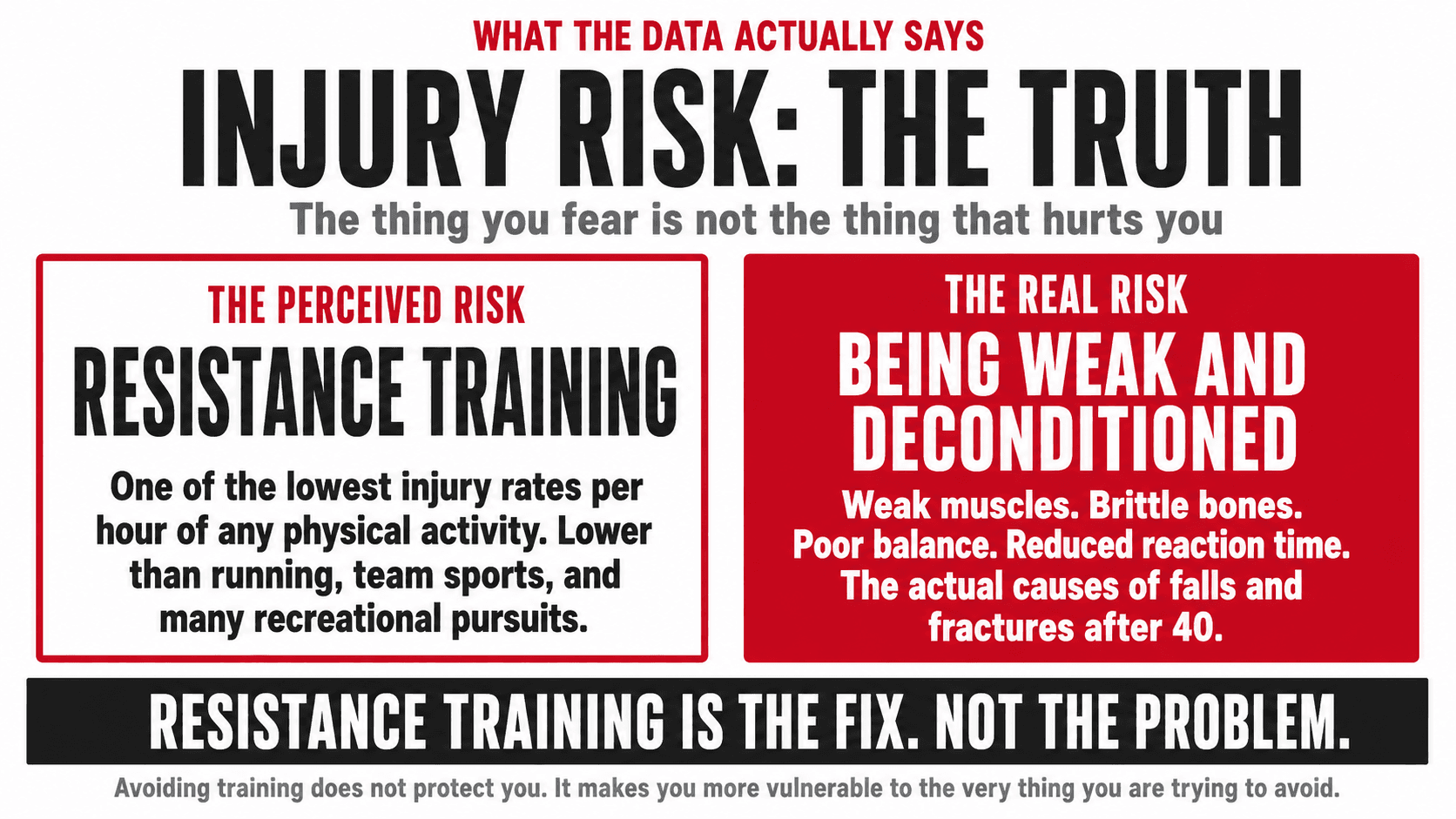
| “I am worried I will hurt myself. I have seen people get injured lifting weights. It is not worth the risk.” | The injury risk from properly supervised resistance training is extremely low. The injury risk from being weak and deconditioned is extremely high. |
Fear of injury is one of the most frequently cited barriers to exercise in adults over 40(1). And it is understandable. But the data tells a different story from the one most people assume. Resistance training, performed with proper form and appropriate progression, has one of the lowest injury rates of any physical activity. Running, team sports, and even recreational activities like gardening have higher injury incidence per hour of participation.
The real risk is not exercising. Weak muscles, brittle bones, poor balance, and reduced reaction time are the primary causes of falls and fractures in older adults. Resistance training directly addresses every single one of these risk factors. You are not protecting yourself by avoiding the gym. You are making yourself more vulnerable.
Top Tip
Start with lighter weights and higher repetitions while you learn proper technique. Progress gradually. Never sacrifice form for heavier weights. And if you are concerned, work with a qualified coach who can monitor your technique and ensure safe progression.
Excuse 7: “I Have Health Conditions That Prevent Me from Exercising”
| The Excuse | The Reality |
|---|---|
| “I have diabetes / high blood pressure / heart problems / arthritis. My doctor has not told me to exercise, so I assume I should not.” | For almost every chronic condition common in adults over 40, exercise is not just safe. It is part of the recommended clinical treatment. |
This is an area I feel strongly about because I specialise in coaching clients with health conditions including type 2 diabetes, hypertension, and PCOS. In almost every case, structured exercise is recommended as part of the management plan by every major clinical guideline. The Diabetes Prevention Program showed that exercise and nutrition reduced diabetes incidence by 58 percent(6). Meta-analyses confirm that exercise training reduces blood pressure by clinically significant amounts(7).
If your GP has not specifically told you to exercise, that does not mean exercise is contraindicated. It often simply means the conversation has not happened. Ask your GP directly. In the overwhelming majority of cases, you will be encouraged to start. If you have a specific cardiac condition, get medical clearance first, but even most cardiac rehabilitation programmes centre around structured exercise.
Top Tip
If you have a health condition, tell your coach about it before you start. A competent coach will know how to programme around your condition and will coordinate with your GP if needed. Having a health condition is not a reason to avoid training. It is a reason to train more carefully.
Excuse 8: “I Cannot Afford a Gym or a Coach”
| The Excuse | The Reality |
|---|---|
| “Gym memberships are expensive. Personal training is expensive. I cannot justify the cost.” | Structured exercise is one of the cheapest health interventions available. The cost of not exercising is medication, medical appointments, and lost independence. |
I am not going to pretend that cost is not a real consideration. It is. But let me reframe the question. How much does a month of blood pressure medication cost the NHS? How much does a hip replacement cost? How much does managing type 2 diabetes cost per year? The financial cost of preventable chronic disease dwarfs the cost of a gym membership many times over.
A basic gym membership in the UK costs between 20 and 40 pounds per month. A set of adjustable dumbbells for home use costs 50 to 150 pounds as a one-off purchase. Bodyweight exercises require no equipment at all. Walking is free. The financial barrier to exercise is lower than people think.
Top Tip
If personal training is beyond your budget, consider online coaching. It is significantly more affordable than in-person training and gives you a personalised programme, nutritional guidance, and accountability. The investment in your health now prevents far greater costs later.
Excuse 9: “I Am Too Overweight to Exercise”
| The Excuse | The Reality |
|---|---|
| “I need to lose weight before I start training. I would be embarrassed walking into a gym at my size.” | You do not lose weight to start training. You start training to lose weight. And nobody who matters is judging your body. |
This excuse breaks my heart because it traps people in a cycle of shame and inaction. The idea that you need to be in shape before you go to the gym is like saying you need to be healthy before you go to the doctor. It defeats the entire purpose.
I have worked with clients who started their journey carrying 30kg or more of excess weight. Clients who went from XXL to Medium. Clients who were embarrassed to walk through the gym door on day one and who now train with confidence and pride. Every single one of them started exactly where they were, not where they wished they were.
Exercise can and should be modified to suit your current fitness level and body. If you cannot do a full squat, start with a sit to stand from a chair. If you cannot run, walk. If you cannot walk far, walk a short distance and build. There is always a starting point. Always.
Top Tip
If gym anxiety is a genuine barrier, start with home workouts or outdoor walking. Build some baseline fitness and confidence, then transition to a gym environment when you are ready. But do not wait until you feel ready. Readiness is a feeling that follows action, not one that precedes it.
Excuse 10: “I Have Tried Before and It Did Not Work”
| The Excuse | The Reality |
|---|---|
| “I have tried diets. I have tried gyms. I have tried personal trainers. Nothing sticks. I always end up back where I started.” | The fact that previous attempts failed does not mean you are incapable of change. It means the approach was wrong, not you. |
Past failure is one of the most psychologically powerful barriers because it erodes self-efficacy, your belief in your own ability to succeed. Research consistently identifies low self-efficacy as one of the strongest predictors of exercise non-adherence in adults over 40(2). If you have tried and failed before, it is natural to protect yourself from further disappointment by not trying again.
But I want to challenge your interpretation of what happened. In my experience, when someone says ‘it did not work,’ what actually happened was one or more of the following: the programme was not personalised to them, the approach was too extreme and unsustainable, they did not have accountability or support, the nutrition was neglected, or they expected results in weeks that realistically take months. None of those are reasons to give up. They are reasons to find a better approach.
The most important quality in any transformation is not willpower. It is the willingness to try again with better information and better support.
Top Tip
If you have failed before, do not try the same approach again. Something needs to change: the programme, the coach, the accountability system, the nutritional strategy, or the expectations. If you keep doing what you have always done, you will keep getting what you have always got.
The Real Barrier: Fear of Change
Underneath every excuse I have listed above, there is usually a deeper, unspoken fear. Fear of failure. Fear of judgement. Fear of discomfort. Fear of looking foolish. Fear of starting something and not finishing it. Fear of discovering how much ground you have lost. These are human fears, and they are completely normal.
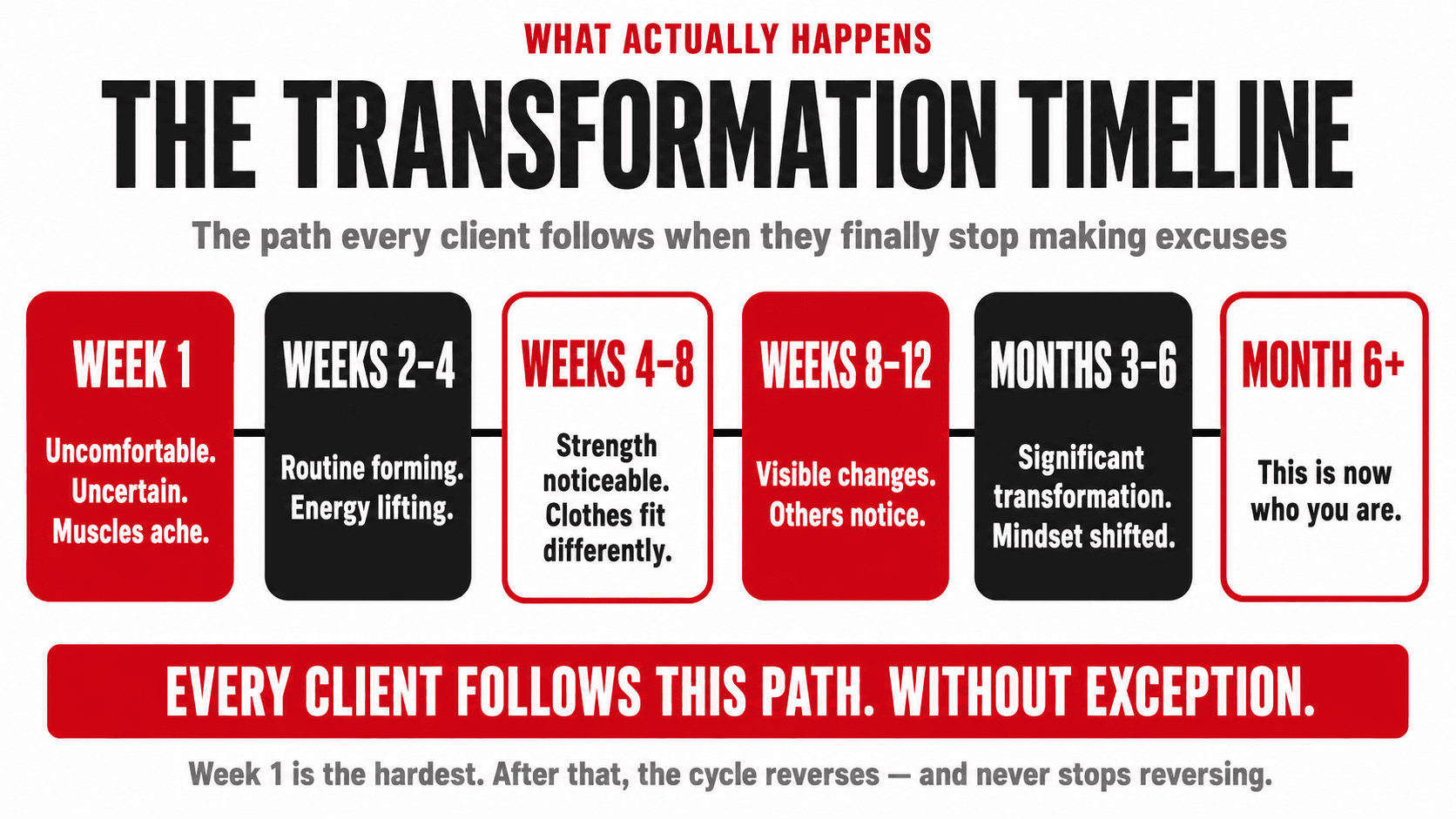
But here is what I have learned from coaching hundreds of clients through exactly this process: the fear is always worse than the reality. The first session is always the hardest. The first week is uncomfortable. By the second week, you have a routine. By the fourth week, you feel different. By the eighth week, you look different. And by the third month, you cannot imagine going back to the way things were.
| The Transformation Timeline | What Happens |
|---|---|
| Week 1 | Uncomfortable. Uncertain. Muscles ache. You wonder if this is worth it. |
| Week 2–4 | Routine forming. Exercises becoming familiar. Energy improving. |
| Week 4–8 | Strength increasing noticeably. Clothes fitting differently. Confidence growing. |
| Week 8–12 | Visible changes. Other people notice. Training becomes part of your identity. |
| Month 3–6 | Significant transformation. Blood markers improving. Mindset fundamentally shifted. |
| Month 6+ | This is now who you are. The excuses from before feel like a different lifetime. |
Every client I have ever coached has followed this trajectory. Without exception.
Every Excuse, Solved: A Quick Reference
| The Excuse | The Reality | The First Step |
|---|---|---|
| “I do not have time” | You need 1.3% of your week | Schedule 3 sessions in your diary now |
| “I am too old” | Strength gains happen at any age | Start with 2 sessions per week, light weights |
| “Bad knees/back” | Exercise is the treatment, not the problem | Find a coach who can modify movements |
| “I do not know what to do” | Nobody does at first | Book one session with a qualified coach |
| “I am too tired” | Exercise creates energy | Try one morning session this week |
| “Fear of injury” | Proper training has very low injury risk | Start light, focus on form, progress slowly |
| “Health conditions” | Exercise is clinically recommended | Get GP clearance, then start with a coach |
| “Cannot afford it” | A gym costs less than your Netflix subscription | Get a basic gym membership or buy home dumbbells |
| “Too overweight” | You start where you are, not where you wish you were | Walk 20 minutes today. Build from there. |
| “Tried before and failed” | The approach was wrong, not you | Find better support, accountability, and a personalised plan |
How I Can Help You
I have spent my career helping people overcome exactly the barriers I have described in this article. Not with motivational platitudes, but with structured programmes, genuine accountability, and an approach that meets you where you are. I do not expect you to be fit on day one. I expect you to show up. The fitness comes after.
I work with men and women of all ages, all fitness levels, and all dietary backgrounds. I coach clients managing hypertension, type 2 diabetes, PCOS, joint problems, and every other condition that people assume prevents them from training. I am a lifelong vegetarian, so I understand the specific nutritional challenges of plant-based eating. I work with omnivores, vegetarians, and vegans with equal expertise.
I offer one-to-one coaching online globally. If any of the excuses in this article sounded familiar, I am the person who can help you move past them.
Get in touch at trperformancecoaching.com. Your excuses expire today.
Work with Me
Get a personalised coaching plan built around your goals, your schedule, and your life.
Enquire NowReferences
- Kilgour AHM, Rutherford M, Higson J, Meredith SJ, McNiff J, Mitchell S, et al. Barriers and motivators to undertaking physical activity in adults over 70: a systematic review of the quantitative literature. Age and Ageing. 2024; 53(4): afae080.
- Beauchamp MR, Ruissen GR, Dunlop WL, Estabrooks PA, Harden SM, Wolf SA, et al. Group-based physical activity for older adults (GOAL) randomised controlled trial: exercise adherence outcomes. Health Psychology. 2018; 37(5): 451–461.
- Liu CJ, Latham NK. Progressive resistance strength training for improving physical function in older adults. Cochrane Database of Systematic Reviews. 2009; (3): CD002759.
- National Institute for Health and Care Excellence (NICE). Osteoarthritis: care and management. Clinical Guideline CG177. NICE. 2014 (updated 2022).
- Puetz TW. Physical activity and feelings of energy and fatigue: epidemiological evidence. Sports Medicine. 2006; 36(9): 767–780.
- Knowler WC, Barrett-Connor E, Fowler SE, Hamman RF, Lachin JM, Walker EA, et al. Reduction in the incidence of type 2 diabetes with lifestyle intervention or metformin. New England Journal of Medicine. 2002; 346(6): 393–403.
- Cornelissen VA, Smart NA. Exercise training for blood pressure: a systematic review and meta-analysis. Journal of the American Heart Association. 2013; 2(1): e004473.
Disclaimer: This article is for educational purposes only and does not constitute medical advice. If you have existing health conditions, consult your GP or relevant healthcare professional before starting any new exercise programme.