When most people think about exercise for fat loss, they think about the gym. They think about treadmills and rowing machines and sweating through a spin class. What they do not think about is the 15 or 16 hours of the day they spend outside of the gym, and that is where the real calorie expenditure happens. The truth about walking, steps, and fat loss is counterintuitive but backed by decades of research: the movement you do outside of your structured workouts contributes far more to your daily energy expenditure than the workouts themselves. Your daily step count is not a nice bonus on top of your training. It is the foundation upon which your entire fat loss effort is built.
Across hundreds of fat loss clients, the single most reliable predictor of progress in a fat loss phase is not the intensity of someone's gym sessions, not the sophistication of their training programme, and not the precision of their macronutrient split. It is their daily step count. The clients who hit their steps consistently lose fat consistently. The clients whose step count drops as their diet progresses are the ones who plateau. It is that simple, and the science explains exactly why.
The problem is that most people dramatically overestimate how many calories they burn in the gym and dramatically underestimate the importance of everything else they do during the day. A typical one-hour resistance training session burns somewhere between 200 and 400 calories depending on the individual, the exercises performed, and the intensity. That sounds meaningful until you realise that the total energy you burn through all your non-gym movement throughout the day, walking, standing, fidgeting, climbing stairs, household tasks, and general life activity, can account for 300 to 2,000 calories or more. The gym is one hour. Life is the other twenty-three. If you ignore those twenty-three hours, you are ignoring the biggest variable in your daily energy budget, and that is exactly what most people do.
What Is NEAT and Why Does It Matter So Much?
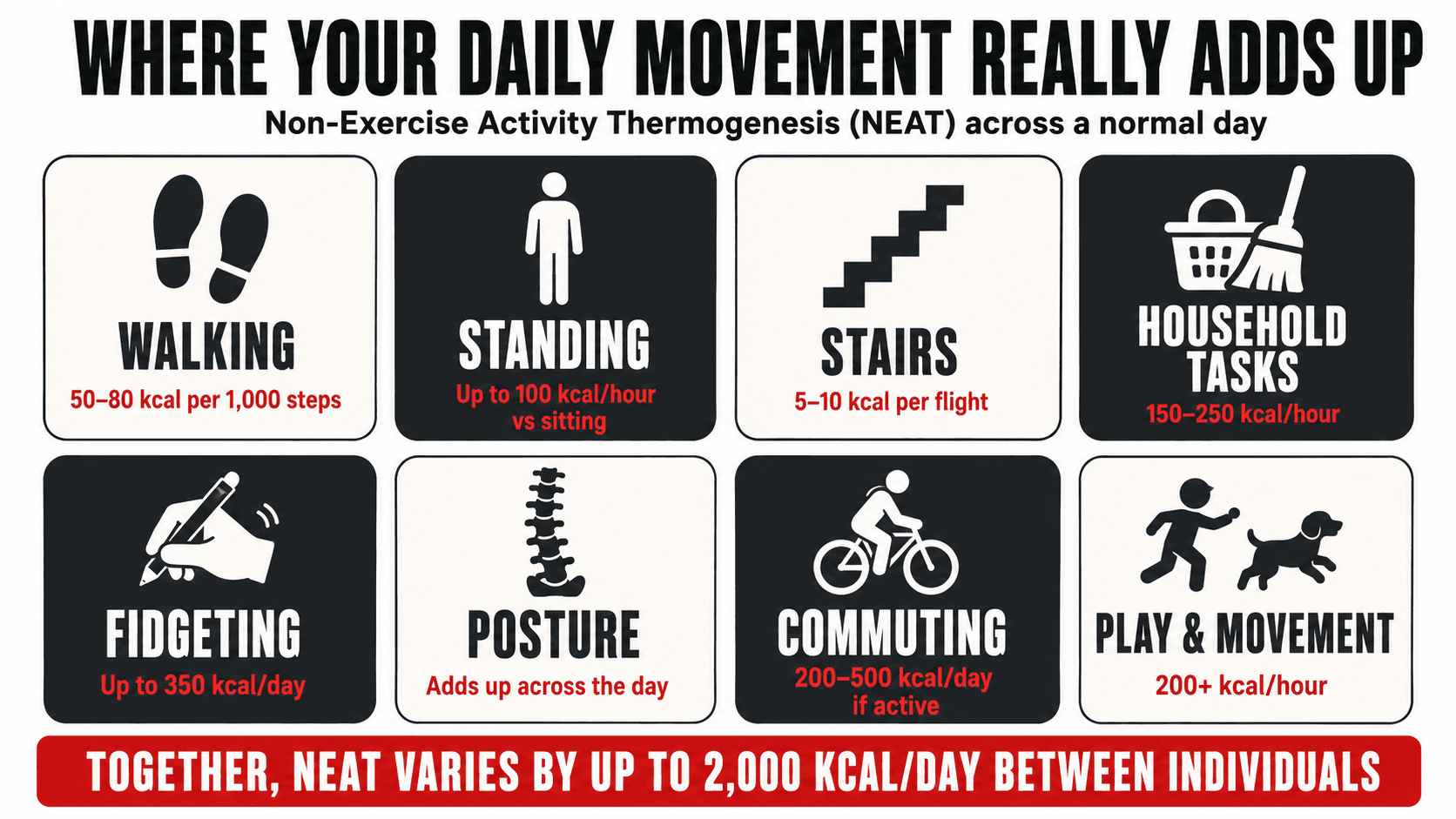
NEAT stands for Non-Exercise Activity Thermogenesis, a term coined by Professor James Levine at the Mayo Clinic. It refers to the energy expended for everything you do that is not sleeping, eating, or structured exercise. Walking to the shops. Typing at your desk. Playing with your children. Standing on the train. Fidgeting in your chair. Cleaning the house. Even the way you maintain your posture throughout the day. All of it burns energy, and the cumulative total of all these small activities is enormous (1).
In a landmark paper published in the journal Best Practice and Research Clinical Endocrinology and Metabolism, Levine demonstrated that NEAT varies between two people of similar size by up to 2,000 calories per day. That is not a typo. Two people who weigh the same, have similar body composition, and eat the same diet can differ in daily energy expenditure by 2,000 calories purely because of differences in how much they move outside of exercise (1). To put that in perspective, a 500-calorie daily deficit, which is typically considered an aggressive but sustainable target for fat loss, is only one quarter of the gap that NEAT differences can create between two individuals of the same size.
In a later study published in Science, Levine and colleagues measured postures and movements in lean and obese sedentary volunteers over ten consecutive days. They found that obese individuals were seated on average two hours per day longer than their lean counterparts. The researchers calculated that if obese individuals adopted the movement patterns of lean individuals, they could expend an additional 350 calories per day without setting foot in a gym (2). That is the equivalent of roughly 36 pounds of body fat per year, from nothing more than standing up more, walking a bit further, and fidgeting a bit more.
Where Your Calories Really Go: Components of Daily Energy Expenditure
Adapted from Levine JA, Best Practice and Research Clinical Endocrinology and Metabolism, 2002 (1). For most people, NEAT burns significantly more calories than structured exercise.
| Component | % of Total | What It Includes |
|---|---|---|
| Basal Metabolic Rate (BMR) | 60 to 70% | Energy to keep you alive at rest: breathing, circulation, brain function, organ maintenance, cell repair. |
| NEAT (Non-Exercise Activity Thermogenesis) | 15 to 30% | Walking, standing, fidgeting, stairs, housework, commuting, playing with children, general life movement. This is the most variable component and the biggest lever you can pull. |
| Thermic Effect of Food (TEF) | 8 to 15% | Energy used to digest, absorb, and process food. Higher with protein-rich meals. |
| Exercise Activity Thermogenesis (EAT) | 5 to 10% | Structured exercise: gym sessions, runs, classes, sports. For most people, this is the smallest variable component. |
Your Gym Session Burns Less Than You Think
One of the most persistent misconceptions in fitness is the idea that an hour in the gym creates a massive calorie burn that drives fat loss. The reality is more humbling. A well-executed 60-minute resistance training session for someone weighing 80 kilograms typically burns between 200 and 400 calories. A 30-minute moderate-intensity run burns approximately 250 to 350 calories. A spin class, which feels exhausting, burns 400 to 600 calories for most people despite what the machine display says. These are meaningful numbers, but they represent a small fraction of total daily energy expenditure.
Now compare that to walking. A person weighing 80 kilograms burns approximately 50 to 80 calories per 1,000 steps depending on pace and terrain. At 10,000 steps, that is 500 to 800 calories burned through walking alone. At 12,000 to 15,000 steps, which is achievable for most able-bodied people with some planning, it is 600 to 1,200 calories. And those steps happen throughout the day, require no recovery, create no additional stress on the body, do not require a gym membership, and can be accumulated in ways that fit around any schedule.
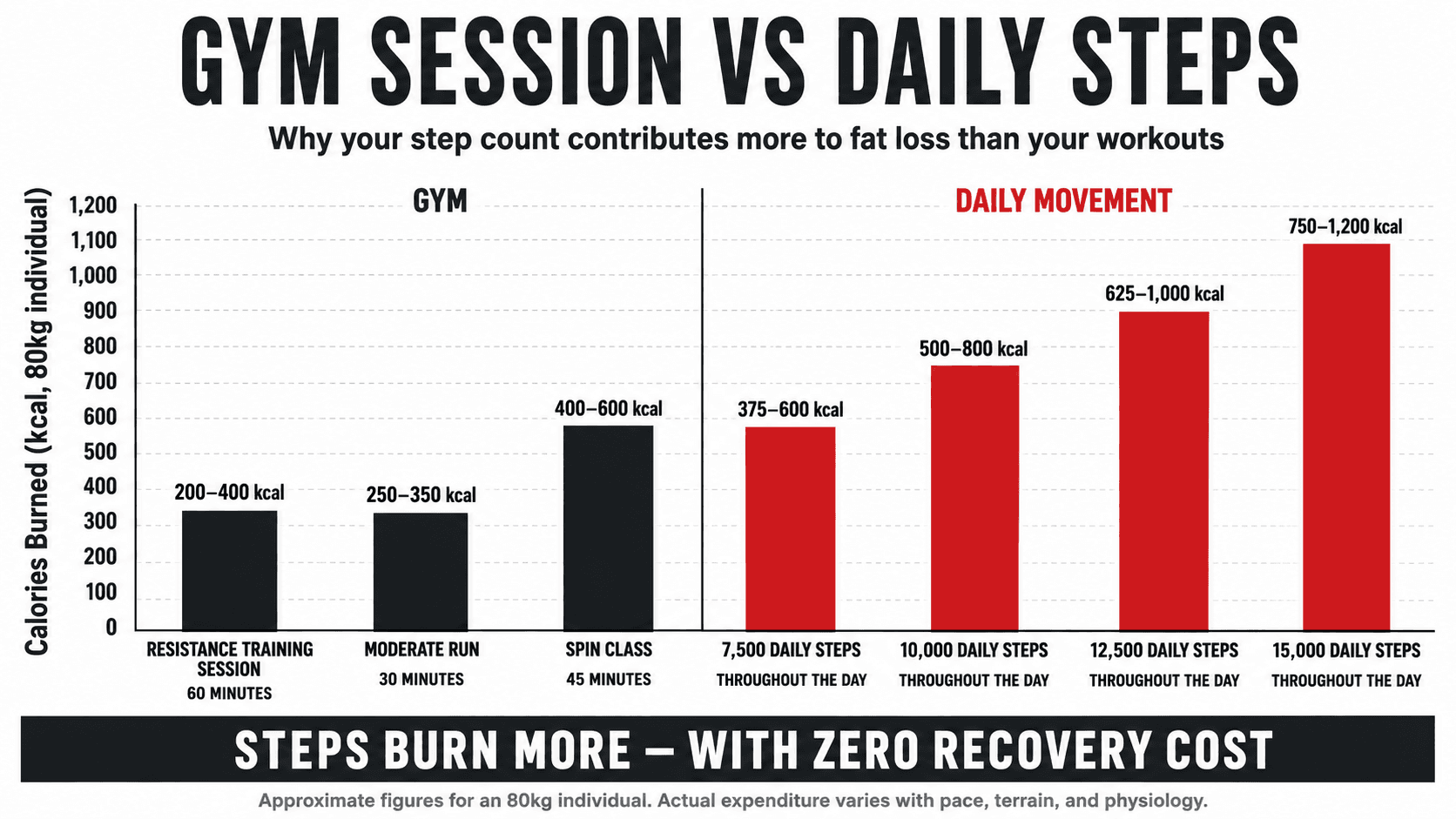
Calorie Expenditure Comparison: Gym vs Steps (80kg Individual)
Approximate figures based on an 80kg individual. Actual expenditure varies with pace, terrain, and individual physiology. Steps accumulate across the entire day with zero recovery cost.
| Activity | Duration / Volume | Approximate Calories |
|---|---|---|
| Resistance Training Session | 60 minutes | 200 to 400 kcal |
| Moderate Run | 30 minutes | 250 to 350 kcal |
| Spin Class | 45 minutes | 400 to 600 kcal |
| 7,500 Daily Steps | Throughout the day | 375 to 600 kcal |
| 10,000 Daily Steps | Throughout the day | 500 to 800 kcal |
| 12,500 Daily Steps | Throughout the day | 625 to 1,000 kcal |
| 15,000 Daily Steps | Throughout the day | 750 to 1,200 kcal |
The Silent Drop: How Dieting Kills Your Step Count
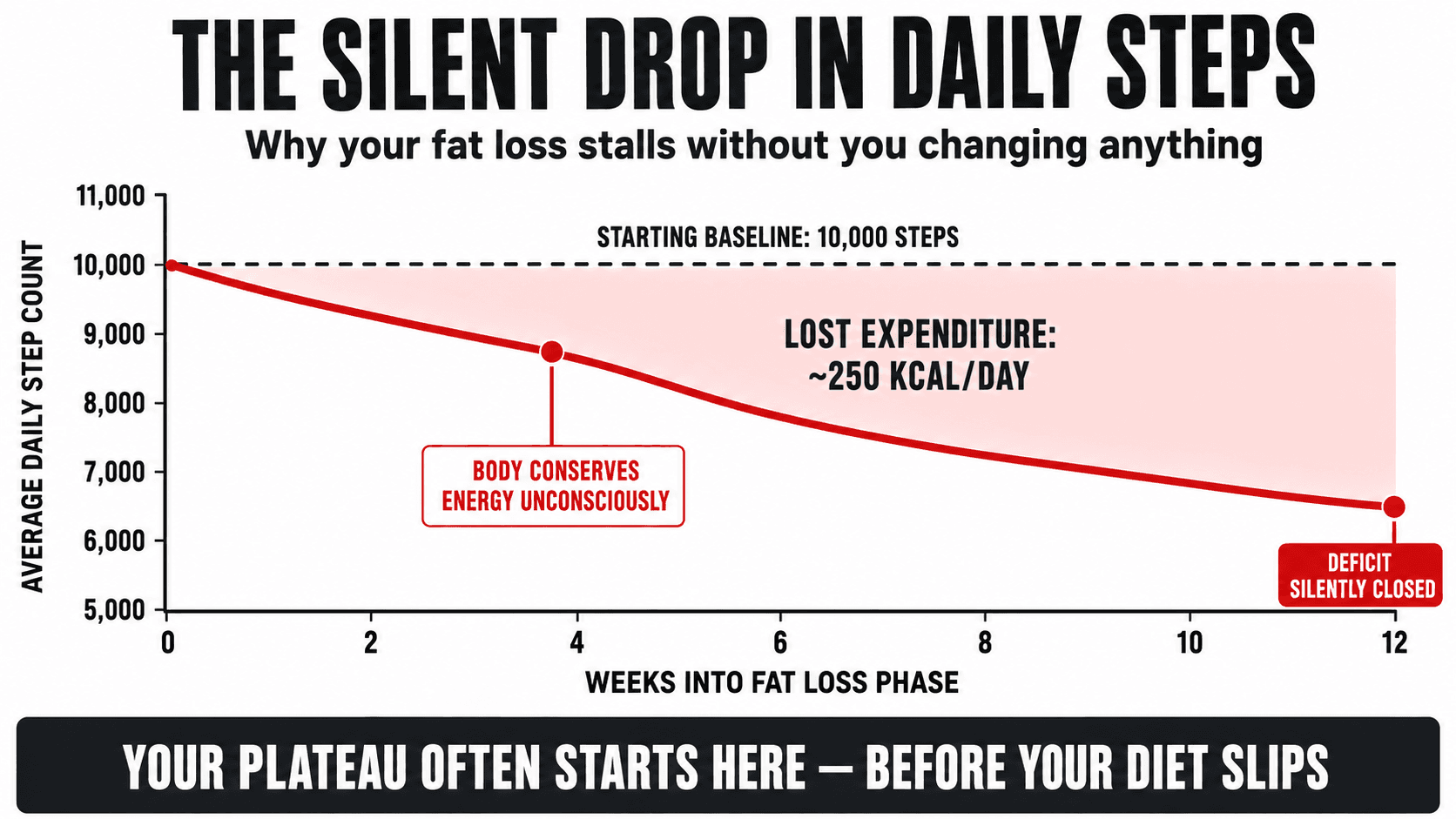
Here is where this becomes critical for anyone in a fat loss phase. As I covered in my article on metabolic adaptation and fat loss plateaus, one of the most significant adaptations your body makes during a sustained calorie deficit is an unconscious reduction in NEAT. Your body does not send you a notification telling you that it has reduced your daily movement. It simply makes you move less. You sit down more. You walk more slowly. You stand for shorter periods. You take the car instead of walking. You stop taking the stairs. You fidget less at your desk. All of these tiny changes happen below conscious awareness, and they compound into a substantial reduction in daily energy expenditure over weeks and months.
Research published by Levine's group demonstrated that NEAT decreases with underfeeding as a direct biological response to energy restriction (1). A review in the Endotext series on human energy homeostasis found that caloric deprivation reduced NEAT by approximately 150 calories per day, equivalent to a 27 percent reduction from baseline levels (3). The review also noted that when participants engaged in structured exercise programmes alongside their dietary restriction, their NEAT remained unaffected, suggesting that the combination of a calorie deficit with structured exercise can protect against this unconscious decline in daily movement.
This is one of the primary reasons that fat loss plateaus occur. Your starting deficit of 500 calories per day can easily be eroded by 150 to 300 calories per day of unconscious NEAT reduction, combined with the reduction in basal metabolic rate from weight loss itself. Without actively monitoring and defending your step count, you may reach a point where your deficit has essentially disappeared without you changing anything deliberately about your diet or training. The step counter on your phone or watch is not a toy. It is a critical diagnostic tool that tells you whether your energy expenditure is being maintained or whether your body is silently undermining your deficit.
The Research on Walking and Fat Loss
The direct evidence for walking as a fat loss intervention is robust. A 36-week study by Schneider and colleagues prescribed 10,000 steps per day to overweight and obese adults. Participants who adhered to the programme lost an average of 2.4 kilograms of body weight, 2.7 kilograms of fat mass, and 1.8 centimetres from their waist circumference. Their body fat percentage dropped by 1.9 percent. Crucially, adherence was the key differentiator: those who hit the step target consistently showed large improvements in body composition, while non-adherers showed little or no change (4).
A meta-analysis published in Annals of Family Medicine by Richardson and colleagues examined pedometer-based walking studies that did not include a dietary intervention. Across nine studies with 307 total participants, they found that pedometer use was associated with meaningful improvements in physical activity levels and modest but consistent weight loss, even without any changes to diet (5). When you combine a step target with a structured calorie deficit, the results are dramatically amplified.
A secondary analysis from the Step-Up randomised trial published in Obesity found that adults who successfully lost at least 10 percent of their baseline body weight by 18 months were averaging approximately 10,000 steps per day at 6, 12, and 18 months. The researchers noted that this level of physical activity was superior to the general recommendation of 150 minutes per week of moderate intensity exercise for driving and maintaining meaningful weight loss (6).
Steps Are the Great Equaliser
One of the reasons I prioritise step count so heavily in my coaching is that it works for everyone, regardless of fitness level, training experience, age, injury status, or schedule. A busy executive who cannot commit to five gym sessions per week can still accumulate 10,000 steps by taking walking meetings, using the stairs at the office, and adding a 20-minute walk before or after work. A new mother can accumulate steps through pushchair walks, playing with children, and household movement. An older client with joint limitations who cannot run or do high-impact exercise can walk comfortably at their own pace. A client recovering from injury who cannot train in the gym can maintain their calorie expenditure through walking while they rehabilitate.
Steps also have no recovery cost. You can walk 10,000 steps every single day of the week without any risk of overtraining, without impacting your gym recovery, and without accumulating fatigue. Try doing five high-intensity cardio sessions per week on top of four resistance training sessions and see how your recovery holds up. Now compare that with simply walking more throughout your day. The step count approach creates a massive, sustainable, daily calorie burn without stealing from your training capacity or leaving you exhausted.

How Many Steps Should You Aim For?
The answer depends on where you are starting from, what your fat loss goals are, and what is realistically sustainable for your lifestyle. There is no magic number, but the evidence and my coaching experience point towards some clear guidelines.
Step Count Recommendations by Goal and Starting Point
These are general guidelines. Individual targets are set based on lifestyle, occupation, physical limitations, and fat loss goals.
| Current Level | Target Range | Rationale |
|---|---|---|
| Very Sedentary (under 4,000/day) | 6,000 to 7,500 | Build the habit gradually. A sudden jump from 3,000 to 10,000 steps is unsustainable for most people. Increase by 1,000 to 2,000 steps every two weeks. |
| Moderately Active (4,000 to 7,000/day) | 8,000 to 10,000 | This is where most of my clients start. 8,000 to 10,000 steps combined with a structured deficit and resistance training produces excellent, consistent fat loss. |
| Active Fat Loss Phase | 10,000 to 12,500 | The sweet spot for most clients pursuing meaningful fat loss. Provides substantial daily energy expenditure with no recovery cost. Sustainable for 12 to 16 weeks. |
| Aggressive Fat Loss or Lean Clients | 12,500 to 15,000 | Higher targets for clients who are already lean and need additional expenditure to continue progress, or for clients who prefer walking over gym-based cardio. |
| Maintenance Phase | 7,500 to 10,000 | Sustaining a moderate step count during maintenance protects against NEAT decline and supports long-term weight management. |
Practical Ways to Get Your Steps In
The most common objection I hear from clients is that they do not have time to walk. In almost every case, this is a scheduling problem, not a time problem. Walking can be woven into your existing day without adding dedicated exercise time. A 10-minute walk after each meal is 30 minutes of walking and approximately 3,000 to 4,000 steps that also aids digestion and improves postprandial blood glucose. Getting off the train or bus one stop early adds 1,000 to 2,000 steps. Taking a 15-minute walk during your lunch break adds another 1,500 to 2,000. Walking meetings, phone calls taken while walking, taking the stairs instead of the lift, parking further from the entrance, walking to the shops instead of driving for small purchases: every one of these adds steps without requiring dedicated exercise time.
For clients who work from home, which has become increasingly common, I recommend setting a timer to get up and walk for five minutes every hour. Over an eight-hour working day, that is 40 minutes of walking accumulated in short bursts that barely interrupt your workflow but add 4,000 to 5,000 steps. Combined with a morning walk of 15 to 20 minutes and an evening walk of the same duration, you are well above 10,000 steps without ever needing to set foot in a gym. Some of my most successful clients listen to podcasts or audiobooks during their walks, turning the step target into something they genuinely look forward to rather than a chore.

Steps and Resistance Training: The Ideal Combination
I want to be absolutely clear about something: when I say your step count matters more than your gym session for fat loss, I am not saying you should stop going to the gym. Resistance training is non-negotiable for body composition. It preserves muscle mass during a calorie deficit, it maintains your basal metabolic rate, it shapes your physique, and it produces long-term metabolic benefits that walking alone cannot provide. What I am saying is that if you had to choose between adding a fifth gym session or adding 3,000 steps to your daily target, the steps would produce a greater fat loss benefit in almost every scenario.
The ideal fat loss programme combines three to four resistance training sessions per week with a daily step count target of 8,000 to 12,000 steps. The resistance training builds and preserves muscle. The steps create a large, sustainable, daily calorie burn that underpins your deficit. Together, they are far more effective than either one alone. The research from the Endotext review supports this, showing that structured exercise alongside dietary restriction protects NEAT from declining, creating a synergistic effect where the gym sessions not only burn calories directly but also help maintain the much larger calorie contribution from daily movement (3).
Top Tips for Using Your Daily Step Count to Drive Fat Loss
Set a Non-Negotiable Daily Step Target and Track It. Whatever number you agree on, whether it is 8,000, 10,000, or 12,000, treat it like a commitment, not a suggestion. Track it daily. Review it weekly. Your step count is the single most reliable leading indicator of fat loss progress.
Front-Load Your Steps. A morning walk of 15 to 30 minutes before your day gets busy puts 2,000 to 4,000 steps in the bank before anything else can derail your plan. Clients who leave all their steps for the evening are the most likely to fall short.
Walk After Meals. A 10 to 15 minute walk after lunch and dinner adds 2,000 to 3,000 steps, aids digestion, and improves blood glucose control. This is particularly valuable for clients managing diabetes or insulin resistance.
Use Walking as Active Recovery on Rest Days. Rest days from the gym should not be sedentary days. A moderate walk of 30 to 45 minutes on rest days maintains your calorie expenditure, promotes blood flow for recovery, and keeps your weekly step average consistent.
Monitor Your Step Count Throughout Your Fat Loss Phase. If your average step count drops from week one to week eight, your body is reducing your NEAT unconsciously. This is one of the earliest warning signs of metabolic adaptation. Catch it early and correct it before it becomes a plateau.
Do Not Rely on the Gym Alone for Energy Expenditure. Three to four gym sessions per week burn 600 to 1,600 calories total. Seven days of 10,000 steps burns 3,500 to 5,600 calories. The numbers speak for themselves. Your steps contribute more to your weekly energy expenditure than your workouts do.
Make It Enjoyable and Sustainable. Listen to podcasts, audiobooks, or music while you walk. Walk with a friend, partner, or client. Explore different routes. Walk in green spaces where possible. The more enjoyable you make it, the more likely you are to sustain it across weeks and months.
Defend Your Steps Even When Life Gets Busy. Busy days are the days your step count matters most, because they are the days your body is most likely to default to sedentary behaviour. On days when your schedule is packed, find creative ways to accumulate steps: walking meetings, pacing while on phone calls, taking stairs, parking further away. Even 7,000 steps on a busy day is better than 3,000.
The Bottom Line
Your daily step count is the most underrated tool in fat loss. It is free, it is sustainable, it requires no equipment, it has no recovery cost, it works for every fitness level and schedule, and it creates a larger daily calorie burn than your gym sessions do. The research is clear: NEAT varies by up to 2,000 calories per day between individuals of similar size, obese individuals sit for two hours more per day than lean individuals, and step-based walking interventions consistently produce improvements in body weight, fat mass, and waist circumference. During a calorie deficit, NEAT declines unconsciously by up to 27 percent, making active step count management essential for maintaining your deficit and avoiding plateaus.
If your fat loss has stalled, before you cut more calories or add more cardio, check your step count. Chances are it has declined since the start of your diet without you noticing. Restoring it may be the simplest, most effective thing you can do to get progress moving again. I have seen this play out hundreds of times with my clients. The step count does not lie.
If you want a coaching approach that integrates nutrition, resistance training, and daily movement into a structured, sustainable fat loss plan, get in touch through trperformancecoaching.com. I work one-to-one with clients online globally, across all dietary backgrounds including vegetarian, vegan, and plant-based. Whether you are a busy executive, a new parent, or someone who has been stuck for months, I will build a plan that works for your real life.
Work with Me
Get a personalised coaching plan built around your goals, your schedule, and your life.
Enquire NowReferences
- Levine JA. Non-exercise activity thermogenesis (NEAT). Best Practice and Research Clinical Endocrinology and Metabolism. 2002; 16(4): 679-702.
- Levine JA, Lanningham-Foster LM, McCrady SK, Krizan AC, Olson LR, Kane PH, Jensen MD, Clark MM. Interindividual variation in posture allocation: possible role in human obesity. Science. 2005; 307(5709): 584-586.
- Kotz CM, Perez-Leighton CE, Teske JA, Billington CJ. Non-Exercise Activity Thermogenesis in Human Energy Homeostasis. Endotext. 2022. South Dartmouth, MA: MDText.com Inc.
- Schneider PL, Bassett DR, Thompson DL, Pronk NP, Bielak KM. Effects of a 10,000 steps per day goal in overweight adults. American Journal of Health Promotion. 2006; 21(2): 85-89.
- Richardson CR, Newton TL, Abraham JJ, Sen A, Jimbo M, Swartz AM. A meta-analysis of pedometer-based walking interventions and weight loss. Annals of Family Medicine. 2008; 6(1): 69-77.
- Jakicic JM, Tate DF, Lang W, Davis KK, Polzien K, Rickman AD, Erickson K, Neiberg RH, Finkelstein EA. Pattern of daily steps is associated with weight loss: secondary analysis from the Step-Up randomized trial. Obesity. 2019; 27(4): 572-579.